Chronic Spontaneous Urticaria Market Size in 7MM Set for Steady Growth Beyond USD 2 Billion Milestone by 2036
Get a Sneak Peek at the Latest chronic spontaneous urticaria market size and forecast Report
- Across the 7MM countries, the Chronic Spontaneous Urticaria (CSU) market size was valued at approximately USD 2,000 million in 2025 and is projected to grow significantly over the forecast period from 2026 to 2036. DelveInsight's comprehensive market research provides critical insights into such market trends, enabling stakeholders to understand growth drivers, emerging opportunities, and potential challenges within the Chronic Spontaneous Urticaria landscape.
- In 2025, the United States led the CSU market among the 7MM, with a valuation of approximately USD 1,000 million, expected to grow at a CAGR of 15% during the forecast period driven by increasing disease awareness and the launch of emerging therapies. The total market size of CSU in EU4 and the UK was calculated to be approximately USD 600 million in 2025, nearly 30% of the total 7MM market revenue. Among EU4 and the UK, Germany accounted for the highest market at approximately USD 160 million, while Spain accounted for the lowest at nearly USD 80 million. In 2025, the market size of CSU in Japan was nearly USD 380 million, which is expected to change by 2036.
- In 2025, the total diagnosed prevalent cases of chronic urticaria across the 7MM were approximately 4.8 million, with these numbers anticipated to increase by 2036. Among the 7MM, the US accounted for nearly 19% of the total diagnosed prevalent cases, with around 920,000 cases in 2025, and approximately 610,000 diagnosed prevalent cases of CSU specifically. EU4 and the UK accounted for approximately 39% of the total chronic urticaria cases, while Japan accounted for around 42% in 2025 (37% of diagnosed prevalent CSU cases specifically). In EU4 and the UK, the age group ≥60 years represented the largest number of diagnosed CSU cases in 2025, with nearly 450,000 cases, followed by the 50–59 years age group with around 250,000 cases. Among EU4 and the UK in 2025, Germany reported the highest number of diagnosed prevalent cases of CSU with approximately 390,000 cases, while Spain reported the lowest with approximately 190,000 cases.
DelveInsight's report "Chronic Spontaneous Urticaria Market Insights, Epidemiology, and Market Forecast 2036" provides a comprehensive analysis of the Chronic Spontaneous Urticaria landscape. The report delivers detailed insights into the disease, including historical and projected epidemiology, helping stakeholders understand the prevalence and patient demographics across key regions.
Additionally, it examines Chronic Spontaneous Urticaria market dynamics, offering a thorough assessment of current and emerging market trends, treatment patterns, and therapeutic developments. The analysis spans major markets, including the United States, EU4 (Germany, France, Italy, and Spain), and the United Kingdom, and Japan, equipping decision-makers with actionable intelligence for strategic planning, investment, and research initiatives.
To Know in detail about the Chronic Spontaneous Urticaria market outlook, drug uptake, treatment scenario, and epidemiology trends, Click here; Chronic Spontaneous Urticaria Market Forecast
Some of the key facts of the Chronic Spontaneous Urticaria Market Report:
- Key Chronic Spontaneous Urticaria Companies: Sanofi/Regeneron Pharmaceuticals, Celldex Therapeutics, Novartis, Sanofi, Incyte, Jasper Therapeutics, Evommune, and others
- Key Chronic Spontaneous Urticaria Therapies: DUPIXENT (dupilumab), Barzolvolimab (CDX-0159), LOU064 (remibrutinib), Rilzabrutinib, Povorcitinib, Briquilimab, and others
- Women are twice as likely as men to be diagnosed with Chronic Spontaneous Urticaria, and most people first develop symptoms between 20 and 40 years of age.
- The Chronic Spontaneous Urticaria market is expected to surge due to the disease's increasing prevalence, an aging population, increased exposure to environmental irritants, underlying autoimmune dysregulation, and improved diagnostic awareness among healthcare professionals. Furthermore, the introduction of innovative therapies such as barzolvolimab, remibrutinib, rilzabrutinib, povorcitinib, and briquilimab will significantly revolutionize the Chronic Spontaneous Urticaria market dynamics.
Chronic Spontaneous Urticaria Overview
Chronic Spontaneous Urticaria is a common and heterogeneous inflammatory skin disorder presenting with wheals, angioedema, or both, due to activation and degranulation of skin mast cells and the release of histamine and other mediators. It is classified as chronic when episodes last for more than 6 weeks and persist for more than 1 year. Unlike chronic inducible urticaria, which has definite, subtype-specific triggers, the cause of CSU is unknown, though it may involve autoimmune reactions in which the immune system mistakenly targets healthy skin cells. Other potential triggers include medications, infections, insect bites, stress, and temperature changes. The disease significantly impacts quality of life and is linked to psychiatric comorbidities and high healthcare costs.
Get a Free sample for the Chronic Spontaneous Urticaria Market Forecast, Size & Share Analysis Report : Chronic Spontaneous Urticaria Market
Key Trends in Chronic Spontaneous Urticaria Therapeutics Market
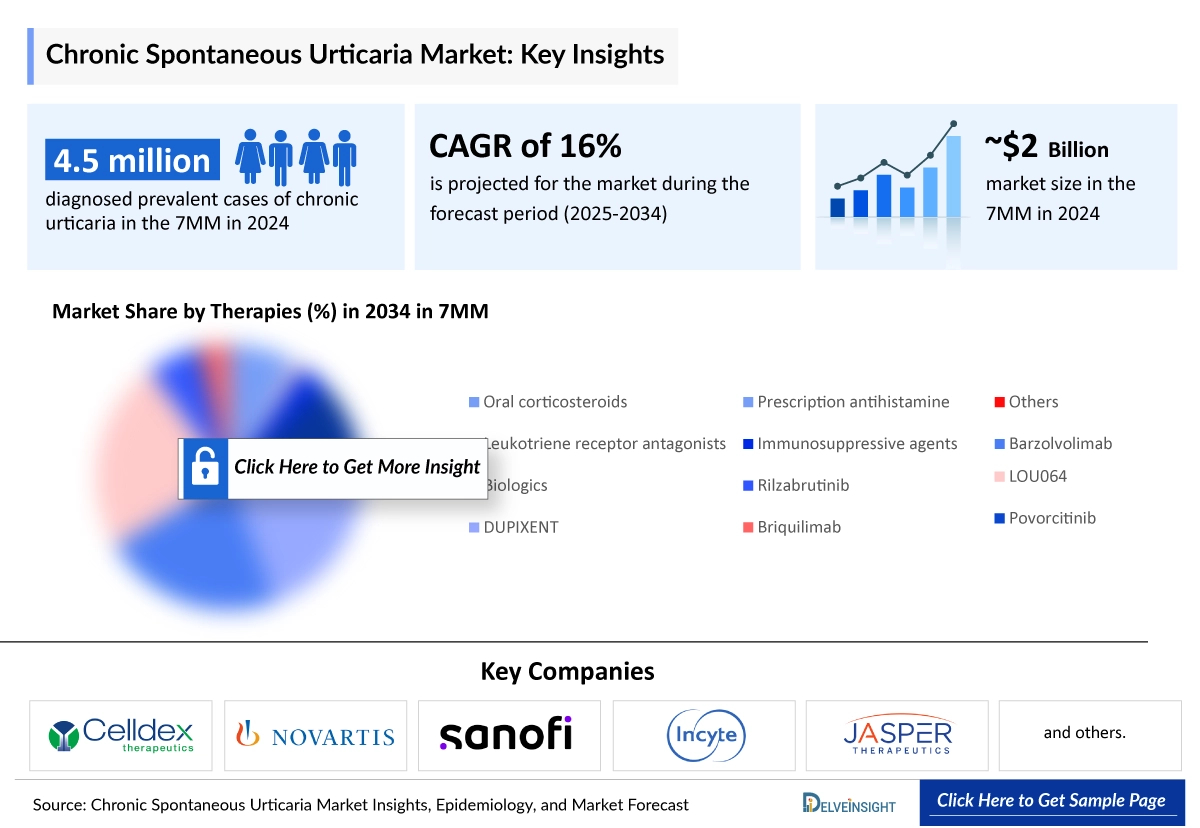
- Growing Chronic Spontaneous Urticaria Prevalence: The total diagnosed prevalent cases of chronic urticaria in the 7MM were approximately 4.5 million in 2024, with these numbers anticipated to increase by 2034, driven by an aging population, environmental exposure, autoimmune dysregulation, and improved diagnostic awareness.
- DUPIXENT's Entry Reshapes the Treatment Landscape: The approval of DUPIXENT (dupilumab) by the US FDA, along with its earlier approval in Japan by the MHLW, marks a notable shift in the treatment landscape, introducing a targeted therapy likely to drive market competition and influence adoption.
- Growing CSU Clinical Trial Activity: The CSU treatment pipeline is increasingly competitive, featuring candidates such as barzolvolimab, remibrutinib, rilzabrutinib, povorcitinib, and briquilimab at various stages of development, targeting alternative pathways such as BTK inhibition.
- Persistent Unmet Need Despite Existing Treatments: Despite the availability of antihistamines, omalizumab, and DUPIXENT, a significant proportion of CSU patients continue to experience inadequate symptom control or relapses, underscoring the need for safer, more effective therapies.
Chronic Spontaneous Urticaria Epidemiology
The Chronic Spontaneous Urticaria market is derived using a patient-based model. The epidemiology chapter of the report provides historical and forecasted epidemiology trends in the 7MM - the United States, EU4 (Germany, France, Italy, and Spain), the United Kingdom, and Japan - from 2022 to 2036.
Chronic Spontaneous Urticaria Epidemiology Segmentation
- Total Diagnosed Prevalent Cases of Chronic Urticaria
- Type-specific Cases of Chronic Urticaria
- Gender-specific Cases of Chronic Spontaneous Urticaria
- Age-specific Cases of Chronic Spontaneous Urticaria
- Severity-specific Cases of Chronic Spontaneous Urticaria
Download the report to understand which factors are driving Chronic Spontaneous Urticaria epidemiology trends @ Chronic Spontaneous Urticaria Epidemiology Forecast
Recent Development in the Chronic Spontaneous Urticaria Treatment Landscape
- In January 2026, Jasper Therapeutics reported updated results from the Phase Ib/IIa BEACON study and its open-label extension showing that briquilimab delivered sustained disease control in CSU, with additional patients achieving complete responses and marked reductions in UAS7 scores at 12 weeks.
- In November 2025, the European Commission approved DUPIXENT (dupilumab) for moderate-to-severe CSU in adult and adolescent patients 12 years and above with inadequate response to H1 antihistamines who are naive to anti-IgE therapy for CSU.
- In April 2025, Regeneron Pharmaceuticals and Sanofi announced that the FDA approved Dupixent® (dupilumab) for treating CSU in adults and adolescents aged 12 years and older who remain symptomatic despite H1 antihistamine treatment.
Chronic Spontaneous Urticaria Drugs Uptake and Pipeline Development Activities
The drugs uptake section focuses on the rate of uptake of potential drugs recently launched in the Chronic Spontaneous Urticaria market or expected to be launched during the study period. The analysis covers market uptake by drugs, patient uptake by therapies, and sales of each drug.
Moreover, the therapeutics assessment section helps understand the drugs with the most rapid uptake and the reasons behind maximal use, comparing drugs based on market share.
The report also covers Chronic Spontaneous Urticaria Pipeline Development Activities, providing valuable insights about therapeutic candidates in various stages and the key companies involved in developing targeted therapeutics, along with recent developments such as collaborations, acquisitions, mergers, licensing patent details, and other information for emerging therapies.
Chronic Spontaneous Urticaria Therapies and Key Companies
- DUPIXENT (dupilumab): Sanofi/Regeneron Pharmaceuticals
- Barzolvolimab (CDX-0159): Celldex Therapeutics
- LOU064 (remibrutinib): Novartis
- Rilzabrutinib: Sanofi
- Briquilimab: Jasper Therapeutics
- Povorcitinib: Incyte
- Others: Evommune
Discover more about therapies set to grab major Chronic Spontaneous Urticaria market share @ Chronic Spontaneous Urticaria Treatment Landscape
Chronic Spontaneous Urticaria Market Drivers
- Growing Chronic Spontaneous Urticaria Prevalence: Rising cases driven by an aging population, increased environmental exposure, and autoimmune dysregulation are expanding the diagnosed patient pool.
- DUPIXENT's Entry into the Market: The FDA and MHLW approvals of DUPIXENT introduce the first targeted biologic option in over a decade, driving competitive dynamics and adoption.
- Growing Clinical Trial Activity: A competitive pipeline featuring barzolvolimab, remibrutinib, rilzabrutinib, povorcitinib, and briquilimab is expanding future treatment options.
- Persistent Unmet Medical Need: Inadequate symptom control among patients on antihistamines or omalizumab is driving demand for safer, more effective alternatives such as BTK inhibitors.
Chronic Spontaneous Urticaria Market Barriers
- Complex and Unknown Etiology: The exact cause of CSU is often unknown, complicating treatment development and patient management.
- Diagnostic Challenges: Diagnosis relies on ruling out underlying causes through blood tests, allergy tests, and skin biopsies rather than a single definitive test.
- Safety Concerns with Existing Options: Escalating antihistamine doses can cause sedation and anticholinergic toxicity, while omalizumab carries a risk of anaphylaxis, and cyclosporine use is limited by safety concerns.
- Fluctuating Disease Course: The need to reassess treatment every 3–6 months due to CSU's fluctuating nature complicates long-term management.
Scope of the Chronic Spontaneous Urticaria Market Report
- Study Period: 2022–2036
- Forecast Period: 2026–2036
- Coverage: 7MM [The United States, EU4 (Germany, France, Italy, and Spain) and the United Kingdom, and Japan]
- Key Chronic Spontaneous Urticaria Companies: Sanofi/Regeneron Pharmaceuticals, Celldex Therapeutics, Novartis, Sanofi, Incyte, Jasper Therapeutics, Evommune, and others
- Key Chronic Spontaneous Urticaria Therapies: DUPIXENT (dupilumab), Barzolvolimab (CDX-0159), LOU064 (remibrutinib), Rilzabrutinib, Povorcitinib, Briquilimab, and others
- Chronic Spontaneous Urticaria Therapeutic Assessment: Marketed and emerging Chronic Spontaneous Urticaria therapies
- Chronic Spontaneous Urticaria Market Dynamics: Market drivers and market barriers
- Competitive Intelligence Analysis: SWOT analysis, KOL views, Conjoint analysis, Unmet needs
To know more about Chronic Spontaneous Urticaria companies working in the treatment market, visit @ Chronic Spontaneous Urticaria Market
Need more?
- ✅ Connect with our analyst to learn how this research was developed
- ✅ Expand the scope with additional segments or countries through free customization
- ✅ Discover how this report can directly influence your business growth
Related Reports

Chronic Spontaneous Urticaria (CSU) - Epidemiology Forecast - 2034
DelveInsight's Chronic spontaneous urticaria- Market Insights, Epidemiology and Market Forecast - 2034 report provides an in depth understanding of historical..

Chronic Spontaneous Urticaria- Pipeline Insight, 2025
"Chronic Spontaneous Urticaria Pipeline Insights, 2025" report by DelveInsight outlays comprehensive insights of present clinical development scenario and growth prospects across..
