CRISPR Therapies Pipeline: Intellia Therapeutics, Locus Biosciences, and CRISPR Therapeutics Advance Next-Generation Gene-Editing Medicines
Get a Sneak Peek at the Latest crispr therapies pipeline insight Report
CRISPR therapies are a new class of gene-editing medicines designed to precisely modify disease-causing DNA sequences or regulate gene expression. Companies such as Intellia Therapeutics, Locus Biosciences, and CRISPR Therapeutics are advancing in vivo gene editing, engineered bacteriophage approaches, and lipid nanoparticle delivery platforms. Advances in high-fidelity Cas enzymes, optimized guide RNA design, and non-viral delivery technologies are strengthening the CRISPR therapies pipeline.
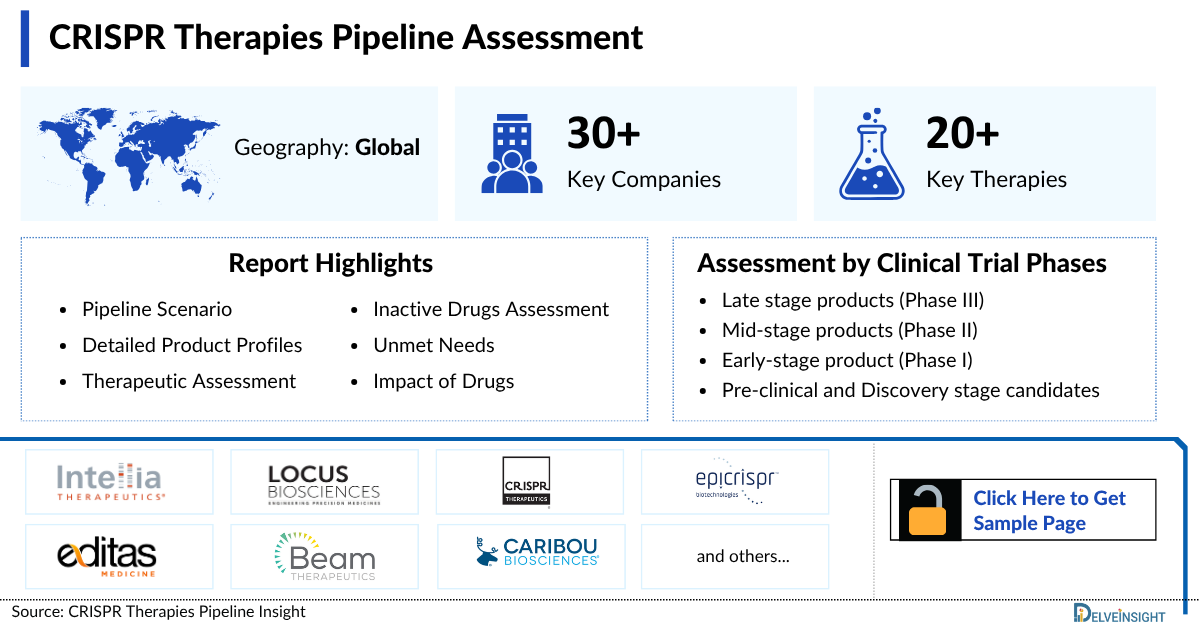
DelveInsight's "CRISPR Therapies Pipeline Insight, 2026" report provides comprehensive insights about 20+ companies and 30+ pipeline drugs in the CRISPR therapies pipeline landscape. It covers pipeline drug profiles, including clinical and nonclinical stage products. It also covers the therapeutic assessment by product type, stage, route of administration, and molecule type, and highlights inactive pipeline products in this space.
Explore the complete pipeline landscape and uncover growth opportunities in CRISPR therapies: CRISPR Therapies Clinical Trial Analysis
Key Takeaways from the CRISPR Therapies Pipeline Report
- DelveInsight's analysis covers 20+ companies developing CRISPR therapies, with 30+ pipeline drugs under evaluation
- Intellia Therapeutics has the candidate in the most advanced stage of development (Pre-registration)
- Intellia initiated a rolling Biologics License Application (BLA) submission to the US FDA in 2026 for lonvoguran ziclumeran (NTLA-2002) as a potential one-time treatment for hereditary angioedema, based on positive Phase III results
- CRISPR Therapeutics is evaluating CTX310, an in vivo ANGPTL3-editing therapy for refractory dyslipidemias, in a first-in-human, open-label Phase I trial
- Locus Biosciences is evaluating LBP-EC01, a CRISPR-Cas3-enhanced bacteriophage therapy for drug-resistant E. coli urinary tract infections, in the ELIMINATE Phase II trial
- Base editing and prime editing are enabling single-nucleotide modifications and targeted insertions without double-strand DNA breaks
- CRISPR is being integrated with cell therapies by engineering CAR-T and CAR-NK cells to enhance anti-tumor activity, persistence, and immune evasion
- Epigenome editing and CRISPR interference/activation (CRISPRi/CRISPRa) are being explored to regulate gene expression reversibly without altering the DNA sequence
Understanding CRISPR Therapies: A New Class of Precision Gene-Editing Medicines
CRISPR therapies use programmable gene-editing technologies to modify disease-associated DNA or regulate gene expression. Cas9, guided by single-guide RNA, targets specific genomic sequences, while cellular repair mechanisms enable gene disruption or correction. Advanced approaches such as base and prime editing can make precise genetic changes without double-strand DNA breaks, potentially improving safety and accuracy. CRISPR therapies may be administered ex vivo by modifying patient-derived cells or in vivo through viral vectors and lipid nanoparticles. Applications span genetic, hematologic, oncologic, infectious, ophthalmic, metabolic, and neurological disorders. CRISPR is also being investigated for e
Stay ahead with comprehensive pipeline intelligence and competitive landscape analysis: CRISPR Therapies Pipeline Outlook
Evolving CRISPR Therapies Pipeline Landscape: Innovation Driving Therapeutic Breakthroughs
The CRISPR therapies pipeline is advancing through improvements in editing precision, delivery technologies, and next-generation editors. DelveInsight's analysis indicates that approximately 20+ key companies are developing CRISPR therapies, collectively working on 30+ pipeline drugs across various stages of clinical development. These include late-stage (Phase III), mid-stage (Phase II), early-stage (Phase I), as well as preclinical and discovery-stage candidates.
The companies with CRISPR therapy candidates in the most advanced stage of development, i.e., Pre-registration, include Intellia Therapeutics. Companies and academic groups are working to assess challenges and seek opportunities that could influence CRISPR therapies R&D, with therapies under development focused on novel approaches to improve treatment.
Request a sample report to explore emerging drug trends and clinical advancements: CRISPR Therapies Competitive Landscape
CRISPR Therapies Emerging Drugs Profile
-
NTLA-2002: Intellia Therapeutics
NTLA-2002 (lonvoguran ziclumeran [lonvo-z]) is an investigational in vivo CRISPR-Cas9 gene-editing therapy developed by Intellia Therapeutics for the treatment of hereditary angioedema (HAE). It uses lipid nanoparticles (LNPs) to deliver Cas9 mRNA and a guide RNA to hepatocytes, where it permanently inactivates the KLKB1 gene, resulting in sustained reductions in plasma kallikrein and bradykinin levels that drive HAE attacks. Designed as a single-dose therapy, NTLA-2002 aims to provide durable prevention of recurrent swelling episodes and reduce the need for lifelong prophylactic treatment. Based on positive Phase III results, Intellia initiated a rolling Biologics License Application (BLA) submission to the US FDA in 2026 for lonvoguran ziclumeran as a potential one-time treatment for HAE.
-
LBP-EC01: Locus Biosciences, Inc
LBP-EC01 is an investigational CRISPR-Cas3-enhanced bacteriophage therapy developed by Locus Biosciences for the treatment of acute uncomplicated urinary tract infections (uUTIs) caused by antimicrobial-resistant and multidrug-resistant Escherichia coli. The therapy consists of a recombinant bacteriophage cocktail engineered with a CRISPR-Cas3 system that selectively targets and degrades the bacterial genome, combining the natural lytic activity of bacteriophages with programmable CRISPR-mediated bacterial killing. LBP-EC01 is administered in combination with trimethoprim/sulfamethoxazole (TMP/SMX) to improve bacterial eradication while minimizing disruption of the normal microbiome. The therapy is currently being evaluated in the ELIMINATE Phase II clinical trial, where early results have demonstrated favorable safety, pharmacokinetics, and promising microbiological and clinical efficacy against drug-resistant E. coli infections.
-
CTX310: CRISPR Therapeutics
CTX310 is an investigational in vivo CRISPR-Cas9 gene-editing therapy developed by CRISPR Therapeutics for the treatment of refractory dyslipidemias, including hypercholesterolemia, hypertriglyceridemia, and familial hypercholesterolemia. It is formulated as a lipid nanoparticle (LNP) containing Cas9 mRNA and a guide RNA that selectively edits the ANGPTL3 gene in hepatocytes following a single intravenous infusion. By permanently disrupting ANGPTL3 expression, CTX310 aims to produce durable reductions in LDL cholesterol, triglycerides, and other atherogenic lipids, offering a potential one-time treatment for patients inadequately controlled with existing lipid-lowering therapies. CTX310 is currently being evaluated in a first-in-human, open-label Phase I clinical trial assessing its safety, tolerability, pharmacodynamics, and preliminary efficacy.
CRISPR Therapies Pipeline Segmentation and Therapeutic Assessment
The report provides insights into the different CRISPR therapies drugs, segmented based on the following parameters that define the scope of the report.
CRISPR Therapies Clinical Trial Phases
- Late-stage products (Phase III)
- Mid-stage products (Phase II)
- Early-stage products (Phase I)
- Preclinical and discovery-stage candidates
- Discontinued and inactive candidates
CRISPR Therapies Route of Administration
- Oral
- Intravenous
- Subcutaneous
- Parenteral
- Topical
CRISPR Therapies Molecule Types
- Recombinant fusion proteins
- Small molecules
- Monoclonal antibodies
- Peptides
- Polymers
- Gene therapies
CRISPR Therapies Challenges and Future Outlook
Despite its transformative potential, CRISPR therapy faces important scientific and clinical challenges, including efficient tissue-specific delivery, off-target editing, immune responses to Cas proteins, mosaic editing, and long-term safety monitoring. Advances in high-fidelity Cas enzymes, optimized guide RNA design, transient editing systems, and non-viral delivery technologies have significantly improved editing specificity and reduced unintended genomic changes. Regulatory agencies require extensive preclinical and long-term clinical follow-up to assess durability, genotoxicity, and potential delayed adverse effects.
Ongoing research is expanding the therapeutic scope through multiplex genome editing, RNA-targeting CRISPR systems, programmable gene insertion, and next-generation editors with greater precision. As these technologies continue to mature, CRISPR-based therapies are expected to become an increasingly important component of precision medicine for both rare genetic disorders and more common complex diseases.
Explore detailed drug profiles and clinical trial insights: CRISPR Therapies Clinical Trial and FDA Approval
Scope of the CRISPR Therapies Pipeline Report
- Coverage: Global
- Key CRISPR Therapies Companies: Intellia Therapeutics, Locus Biosciences, CRISPR Therapeutics, and other emerging players
- Key CRISPR Therapies: NTLA-2002, LBP-EC01, CTX310, and other pipeline candidates
- CRISPR Therapies Therapeutic Assessment by Clinical Stage: Discovery, Preclinical, Phase I, Phase II, Phase III
- CRISPR Therapies Therapeutic Assessment by Route of Administration: Oral, Intravenous, Subcutaneous, Parenteral, Topical
About DelveInsight
DelveInsight is a leading Life Science market research and business consulting company recognized for its off-the-shelf syndicated market research reports and customized solutions to firms in the healthcare sector.
Need more?
- ✅ Connect with our analyst to learn how this research was developed
- ✅ Expand the scope with additional segments or countries through free customization
- ✅ Discover how this report can directly influence your business growth
Related Reports

CRISPR therapies - Pipeline Insight, 2026
The “CRISPR Therapies Pipeline Insights, 2026” report by DelveInsight provides comprehensive insights into the current clinical development landscape and future growth prospects of the CRISPR Therapies treatment landscape.
