Endometriosis Market Positioned for Accelerated Development Through 2036, DelveInsight Finds
Get a Sneak Peek at the Latest endometriosis market insights Report
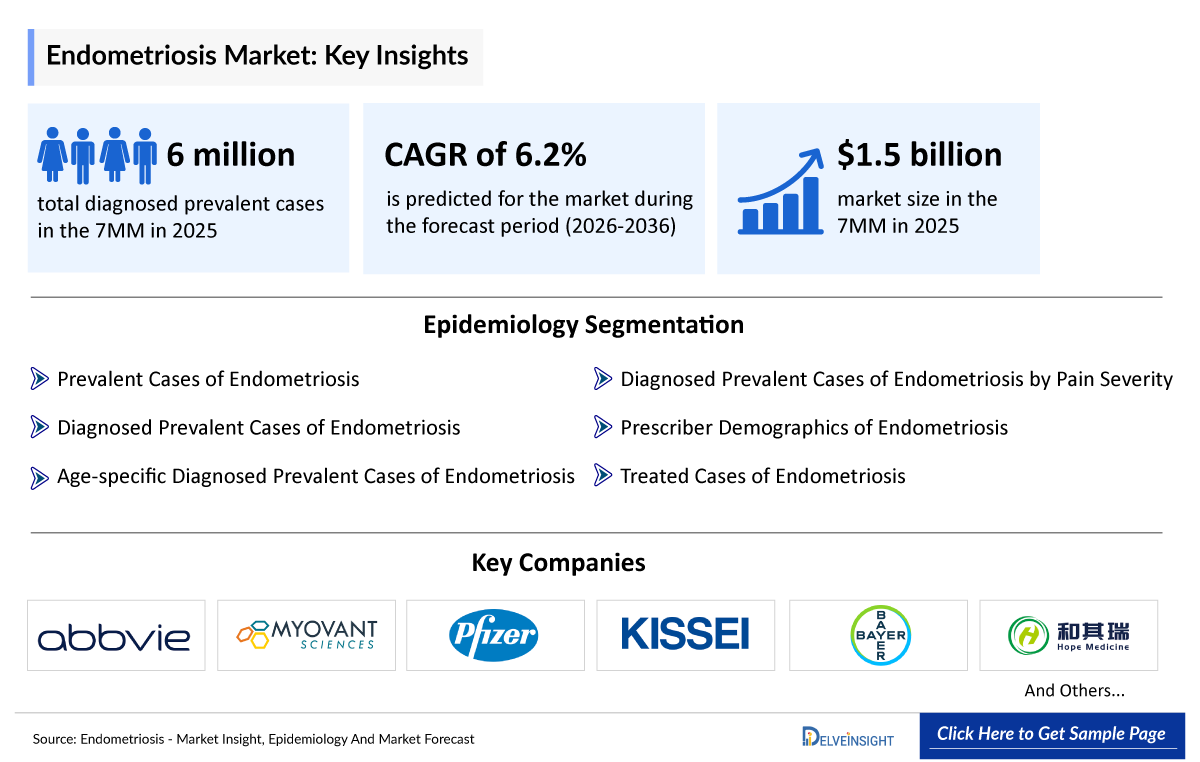
According to DelveInsight's analysis, the endometriosis market size was found to be around USD ~1,500 million in the leading markets (the United States, EU4 [Germany, France, Italy, and Spain], the United Kingdom, and Japan) in 2025, and is projected to reach approximately USD ~2,700 million by 2036, growing at a CAGR of 6.2% during 2026–2036. DelveInsight's comprehensive market research provides critical insights into such market trends, enabling stakeholders to understand growth drivers, emerging opportunities, and potential challenges within the endometriosis landscape.
Current treatment strategies remain largely suppressive, relying on hormonal therapies (oral combined contraceptive pills, progestins, GnRH analogs) and surgery. Surgical intervention provides short-term relief but limited durability, with high recurrence rates and diminishing returns following repeat procedures, reinforcing the unmet need for non-surgical, disease-modifying therapies. The most transformative shift in endometriosis management has occurred with the introduction of oral GnRH antagonists — in the US, FDA approvals of elagolix (ORILISSA) by AbbVie and relugolix with estradiol and norethindrone acetate (MYFEMBREE) by Myovant/Pfizer marked a departure from injectable GnRH agonists by enabling rapid, dose-dependent estrogen suppression without an initial flare. MYFEMBREE holds a competitive advantage due to its fixed-dose add-back composition, which improves bone protection and supports longer-term use.
By analyzing historical data, current market dynamics, and future projections, DelveInsight equips pharmaceutical companies, investors, and healthcare professionals with actionable intelligence to make informed strategic decisions, identify investment opportunities, optimize product positioning, and plan research and development initiatives effectively.
Endometrial diseases reported approximately 7 million prevalent cases and around 4 million diagnosed prevalent cases in the US. The total number of prevalent cases of endometriosis in the 7MM was approximately ~12 million in 2025, whereas the total number of diagnosed prevalent cases in the 7MM was around ~6 million. In the United States, diagnosed prevalent cases of endometriosis are predominantly managed by gynecologists, accounting for 3 million cases in 2025. In Japan, age-specific prevalent cases of endometriosis were 7% for ages 15–19, 26% for 20–29, 33% for 30–39, and 34% for 40–49 years. In 2025, Stage I (minimal) endometriosis accounted for the largest share of diagnosed prevalent cases across EU4 and the UK at 50%, followed by Stage II (mild) disease at 24% and Stage III (moderate) disease at 14%, while Stage IV (severe) endometriosis represented the smallest proportion at 13%. In Japan, diagnosed prevalent cases were predominantly managed by gynecologists (600,000 cases), followed by generalists (270,000 cases) and other prescribers (27,000 cases).
DelveInsight's report, "Endometriosis Market Insights, Epidemiology and Market Forecast – 2036," provides a comprehensive analysis of the endometriosis landscape. The report delivers detailed insights into the disease, including historical and projected epidemiology, helping stakeholders understand the prevalence, incidence, and patient demographics across key regions.
Additionally, it examines endometriosis market dynamics, offering a thorough assessment of current and emerging market trends, treatment patterns, and therapeutic developments. The analysis spans major markets, including the United States, EU4 (Germany, France, Italy, and Spain), the United Kingdom, and Japan, equipping decision-makers with actionable intelligence for strategic planning, investment, and research initiatives.
To know in detail about the Endometriosis market outlook, drug uptake, treatment scenario and epidemiology trends, Click here — Endometriosis Market Insights
Key Facts of the Endometriosis Market Report
- Key Endometriosis Companies: AbbVie, Kissei Pharmaceutical/Theramex, ASKA Pharmaceutical, Myovant Sciences/Pfizer, Hope Medicine, TiumBio, Gesynta Pharma, and others
- Key Endometriosis Therapies: Linzagolix choline (YSELTY), Relugolix/estradiol/norethindrone acetate (MYFEMBREE/RYEQO), Relugolix (RELUMINA), Elagolix (ORILISSA), HMI-115, TU2670 (Merigolix), Vipoglanstat (GS-248), VML-0501, and more
- The endometriosis market is expected to grow due to the substantial patient burden, the shift toward oral GnRH antagonists over injectable therapies, and diversification of the pipeline with non-hormonal, disease-modifying mechanisms during the forecast period. Furthermore, the launch of first-in-class therapies such as HMI-115 will significantly influence the endometriosis market dynamics.
Endometriosis Overview
Endometriosis is a chronic, estrogen-dependent inflammatory disease involving the growth of endometrial-like tissue outside the uterus, commonly affecting the ovaries, fallopian tubes, and pelvic peritoneum, leading to pain and infertility. Symptoms vary by lesion location but commonly include dysmenorrhea, chronic pelvic pain, dyspareunia, heavy periods, and infertility.
Laparoscopy with histological confirmation remains the gold standard for diagnosis, revealing ectopic endometrial glands/stroma, while noninvasive tools like transvaginal ultrasound and MRI aid in detecting ovarian endometriomas or deep lesions. First-line management for pain targets hormonal suppression with NSAIDs, combined oral contraceptives, or progestins. GnRH agonists/antagonists (often with add-back therapy) serve as second-line options for persistent symptoms, while laparoscopic excision of lesions improves pain and fertility in select cases.
Request the sample page for the Endometriosis Market Report
Key Trends in Endometriosis Therapeutics Market
- Shift Toward Oral GnRH Antagonists: FDA approvals of elagolix (ORILISSA) and relugolix combination (MYFEMBREE) marked a departure from injectable GnRH agonists, enabling rapid, dose-dependent estrogen suppression without an initial flare.
- Diversifying Non-Hormonal Pipeline: Emerging candidates such as HMI-115 (a first-in-class prolactin receptor–targeting antibody) and vipoglanstat (an HPGDS inhibitor) are broadening the therapeutic landscape beyond hormonal suppression.
- Persistent Unmet Need for Disease-Modifying Therapies: High recurrence rates following surgical intervention continue to reinforce demand for non-surgical, disease-modifying treatment options.
- Expanding Reimbursement Access: NICE's recommendation of NHS reimbursement for linzagolix choline (YSELTY) reflects growing payer support for newer oral therapies.
- Fixed-Dose Add-Back Formulations Gaining Preference: Therapies like MYFEMBREE, with fixed-dose add-back composition, are favored for improved bone protection and longer-term use.
- Regional Pipeline Expansion: Next-generation therapies including TU2670 (MERIGOLIX) and linzagolix choline are advancing across Japan and other key markets.
Endometriosis Epidemiology
Key findings from endometriosis epidemiological analysis and forecast highlight the disease's prevalence, incidence, and patient demographics across the 7MM, including prescriber-pattern, age-, and stage-specific segmentation, helping stakeholders understand the scope of the disease and plan targeted interventions, research, and treatment strategies.
Endometriosis Epidemiology Segmentation
The endometriosis market report proffers epidemiological analysis for the study period 2022–2036 in the 7MM, segmented into:
- Total Prevalent Cases of Endometriosis
- Total Diagnosed Prevalent Cases of Endometriosis
- Prescriber Pattern-specific Diagnosed Prevalent Cases of Endometriosis
- Age-specific Diagnosed Prevalent Cases of Endometriosis
- Stage-specific Diagnosed Prevalent Cases of Endometriosis
Download the report to understand which factors are driving Endometriosis epidemiology trends @ Endometriosis Epidemiology Forecast
Recent Developments in the Endometriosis Treatment Landscape
- In March 2026: Gesynta Pharma dosed the first patient in its new Phase II NOVA trial of vipoglanstat (GS-248), a non-hormonal treatment candidate for endometriosis, advancing an approach designed to circumvent the adverse effects of hormone-based therapy.
- In December 2025: HMI-115, a monoclonal antibody targeting the prolactin receptor developed by Hope Medicine, received Fast Track Designation from the US FDA for the treatment of moderate to severe pain associated with endometriosis, with Phase II data showing dose-dependent, clinically meaningful reductions in dysmenorrhea and nonmenstrual pelvic pain.
- In June 2025: NICE reported a positive recommendation for linzagolix choline (YSELTY) for NHS reimbursement for the symptomatic treatment of endometriosis in women with a history of prior medical or surgical intervention.
- In May 2025: Theramex reported that NICE recommended NHS reimbursement of linzagolix (YSELTY) for the symptomatic treatment of endometriosis in women with a history of prior medical or surgical treatment.
Endometriosis Drugs Uptake and Pipeline Development Activities
This section focuses on the uptake rate of potential endometriosis drugs expected to be launched during the forecast period (2026–2036), covering drug uptake, performance at peak, factors affecting performance during prime growth years, patient uptake by therapy, and anticipated sales generated by each drug. Among current medical therapies, progestin-only pills are most commonly used (16.1–17.4%), followed by combined oral contraceptives (14.2–14.4%); GnRH agonists are prescribed in 9.3–11.3% of patients, while GnRH antagonists show limited uptake at 1.8–2.2%, and danazol use is rare (0.3%). Opioids are used in 27.8–28.8% of patients overall and as first-line therapy in 12.5–12.7%, with over half of opioid-first patients requiring subsequent treatment.
HMI-115, developed by Hope Medicine, is a subcutaneously administered monoclonal antibody that blocks prolactin receptor signaling — a novel, non-hormonal mechanism implicated in endometriosis-associated pain — and by avoiding direct ovarian hormone suppression, may offer a differentiated option for patients intolerant to GnRH-based therapies. If approved, HMI-115 is anticipated to launch in major markets in 2030.
Endometriosis Approved and Emerging Therapies
- Elagolix (ORILISSA): AbbVie | Approved in the US in 2018
- Linzagolix choline (YSELTY): Kissei Pharmaceutical/Theramex | Approved in the EU in 2024 and the UK in 2025; Japan launch anticipated in 2028
- Relugolix, estradiol, norethindrone acetate (MYFEMBREE/RYEQO): Myovant Sciences/Pfizer | Approved in the US, EU4, and UK
- Relugolix (RELUMINA): Marketed
- Vipoglanstat (GS-248): Gesynta Pharma | Phase II
- HMI-115: Hope Medicine | Phase II; US launch anticipated in 2030
- TU2670 (Merigolix): TiumBio | Phase II
- VML-0501: Viramal | Phase II
Among the 7MM, the US accounted for the largest market size of endometriosis, at approximately ~USD 1,300 million in 2025. In 2036, among all endometriosis therapies, the highest revenue is estimated to be generated by HMI-115 in the 7MM. In Europe, the most meaningful recent shift has been the approval of oral GnRH antagonists with improved usability profiles — MYFEMBREE/RYEQO has been approved across EU markets, offering fixed-dose add-back therapy that supports longer treatment duration and improved bone protection.
US administrative claims data show that endometriosis care remains surgery-dominant, with 70.9–72.1% of patients undergoing surgery, while 42.1–44.9% received pharmacologic therapy (excluding opioids). Surgery was frequently first-line, used in 37.6–41.8% of patients; among these, laparoscopy accounted for 53.4–57.6% and hysterectomy for 42.4–46.6%.
To know more about Endometriosis companies working in the treatment market, visit @ Endometriosis Clinical Trials and Therapeutic Assessment
Endometriosis Market Drivers
- Substantial global patient burden, with approximately 12 million prevalent cases across the 7MM in 2025
- Shift from injectable GnRH agonists to oral GnRH antagonists, offering rapid, dose-dependent estrogen suppression without an initial flare
- Diversification of the treatment pipeline through non-hormonal, disease-modifying mechanisms such as prolactin receptor antagonism and HPGDS inhibition
- Expanding reimbursement support, exemplified by NICE's NHS reimbursement recommendation for linzagolix choline
- High recurrence rates following surgery reinforcing continued demand for effective medical therapies
- Improved diagnostic awareness and testing supporting steady growth in the diagnosed and treated patient pool
Endometriosis Market Barriers
- Lack of disease-modifying therapies that reverse underlying disease biology rather than suppress hormone activity
- Limited nonhormonal and fertility-sparing therapeutic choices
- High recurrence rates following surgical intervention, with diminishing returns after repeat procedures
- Insufficient long-term medical options compatible with chronic use
- Inadequate solutions for persistent pain independent of lesion burden
- Continued reliance on opioids for severe or refractory pain, which do not address disease drivers and carry dependency risks
Scope of the Endometriosis Market Report
- Study Period: 2022–2036
- Forecast Period: 2026–2036
- Key Coverage : Global
- Key Endometriosis Companies: AbbVie, Kissei Pharmaceutical/Theramex, ASKA Pharmaceutical, Myovant Sciences/Pfizer, and others
- Key Endometriosis Therapies: Linzagolix choline (YSELTY), Elugolix/estradiol/norethindrone acetate (MYFEMBREE/RYEQO), Relugolix (RELUMINA), Elagolix (ORILISSA), HMI-115, TU2670 (Merigolix), and more
- Endometriosis Market Segmented By: Region/geographies, drugs/therapies
- Analysis Covered: Addressable patient population, market drivers and barriers, cost assumptions and pricing analogues, KOL views, SWOT analysis, reimbursement, attribute analysis, unmet need
Discover more about therapies set to grab major Endometriosis market share @ Endometriosis Treatment Market
About DelveInsight
DelveInsight is a leading Healthcare Business Consultant, and Market Research firm focused exclusively on life sciences. It supports Pharma companies by providing comprehensive end-to-end solutions to improve their performance. It also offers Healthcare Consulting Services, which benefits in market analysis to accelerate the business growth and overcome challenges with a practical approach.
Need more?
- ✅ Connect with our analyst to learn how this research was developed
- ✅ Expand the scope with additional segments or countries through free customization
- ✅ Discover how this report can directly influence your business growth
Related Reports

Endometriosis - Market Insight, Epidemiology And Market Forecast - 2034
DelveInsight's Endometriosis Market Insights, Epidemiology, and Market Forecast-2034" report delivers an in-depth understanding of the Endometriosis.
