Idiopathic Pulmonary Fibrosis Market to Grow Significantly from USD 3.3 Billion in 2023 Through 2034
Get a Sneak Peek at the Latest idiopathic pulmonary fibrosis market size and forecast Report
The Idiopathic Pulmonary Fibrosis market size was valued at approximately USD 3,300 million in 2023 and is expected to expand at a notable compound annual growth rate (CAGR) throughout the study period from 2020 to 2034. DelveInsight’s comprehensive market research provides critical insights into such market trends, enabling stakeholders to understand growth drivers, emerging opportunities, and potential challenges within the Idiopathic Pulmonary Fibrosis landscape.
According to DelveInsight’s analysts, the market is projected to witness steady growth over the forecast period (2024–2034), primarily driven by the rising patient population and the anticipated introduction of new therapies. In 2023, the Idiopathic Pulmonary Fibrosis market across the EU4 and the UK was valued at approximately USD 702 million, representing nearly 21% of the overall 7MM market. Within this region, Germany recorded the largest market share at about USD 183 million, followed by the UK and France with around USD 141 million and USD 140 million, respectively. These figures are expected to evolve over the forecast timeline. Meanwhile, the Idiopathic Pulmonary Fibrosis market in Japan accounted for nearly 5% of the total 7MM market in 2023 and is projected to increase by 2034.
According to DelveInsight’s analysis, the total diagnosed prevalent cases of Idiopathic Pulmonary Fibrosis across the seven major markets (7MM) were estimated to be around 193,000 in 2023. This number is anticipated to grow in the coming years, largely driven by an aging population and advancements in diagnostic capabilities. In 2023, the United States recorded the highest number of diagnosed prevalent cases among the 7MM, with nearly 95,000 patients, and this figure is projected to rise during the forecast period from 2024 to 2034. Within the EU4 and the UK, Germany reported the largest number of diagnosed cases at approximately 21,000, followed by the UK and France with about 15,700 and 15,500 cases, respectively.
In 2023, the prevalence of idiopathic pulmonary fibrosis across the seven major markets (7MM) was segmented by disease severity as follows: mild cases (FVC >75%) accounted for 55,926 patients, moderate cases (FVC 50%–75%) for 96,424 patients, and severe cases (FVC <50%) for 40,498 patients. This distribution highlights that a large proportion of patients fall within the moderate stage of the disease, emphasizing the need for effective treatment and management approaches.
Additionally, the epidemiological model for idiopathic pulmonary fibrosis in the 7MM in 2023 categorized patients by age group. There were approximately 6,573 cases among individuals aged 18–39 years, 24,492 cases in the 40–59 years group, 113,411 cases in the 60–79 years group, and 48,368 cases in those aged 80 years and above. These figures demonstrate a clear rise in disease prevalence with increasing age.
In 2023, the gender-specific diagnosed prevalence of Idiopathic Pulmonary Fibrosis across the seven major markets (7MM) was higher among males, with nearly 120,718 cases, whereas females accounted for about 73,152 cases, indicating a greater burden of the disease in the male population.
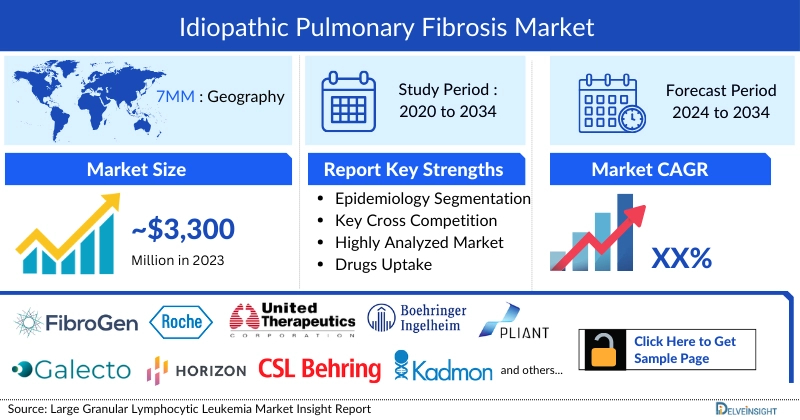
DelveInsight’s report, “Idiopathic Pulmonary Fibrosis Market Insights, Epidemiology, and Market Forecast-2034,” provides a comprehensive analysis of the Idiopathic Pulmonary Fibrosis landscape. The report delivers detailed insights into the disease, including historical and projected epidemiology, helping stakeholders understand the prevalence, incidence, and patient demographics across key regions.
Additionally, it examines Idiopathic Pulmonary Fibrosis market dynamics, offering a thorough assessment of current and emerging market trends, treatment patterns, and therapeutic developments. The analysis spans major markets, including the United States, EU4 (Germany, Spain, Italy, France, and the United Kingdom), and Japan, equipping decision-makers with actionable intelligence for strategic planning, investment, and research initiatives.
To Know in detail about the Idiopathic Pulmonary Fibrosis market outlook, drug uptake, treatment scenario and epidemiology trends, Click here; Idiopathic Pulmonary Fibrosis Market Forecast
Some of the key facts of the Idiopathic Pulmonary Fibrosis Market Report:
- The Idiopathic Pulmonary Fibrosis (IPF) treatment market is expected to witness considerable growth during the forecast period from 2024 to 2032, driven by the development of emerging therapies such as Pamrevlumab, Tyvaso (treprostinil), PLN-74809, BI 1015550, VP01 (C21), and BMS-986278, among others.
- Key Idiopathic Pulmonary Fibrosis Companies: Boehringer Ingelheim, PureTech, Guangzhou JOYO Pharma, Tvardi Therapeutics, Pliant Therapeutics, Inc., GlaxoSmithKline, Amgen, Bristol-Myers Squibb, Endeavor Biomedicines, Syndax Pharmaceuticals, Regend Therapeutics, and others
- Key Idiopathic Pulmonary Fibrosis Therapies: BI 1015550, OFEV (Nintedanib), Pirfenidone, SC1011, TTI-101, PLN-74809, GSK3915393, HZN-825, BMS-986278, taladegib, BI 181947, Axatilimab, REGEND001, and others
Idiopathic Pulmonary Fibrosis Overview
Idiopathic Pulmonary Fibrosis (IPF) is a chronic and progressive lung disease characterized by the scarring or thickening of lung tissue, which leads to difficulty breathing. The cause of IPF is unknown ("idiopathic"), and it primarily affects older adults. The scarring reduces the lung's ability to transfer oxygen to the bloodstream, causing symptoms such as shortness of breath, persistent cough, and fatigue. Treatment options are limited, but include medications to slow disease progression and manage symptoms.
Get a Free sample for the Idiopathic Pulmonary Fibrosis Market Forecast, Size & Share Analysis Report:
https://www.delveinsight.com/report-store/idiopathic-pulmonary-fibrosis-market
Key Trends in Idiopathic Pulmonary Fibrosis Therapeutics Market:
- Rising adoption of antifibrotic therapies: Approved antifibrotic drugs such as pirfenidone and nintedanib continue to dominate the treatment landscape, as they help slow lung function decline and disease progression. Ongoing research aims to develop next-generation antifibrotic agents with improved efficacy and safety profiles.
- Growing focus on combination and novel mechanism therapies: Pharmaceutical companies are increasingly exploring combination therapies and drugs targeting multiple fibrotic pathways to enhance treatment outcomes and address the complex pathophysiology of IPF.
- Emergence of personalized and biomarker-driven treatments: Advances in genetic research and biomarker identification are enabling more personalized treatment approaches, allowing clinicians to tailor therapies based on individual disease characteristics and improve patient outcomes.
- Innovation in drug delivery methods: While oral therapies currently dominate the market, inhaled formulations and targeted pulmonary drug delivery systems are gaining traction as they may reduce systemic side effects and improve drug tolerability.
- Integration of digital health and remote monitoring: Telemedicine platforms, AI-driven imaging tools, and remote patient monitoring technologies are increasingly being incorporated into IPF management to improve disease monitoring, clinical trial efficiency, and patient adherence to treatment.
Idiopathic Pulmonary Fibrosis Epidemiology
The Idiopathic Pulmonary Fibrosis epidemiology section provides insights into the historical, current, and forecasted epidemiology trends in the seven major countries (7MM) from 2020 to 2034. It helps to recognize the causes of current and forecasted trends by exploring numerous studies and views of key opinion leaders. The epidemiology section also provides a detailed analysis of the diagnosed patient pool and future trends.
Idiopathic Pulmonary Fibrosis Epidemiology Segmentation:
The Idiopathic Pulmonary Fibrosis market report proffers epidemiological analysis for the study period 2020–2034 in the 7MM segmented into:
- Total Prevalence of Idiopathic Pulmonary Fibrosis
- Prevalent Cases of Idiopathic Pulmonary Fibrosis by severity
- Gender-specific Prevalence of Idiopathic Pulmonary Fibrosis
- Diagnosed Cases of Episodic and Chronic Idiopathic Pulmonary Fibrosis
Download the report to understand which factors are driving Idiopathic Pulmonary Fibrosis epidemiology trends @ Idiopathic Pulmonary Fibrosis Epidemiology Forecast
Recent Development In The Idiopathic Pulmonary Fibrosis Treatment Landscape:
- In January 2026, Boehringer Ingelheim has announced the initiation of a Phase IIa clinical study to assess BI 765423, a first-in-class monoclonal antibody directed against interleukin-11 (IL-11), in patients with idiopathic pulmonary fibrosis (IPF). The trial represents an important step in the company’s ongoing efforts to develop new treatments for progressive fibrotic lung disorders.
- In January 2026, Jascayd® (nerandomilast/BI 1015550) is a phosphodiesterase-4 (PDE4) inhibitor developed by Boehringer Ingelheim for adult patients with idiopathic pulmonary fibrosis (IPF) and progressive pulmonary fibrosis (PPF). It is positioned as the first and only preferential phosphodiesterase-4B (PDE4B) inhibitor approved for IPF treatment in adults. The therapy is marketed as oval, biconvex, film-coated tablets available in 9 mg light-yellow and 18 mg light-red strengths.
- In September 2025, United Therapeutics is seeking approval for Tyvaso (treprostinil) in idiopathic pulmonary fibrosis (IPF) following positive results from a Phase III trial. In the TETON-2 study (NCT05255991), the inhaled prostacyclin mimetic significantly improved forced vital capacity (FVC), showing a 95.6 mL increase from baseline. Since FVC is a crucial indicator of breathing restriction in IPF, this outcome is notable. Additionally, the systemic vasodilator delayed the time to the first clinical worsening event, achieving its key secondary endpoint.
- In May 2025, Endeavor BioMedicines, a clinical-stage biotech company developing treatments for serious conditions, presented a post hoc analysis from its completed Phase 2a trial of the investigational drug ENV-101 (taladegib). The findings indicated that patients with idiopathic pulmonary fibrosis (IPF) treated with ENV-101 for 12 weeks showed a marked reduction in pulmonary vessel volume, a significant increase in lung volume, and a trend toward decreased lung fibrosis compared to placebo. This analysis, utilizing Qureight’s advanced deep learning CT technology, was highlighted in a poster presentation at the ATS 2025 International Conference.
- In February 2025, Pliant Therapeutics, Inc. (Nasdaq: PLRX) has temporarily halted enrollment and dosing in the ongoing BEACON-IPF Phase 2b trial of bexotegrast for idiopathic pulmonary fibrosis (IPF) following a prespecified data review and recommendations from the independent Data Safety Monitoring Board (DSMB). However, patients already enrolled will continue participation in the trial.
- In January 2025, Mediar Therapeutics entered into a global licensing agreement with Eli Lilly and Company to progress MTX-463 into a Phase II clinical trial for idiopathic pulmonary fibrosis (IPF). MTX-463 is a novel human IgG1 antibody designed to inhibit WISP1-driven fibrotic signaling associated with multiple severe diseases.
- In December 2024, Boston-based clinical-stage biotherapeutics company PureTech announced that its Phase IIb trial of deupirfenidone successfully met all primary and secondary endpoints, demonstrating a reduction in lung function decline in patients with idiopathic pulmonary fibrosis (IPF). The dose-ranging study assessed deupirfenidone (LYT-100) over 26 days, revealing that the high dose effectively slowed lung degeneration. PureTech aims to position the therapy as a new standard of care (SOC) for IPF
- In September 2024, Insilico Medicine reported positive initial findings from its Phase IIa clinical trial of ISM001-055, a generative AI-designed small molecule drug for idiopathic pulmonary fibrosis (IPF). The randomized, double-blind, placebo-controlled study was conducted at 21 sites in China, enrolling 71 IPF patients. The trial evaluated the safety, tolerability, pharmacokinetics, and preliminary efficacy of 12-week oral treatment with ISM001-055.
Idiopathic Pulmonary Fibrosis Drugs Uptake and Pipeline Development Activities
The drugs uptake section focuses on the rate of uptake of the potential drugs recently launched in the Idiopathic Pulmonary Fibrosis market or expected to get launched during the study period. The analysis covers Idiopathic Pulmonary Fibrosis market uptake by drugs, patient uptake by therapies, and sales of each drug.
Moreover, the therapeutics assessment section helps understand the drugs with the most rapid uptake and the reasons behind the maximal use of the drugs. Additionally, it compares the drugs based on market share.
The report also covers the Idiopathic Pulmonary Fibrosis Pipeline Development Activities. It provides valuable insights about different therapeutic candidates in various stages and the key companies involved in developing targeted therapeutics. It also analyzes recent developments such as collaborations, acquisitions, mergers, licensing patent details, and other information for emerging therapies.
Idiopathic Pulmonary Fibrosis Therapies and Key Companies
- BI 1015550: Boehringer Ingelheim
- OFEV (Nintedanib): Boehringer Ingelheim Pharma GmbH
- Pirfenidone: PureTech
- SC1011: Guangzhou JOYO Pharma
- TTI-101: Tvardi Therapeutics
- PLN-74809: Pliant Therapeutics, Inc.
- GSK3915393: GlaxoSmithKline
- HZN-825: Amgen
- BMS-986278: Bristol-Myers Squibb
- taladegib: Endeavor Biomedicines
- BI 1819479: Boehringer Ingelheim
- Axatilimab: Syndax Pharmaceuticals
- REGEND001: Regend Therapeutics
Discover more about therapies set to grab major Idiopathic Pulmonary Fibrosis market share @ Idiopathic Pulmonary Fibrosis Treatment Landscape
Idiopathic Pulmonary Fibrosis Market Drivers
- Rising prevalence of chronic respiratory diseases, particularly among the aging population.
- Increasing awareness and improved diagnosis through high-resolution CT scans and advanced pulmonary testing.
- Growing research and development activities focused on antifibrotic therapies and disease-modifying treatments.
- Availability of approved therapies such as antifibrotic drugs that help slow disease progression.
- Expanding pipeline of innovative treatments, including anti-fibrotic agents, monoclonal antibodies, and gene-targeted therapies.
Idiopathic Pulmonary Fibrosis Market Barriers
- Limited number of effective disease-modifying treatments, with current therapies mainly slowing progression rather than curing the disease.
- High treatment costs, which can limit patient access in some healthcare systems.
- Delayed or complex diagnosis, as symptoms often overlap with other interstitial lung diseases.
- Adverse effects associated with existing antifibrotic drugs, leading to treatment discontinuation in some patients.
- Challenges in clinical trial recruitment due to the rarity and progressive nature of the disease.
- High mortality rate and rapid disease progression, which complicate long-term treatment evaluation.
- Regulatory and development challenges associated with novel pulmonary fibrosis therapies
Scope of the Idiopathic Pulmonary Fibrosis Market Report
- Study Period: 2020–2034
- Coverage: 7MM [The United States, EU5 (Germany, France, Italy, Spain, and the United Kingdom), and Japan]
- Key Idiopathic Pulmonary Fibrosis Companies: Boehringer Ingelheim, PureTech, Guangzhou JOYO Pharma, Tvardi Therapeutics, Pliant Therapeutics, Inc., GlaxoSmithKline, Amgen, Bristol-Myers Squibb, Endeavor Biomedicines, Syndax Pharmaceuticals, Regend Therapeutics, and others
- Key Idiopathic Pulmonary Fibrosis Therapies: BI 1015550, OFEV (Nintedanib), Pirfenidone, SC1011, TTI-101, PLN-74809, GSK3915393, HZN-825, BMS-986278, taladegib, BI 181947, Axatilimab, REGEND001, and others
- Idiopathic Pulmonary Fibrosis Therapeutic Assessment: Idiopathic Pulmonary Fibrosis current marketed and Idiopathic Pulmonary Fibrosis emerging therapies
- Idiopathic Pulmonary Fibrosis Market Dynamics: Idiopathic Pulmonary Fibrosis market drivers and Idiopathic Pulmonary Fibrosis market barriers
- Competitive Intelligence Analysis: SWOT analysis, PESTLE analysis, Porter’s five forces, BCG Matrix, Market entry strategies
- Idiopathic Pulmonary Fibrosis Unmet Needs, KOL’s views, Analyst’s views, Idiopathic Pulmonary Fibrosis Market Access and Reimbursement
To know more about Idiopathic Pulmonary Fibrosis companies working in the treatment market, visit @ Idiopathic Pulmonary Fibrosis Clinical Trials and Therapeutic Assessment
About DelveInsight
DelveInsight is a leading Healthcare Business Consultant, and Market Research firm focused exclusively on life sciences. It supports Pharma companies by providing comprehensive end-to-end solutions to improve their performance.
It also offers Healthcare Consulting Services, which benefits in market analysis to accelerate the business growth and overcome challenges with a practical approach.
Need more?
- ✅ Connect with our analyst to learn how this research was developed
- ✅ Expand the scope with additional segments or countries through free customization
- ✅ Discover how this report can directly influence your business growth
Related Reports

Idiopathic Pulmonary Fibrosis - Epidemiology Forecast - 2034
DelveInsight's Idiopathic Pulmonary Fibrosis - Epidemiology Forecast 2034 report delivers an in-depth understanding of the disease, historical, and forecasted epidemiology of IPF...

Idiopathic pulmonary fibrosis - Pipeline Insight, 2026
Idiopathic Pulmonary Fibrosis Pipeline Insights, 2026 report by DelveInsight outlays comprehensive insights of present clinical development scenario and growth prospects
