Kidney Transplant Rejection Market Size is Expected to Reach USD 6,647 million in 2034.
Get a Sneak Peek at the Latest kidney transplant rejection market size Report
The Kidney Transplant Rejection Market across the 7MM (US, EU4, UK, Japan) is projected to grow from USD 4,260 million in 2025 to USD 6,647 million by 2034, at a CAGR of 5.07%. The United States holds the largest market share, driven by the highest number of kidney transplants and rapid adoption of innovative therapies.
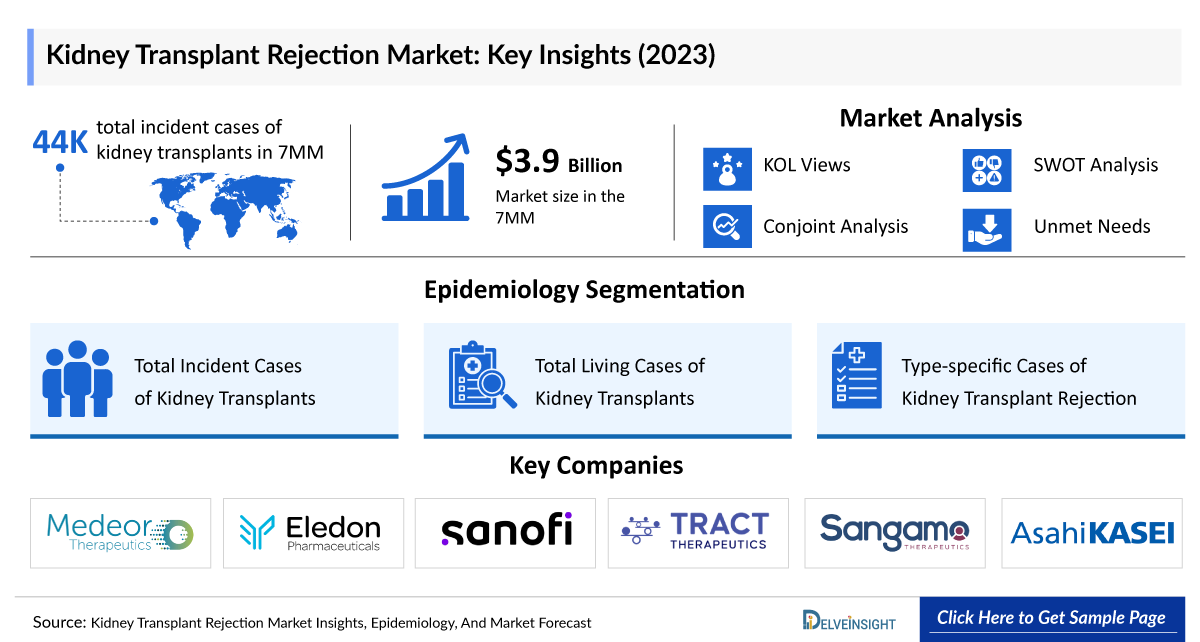
In 2023, the Kidney Transplant Rejection market was valued at approximately USD 3.97 billion, supported by about 44,000 kidney transplant procedures across the 7MM with the US accounting for 62% of cases. Rising prevalence of End-Stage Renal Disease (ESRD) and an increasing number of transplant procedures continue to fuel Kidney Transplant Rejection market expansion.
Current Standard Kidney Transplant Rejection Therapies
Existing prophylactic treatments such as ENVARSUS XR, IDEFIRIX, NULOJIX, THYMOGLOBULIN, MYHIBBIN, and SIMULECT play key roles in managing immune responses and preventing rejection.
Kidney Transplant Rejection Emerging Therapies & Key Companies
Next-generation treatments are reshaping the competitive landscape. Leading pipeline assets include MDR-101 (Medeor Therapeutics) in Phase III (expected US launch by 2026), tegoprubart (Eledon Pharmaceuticals), riliprubart (Sanofi), and TRK-001 (TRACT Therapeutics). These novel therapies aim to improve graft survival, minimize adverse effects, and address unmet needs in transplant care.
DelveInsight’s “Kidney Transplant Rejection Market Insights, Epidemiology, and Market Forecast – 2034” report delivers an in-depth understanding of kidney transplant rejection, historical and forecasted epidemiology, as well as the kidney transplant rejection therapeutics market trends in the United States, EU4 (Germany, France, Italy, and Spain) and the United Kingdom, and Japan.
Unlock key insights into the Kidney Transplant Rejection Market! Download DelveInsight’s comprehensive report to explore market trends, pipeline analysis, and emerging therapies @ Kidney Transplant Rejection Market Size
Key Takeaways from the Kidney Transplant Rejection Market Report
- In June 2025, Biogen announced a clinical trial is to evaluate the efficacy of felzartamab compared to placebo in kidney transplant recipients diagnosed with late active or chronic active AMR.
- In June 2025, Tract Therapeutics Inc. organized a Phase 2 trial is to determine the safety and efficacy of administering expanded regulatory T cells (TRK-001) to prevent allograft rejection in living donor renal transplant recipients.
- In 2023, there were an estimated 44 thousand total incident cases of kidney transplants across the 7MM, with the number expected to rise by 2034.
- According to DelveInsight’s estimates, there were approximately 27 thousand incident cases of kidney transplants across the US in 2023, with the number expected to rise by 2034.
- In 2023, the US reported approximately 2 thousand acute and 8 thousand chronic cases of kidney transplant rejection, with these numbers expected to increase by 2034.
- In 2023, among EU4 and the UK, the UK reported the highest number of living kidney transplants, with approximately 46 thousand instances, followed by France, with nearly 45 thousand cases. In contrast, Italy recorded the lowest, with around 28 thousand cases.
- In 2023, EU4 and the UK reported approximately 2 thousand acute and 4 thousand chronic cases of kidney transplant rejection. By 2034, these numbers are expected to increase to nearly 4 thousand acute cases and 7 thousand chronic cases.
- In 2023, Japan had approximately 2 thousand incident cases of kidney transplants. This number is projected to rise by 2034, growing at a CAGR of 0.7%.
- The leading Kidney Transplant Rejection Companies such as Amgen Inc, Amyndas Pharmaceuticals LLC, Astellas Pharma Inc, Bristol-Myers Squibb Co, Alphamab Oncology, AltruBio Inc, Cynata Therapeutics Ltd, Eledon Pharmaceuticals Inc, Enceladus Pharmaceuticals BV, Hansa Biopharma AB, Helocyte Bi, and others.
- Promising Kidney Transplant Rejection Pipeline Therapies such as Sonazoid, Belatacept, VIB4920, Thymoglobulin, AT-1501, Tacrolimus, Simulect, Belimumab and others.
Stay ahead in the competitive landscape of the Kidney Transplant Rejection Market. Access DelveInsight’s in-depth market analysis and strategic insights today! Click here for more @ Kidney Transplant Rejection Treatment Market Size
Kidney Transplant Rejection Epidemiology
In 2023, there were an estimated 44,000 kidney transplant cases across the 7 major markets (7MM), a number projected to rise by 2034. The United States accounted for about 27,000 cases, alongside 2,000 acute and 8,000 chronic kidney transplant rejection cases, both expected to increase over time.
Within EU4 and the UK, the UK recorded the highest number of living kidney transplants (~46,000), followed by France (~45,000), while Italy reported the lowest (~28,000). The region also saw around 2,000 acute and 4,000 chronic rejection cases in 2023, expected to reach 4,000 acute and 7,000 chronic cases by 2034.
In Japan, there were about 2,000 kidney transplants in 2023, with the number projected to grow modestly at a CAGR of 0.7% through 2034.
Kidney Transplant Rejection Epidemiology Segmentation in the 7MM
- Total Kidney Transplant Rejection Incident Cases
- Total Kidney Transplant Rejection Living Cases
- Kidney Transplant Rejection Type-specific Cases
Download the report to understand which factors are driving Kidney Transplant Rejection epidemiology trends @ Kidney Transplant Rejection Prevalence
Kidney Transplant Rejection Competitive Analysis
Marketed Kidney Transplant Rejection Prophylaxis Drugs
-
MYHIBBIN: Azurity Pharmaceuticals
MYHIBBIN, developed by Azurity Pharmaceuticals, is the first ready-to-use mycophenolate mofetil (MMF) oral suspension approved for preventing organ rejection in patients aged 3 months and older who have received allogeneic kidney, heart, or liver transplants. Approved by the US FDA in May 2024, MYHIBBIN is intended for use in combination with other immunosuppressive therapies. The product works by inhibiting inosine monophosphate dehydrogenase (IMPDH), a key enzyme in the de novo guanosine nucleotide synthesis pathway, leading to the suppression of T and B lymphocyte proliferation and cytokine production, which prevents graft rejection.
-
THYMOGLOBULIN: Sanofi
THYMOGLOBULIN, developed by Sanofi, is an immunosuppressive therapy derived from rabbit serum through immunization with human thymocytes. This purified, pasteurized IgG product targets T lymphocyte antigens and is designed for the prevention of acute kidney transplant rejection. Administered via intravenous infusion, it exerts therapeutic effects by clearing circulating T cells and modulating their activation, homing, and cytotoxic functions. Its mechanism includes targeting multiple T-cell markers, such as CD2, CD3, CD4, and HLA-DR, promoting immune suppression and reducing the risk of transplant rejection.
-
NULOJIX: Bristol Myers Squibb
NULOJIX (belatacept), developed by Bristol Myers Squibb, is a selective T-cell costimulation blocker approved for the prevention of organ rejection in adult kidney transplant recipients. Administered via intravenous infusion, NULOJIX is used alongside basiliximab induction, mycophenolate mofetil, and corticosteroids. Its mechanism of action involves targeting CD80 and CD86 on antigen-presenting cells, thereby preventing CD28-mediated T-cell activation, a key driver of immunologic rejection. This results in reduced T-cell proliferation and cytokine production, including interleukin-2 and TNF-a, mitigating the immune response in transplant rejection.
Emerging Kidney Transplant Rejection Drugs
-
MDR-101: Medeor Therapeutics
MDR-101, developed by Medeor Therapeutics, is an innovative cellular therapy derived from the blood and peripheral stem cells of a living kidney donor. The therapy is designed to induce donor-specific immune tolerance, effectively preventing kidney transplant rejection. By reprogramming the recipient’s immune system to accept the donor organ, MDR-101 eliminates the need for lifelong immunosuppressive drugs and their associated side effects, thereby enhancing transplant kidney function and long-term survival. Positive interim data from a Phase III trial, presented as a late-breaking oral presentation at the American Society of Nephrology (ASN) Kidney Week in November 2023, highlighted its potential as a breakthrough in transplantation medicine. MDR-101 has received ODD in both the US and EU. The clinical trial is being conducted under an FDA Special Protocol Assessment (SPA). In September 2020, the US FDA also granted Regenerative Medicine Advanced Therapy (RMAT) designation to MDR-101 for the prevention of kidney transplant rejection. Further, in January 2018, the California Institute for Regenerative Medicine (CIRM) awarded USD 18.8 million to support the Phase III clinical trial under its clinical trial funding initiative.
-
Tegoprubart (AT-1501): Eledon Pharmaceuticals
Tegoprubart, developed by Eledon Pharmaceuticals, is a humanized monoclonal antibody targeting the CD40L pathway, designed to prevent kidney transplant rejection by blocking the CD40-CD40L interaction. This innovative immunosuppressive therapy aims to replace traditional calcineurin inhibitors (CNIs), such as tacrolimus, potentially improving long-term graft survival and patient outcomes. In September 2024, Eledon completed enrollment for the Phase II BESTOW trial, four months ahead of schedule, with topline results anticipated in Q4 2025. Phase Ib trial data presented at the American Transplant Congress (ATC) in June 2024 demonstrated the drug’s safety and tolerability.
-
Riliprubart (BIVV020, SAR445088): Sanofi
Riliprubart, developed by Sanofi, is an IgG4 humanized monoclonal antibody under investigation for the treatment of Antibody-Mediated Rejection (AMR) in kidney transplants. The drug works by selectively inhibiting activated complement component C1s, a critical mediator of the inflammatory processes associated with AMR. Phase II clinical trials are currently underway to evaluate the efficacy and safety of Riliprubart in patients diagnosed with or at risk of AMR. Administered intravenously, Riliprubart represents a promising therapeutic approach to addressing AMR in kidney transplant recipients.
Discover the future of Kidney Transplant Rejection Treatments with DelveInsight's latest market report. Get expert insights and forecasts—download now! @ Kidney Transplant Rejection Market Drivers and Barriers
Kidney Transplant Rejection Market Outlook
Kidney transplant rejection is a major concern for recipients, as it can severely affect the long-term success and function of the transplanted organ. Rejection happens when the recipient’s immune system recognizes the donor kidney as foreign, prompting an immune response that damages the graft. There are two main types of rejection: Acute, which usually occurs within the first-year after transplantation, and chronic, which develops gradually over several years and is more prevalent. Chronic rejection is often associated with insufficient immunosuppression or non-compliance with medication regimens, leading to ongoing immune attacks that result in scarring and eventual loss of kidney function. Around 15–20% of transplant recipients experience some form of rejection, highlighting the importance of regular monitoring and strict adherence to immunosuppressive therapy to reduce this risk.
Kidney Transplant Rejection Market Analysis
Currently, a variety of medication approaches for kidney transplant rejection prophylaxis involve approved treatments that utilize different mechanisms of action to support long-term transplant success. These include ENVARSUS XR, IDEFIRIX, NULOJIX, THYMOGLOBULIN, MYHIBBIN, and SIMULECT, among others, all of which play a crucial role in managing immune responses and minimizing the risk of rejection. Kidney transplant rejection aims to manage immune responses, prevent further organ damage, and ensure long-term transplant success. Treatment involves a combination of immunosuppressive therapies, close monitoring, and supportive care to address acute and chronic rejection. Key goals include preserving graft function, reducing inflammation, minimizing complications, and improving the patient’s quality of life. Lifestyle adjustments, including dietary management and adherence to medication regimens, are essential for long-term success. While challenges remain, ongoing research is focused on advancing therapies to enhance graft survival and improve outcomes for transplant recipients.
Explore the dynamics of the Kidney Transplant Rejection Market with DelveInsight. From market size to emerging drugs - find it all in our latest report. Read now! @ Kidney Transplant Rejection Ongoing Clinical Trials Analysis
Scope of the Kidney Transplant Rejection Market Report
- Coverage- 7MM
- Study Period- 2020-2034
- Kidney Transplant Rejection Companies- Amgen Inc, Amyndas Pharmaceuticals LLC, Astellas Pharma Inc, Bristol-Myers Squibb Co, Alphamab Oncology, AltruBio Inc, Cynata Therapeutics Ltd, Eledon Pharmaceuticals Inc, Enceladus Pharmaceuticals BV, Hansa Biopharma AB, Helocyte Bi, and others.
- Kidney Transplant Rejection Pipeline Therapies- Sonazoid, Belatacept, VIB4920, Thymoglobulin, AT-1501, Tacrolimus, Simulect, Belimumab and others.
- Kidney Transplant Rejection Therapeutic Assessment: Kidney Transplant Rejection Current Marketed and Kidney Transplant Rejection Emerging Therapies
- Kidney Transplant Rejection Market Dynamics: Kidney Transplant Rejection market drivers and Kidney Transplant Rejection market barriers
- Kidney Transplant Rejection Unmet Needs, KOL’s views, Analyst’s views, Kidney Transplant Rejection Market Access and Reimbursement
Need more?
- ✅ Connect with our analyst to learn how this research was developed
- ✅ Expand the scope with additional segments or countries through free customization
- ✅ Discover how this report can directly influence your business growth
Related Reports

Kidney Transplant Rejection Market Insight, Epidemiology And Market Forecast - 2034
DelveInsight's Kidney Transplant Rejection Market Insights, Epidemiology, and Market Forecast-2032" report delivers an in-depth understanding of the Kidney Transplant Rejection, historical...

Kidney Transplant Rejection - Pipeline Insight, 2025
"Kidney Transplant Rejection Pipeline Insights, 2025" report by DelveInsight outlays comprehensive insights of present clinical development scenario and growth prospects across..
