Myasthenia Gravis Market size is Expected to grow at a CAGR of 10.4% by 2034
Get a Sneak Peek at the Latest myasthenia gravis market size and forecast Report
In 2024, the myasthenia gravis market size across the 7MM was valued at around USD 4,500 million and is expected to expand at a CAGR of 10.4% during the forecast period from 2025 to 2034. DelveInsight’s comprehensive market research provides critical insights into such market trends, enabling stakeholders to understand growth drivers, emerging opportunities, and potential challenges within the Myasthenia Gravis landscape.
In 2024, the myasthenia gravis market in the US was valued at approximately USD 2,900 million and is expected to grow further with the introduction of emerging therapies. The combined market size of the EU4 and the UK was about USD 1,200 million in 2024, accounting for nearly 27% of the total 7MM revenue, and is projected to rise by 2034. Within the EU4 and the UK, Germany led the market with around USD 400 million, followed by France at approximately USD 300 million and Italy at about USD 200 million. In Japan, the market size was estimated at roughly USD 350 million in 2024 and is anticipated to expand throughout the forecast period (2025–2034).
According to DelveInsight’s estimates, there were around 310,000 diagnosed prevalent cases of myasthenia gravis across the 7MM in 2024. In the US, approximately 137,000 individuals were living with the condition, a figure projected to rise by 2034 owing to better disease awareness and diagnostic improvements. Within the EU4 and the UK, Germany reported the highest number of diagnosed cases at about 37,000, while Spain had the fewest, with roughly 14,000 cases in 2024.
In 2024, within the EU4 and the UK, mild generalized myasthenia gravis (Class II) was the most common form, affecting around 50,000 individuals. This was followed by ocular myasthenia gravis (Class I) with over 45,000 cases and moderate generalized (Class III) with more than 28,000 cases. Severe gMG (Class IV) was observed in approximately 7,000 individuals, while the most critical stage, Class V (requiring intubation), affected over 2,000 patients. This distribution underscores the dominance of milder forms and highlights the need for early diagnosis and timely intervention to prevent disease progression.
In Japan, as of 2024, the antibody serology profile of patients with generalized myasthenia gravis (gMG) indicated that around 19,000 were positive for anti-AChR antibodies, approximately 1,000 for anti-MuSK antibodies, and nearly 2,000 were double seronegative, including individuals with anti-LRP4, anti-agrin, or other rare antibodies.
In 2024, females represented about 52% of diagnosed myasthenia gravis cases in Germany, while males accounted for 48%, reflecting a slight yet consistent gender difference, with a higher prevalence observed among women.
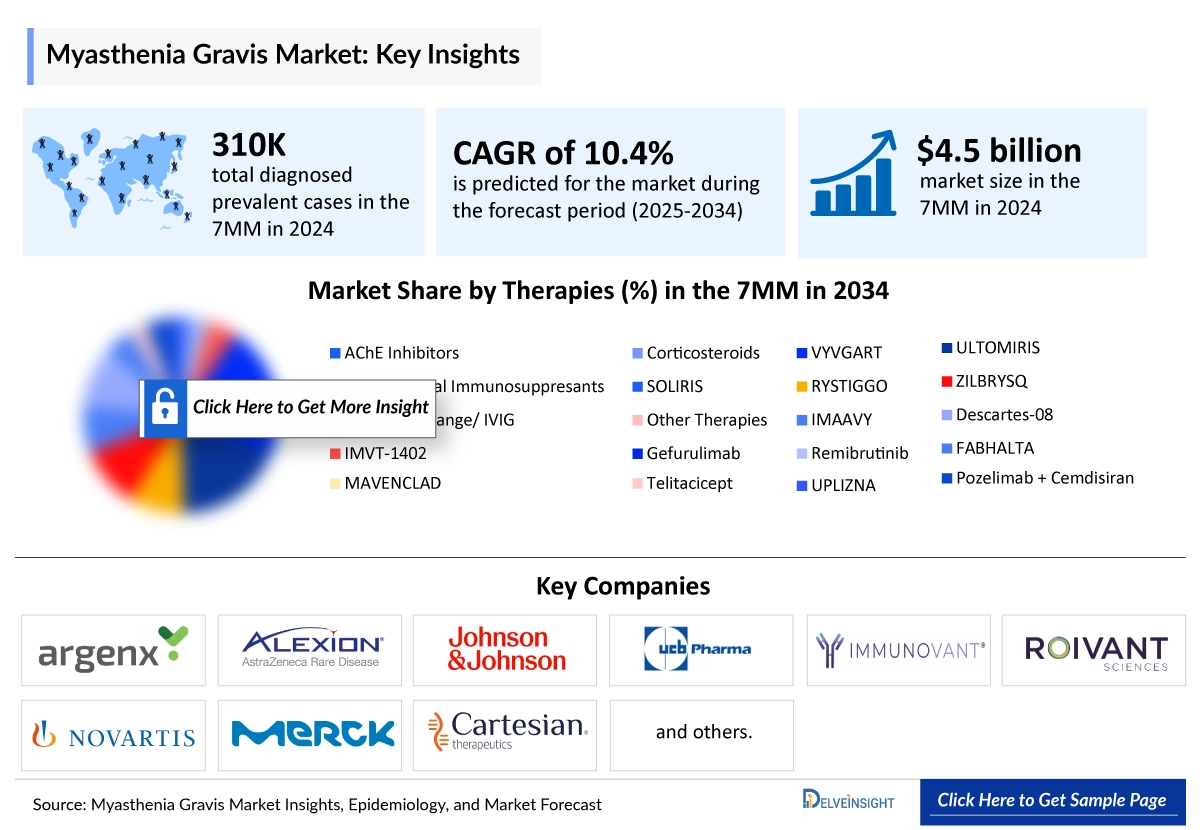
DelveInsight’s report “Myasthenia Gravis Market Insights, Epidemiology, and Market Forecast-2034,” provides a comprehensive analysis of the Myasthenia Gravis landscape. The report delivers detailed insights into the disease, including historical and projected epidemiology, helping stakeholders understand the prevalence, incidence, and patient demographics across key regions
To Know in detail about the Myasthenia Gravis market outlook, drug uptake, treatment scenario and epidemiology trends, Click here; Myasthenia Gravis Market Forecast
Some of the key facts of the Myasthenia Gravis Market Report:
- A range of targeted therapies has transformed myasthenia gravis treatment, including Neonatal Fc Receptor (FcRn) inhibitors like RYSTIGGO, VYVGART, VYVGART HYTRULO/VYVDURA, IMAAVY; complement inhibitors such as SOLIRIS and ULTOMIRIS and the Complement C5 inhibitor ZILBRYSQ. These advances reflect a shift toward precision immunotherapy and improved patient outcomes.
- Key Myasthenia Gravis Companies: Alexion, AstraZeneca, Argenx, Novartis, Alpine Immune Science, Toleranzia, Cabaletta Bio, Rallybio, Alexion Pharmaceuticals, Takeda, Cartesian Therapeutics, RemeGen, Horizon Therapeutics and others
- Key Myasthenia Gravis Therapies: ULTOMIRIS (ravulizumab), VYVGART (efgartigimod alfa-fcab), Gefurulimab (ALXN-1720), FABHALTA (Iptacopan), Povetacicept, TOL 2, MuSK-CAART, RLYB116, ALXN2050, TAK-079, Descartes-08, Telitacicept, Inebilizumab, and others
- The Myasthenia Gravis market is expected to surge due to the disease's increasing prevalence and awareness during the forecast period. Furthermore, launching various multiple-stage Myasthenia Gravis pipeline products will significantly revolutionize the Myasthenia Gravis market dynamics.
Myasthenia Gravis Overview
Myasthenia gravis (MG) is a chronic autoimmune neuromuscular disorder characterized by weakness and fatigue of voluntary muscles. It occurs when the body's immune system mistakenly attacks and damages the communication between nerve cells and muscles, specifically at the neuromuscular junction.
Get a Free sample for the Myasthenia Gravis Market Forecast, Size & Share Analysis Report:
https://www.delveinsight.com/report-store/myasthenia-gravis-market
Myasthenia Gravis Epidemiology
The epidemiology section provides insights into the historical, current, and forecasted epidemiology trends in the seven major countries (7MM) from 2020 to 2034. It helps to recognize the causes of current and forecasted trends by exploring numerous studies and views of key opinion leaders. The epidemiology section also provides a detailed analysis of the diagnosed patient pool and future trends.
Myasthenia Gravis Epidemiology Segmentation:
The Myasthenia Gravis market report proffers epidemiological analysis for the study period 2020–2034 in the 7MM segmented into:
- Total Diagnosed Prevalent Cases of Myasthenia Gravis in the 7MM
- Gender-specific Diagnosed Prevalent Cases of Myasthenia Gravis in the 7MM
- Age-specific Diagnosed Prevalent Cases of Myasthenia Gravis in the 7MM
- Diagnosed Prevalent Cases of Myasthenia Gravis by MGFA Classification in the 7MM
- Diagnosed Prevalent Cases of Generalized Myasthenia Gravis by Antibody Serology in the 7MM
Download the report to understand which factors are driving Myasthenia Gravis epidemiology trends @ Myasthenia Gravis Epidemiology Forecast
Recent Developments In The Myasthenia Gravis Treatment Landscape:
- In January 2026, argenx SE (Euronext & Nasdaq: ARGX), a global immunology company committed to improving the lives of people suffering from severe autoimmune diseases, today announced that the U.S. Food and Drug Administration (FDA) has accepted for priority review a supplemental Biologics License Application (sBLA) for VYVGART® (IV: efgartigimod alfa-fcab) for the treatment of adults with acetylcholine receptor antibody (AChR-Ab) seronegative generalized myasthenia gravis (gMG). The application has been granted a Prescription Drug User Fee Act (PDUFA) target action date of May 10, 2026.
- In December 2025, Amgen (NASDAQ:AMGN) today announced that the U.S. Food and Drug Administration (FDA) has approved UPLIZNA® (inebilizumab-cdon) for the treatment of generalized myasthenia gravis (gMG) in adults who are anti-acetylcholine receptor (AChR) and anti-muscle specific tyrosine kinase (MuSK) antibody positive. The approval offers patients a new targeted treatment option that has the potential for long-term disease control with just two doses a year, after two initial loading doses.
- In October 2025, Johnson & Johnson (NYSE: JNJ) announced plans to launch the first head-to-head clinical trial comparing FcRn inhibitors in patients with generalized myasthenia gravis (gMG), with the goal of positioning IMAAVY™ (nipocalimab-aahu) as a preferred FcRn therapy. Details from the EPIC study design and Vibrance-MG Phase 2/3 LTE data were among 38 abstracts presented at the 2025 MGFA Scientific Session and AANEM Annual Meeting.
- Also in October 2025, COUR Pharma revealed that the US FDA granted Orphan Drug Designation (ODD) to CNP-106, its investigational antigen-specific immune tolerance therapy for gMG.
- In August 2025, Kyverna Therapeutics announced a virtual KOL event focused on its neuroimmunology CAR-T platform for stiff person syndrome and myasthenia gravis.
- In June 2025, the Food and Drug Administration (FDA) approved darolutamide (Nubeqa, Bayer Healthcare Pharmaceuticals Inc.) for metastatic castration-sensitive prostate cancer (mCSPC). The FDA previously approved darolutamide in combination with docetaxel for mCSPC.
- In May 2025, The FDA approved a new therapy for generalized myasthenia gravis (gMG), a condition characterized by severe muscle weakness, rapid fatigue, and challenges with speech and swallowing. This new treatment, called nipocalimab and marketed as Imaavy, provides a long-lasting option for symptom management, benefiting approximately 100,000 people affected by gMG in the U.S. It is the first and only therapy designed to address the underlying cause of the disease in adults and adolescents aged 12 and older who possess specific antibodies associated with gMG.
- In April 2025, Nipocalimab-aahu is a human IgG1 monoclonal antibody designed to target the neonatal Fc receptor (FcRn) with high affinity, thereby reducing circulating IgG levels. Its approval was supported by results from the Phase 3 Vivacity-MG3 trial (ClinicalTrials.gov ID: NCT04951622), a randomized, double-blind, placebo-controlled study. The trial involved adult patients with generalized myasthenia gravis (gMG), classified as class II to IV by the Myasthenia Gravis Foundation of America, who had an inadequate response to standard therapies, indicated by an MG-ADL score of 6 or above.
- In April 2025, Promising results from the Phase 3 clinical trial (NCT05737160) assessing the safety and efficacy of Telitacicept (RC18; brand name: 泰爱®) in patients with generalized myasthenia gravis (gMG) were shared during the Late-Breaking Science Session at the 2025 American Academy of Neurology (AAN) Annual Meeting.
- In April 2025, Cartesian Therapeutics, Inc. (NASDAQ: RNAC), a clinical-stage biotech company focused on developing cell therapies for autoimmune disorders, has reported 12-month efficacy and safety results from its Phase 2b trial of Descartes-08 in patients with generalized myasthenia gravis (MG). Patients who received a single six-week treatment course of Descartes-08 showed sustained improvement in MG symptoms, which persisted through the 12-month follow-up evaluation.
- In March 2025, Immunovant decided not to pursue regulatory approval for its myasthenia gravis (MG) treatment, batoclimab, despite the Phase III study meeting its primary endpoint of reducing disease symptoms. Instead, the company will leverage the data to further develop its alternative therapy, IMVT-1402. The Phase III randomized trial (NCT05403541) assessed the impact of weekly or bi-monthly doses of batoclimab on acetylcholine receptor antibody-positive (AChR+) patients, using the Myasthenia Gravis Activities of Daily Living (MG-ADL) score over a 12-week period.
- In December 2024, Cartesian Therapeutics revealed updated efficacy and safety data from the Phase IIb trial of its mRNA cell therapy candidate, Descartes-08, for generalized myasthenia gravis (MG). The results showed sustained responses at the 12-month mark. The double-blind, placebo-controlled, crossover trial (NCT06038474) was open-label and involved 36 heavily pre-treated, symptomatic patients. Half of the participants received a placebo, while the other half were treated with Descartes-08, both administered as six weekly outpatient infusions without prior chemotherapy preconditioning.
Myasthenia Gravis Drugs Uptake and Pipeline Development Activities
The drugs uptake section focuses on the rate of uptake of the potential drugs recently launched in the Myasthenia Gravis market or expected to get launched during the study period. The analysis covers Myasthenia Gravis market uptake by drugs, patient uptake by therapies, and sales of each drug.
Moreover, the therapeutics assessment section helps understand the drugs with the most rapid uptake and the reasons behind the maximal use of the drugs. Additionally, it compares the drugs based on market share.
The report also covers the Myasthenia Gravis Pipeline Development Activities. It provides valuable insights about different therapeutic candidates in various stages and the key companies involved in developing targeted therapeutics. It also analyzes recent developments such as collaborations, acquisitions, mergers, licensing patent details, and other information for emerging therapies.
Myasthenia Gravis Therapies and Key Companies
- ULTOMIRIS (ravulizumab): Alexion: AstraZeneca Rare Disease
- VYVGART (efgartigimod alfa-fcab): Argenx
- Gefurulimab (ALXN-1720): Alexion, AstraZeneca Rare Disease
- FABHALTA (Iptacopan): Novartis
- Tolebrutinib: Sanofi
- Descartes-08: Cartesian Therapeutics
- Mezagitamab (TAK-079): Takeda
- DAS-001: DAS Therapeutics, Inc.
- Rozanolixizumab: UCB Biopharma
- Zilucoplan: UCB Biopharma
- Subcutaneous Efgartigimod: Argenx-Halozyme Therapeutics
- Uplizna (Inebilizumab): Horizon Therapeutics
- Enspryng (Satralizumab): Hoffmann-La Roche
- Nipocalimab: Janssen Research & Development, LLC
- Batoclimab: Immunovant Sciences GmbH
Discover more about therapies set to grab major Myasthenia Gravis market share @ Myasthenia Gravis Treatment Landscape
Myasthenia Gravis Market Strengths
- The growing prevalence of myasthenia gravis (MG) and the geriatric population offers a stable market demand for treatments and therapies.
- Myasthenia gravis treatments may qualify for orphan drug status, offering regulatory incentives, such as extended market exclusivity and tax benefits.
Myasthenia Gravis Market Opportunities
- Potential for developing new, more effective therapies, such as gene therapy or targeted biologics, could address unmet medical needs.
- Improved diagnostic techniques using clear biomarkers and an increase in awareness will likely lead to a diagnosis of more patients, expanding the market.
Scope of the Myasthenia Gravis Market Report
- Study Period: 2020-2034
- Coverage: 7MM Countries
- Key Myasthenia Gravis Companies: Alexion, AstraZeneca, Argenx, Novartis, Alpine Immune Science, Toleranzia, Cabaletta Bio, Rallybio, Alexion Pharmaceuticals, Takeda, Cartesian Therapeutics, RemeGen, Horizon Therapeutics, and others
- Key Myasthenia Gravis Therapies: ULTOMIRIS (ravulizumab), VYVGART (efgartigimod alfa-fcab), Gefurulimab (ALXN-1720), FABHALTA (Iptacopan), Povetacicept, TOL 2, MuSK-CAART, RLYB116, ALXN2050, TAK-079, Descartes-08, Telitacicept, Inebilizumab, and others
- Myasthenia Gravis Therapeutic Assessment: Myasthenia Gravis current marketed and Myasthenia Gravis emerging therapies
- Myasthenia Gravis Market Dynamics: Myasthenia Gravis market drivers and Myasthenia Gravis market barriers
- Competitive Intelligence Analysis: SWOT analysis, PESTLE analysis, Porter’s five forces, BCG Matrix, Market entry strategies
- Myasthenia Gravis Unmet Needs, KOL’s views, Analyst’s views, Myasthenia Gravis Market Access and Reimbursement
To know more about Myasthenia Gravis companies working in the treatment market, visit @ Myasthenia Gravis Clinical Trials and Therapeutic Assessment
Need more?
- ✅ Connect with our analyst to learn how this research was developed
- ✅ Expand the scope with additional segments or countries through free customization
- ✅ Discover how this report can directly influence your business growth
Related Reports

Myasthenia Gravis - Pipeline Insight, 2025
Myasthenia Gravis Pipeline Insights, 2025 report by DelveInsight outlays comprehensive insights of present clinical development scenario and growth prospects across

Myasthenia Gravis - Epidemiology Forecast - 2034
Myasthenia Gravis Epidemiology Forecast report delivers an in-depth understanding of the disease, historical, and forecasted epidemiology of Myasthenia Gravis in the 7MM
