
Healthcare Analytics Market Summary
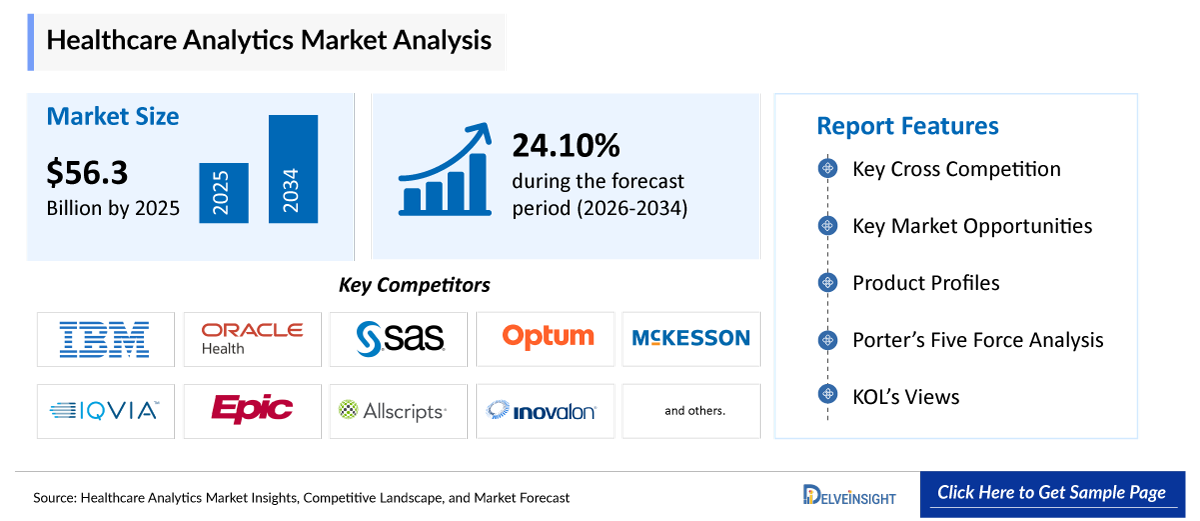
- The global healthcare analytics market is expected to increase from USD 56,307.08 million in 2025 to USD 389,934.24 million by 2034, reflecting strong and sustained growth.
- The global healthcare analytics market is growing at a CAGR of 24.10% during the forecast period from 2026 to 2034.
Healthcare Analytics Market Trends & Insights
- The healthcare analytics market is primarily driven by the rapid adoption of electronic health records, which generate large volumes of patient data requiring advanced analysis. The rising prevalence of chronic diseases such as diabetes, cardiovascular diseases, and cancer is increasing the need for data-driven decision-making and personalized treatment. Additionally, the growing shift toward value-based care, advancements in artificial intelligence and machine learning, and the surge in healthcare costs are encouraging providers to adopt analytics solutions for improving efficiency and outcomes. The expansion of big data from sources like wearables, telehealth, and clinical trials, along with supportive government initiatives for digital health, is further accelerating market growth.
- The leading companies operating in the healthcare analytics market include IBM Corporation, Oracle Health, SAS Institute, Optum, McKesson Corporation, IQVIA, Epic Systems, Allscripts, Inovalon, Arcadia, Microsoft, Koninklijke Philips N.V., GE Healthcare, Tableau, MedeAnalytics, Siemens Healthineers, Verisk Analytics, CitiusTech, Datavant, Cloudera, and others.
- North America is expected to dominate the healthcare analytics market due to its highly advanced healthcare IT infrastructure and widespread adoption of Electronic Health Records across healthcare systems. The region benefits from the strong presence of leading analytics providers, high healthcare spending, and early adoption of advanced technologies such as AI and big data analytics. Additionally, supportive government initiatives promoting digital health, along with the growing focus on value-based care and data-driven decision-making, further contribute to the region’s market leadership.
- In the component segment of the healthcare analytics market, the software category is estimated to account for the largest market share in 2025.
Request for unlocking the report of the @ Healthcare Analytics Market
Healthcare Analytics Market Size and Forecasts | |
|
Report Metrics |
Details |
|
2025 Market Size |
USD 56,307.08 million |
|
2034 Projected Market Size |
USD 389,934.24 million |
|
Growth Rate (2026-2034) |
24.10% CAGR |
|
Largest Market |
North America |
|
Fastest Growing Market |
Asia-Pacific |
|
Market Structure |
Moderately Concentrated |
Factors Contributing to the Growth of the Healthcare Analytics Market
Rising adoption of Electronic Health Records (EHRs)
The rising adoption of Electronic Health Records is significantly boosting the healthcare analytics market by generating large volumes of structured and unstructured patient data. This data serves as a foundation for analytics platforms to derive actionable insights, improve clinical decision-making, and enhance patient outcomes. Additionally, EHRs enable real-time data access and integration across healthcare systems, allowing providers to optimize operations, reduce errors, and support value-based care initiatives, thereby accelerating the demand for advanced analytics solutions.
The growing burden of chronic diseases is escalating the market of healthcare analytics
The growing burden of chronic diseases, such as diabetes, cardiovascular diseases, and cancer, is significantly escalating the healthcare analytics market. The increasing number of long-term patients generates vast amounts of clinical and treatment data, creating a strong need for analytics tools to enable early diagnosis, risk prediction, and personalized care. Additionally, healthcare providers use analytics to monitor disease progression, reduce hospital readmissions, and improve patient outcomes, thereby driving the adoption of advanced analytics solutions.
Increase in technological advancement and product development activities
The increase in technological advancements and product development activities is significantly boosting the healthcare analytics market by enabling more efficient and accurate data processing. Innovations in artificial intelligence, machine learning, cloud computing, and big data platforms are enhancing the capabilities of analytics solutions, allowing real-time insights, predictive modeling, and improved clinical decision support. Additionally, continuous product launches and upgrades by key players are expanding the functionality and accessibility of analytics tools, encouraging healthcare providers and payers to adopt advanced solutions for better patient outcomes and operational efficiency.
Healthcare Analytics Market Report Segmentation
This Healthcare Analytics market report offers a comprehensive overview of the global Healthcare Analytics market, highlighting key trends, growth drivers, challenges, and opportunities. It covers detailed market segmentation by Component (Software, Hardware, and Services), Deployment Mode (Cloud-based, On-premises, and Hybrid), Application (Clinical Analytics, Financial Analytics, Operational & Administrative Analytics, and Others), Type (Descriptive Analytics, Predictive Analytics, and Prescriptive Analytics), End-Users (Payers, Providers, and Others), and geography. The report provides valuable insights into the competitive landscape, regulatory environment, and market dynamics across major markets, including North America, Europe, and Asia-Pacific. Featuring in-depth profiles of leading industry players and recent product innovations, this report equips businesses with essential data to identify market potential, develop strategic plans, and capitalize on emerging opportunities in the rapidly growing healthcare analytics market.
The healthcare analytics market is primarily driven by the rapid adoption of Electronic Health Records, which are generating vast volumes of structured and unstructured patient data that require advanced tools for meaningful interpretation. The rising prevalence of chronic diseases such as Diabetes, Cardiovascular Diseases, and Cancer is further increasing the demand for data-driven decision-making, enabling early diagnosis, risk prediction, and personalized treatment approaches. In addition, the ongoing shift toward value-based care models is pushing healthcare providers to focus on improving patient outcomes while controlling costs, thereby accelerating the adoption of analytics solutions.
Technological advancements in artificial intelligence, machine learning, and cloud computing are enhancing the capabilities of healthcare analytics platforms by enabling real-time insights, predictive modeling, and automation of complex clinical and operational processes. At the same time, rising healthcare expenditures are compelling organizations to adopt analytics tools for cost optimization, fraud detection, and efficient resource utilization. Furthermore, the expansion of big data from sources such as wearable devices, telehealth platforms, and clinical trials is significantly increasing the need for scalable analytics systems. Supportive government initiatives promoting digital health transformation and interoperability are also playing a crucial role in encouraging widespread adoption, ultimately driving sustained market growth.
Get More Insights into the Report @ Healthcare Analytics Market
What are the latest Healthcare Analytics market dynamics and trends?
The healthcare analytics market is witnessing robust growth, primarily driven by the increasing adoption of electronic health records (EHRs), the rising prevalence of chronic diseases, and the ongoing shift toward value-based care models. These factors are collectively transforming healthcare systems into data-driven ecosystems, thereby accelerating the demand for advanced analytics solutions.
A key growth driver is the widespread adoption of Electronic Health Records, which has significantly enhanced the availability of real-time, structured, and interoperable patient data. This data serves as the foundation for advanced analytics, enabling healthcare providers to generate actionable clinical and operational insights. Recent industry developments further underscore this trend. For instance, in June 2025, AdvancedMD introduced its 2025 Summer Product Release, incorporating enhanced navigation workflows and artificial intelligence (AI)-driven automation across its integrated EHR and practice management platform. Such advancements highlight how EHR systems are evolving beyond data storage tools into intelligent platforms that actively support clinical decision-making and workflow optimization. As EHR systems become increasingly AI-enabled and interoperable, they are expected to play a pivotal role in driving the adoption of healthcare analytics by improving patient outcomes and operational efficiency.
In parallel, the growing burden of chronic diseases, including diabetes, cancer, and cardiovascular conditions, is significantly contributing to market expansion. According to the International Diabetes Federation (2025), approximately 590 million people globally were living with diabetes, with projections indicating a rise to 853 million by 2050. The management of such chronic conditions involves continuous monitoring of patient parameters, treatment adherence, and lifestyle factors, generating vast and complex datasets. Healthcare analytics platforms leverage this data to enable early risk detection, personalized treatment strategies, and real-time patient monitoring. Furthermore, the increasing prevalence of chronic diseases is placing substantial pressure on healthcare systems to reduce costs and improve care quality, thereby accelerating the adoption of analytics for population health management and resource optimization.
Another important growth catalyst is the rising pace of product innovation and technological advancements in the healthcare analytics space. Companies are increasingly focusing on integrating AI and machine learning capabilities to deliver more accurate, real-time, and transparent insights. For example, in August 2025, Komodo Health launched “Marmot,” an AI-powered analytics engine designed to provide real-time insights for healthcare and life sciences stakeholders. Such innovations are enhancing the scalability and usability of analytics platforms, further supporting market growth.
Despite these positive trends, the market faces notable challenges related to data privacy, security, and regulatory compliance. Stringent regulations governing patient data protection, such as HIPAA in the United States and GDPR in Europe, impose strict requirements on data collection, storage, and sharing. Additionally, the increasing incidence of cyberattacks and data breaches has heightened concerns around data confidentiality and trust. These factors contribute to increased implementation complexity, higher costs, and longer deployment timelines, particularly for small and mid-sized healthcare providers. As a result, regulatory and security challenges continue to act as key restraints, potentially slowing the pace of adoption of healthcare analytics solutions.
Overall, the convergence of digital health infrastructure, rising disease burden, and AI-driven innovation is expected to drive sustained growth in the healthcare analytics market during the forecast period from 2026 to 2034.
Healthcare Analytics Market Segment Analysis
Healthcare Analytics Market by Component (Software, Hardware, and Services), Deployment Mode (Cloud-based, On-premises, and Hybrid), Application (Clinical Analytics, Financial Analytics, Operational & Administrative Analytics, and Others), Type (Descriptive Analytics, Predictive Analytics, and Prescriptive Analytics), End-Users (Payers, Providers, and Others), and Geography (North America, Europe, Asia-Pacific, and Rest of the World)
Healthcare Analytics Market By Component: Software Category is Projected to Register the Highest Revenue Share
In the component segment of the healthcare analytics market, the software category is projected to dominate, accounting for approximately 60.31% of the market share in 2025. This dominance is primarily attributed to the critical role software solutions play as the backbone of healthcare analytics, enabling the efficient collection, integration, and analysis of vast volumes of complex healthcare data generated from diverse sources, including electronic health records (EHRs), medical devices, laboratory information systems, and claims databases.
Healthcare analytics software encompasses a wide range of solutions, such as clinical analytics platforms, predictive and prescriptive analytics tools, population health management systems, and business intelligence dashboards. These tools empower healthcare providers, payers, and life sciences companies to derive actionable insights that support improved patient outcomes, cost optimization, and data-driven strategic decision-making. The increasing reliance on data-centric healthcare delivery models is further reinforcing the demand for advanced analytics software.
A key factor accelerating growth in this segment is the rising adoption of artificial intelligence (AI) and machine learning (ML)-enabled software. These advanced capabilities enable predictive modeling, early disease detection, risk stratification, and real-time clinical decision support, thereby enhancing both clinical and operational efficiency. In addition, the growing shift toward cloud-based deployment models is further strengthening the software segment, as cloud-enabled solutions offer scalability, cost efficiency, seamless updates, and improved interoperability across healthcare systems, while also supporting remote access and collaborative data sharing.
Continuous innovation and product development by key market players are also contributing significantly to segment growth. Vendors are increasingly integrating advanced features such as AI-driven analytics, enhanced data visualization, and automated reporting functionalities to improve usability and decision-making capabilities. For instance, in April 2025, MedeAnalytics launched its “Health Fabric” analytics platform powered by Snowflake’s AI Data Cloud, aimed at enabling predictive analytics and advanced data enrichment across healthcare organizations.
Furthermore, healthcare analytics software plays a pivotal role in enabling value-based care models, population health management, and real-world evidence generation—areas that are gaining increasing importance among healthcare providers and regulatory bodies globally. As healthcare systems continue to transition toward outcome-based and data-driven frameworks, the demand for robust and scalable analytics software is expected to rise significantly.
Overall, the software component not only leads the healthcare analytics market in terms of revenue but also serves as a key enabler of digital transformation in healthcare, and is expected to maintain its dominant position throughout the forecast period.
Healthcare Analytics Market By Deployment Mode: Cloud-based Category Dominates the Market
In the deployment mode segment of the healthcare analytics market, the cloud-based category is estimated to account for the largest share, approximately 60.21% in 2025. This dominance is primarily driven by its ability to offer scalable, flexible, and cost-effective solutions that align with the growing need for real-time data access and interoperability across healthcare systems.
Cloud-based healthcare analytics platforms enable healthcare providers, payers, and life sciences companies to efficiently store, manage, and process vast volumes of structured and unstructured data generated from diverse sources, including electronic health records (EHRs), wearable devices, laboratory systems, and medical imaging equipment. These platforms support advanced analytics capabilities such as predictive modeling, population health management, risk stratification, and real-time clinical decision support, without the need for extensive on-premises infrastructure.
A key factor accelerating adoption is the integration of artificial intelligence (AI) and machine learning (ML) within cloud environments, which enhances the ability to generate faster and more accurate insights. Additionally, cloud deployment facilitates seamless collaboration among multiple stakeholders, enabling secure data sharing and improving care coordination. Advanced security frameworks, including encryption protocols and role-based access controls, further ensure compliance with stringent data protection regulations.
Technological advancements such as hybrid cloud architectures and AI-enabled analytics platforms have significantly improved processing speed, scalability, and accessibility. These innovations allow healthcare organizations to derive actionable insights more efficiently while maintaining operational agility. Moreover, the cloud model reduces upfront capital expenditure and ongoing maintenance costs compared to traditional on-premises systems, making it particularly attractive for small and mid-sized healthcare providers.
Furthermore, the increasing adoption of telehealth and decentralized care models has amplified the need for remote data accessibility, further strengthening the case for cloud-based deployment. Supportive regulatory frameworks and growing confidence in secure cloud infrastructure are also contributing to its widespread adoption.
Overall, the cloud-based deployment model is emerging as a critical enabler of digital transformation in healthcare analytics, driving market growth by delivering enhanced scalability, improved data accessibility, and cost efficiency, while supporting advanced, data-driven decision-making.
Healthcare Analytics Market By Application: Financial Analytics Category Dominates the Market
In the application segment of the healthcare analytics market, the financial analytics category plays a dominant role, accounting for approximately 41.32% of the market share in 2025. This leadership position is driven by its critical contribution to optimizing revenue cycle management, reducing operational costs, and enhancing overall financial performance across healthcare organizations.
Financial analytics solutions enable healthcare providers, payers, and life sciences companies to analyze large volumes of financial data, including claims, billing, and reimbursement records. These tools help identify inefficiencies, minimize claim denials, detect fraudulent activities, and improve cash flow management. As a result, organizations are better equipped to streamline financial operations while aligning with value-based care models.
Recent product innovations further highlight the growing importance of this segment. For instance, in May 2025, Optum expanded its analytics portfolio with advanced revenue cycle and financial performance modules aimed at improving billing efficiency and reducing claim denials. Similarly, in August 2025, SAS Institute introduced an AI-driven financial analytics solution specifically designed for healthcare payers, focusing on enhancing fraud detection, improving claims accuracy, and enabling more precise cost forecasting.
Moreover, financial analytics tools provide both historical and real-time insights, allowing organizations to make informed budgeting decisions, optimize resource allocation, and improve financial planning. The increasing complexity of reimbursement frameworks, rising healthcare expenditures, and stringent regulatory requirements are further accelerating the demand for robust financial analytics solutions that ensure compliance while maintaining profitability.
An additional advantage lies in the integration of financial analytics with clinical and operational data, enabling a more holistic approach to decision-making. This integrated perspective allows healthcare stakeholders to align financial performance with patient outcomes and operational efficiency.
Overall, financial analytics has emerged as a critical application area within the healthcare analytics market, significantly contributing to market growth by enabling data-driven financial management, improving operational transparency, and supporting sustainable healthcare delivery models.
Healthcare Analytics Market By Type: Descriptive Analytics Category Dominates the Market
In the type segment of the healthcare analytics market, descriptive analytics holds the dominant position, accounting for approximately 47.32% of the market share in 2025. This leadership is primarily driven by its fundamental role in enabling healthcare organizations to interpret and derive value from vast volumes of historical and real-time data.
Descriptive analytics focuses on summarizing past events and operational trends, such as patient admissions, treatment outcomes, resource utilization, and financial performance, into clear, actionable insights through dashboards, reports, and data visualizations. These capabilities allow healthcare providers, payers, and administrators to understand what has occurred within their systems, identify patterns, and support informed decision-making across clinical, operational, and financial domains.
The rapid adoption of digital health technologies, including electronic health records (EHRs), wearable devices, and telehealth platforms, is significantly fueling demand for descriptive analytics. As healthcare data becomes increasingly complex and voluminous, organizations require efficient tools to organize, process, and visualize this information in an accessible and meaningful way. Descriptive analytics addresses this need by offering immediate, easy-to-interpret insights without the complexity associated with more advanced analytical models.
Additionally, descriptive analytics serves as the foundation for higher-level analytics, such as predictive and prescriptive analytics, by structuring and standardizing data for deeper analysis. Healthcare organizations are increasingly relying on these solutions to monitor key performance indicators (KPIs), track quality metrics, ensure regulatory compliance, and optimize operational workflows.
Its widespread adoption is further supported by its cost-effectiveness, ease of implementation, and ability to deliver quick insights, making it particularly valuable for hospitals, clinics, and payer organizations. Overall, descriptive analytics remains a critical component of the healthcare analytics ecosystem, driving market growth by enabling data-driven decision-making and operational transparency across the healthcare value chain.
Healthcare Analytics Market By End-Users: Payers Category Dominates the Market
In the end-user segment of the healthcare analytics market, payers are significantly boosting growth by leveraging analytics solutions to optimize claims processing, manage risk, control costs, and improve member outcomes. By analyzing large volumes of claims, utilization, and patient data, payers can detect fraud, identify high-risk populations, and design value-based care programs. The increasing complexity of reimbursement models, rising healthcare costs, and regulatory requirements are driving payers to adopt advanced analytics tools, making them one of the key contributors to the expansion of the healthcare analytics market.
Healthcare Analytics Market Regional Analysis
North America Healthcare Analytics Market Trends
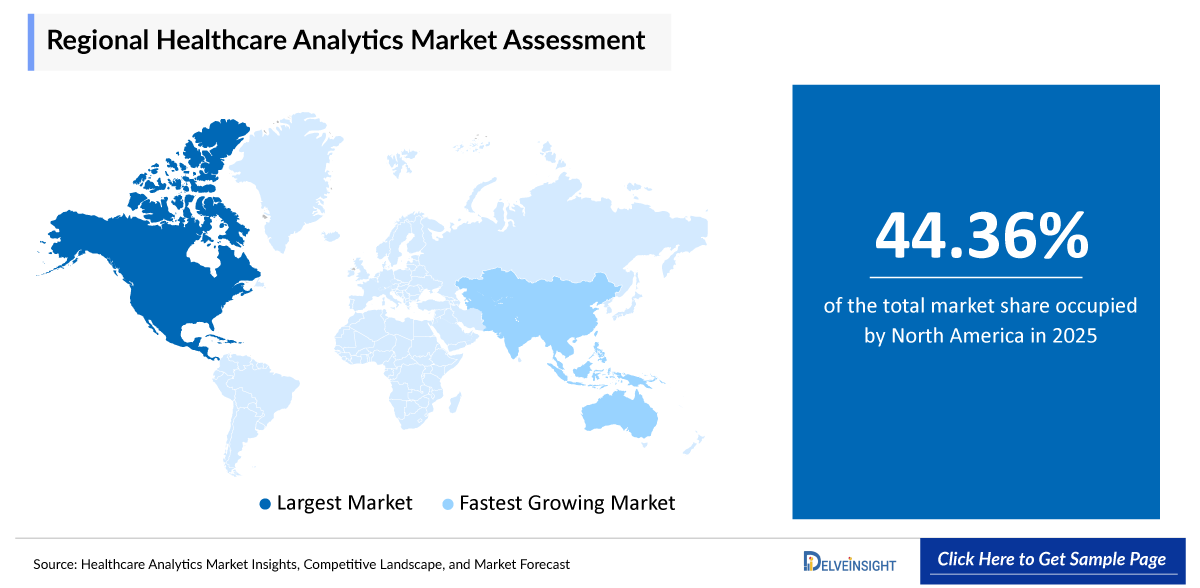
North America is expected to account for the largest share of the healthcare analytics market, contributing approximately 44.36% in 2025. This dominance is primarily attributed to the region’s highly advanced healthcare IT infrastructure, widespread adoption of Electronic Health Records (EHRs), and strong presence of leading analytics solution providers. Additionally, high healthcare expenditure, early adoption of advanced technologies such as artificial intelligence (AI) and big data analytics, and supportive government initiatives promoting digital health further reinforce the region’s leadership. The increasing shift toward value-based care and data-driven decision-making also plays a critical role in driving market growth across North America.
A major growth driver in the region is the extensive adoption of EHR systems, which provide a robust and interoperable data foundation for advanced analytics. With the widespread implementation of EHRs, healthcare providers can capture large volumes of structured clinical and administrative data that can be leveraged to improve care quality, enhance operational efficiency, and support value-based care initiatives. This trend is further supported by the increasing integration of advanced technologies within EHR platforms. For instance, according to the Assistant Secretary for Technology Policy, in 2024, approximately 71% of U.S. hospitals reported using predictive AI integrated within their EHR systems, up from 66% in 2023. This highlights the growing role of EHR systems as active enablers of advanced analytics, supporting applications such as readmission risk prediction, early disease detection, and automated administrative workflows.
Furthermore, the rising burden of chronic diseases, particularly cancer, is significantly accelerating the adoption of healthcare analytics solutions in the region. According to the International Agency for Research on Cancer (2026), North America recorded an estimated 2,850,879 new cancer cases in 2025, with projections indicating an increase to approximately 3,828,805 cases by 2045. The growing complexity of disease management, especially in oncology, is driving the need for advanced analytics platforms capable of integrating clinical, genomic, and treatment data. These solutions enable healthcare providers to identify patterns, predict disease progression, and personalize treatment strategies, ultimately improving patient outcomes while reducing overall healthcare costs.
Overall, the combination of strong digital infrastructure, increasing data availability, technological advancements, and rising disease burden is expected to continue driving the growth of the healthcare analytics market in North America throughout the forecast period.
Europe Healthcare Analytics Market Trends
In Europe, the growth of the healthcare analytics market is being strongly driven by digital health transformation initiatives, government support for health data sharing, and increased adoption of AI and interoperable analytics solutions. The European Health Data Space (EHDS), which entered into force in 2025, is a major enabler by allowing secure access and secondary use of health data across EU member states, fostering research and innovation in analytics that can improve clinical practices and policy-making. Additionally, the European Union’s Artificial Intelligence Act, effective from August 1, 2024, is creating a regulatory framework that encourages responsible development and use of AI systems, including high‑risk healthcare analytics tools, while driving investment and uptake across the region. Europe is also witnessing large‑scale AI and data infrastructure initiatives such as the AI Factories under the EuroHPC program and the 1+ Million Genomes Initiative, which aim to boost access to high‑quality health and genomic datasets to support advanced analytics applications in precision medicine and disease prediction by 2026. Together, these policy frameworks, data sharing platforms, and AI investments are accelerating the expansion of healthcare analytics across Europe by enabling better data interoperability, innovation, and adoption of cutting‑edge analytics technologies.
Asia-Pacific Healthcare Analytics Market Trends
The Asia Pacific region is emerging as a significant growth driver for the healthcare analytics market due to a combination of rapid digital transformation, expanding healthcare IT infrastructure, rising healthcare expenditure, and supportive government initiatives across key countries. Economic development in major markets such as China, India, Japan, and South Korea is fueling investments in advanced analytics solutions that improve patient outcomes, optimize operations, and reduce costs, while the region’s large and aging population increases demand for data‑driven healthcare services. Governments are actively promoting digitalization, for example, India’s digital health initiatives under the Ayushman Bharat Digital Mission in January 2025 accelerated the adoption of EHRs, telemedicine, and AI diagnostics, significantly expanding analytics use cases. Expanding telehealth services and mobile health adoption are also generating vast health data streams that require analytics tools for actionable insights, particularly in rural and underserved areas. The increasing prevalence of chronic diseases in the region further underscores the need for analytics to enhance disease management and resource planning. Because of these factors, the Asia Pacific healthcare analytics market is projected to grow at one of the highest regional CAGR rates globally through 2030, supported by continuous technological and policy developments that encourage analytics adoption across public and private healthcare sectors.
Healthcare Analytics Companies
Who are the major players in the healthcare analytics market?
The following are the leading companies in the healthcare analytics market. These companies collectively hold the largest market share and dictate industry trends.
- IBM Corporation
- Oracle Health
- SAS Institute
- Optum
- McKesson Corporation
- IQVIA
- Epic Systems
- Allscripts
- Inovalon
- Arcadia
- Microsoft
- Koninklijke Philips N.V.
- GE Healthcare
- Tableau
- MedeAnalytics
- Siemens Healthineers
- Verisk Analytics
- CitiusTech
- Datavant
- Cloudera
- Others
How is the competitive landscape shaping the healthcare analytics market?
The competitive landscape of the healthcare analytics market is rapidly evolving as both established technology giants and specialized healthcare IT firms expand their analytics offerings, leading to an increasingly dynamic yet moderately concentrated market. Large incumbents such as IBM, Oracle Health, SAS Institute, Microsoft, and Google Cloud hold significant market share due to their strong portfolios, global presence, and ability to integrate analytics across clinical, operational, and financial domains. These players leverage deep technology investments, strategic partnerships, and acquisitions to enhance their analytics capabilities, such as AI integration, predictive modeling, and cloud‑based solutions, making it challenging for smaller vendors to compete purely on scale. At the same time, mid‑sized and niche companies like Health Catalyst, MedeAnalytics, Innovaccer, Arcadia, and Flatiron Health are gaining traction by offering highly specialized solutions focused on population health, real‑world evidence, or oncology analytics, differentiating themselves through domain expertise and faster innovation cycles.
While the market does exhibit concentration among top players with extensive resources and customer bases, barriers to entry are being mitigated by cloud infrastructure and open data standards that lower implementation costs and enable interoperability with Electronic Health Records and other data sources. The increasing emphasis on partnerships between analytics vendors and EHR/health IT providers is also reshaping competition, as integrated analytics suites become a key decision factor for healthcare organizations. Furthermore, regional technology firms in North America, Europe, and the Asia Pacific are adapting solutions to local regulatory and clinical needs, adding competitive diversity. Overall, the competitive environment is characterized by collaboration and convergence, with leading vendors driving scale and innovation while specialized players push niche capabilities, collectively expanding adoption and shaping the strategic direction of the healthcare analytics market.
Recent Developmental Activities in the Healthcare Analytics Market
- In August 2025, Komodo Health launched “Marmot,” an AI-powered healthcare analytics engine designed to deliver transparent and real-time insights for life sciences and healthcare organizations.
- In August 2025, SAS Institute released an AI‑driven financial analytics solution tailored for healthcare payers to improve fraud detection, claims accuracy, and cost prediction.
- In May 2025, Optum expanded its analytics suite with enhanced revenue cycle and financial performance modules designed to help healthcare providers optimize billing and reduce claim denials.
- In April 2025, MedeAnalytics announced the launch of its Health Fabric analytics platform powered by Snowflake’s AI data cloud to support predictive analytics and data enrichment across healthcare organizations.
Scope of the Healthcare Analytics Market Report | |
|
Report Metrics |
Details |
|
Study Period |
2023 to 2034 |
|
Base Year |
2025 |
|
Forecast Period |
2026 to 2034 |
|
Healthcare Analytics Market CAGR |
24.10% |
|
Key Companies in the Healthcare Analytics Market |
IBM Corporation, Oracle Health, SAS Institute, Optum, McKesson Corporation, IQVIA, Epic Systems, Allscripts, Inovalon, Arcadia, Microsoft, Koninklijke Philips N.V., GE Healthcare, Tableau, MedeAnalytics, Siemens Healthineers, Verisk Analytics, CitiusTech, Datavant, Cloudera, and others. |
|
Healthcare Analytics Market Segments |
By Component, by Deployment Mode, by Application, by Type, by End-Users, and by Geography |
|
Healthcare Analytics Regional Scope |
North America, Europe, Asia Pacific, Middle East, Africa, and South America |
|
Healthcare Analytics Country Scope |
U.S., Canada, Mexico, Germany, United Kingdom, France, Italy, Spain, China, Japan, India, Australia, South Korea, and key Countries |
Healthcare Analytics Market Segmentation
Healthcare Analytics by Component Exposure
- Software
- Hardware
- Services
Healthcare Analytics Deployment Mode Exposure
- Cloud-based
- On-premises
- Hybrid
Healthcare Analytics Application Exposure
- Clinical Analytics
- Financial Analytics
- Operational & Administrative Analytics
- Others
Healthcare Analytics Type Exposure
- Descriptive Analytics
- Predictive Analytics
- Prescriptive Analytics
Healthcare Analytics End-Users Exposure
- Payers
- Providers
- Others
Healthcare Analytics Geography Exposure
North America Healthcare Analytics Market
- United States Healthcare Analytics Market
- Canada Healthcare Analytics Market
- Mexico Healthcare Analytics Market
Europe Healthcare Analytics Market
- United Kingdom Healthcare Analytics Market
- Germany Healthcare Analytics Market
- France Healthcare Analytics Market
- Italy Healthcare Analytics Market
- Spain Healthcare Analytics Market
- Rest of Europe Healthcare Analytics Market
Asia-Pacific Healthcare Analytics Market
- China Healthcare Analytics Market
- Japan Healthcare Analytics Market
- India Healthcare Analytics Market
- Australia Healthcare Analytics Market
- South Korea Healthcare Analytics Market
- Rest of Asia-Pacific Healthcare Analytics Market
Rest of the World Healthcare Analytics Market
- South America Healthcare Analytics Market
- Middle East Healthcare Analytics Market
- Africa Healthcare Analytics Market
Healthcare Analytics Market Recent Industry Trends and Milestones (2022-2026) | |
|
Category |
Key Developments |
|
Healthcare Analytics Product Launch |
Komodo Health launched “Marmot,” an AI-powered healthcare analytics engine. MedeAnalytics announced the launch of its Health Fabric analytics platform powered by Snowflake’s AI data cloud to support predictive analytics. RXNT announced the launch of new reporting analytics tools, enhancing its platform with advanced data reporting capabilities for healthcare providers. |
|
Healthcare Analytics Partnership |
Health Catalyst entered into a strategic partnership with Microsoft to accelerate AI adoption and analytics transformation for care delivery organizations. Health Catalyst partnered with Databricks to enhance next‑generation healthcare data sharing and analytics, enabling secure, cross‑platform data integration with advanced analytic models. |
|
Company Strategy |
Oracle Health is focusing on integrated analytics and cloud‑native healthcare solutions by enhancing the interoperability of its Cerner platform with Oracle Cloud Infrastructure. The company is strategically embedding AI and predictive analytics across clinical, financial, and operational workflows to provide a unified data ecosystem for large health systems. Health Catalyst continues to pursue a platform expansion and AI adoption strategy. It has strengthened strategic partnerships with Microsoft and Databricks to accelerate cloud‑based analytics adoption and enhance data interoperability. Health Catalyst’s focus on enabling advanced predictive models, analytics‑driven care improvement, and financial performance tools positions it to capture growth across both care delivery and payer segments. Additionally, the company emphasizes value‑based care outcomes and analytics‑led performance improvement. |
|
Emerging Technology |
Artificial Intelligence (AI) & Machine Learning (ML) Integration, Natural Language Processing (NLP), Predictive and Prescriptive Analytics, Cloud Computing and Serverless Analytics, Edge Analytics, and others |
Impact Analysis on Healthcare Analytics Market
AI-Powered Innovations and Applications:
AI-powered innovations and applications in healthcare analytics are revolutionizing how healthcare organizations collect, process, and interpret data to improve patient outcomes, operational efficiency, and financial performance. Artificial intelligence (AI), combined with machine learning (ML), enables predictive and prescriptive analytics, allowing providers to anticipate disease progression, hospital readmissions, and patient risks before they occur. AI algorithms analyze vast datasets from electronic health records (EHRs), imaging systems, genomics, and wearable devices to identify patterns, optimize treatment plans, and support personalized medicine. Natural language processing (NLP) extracts insights from unstructured clinical notes and research publications, enhancing decision-making in complex cases. AI is also being applied in operational and financial analytics, automating billing, claims management, and resource allocation to reduce costs and improve efficiency. Emerging applications include real-time patient monitoring via IoT devices, digital twins for simulating patient outcomes, and federated learning frameworks that enable collaborative analytics across institutions without compromising data privacy. Overall, AI-powered healthcare analytics is enabling data-driven, proactive, and precision-based healthcare, accelerating the shift from reactive care to predictive, outcome-focused strategies.
U.S. Tariff Impact Analysis on Healthcare Analytics Market:
The U.S. tariff impact on the healthcare analytics market primarily affects the cost structure and supply chain of hardware, software, and cloud-based solutions sourced from international vendors. While the majority of healthcare analytics relies on software and cloud platforms, certain components, such as servers, networking equipment, IoT medical devices, and analytics-enabled medical devices, may be subject to tariffs on imported technology. These additional costs can increase the overall price of deploying advanced analytics solutions for healthcare providers and payers, potentially slowing adoption in price-sensitive segments. However, many leading vendors mitigate this impact through domestic partnerships, cloud-based deployment models, and localized data centers that reduce reliance on imported hardware. Additionally, tariff fluctuations may incentivize U.S.-based development of analytics infrastructure and software, driving innovation in homegrown solutions. Overall, while tariffs pose some financial pressure, their impact on the broader healthcare analytics market is moderated by the predominance of software, cloud-based delivery, and the growing emphasis on domestic technology sourcing.
How This Analysis Helps Clients
- Cost Management: By understanding the tariff landscape, clients can anticipate cost increases and adjust pricing strategies accordingly, ensuring profitability.
- Supply Chain Optimization: Clients can identify alternative sourcing options and diversify their supply chains to reduce dependency on high-tariff regions, enhancing resilience.
- Regulatory Navigation: Expert guidance on navigating the evolving regulatory environment helps clients maintain compliance and avoid potential legal challenges.
- Strategic Planning: Insights into tariff impacts enable clients to make informed decisions about manufacturing locations, partnerships, and market entry strategies.
Startup Funding & Investment Trends for Healthcare Analytics | ||||
|
Company Name |
Total Funding |
Main Products |
Stage of Development |
Core Technology |
|
Ambience Healthcare |
$243 million |
Series C |
Clinical workflow analytics platform |
An AI‑driven ambient transcription and clinical workflow analytics platform that automatically records and summarizes doctor‑patient interactions and integrates insights for documentation, coding, and administrative automation using AI/ML speech and contextual analytics. |
Key takeaways from the Healthcare Analytics market report study
- Market size analysis for the current healthcare analytics market size (2025), and market forecast for 8 years (2026 to 2034)
- Top key product/technology developments, mergers, acquisitions, partnerships, and joint ventures happened over the last 3 years.
- Key companies dominating the healthcare analytics market.
- Various opportunities available for the other competitors in the healthcare analytics market space.
- What are the top-performing segments in 2025? How these segments will perform in 2034?
- Which are the top-performing regions and countries in the current healthcare analytics market scenario?
- Which are the regions and countries where companies should have concentrated on opportunities for the healthcare analytics market growth in the future?

