Actinic Keratosis Epidemiology Analysis
Actinic Keratosis Insights and Trends
- According to the American Academy of Dermatology Association (AAD) (2026), more than 40 million Americans are estimated to develop actinic keratosis each year.
- According to the National Institute for Health and Care Excellence (NICE), over 23% of individuals in the UK aged 60 years and above have actinic keratosis.
- Actinic keratosis is more frequently diagnosed in males than in females.
- Dermoscopy has improved the diagnostic accuracy of actinic keratosis by enhancing lesion visualization.
Actinic Keratosis Epidemiology Forecast in the 7MM
- 2025 Diagnosed Prevalence of Actinic Keratosis: ~XXXX
- Actinic Keratosis Growth Rate (2026–2036): ~XX% CAGR
DelveInsight's ‘Actinic Keratosis Epidemiology Forecast – 2036’ report delivers an in-depth understanding of the actinic keratosis, historical and forecasted epidemiology, in the United States, EU4 (Germany, Spain, Italy, and France) and the United Kingdom, and Japan.
|
Study Period |
2022–2036 |
|
Historical Year |
2022–2025 |
|
Forecast Period |
2026–2036 |
|
Base Year |
2026 |
|
Geographies Covered |
|
|
Actinic Keratosis Epidemiology CAGR (Forecast period) |
~XX% (2026–2036) |
|
Actinic Keratosis Epidemiology Segmentation Analysis |
Patient Burden Assessment
|
Actinic Keratosis Understanding and Diagnosis Algorithm
Actinic Keratosis Overview and Diagnosis
Actinic keratosis is a common precancerous skin condition caused by long-term exposure to UV radiation from sunlight or artificial sources like tanning beds. It typically appears as rough, scaly patches on sun-exposed areas such as the face, scalp, ears, neck, and hands. Actinic keratosis is most frequently seen in fair-skinned individuals and older adults due to cumulative sun damage over time. While individual lesions are usually small, their clinical importance lies in the potential to progress into squamous cell carcinoma, making early recognition and management important.
Further details are provided in the report.
Actinic Keratosis Diagnosis
Diagnosis of actinic keratosis is primarily clinical, based on visual inspection and palpation by a dermatologist. Lesions often feel like sandpaper and may be easier to detect by touch than by sight. In uncertain cases, a skin biopsy may be performed to rule out invasive cancer or confirm the diagnosis. Advances in non-invasive diagnostic techniques, such as dermoscopy, have improved accuracy in distinguishing actinic keratosis from other skin conditions. Early diagnosis is essential to prevent progression and to guide appropriate treatment strategies.
Further details are provided in the report.
Actinic Keratosis Epidemiology
Key Findings from Actinic Keratosis Epidemiological Analysis and Forecast
- Actinic keratosis is more prevalent in men and older populations.
- The United States represented the largest patient pool among the 7MM, accounting for the majority of diagnosed cases.
- It has a higher prevalence in fair-skinned individuals.
- Among EU4 and the UK, Germany had the highest number of prevalent cases of actinic keratosis in 2025.
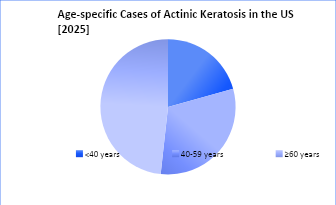
Scope of the Report
- The report covers a segment of a descriptive overview of actinic keratosis, explaining their causes, signs and symptoms, and pathogenesis.
- Comprehensive insight has been provided into the epidemiology segments and forecasts, the future growth potential of the diagnosis rate, and disease progression.
Report Insights
Actinic Keratosis Patient Population Forecast
Report Key Strengths
- Epidemiology‑based (Epi‑based) Bottom‑up Forecasting
- 11-year Forecast
- Patient Burden Trends (by geography)
FAQs
- What are the disease risks, burdens, and unmet needs of actinic keratosis? What will be the growth opportunities across the 7MM concerning the patient population with actinic keratosis?
- What is the historical and forecasted actinic keratosis patient pool in the US, EU4 (Germany, France, Italy, and Spain), the UK, and Japan?
Reasons to Buy
- Insights on patient burden/disease prevalence, evolution in diagnosis, and factors contributing to the change in the epidemiology of the disease during the forecast years.
- To understand key opinion leaders’ perspectives around the diagnostic challenges to overcome barriers in the future.
- Detailed insights on various factors hampering disease diagnosis and other existing diagnostic challenges.