Actinic Keratosis Market
Actinic Keratosis Insights and Trends
- According to the American Academy of Dermatology Association (AAD) (2026), more than 40 million Americans are estimated to develop actinic keratosis each year.
- According to the National Institute for Health and Care Excellence (NICE), over 23% of individuals in the UK aged 60 years and above have actinic keratosis.
- Actinic keratosis is more frequently diagnosed in males than in females.
- Dermoscopy has improved the diagnostic accuracy of actinic keratosis by enhancing lesion visualization.
- The actinic keratosis market is comprised of two approved therapies by companies like Almirall (tirbanibulin (KLISYRI)) and Biofrontera Pharma GmbH (aminolevulinic acid hydrochloride (AMELUZ)).
- The actinic keratosis pipeline is not particularly robust, owing to the limited number of emerging therapies in development. Late-stage candidate Tuvatexib (Vidac Pharma) and early stage candidate RLS-1496 (Rubedo Life Sciences) are being developed to offer more targeted mechanisms, improved tolerability, and better field-directed treatment outcomes.
- A significant unmet need in actinic keratosis is the prevention of lesion recurrence and progression, as many patients experience repeated development of new lesions despite treatment, highlighting the need for therapies that can provide long-term disease control and address the underlying field cancerization.
Actinic Keratosis Market Size and Forecast in the 7MM
- 2025 Actinic Keratosis Market Size: XX million
- 2036 Projected Actinic Keratosis Market Size: XX million
- Actinic Keratosis Growth Rate (2026–2036): XX% CAGR
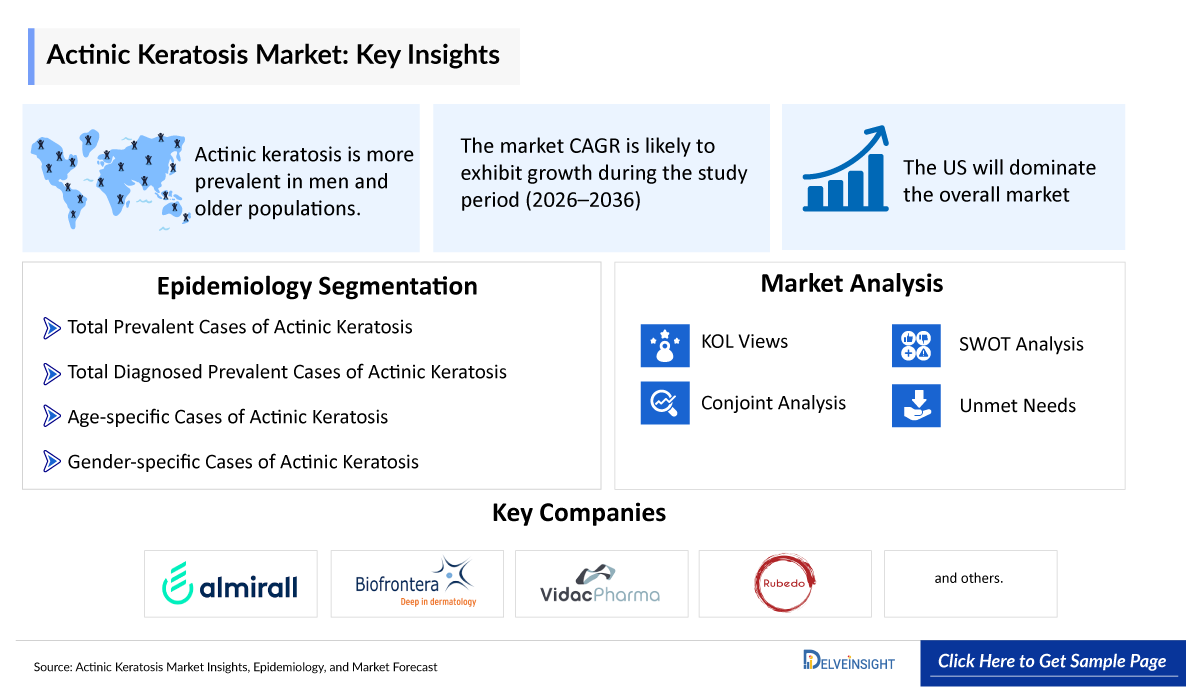
DelveInsight's ‘Actinic Keratosis Market Insights, Epidemiology and Market Forecast – 2036’ report delivers an in-depth understanding of the actinic keratosis, historical and forecasted epidemiology, as well as the actinic keratosis market trends in the United States, EU4 (Germany, Spain, Italy, and France) and the United Kingdom, and Japan.
The actinic keratosis market report delivers a comprehensive analysis of the current treatment landscape, including standards of care, clinical practices, and evolving therapeutic algorithms. It evaluates actinic keratosis patient burden trends, revenue & market share dynamics, peak patient share & therapy uptake analysis, and provides an in-depth market size assessment, and growth rate projections (Historical & Forecast 2022–2036) across global regions. The report highlights key unmet medical needs in actinic keratosis and maps the competitive and clinical landscape to uncover high‑value opportunities, providing a clear outlook on future market growth potential.
|
Study Period |
2022–2036 |
|
Historical Year |
2022–2025 |
|
Forecast Period |
2026–2036 |
|
Base Year |
2026 |
|
Geographies Covered |
|
|
Actinic Keratosis Market CAGR (Forecast period) |
XX% (2026–2036) |
|
Actinic Keratosis Epidemiology Segmentation Analysis |
Patient Burden Assessment
|
|
Actinic Keratosis Companies |
|
|
Actinic Keratosis Therapies |
|
|
Actinic Keratosis Market |
Segmented by
|
|
Analysis |
|
|
|
Key Factors Driving the Actinic Keratosis Market
-
Rising Prevalence of Actinic Keratosis
The most fundamental driver is the increasing prevalence of actinic keratosis globally, caused due to increasing cumulative UV exposure and changing outdoor lifestyle patterns. Prolonged sun exposure and higher awareness of skin cancer risks have led to a growing number of diagnosed actinic keratosis cases worldwide.
-
Aging Population
Aging population is a key driver of actinic keratosis prevalence, as prolonged lifetime UV exposure significantly increases disease risk. Individuals aged 60 years and above are more susceptible due to cumulative sun damage over time.
-
Advancements in Treatment Options
Innovation in topical therapies (e.g., tirbanibulin), photodynamic therapy, and minimally invasive procedures provides better efficacy, shorter treatment duration, and improved safety, driving adoption.
Actinic Keratosis Understanding and Treatment Algorithm
Actinic Keratosis Overview and Diagnosis
Actinic keratosis is a common precancerous skin condition caused by long-term exposure to UV radiation from sunlight or artificial sources like tanning beds. It typically appears as rough, scaly patches on sun-exposed areas such as the face, scalp, ears, neck, and hands. Actinic keratosis is most frequently seen in fair-skinned individuals and older adults due to cumulative sun damage over time. While individual lesions are usually small, their clinical importance lies in the potential to progress into squamous cell carcinoma, making early recognition and management important.
Diagnosis of actinic keratosis is primarily clinical, based on visual inspection and palpation by a dermatologist. Lesions often feel like sandpaper and may be easier to detect by touch than by sight. In uncertain cases, a skin biopsy may be performed to rule out invasive cancer or confirm the diagnosis. Advances in non-invasive diagnostic techniques, such as dermoscopy, have improved accuracy in distinguishing actinic keratosis from other skin conditions. Early diagnosis is essential to prevent progression and to guide appropriate treatment strategies.
Note: Further details are provided in the report.
Current Actinic Keratosis Treatment Landscape
Treatment of actinic keratosis depends on the number, location, and severity of lesions. Common options include lesion-directed therapies like cryotherapy (freezing with liquid nitrogen) and field-directed treatments such as topical medications (e.g., 5-fluorouracil, imiquimod, or tirbanibulin) and photodynamic therapy. Recently approved agents like tirbanibulin offer shorter treatment durations with good tolerability. Preventive measures, including sun protection, regular skin checks, and avoidance of excessive UV exposure, remain essential components of long-term management.
Note: Further details related to country-based variations are provided in the report.
Actinic Keratosis Unmet Needs
The section “unmet needs of actinic keratosis” outlines the critical gaps between the current state of patient care, diagnosis, and the ideal & effective management of the disease. It highlights the obstacles experienced by patients, clinicians, and researchers and identifies potential solutions for future progress.
-
Differentiation from malignant lesions
-
Long-term efficacy and recurrence prevention
-
Non-invasive monitoring and follow-up tools
-
Faster-acting, short-duration therapies, and others…..
Note: Comprehensive unmet needs insights in Actinic Keratosis and their strategic implications are provided in the full report.
Actinic Keratosis Epidemiology
Key Findings from Actinic Keratosis Epidemiological Analysis and Forecast
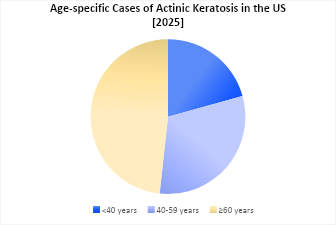
- Actinic keratosis is more prevalent in men and older populations.
- The United States represented the largest patient pool among the 7MM, accounting for the majority of diagnosed cases.
- Actinic keratosis has a higher prevalence in fair-skinned individuals.
- Among EU4 and the UK, Germany had the highest number of prevalent cases of actinic keratosis in 2025.
Actinic Keratosis Drug Analysis & Competitive Landscape
The actinic keratosis drug chapter provides a detailed, market-focused review of the emerging pipeline across Phase III-II clinical trials and preclinical trials. It covers the mechanism of action, clinical trial data, regulatory approvals, patents, collaborations, and strategic partnerships for each therapy, along with their advantages, limitations, and recent developments. This section offers critical insights into the actinic keratosis treatment landscape, supporting market assessment, competitive analysis, and growth forecasting for the actinic keratosis therapeutics market.
Approved Therapies for Actinic Keratosis
Tirbanibulin (KLISYRI): Almirall
Tirbanibulin (KLISYRI), ointment 1%, is a microtubule inhibitor indicated for the topical field treatment of actinic keratosis of the face or scalp. It has demonstrated efficacy and safety, with a convenient 5-day application regimen, representing the shortest treatment duration among available topical therapies for actinic keratosis. In December 2020, Almirall announced that the US FDA had approved tirbanibulin for the topical treatment of actinic keratosis of the face or scalp. According to the company’s 2025 annual presentation, the net sales of tirbanibulin were approximately USD 38 million for 2025.
Aminolevulinic acid hydrochloride (AMELUZ): Biofrontera Pharma GmbH
Aminolevulinic acid hydrochloride topical gel, 10% is a photosensitizing agent indicated for the treatment of actinic keratosis of the face and scalp when used in combination with photodynamic therapy (PDT), enabling selective destruction of atypical keratinocytes after light activation. Aminolevulinic acid hydrochloride was initially approved by the US FDA in May 2016 for the treatment of actinic keratosis of the face and scalp in combination with photodynamic therapy. In February 2024, the Medicines and Healthcare products Regulatory Agency (MHRA) and the European Commission approved an extension of the marketing authorization for aminolevulinic acid hydrochloride, allowing its use with artificial daylight photodynamic therapy for the treatment of actinic keratosis. According to the company’s FY 2025 results presentation, AMELUZ recorded more than 25% growth in the German market and achieved a market share of approximately 73%.
|
Table 1: Competitive Landscape of Actinic Keratosis Marketed/Approved Therapies | ||||||
|
Drug/Therapy |
Company |
Indication |
Molecule Type |
MoA |
RoA |
Marketed Region |
|
Tirbanibulin (KLISYRI) |
Almirall |
Actinic keratosis |
Small molecule |
Microtubule inhibitor |
Topical |
US: 2020 EU: 2021 |
|
Aminolevulinic acid hydrochloride (AMELUZ) |
Biofrontera Pharma GmbH |
Actinic keratosis |
Small molecule |
Photosensitisers |
Topical |
US: 2016 EU: 2011 |
Note: Detailed marketed therapies assessment will be provided in the final report.
Actinic Keratosis Pipeline Analysis
Tuvatexib (VDA-1102): Vidac Pharma
Tuvatexib (VDA-1102) is an investigational topical therapy being developed for the treatment of actinic keratosis. The drug is designed to selectively target abnormal keratinocytes in sun-damaged skin while minimizing effects on surrounding healthy tissue. VDA-1102 works through a novel mechanism of action that dissociates the abnormally overexpressed Hexokinase-2 (HK2) enzyme from the mitochondrial pore, aiming to restore normal cellular metabolism and selectively induce programmed cell death in pathological tissue while sparing healthy cells. The therapy is currently in late-stage of clinical trial (phase II/III).
RLS-1496: Rubedo Life Sciences
RLS-1496, the lead candidate of Rubedo Life Sciences, is in early clinical trial stage, being developed for topical and oral administration as a potential first-in-class selective GPX4 modulator targeting pathological senescent (“aged”) cells involved in chronic degenerative and aging-related conditions, including dermatologic disorders such as actinic keratosis, as well as immunology and inflammation, metabolic diseases, sarcopenia, and neurodegenerative disorders.
Table 2: Competitive Landscape of Emerging Drugs | ||||||
|
Drug Name |
Company |
Highest Phase |
Indication |
RoA |
MoA |
Anticipated Launch in the US |
|
Tuvatexib (VDA-1102) |
Vidac Pharma |
II/III |
Actinic keratosis |
Topical |
Selective modulator of the Voltage-Dependent Anion Channel (VDAC)/Hexokinase 2 (HK2) complex |
Information is available in the full report |
|
RLS-1496 |
Rubedo Life Sciences |
I/II |
Actinic keratosis |
Topical |
GPX4 (glutathione peroxidase 4) modulator |
Information is available in the full report |
|
Note: Launch insights are provisional and may change with future report updates or the occurrence of major key catalysts. | ||||||
Note: Detailed emerging therapies assessment will be provided in the final report.
Actinic Keratosis Key Players, Market Leaders and Emerging Companies
- Almirall
- Biofrontera Pharma GmbH
- Vidac Pharma
- Rubedo Life Sciences, and others
Actinic Keratosis Drug Updates
- In February 2026, Vidac Pharma announced that the first patient had been successfully enrolled and dosed in its Phase IIb clinical study evaluating VDA-1102 for the treatment of highly proliferative lesions of actinic keratosis.
- In December 2025, Vidac Pharma announced the initiation of its Phase IIb clinical trial evaluating a novel targeted therapeutic approach for the treatment of highly proliferative lesions of actinic keratosis with its tuvatexib (VDA1102) ointment. This milestone follows receipt of clearance from the European Medicines Agency (EMA) to proceed with the study.
- In September 2025, Vidac Pharma announced the submission of a Clinical Trial Application (CTA) to the EMA for a new interventional study focused on advanced actinic keratosis lesions.
- In September 2025, Rubedo Life Sciences announced that the US FDA cleared the Investigational New Drug (IND) application for a Phase Ib/IIa clinical study of its lead candidate RLS-1496 in patients with actinic keratosis.
Actinic Keratosis Market Outlook
The treatment landscape for actinic keratosis has historically relied on lesion-directed and field-directed therapies aimed at removing visible lesions and treating surrounding sun-damaged skin. Common approaches include cryotherapy, topical agents such as 5-fluorouracil and imiquimod, and photodynamic therapy (PDT). The approved therapy tirbanibulin is a microtubule inhibitor that disrupts cell proliferation and induces apoptosis. Its short 5-day topical regimen represents a meaningful advancement in convenience and adherence compared to older treatments.
The pipeline for actinic keratosis is evolving with several investigational therapies focusing on improved efficacy, tolerability, and field cancerization management. Tuvatexib is being explored for targeted cytotoxic activity in precancerous skin lesions. Other pipeline agents, including RLS-1496 are under investigation for their potential to provide more selective action, reduced treatment duration, and improved safety profiles compared with existing topical therapies.
Overall, the emergence of shorter-duration topical treatments, advancements in photodynamic therapy, and a growing pipeline of targeted agents are projected to propel steady market growth across the 7MM from 2026 to 2036, yielding significant commercial opportunities for existing products and pipeline candidates. Increasing awareness of actinic keratosis as a precancerous condition, along with improved screening and diagnosis, is further supporting treatment uptake.
Further details will be provided in the report….
Drug Class/Insights into Leading Emerging and Marketed Therapies in Actinic Keratosis (2022–2036 Forecast)
The actinic keratosis market is gradually evolving toward targeted and field-directed therapies aimed at improving lesion clearance, reducing recurrence, and enhancing tolerability compared with conventional destructive procedures and nonspecific topical treatments.
- Microtubule inhibitors: Tirbanibulin, is a topical antineoplastic and microtubule inhibitor that disrupts tubulin polymerization and Src kinase signaling pathways, thereby inhibiting abnormal keratinocyte proliferation and inducing apoptosis in actinic keratosis lesions.
- Photosensitizing agents: Aminolevulinic acid hydrochloride is a porphyrin precursor used in photodynamic therapy that selectively accumulates in dysplastic cells and, upon light activation, generates reactive oxygen species that destroy precancerous keratinocytes while sparing surrounding healthy tissue.
- GPX4 modulators: RLS-1496, belongs to a novel class of adaptive senotherapeutics designed to modulate GPX4 activity and selectively eliminate senescent and dysfunctional cells.
Overall, innovation in actinic keratosis is being driven by emerging therapies with selective and mechanism-based approaches that aim to improve efficacy, tolerability, and long-term disease management while minimizing damage to healthy skin tissue.
Actinic Keratosis Drug Uptake
This section focuses on the uptake rate of potential drugs expected to be launched in the market during the forecast period (2026–2036). The analysis covers the actinic keratosis drug’s uptake, performance at peak, factors affecting performance during prime years of growth, patient uptake by therapy, and anticipated sales generated by each drug.
During the forecast period, currently approved therapy such as tirbanibulin is expected to maintain a strong baseline utilization as a first-line topical therapy due to its short treatment duration, favorable tolerability profile, and convenience in outpatient management of facial and scalp lesions. Similarly, Aminolevulinic acid hydrochloride, used in photodynamic therapy, is expected to sustain steady adoption, particularly in dermatology clinics specializing in field-directed therapy.
Among pipeline agents, VDA-1102 (Tuvatexib) is expected to demonstrate gradual uptake as a next-generation topical small molecule targeting abnormal keratinocyte proliferation, with adoption driven by the need for improved tolerability and enhanced lesion-specific efficacy compared to conventional field therapies. RLS-1496 is an early-stage pipeline agents and their uptake is expected to remain limited during the forecast period, primarily dependent on successful progression through clinical development. Overall uptake will depend on clinical efficacy, safety outcomes, and positioning alongside standard of care therapies.
Detailed insights of emerging therapies' drug uptake is included in the report
Market Access and Reimbursement of Approved Therapies in Actinic Keratosis
The report further provides detailed insights on the country-wise accessibility and reimbursement scenarios, cost-effectiveness scenario of approved therapies, programs making accessibility easier and out-of-pocket costs more affordable, insights on patients insured under federal or state government prescription drug programs, etc.
The United States
|
Table 3: US Reimbursement of Therapies Approved for Actinic Keratosis | |
|
Drug/Therapy |
Access Program |
|
Tirbanibulin (KLISYRI) |
The Almirall Advantage program |
Reimbursement is a crucial factor that affects the drug’s access to the market. Often, the decision to reimburse comes down to the price of the drug relative to the benefit it produces in treated patients. To reduce the healthcare burden of these high-cost therapies, many payment models are being considered by payers and other industry insiders.
NOTE: Further Details are provided in the final report….
Actinic Keratosis Therapies Price Scenario & Trends
Pricing and analogue assessment of actinic keratosis therapies highlights evolving price dynamics structures. This section summarizes the cost of approved treatments, closest and most appropriate analogue selection for emerging therapies, and understanding of how pricing influences market actinic access, adherence, and long-term uptake.
Industry Experts and Physician Views for Actinic Keratosis
To keep up with actinic keratosis market trends, we take Key Opinion Leaders (KOLs) and Subject Matter Experts (SMEs) opinions working in the domain through primary research to fill the data gaps and validate our secondary research. Industry experts were contacted for insights on the actinic keratosis emerging therapies, evolving treatment landscape, patient adherence to conventional therapies, therapy switching trends, drug adoption and uptake, accessibility challenges, and epidemiology and real-world prescription patterns in actinic keratosis, including MD, PhD, Instructor, Postdoctoral Researcher, Professor, Researcher, and others.
DelveInsight’s analysts connected with 15+ KOLs to gather insights at the country level. Centers such as the University of Houston, Charité-Universitätsmedizin , Toho University Omori Medical Center, etc. were contacted. Their opinion helps understand and validate current and emerging actinic keratosis therapies, highlight unmet medical needs, provide epidemiological context, and support strategic decisions for market access, therapy adoption, and pipeline prioritization in actinic keratosis.
|
Region |
Key Opinion Leaders (KOLs) and Subject Matter Experts (SMEs) |
|
United States |
“Treatment options for actinic keratosis are broadly classified into lesion-directed and field-directed therapies. The commonly cited treatment principle, “no pain, no gain,” reflects that effective therapy may be associated with temporary discomfort or treatment-related side effects.” |
|
Germany |
“Actinic keratosis represents a chronic manifestation of cumulative ultraviolet damage and is frequently observed in elderly populations. Effective management requires not only lesion-directed treatment but also field-directed approaches to address the broader area of photodamaged skin.” |
Qualitative Analysis: SWOT and Conjoint Analysis
We perform qualitative and market Intelligence analysis using various approaches, such as SWOT analysis and conjoint analysis.
In the SWOT analysis of actinic keratosis, strengths, weaknesses, opportunities, and threats in terms of disease diagnosis, patient awareness, patient burden, competitive landscape, cost-effectiveness, and geographical actinic accessibility of therapies are provided.
Conjoint analysis analyzes emerging therapies based on relevant attributes such as safety, efficacy, frequency of administration, route of administration, and order of entry. Scoring is given based on these parameters to analyze the effectiveness of therapy.
The team of analysts analyzes promising emerging therapies based on relevant attributes such as safety, efficacy, frequency of administration, route of administration, and order of entry. In efficacy, the trial’s primary and secondary outcome measures are evaluated, whereas the therapies’ safety is evaluated, wherein the acceptability, tolerability, and adverse events are majorly observed. In addition, the scoring is also based on the route of administration, order of entry, probability of success, and the addressable patient pool for each therapy. According to these parameters, the final weightage score and the ranking of the emerging therapies are decided.
Scope of the Report
- The report covers a segment of key events, an executive summary, a descriptive overview of actinic keratosis, explaining their causes, signs and symptoms, pathogenesis, and currently available treatments.
- Comprehensive insight has been provided into the epidemiology segments and forecasts, the future growth potential of the diagnosis rate, and disease progression along treatment guidelines.
- Additionally, an all-inclusive account of both the current and emerging treatments, along with the elaborative profiles of late-stage and prominent therapies, will have an impact on the current treatment landscape.
- A detailed review of the actinic keratosis market, historical and forecasted market size, market share by therapies, detailed assumptions, and rationale behind our approach is included in the report, covering the 7MM drug outreach.
- The report provides an edge while developing business strategies by understanding trends through SWOT analysis and expert insights/KOL views, patient journey, and treatment preferences that help in shaping and driving the 7MM actinic keratosis market.
Report Insights
- Actinic Keratosis Patient Population Forecast
- Actinic Keratosis Therapeutics Market Size
- Actinic Keratosis Pipeline Analysis
- Actinic Keratosis Market Size and Trends
- Actinic Keratosis Market Opportunity (Current and forecasted)
Report Key Strengths
- Epidemiology‑based (Epi‑based) Bottom‑up Forecasting
- Artificial Intelligence (AI)-Enabled Market Research Report
- 11-Year Forecast
- Actinic Keratosis Market Outlook (North America, Europe, Asia-Pacific)
- Patient Burden Trends (By Geography)
- Actinic Keratosis Treatment Addressable Market (TAM)
- Actinic Keratosis Competitve Landscape
- Actinic Keratosis) Major Companies Insights
- Actinic Keratosis Price Trends and Analogue Assessment
- Actinic Keratosis Therapies Drug Adoption/Uptake
- Actinic Keratosis Therapies Peak Patient Share Analysis
Report Assessment
- Actinic Keratosis Current Treatment Practices
- Actinic Keratosis Unmet Needs
- Actinic Keratosis Clinical Development Analysis
- Actinic Keratosis Emerging Drugs Product Profiles
- Actinic Keratosis Market attractiveness
- Actinic Keratosis Qualitative Analysis (SWOT and conjoint analysis)
FAQs
Market Insights
- What was the actinic keratosis market size, the market size by therapies, market share (%) distribution in 2025, and what would it look like by 2036? What are the contributing factors for this growth?
- What are the anticipated pricing variations among different geographies for the emerging therapies in the future?
- What can be the future treatment paradigm of actinic keratosis?
- What are the disease risks, burdens, and unmet needs of actinic keratosis? What will be the growth opportunities across the 7MM concerning the patient population with actinic keratosis?
- Who is the major future competitor in the market, and how will the competitors affect their market share?
- What are the current options for the treatment of actinic keratosis? What are the current guidelines for treating actinic keratosis in the US, Europe, and Japan?
Reasons to Buy
- The report will help in developing business strategies by understanding the latest trends and changing treatment dynamics driving the actinic keratosis market.
- Bottom-up forecasting builds from the affected population to product forecasts, delivering a robust, data-driven approach ideal for new therapies and novel classes.
- Insights on patient burden/disease incidence, evolution in diagnosis, and factors contributing to the change in the epidemiology of the disease during the forecast years.
- Understand the existing market opportunities in varying geographies and the growth potential over the coming years.
- Identifying strong upcoming players in the market will help devise strategies to help get ahead of competitors.
- Detailed analysis and ranking of class-wise potential emerging therapies under the conjoint analysis section to provide visibility around leading classes.
- To understand KOLs’ perspectives on the accessibility, acceptability, and compliance-related challenges of existing treatment to overcome barriers in the future.
- Detailed insights on the unmet needs of the existing market so that the upcoming players can strengthen their development and launch strategy.
- This Artificial Intelligence (AI)-enabled report summarize and simplify complex datasets with in the report into clear, actionable insights for stakeholders, investors, and healthcare providers, enabling faster, data-driven decisions.