Adrenocortical Carcinoma Market
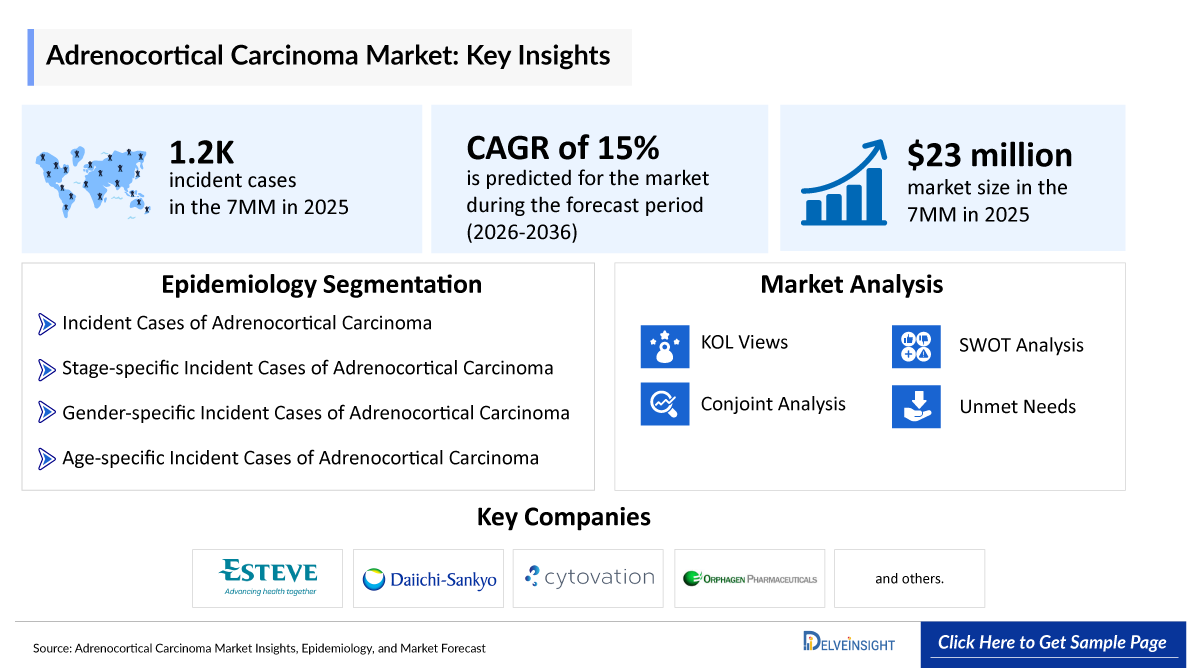
- According to DelveInsight’s analysis, the ACC market size was found to be ~USD 23 million in the leading markets (the United States, the EU4 (Germany, France, Italy, and Spain), the United Kingdom, and Japan) in 2025.
- ACC is a rare but aggressive malignancy arising from the adrenal cortex. Its etiology remains largely elusive, although genetic mutations and hereditary syndromes are implicated. Risk factors encompass age, gender disparities, and specific genetic predispositions.
- The oncocytic variant accounts for approximately 10% of adrenal cortical tumors and is the most common subtype, followed by the myxoid and sarcomatoid variants, which are both exceedingly rare. According to the 2022 WHO classification, oncocytic ACC is defined by the presence of oncocytic tumor cells comprising more than 90% of the tumor mass.
- The ENSAT staging system is widely used to classify ACC and guide treatment decisions, with stages ranging from stage I to stage IV.
- Diagnosis of ACC involves a combination of hormonal evaluation and advanced imaging techniques to assess tumor functionality, size, and spread, with definitive confirmation achieved through histopathological analysis after surgical resection.
- ACC can be managed through several approaches, including surgery, radiation therapy, and chemotherapy. In addition, newer treatment strategies such as immunotherapy and targeted therapies are currently being explored in clinical trials.
- ACC and its treatments often lead to significant morbidity and reduced quality of life for patients. There is a need for comprehensive supportive care measures to manage treatment-related side effects, hormonal imbalances, and psychosocial issues.
- In the US, mitotane (LYSODREN) is the only US FDA-approved drug specifically for the treatment of ACC. It's used both as an adjuvant therapy after surgery and for advanced, inoperable cases.
- The pharmaceutical companies involved in the pipeline of ACC are Daiichi Sankyo, Cytovation, Orphagen Pharmaceuticals, and others.
- A critical unmet need in ACC lies in establishing dependable screening methods for early detection. The majority of cases are diagnosed at advanced stages, hindering treatment options and prognoses. The absence of reliable screening tools delays identification, worsening patient outcomes.
Adrenocortical Carcinoma (ACC) Market Size and Forecast in the 7MM
- 2025 Adrenocortical Carcinoma (ACC) Market Size: ~USD 23 million
- 2036 Projected Adrenocortical Carcinoma (ACC) Market Size: ~USD XXX million
- Adrenocortical Carcinoma (ACC) Growth Rate (2026–2036): ~15% CAGR
Request a sample to unlock the CAGR for "Adrenocortical Carcinoma Market Forecast"
DelveInsight's ‘Adrenocortical Carcinoma Market Insights, Epidemiology and Market Forecast - 2036’ report delivers an in-depth understanding of the ACC, historical and forecasted epidemiology, as well as the ACC market trends in the United States, EU4 (Germany, Spain, Italy, and France) and the United Kingdom, and Japan.
The ACC market report delivers a comprehensive analysis of the current treatment landscape, including standards of care, clinical practices, and evolving therapeutic algorithms. It evaluates ACC patient burden trends, revenue & market share dynamics, peak patient share & therapy uptake analysis, and provides an in-depth market size assessment, and growth rate projections (Historical & Forecast 2022–2036) across global regions. The report highlights key unmet medical needs in ACC and maps the competitive and clinical landscape to uncover high‑value opportunities, providing a clear outlook on future market growth potential.
|
Study Period |
2022–2036 |
|
Historical Year |
2022–2025 |
|
Forecast Period |
2026–2036 |
|
Base Year |
2026 |
|
Geographies Covered |
|
|
Adrenocortical Carcinoma (ACC) Market CAGR (Forecast period) |
~15% (2026–2036) |
|
Adrenocortical Carcinoma (ACC) Epidemiology Segmentation Analysis |
Patient Burden Assessment
|
|
Adrenocortical Carcinoma (ACC) Companies |
|
|
Adrenocortical Carcinoma (ACC) Therapies |
|
|
Adrenocortical Carcinoma (ACC) Market |
Segmented by
|
|
Analysis |
|
|
|
Key Factors Driving the Adrenocortical Carcinoma (ACC) Market
Increasing Diagnosis and Awareness
Improved imaging techniques and hormonal testing are enabling earlier and more accurate detection of ACC. Greater clinical awareness is leading to higher reported incidence rates and which expands the treatable patient population and drives demand for therapies.
Growing Pipeline and Research Activity
Ongoing research into immunotherapy and targeted therapies is expanding the pipeline. The novel approaches aim to improve survival and reduce toxicity. Thereby, increase in R&D investment is expected to drive future market growth.
High Unmet Medical Need
ACC is an aggressive cancer with poor prognosis and high recurrence rates and the limited treatment options create strong demand for effective therapies.
Adrenocortical Carcinoma (ACC) Understanding and Treatment Algorithm
Adrenocortical Carcinoma (ACC) Overview and Diagnosis
ACC is a rare and aggressive malignancy arising from the adrenal cortex. It can occur at any age but shows a bimodal distribution, affecting young children and adults in their 40s–50s. ACC may be functioning (hormone-secreting) or non-functioning. Functioning tumors often produce excess cortisol, androgens, or aldosterone, leading to clinical syndromes such as cushing’s syndrome or virilization. Due to its aggressive nature, ACC is frequently diagnosed at an advanced stage, contributing to poor prognosis and high recurrence rates. The ENSAT (European Network for the Study of Adrenal Tumors) staging system is widely used to classify ACC and guide treatment decisions, ranging from Stage I (localized tumors ≤5 cm) to Stage IV (metastatic disease).
Diagnosis of ACC involves a combination of biochemical evaluation and imaging studies. Hormonal workup is essential to detect excess steroid production, including cortisol, DHEA-S, and aldosterone levels. Imaging techniques such as contrast-enhanced CT or MRI help assess tumor size, characteristics, and local invasion, while PET scans may assist in detecting metastases. Histopathological confirmation following surgical resection or biopsy remains the gold standard, with criteria such as the Weiss score used to distinguish malignant from benign adrenal tumors. Early and accurate diagnosis is critical for improving outcomes.
Further details are provided in the report.
Current Adrenocortical Carcinoma (ACC) Treatment Landscape
Treatment of ACC depends on disease stage and resectability. Surgical resection is the primary and only potentially curative treatment for localized disease. In advanced or metastatic cases, systemic therapy is required, with mitotane (LYSODREN) serving as the cornerstone adrenolytic agent used either alone or in combination with cytotoxic chemotherapy (EDP regimen: etoposide, doxorubicin, cisplatin). Additional approaches include radiation therapy for local control and management of recurrence. Despite these options, prognosis remains limited, and ongoing research is focused on targeted therapies and immunotherapies to improve long-term outcomes.
Further details related to country-based variations are provided in the report.
Adrenocortical Carcinoma (ACC) Unmet Needs
The section “unmet needs of ACC” outlines the critical gaps between the current state of patient care, diagnosis, and the ideal & effective management of the disease. It highlights the obstacles experienced by patients, clinicians, and researchers and identifies potential solutions for future progress.
-
Limited treatment therapies
-
Poor prognosis and high occurance rate
-
Rare disease make scarcity of large clinical trials
-
Need for piagnostic/prognostic markers, and others…..
Note: Comprehensive unmet needs insights in ACC and their strategic implications are provided in the full report.
Adrenocortical Carcinoma (ACC) Epidemiology
Key Findings from ACC Epidemiological Analysis and Forecast
- In the 7MM, the distribution of ACC cases across stages reveals that Stage IV has the highest cases at ~35%, followed by Stage II, Stage III, and Stage I at lowest; ~10%. The predominance of Stage IV ACC cases in the 7MM may stem from delayed diagnosis, aggressive disease behavior, and limited screening methods, highlighting the urgent need for improved detection strategies.
- The incidence of ACC is observed to be higher in females (~60%) compared to males, indicating a notable gender disparity in disease occurrence.
- The United States accounted for the highest incident cases of ACC, representing approximately 30% of total cases in the 7MM in 2025.
- The incidence of ACC increases with age, with the highest proportion observed in individuals aged >60 years, followed closely by those aged 40–60 years.
Adrenocortical Carcinoma (ACC) Drug Analysis & Competitive Landscape
The ACC drug chapter provides a detailed, market-focused review of the emerging pipeline across Phase I/II-I clinical trials and preclinical trials. It covers the mechanism of action, clinical trial data, regulatory approvals, patents, collaborations, and strategic partnerships for each therapy, along with their advantages, limitations, and recent developments. This section offers critical insights into the ACC treatment landscape, supporting market assessment, competitive analysis, and growth forecasting for the ACC therapeutics market.
Approved Therapies for Adrenocortical Carcinoma (ACC)
Mitotane (LYSODREN): ESTEVE
Mitotane, marketed under the brand LYSODREN and distributed by Esteve Pharmaceuticals. It is an oral adrenolytic anticancer agent used primarily for the treatment of ACC. It works by selectively destroying adrenal cortical cells and inhibiting steroid hormone synthesis, thereby reducing cortisol production and tumor-related hormone excess. It remains one of the very few approved systemic therapies for advanced ACC and is considered a cornerstone in both palliative and adjuvant treatment settings. The drug is commonly utilized either alone or in combination. While mitotane monotherapy controls disease in select cases, combination therapies yield superior outcomes in aggressive or high-burden diseases.
|
Adrenocortical Carcinoma (ACC) Marketed/Approved Therapies | ||||||
|
Drug/Therapy |
Company |
Indication |
Molecule Type |
MoA |
RoA |
Marketed Region |
|
Mitotane (LYSODREN) |
Esteve |
ACC |
Small molecule |
Adrenolytic agent |
Oral |
US: 1970 EU: 2004 |
Note: Detailed marketed therapies assessment will be provided in the final report.
Adrenocortical Carcinoma (ACC) Pipeline Analysis
CY-101/Getacatetide: Cytovation
Getacatetide is a membranolytic inhibitor of the Wnt/β-catenin pathway and helps the immune system to fight cancer by exposing tumor neoantigens and inhibiting mechanisms that drive tumor growth and immune evasion. It has demonstrated early signs of antitumor activity in the Phase I (CICILIA) trial, particularly in tumors with dysregulated Wnt/β-catenin signaling. CY-101 is granted ODD in the US for the treatment of ACC. The UK Medicines and Healthcare products Regulatory Agency (MHRA) and Health Research Authority had approved the clinical trial application for the upcoming Phase II study in ACC.
OR-449: Orphagen Pharmaceuticals
OR-449 is a first-in-class orally-bioavailable antagonist for the orphan nuclear receptor steroidogenic factor-1 (SF-1, NR5A1)an orphan nuclear receptor and transcription factor that is essential for the growth and development of the adrenal gland. Orphagen is developing OR-449 for both the adult and pediatric forms of ACC as well as other cancers known to express a high level of SF-1. The US FDAhad granted OR-449 a Rare Pediatric Disease Designation (RPDD), meant to incentivize rapid development of OR-449 for the treatment of the pediatric form of ACC where SF-1 is somatically amplified.
Competitive Landscape of Pipeline Drugs | ||||||
|
Drug Name |
Company |
Highest Phase |
Indication |
RoA |
MoA |
Anticipated Launch in the US |
|
CY-101/ Getacatetide |
Cytovation |
I/II |
ACC |
Intratumoural (IT) injection |
Wnt/β-catenin pathway Inhibitor |
Information is available in the full report |
|
DS9051b/ DS-9051 |
Daiichi Sankyo |
I |
ACC |
Oral |
Ubiquitin protein ligase degraders |
Information is available in the full report |
|
OR-449 |
Orphagen Pharmaceuticals |
Preclinical |
ACC |
Oral |
Steroidogenic factor-1 (SF-1/NR5A1 antagonist |
Information is available in the full report |
|
Note: Launch insights are provisional and may change with future report updates or the occurrence of major key catalysts. | ||||||
Note: Detailed emerging therapies assessment will be provided in the final report.
Adrenocortical Carcinoma (ACC) Key Players, Market Leaders and Emerging Companies
- Esteve
- Daiichi Sankyo
- Cytovation
- Orphagen Pharmaceuticals, and others
Adrenocortical Carcinoma (ACC) Drug Updates
- In July 2025,Cytovation announced that the International Nonproprietary Names (INN) Expert Committee of the World Health Organization (WHO-INN) has approved getacatetide as the International Nonproprietary Name (INN) of CY-101.
- In April 2025, Cytovation announced that it has raised USD 6M funds from existing investors to advance CY-101 into a multi-national Phase II clinical trial in patients with ACC due to start in late 2025 and with first clinical readouts expected in 2026.
- In January 2025, Cytovation announced that Cytovation, Cancer Research UK and the Norwegian Cancer Society have signed a collaboration agreement to bring CY-101, into a multi-national Phase II clinical trial for patients with ACC.
Adrenocortical Carcinoma (ACC) Market Outlook
The standard of care has historically relied on surgery for localized disease and systemic therapy for advanced or metastatic cases. The only widely approved drug specifically for ACC is mitotane (LYSODREN), an adrenolytic agent that selectively targets adrenal cortical cells. It is commonly used both in the adjuvant setting after surgical resection and in advanced disease. The most commonly used regimen for advanced ACC is the EDP-M protocol, which combines etoposide, doxorubicin, and cisplatin with mitotane. This combination has been the backbone of systemic therapy for decades.
The pipeline for ACC is still in early development. Investigational agents such as CY-101, DS-9051b, and OR-449 represent diverse approaches, including immunotherapy, targeted molecular inhibition, and modulation of steroid biosynthesis pathways. For example, OR-449 is designed to selectively inhibit key enzymes involved in cortisol production, potentially addressing both tumor growth and hormone excess, an important clinical feature in many ACC patients.
However, many of the programs are no longer actively progressing, with several trials primarily driven by academic institutions and research organizations. Some studies, such as EO2401 in combination with nivolumab, have also been discontinued. This highlights a significant unmet need and underscores the importance of greater investment and focused efforts to advance therapeutic development in ACC.
Overall, the launch of novel therapies, improved diagnostic techniques, and rising awareness of ACC are projected to propel steady market growth across the 7MM from 2022 to 2036, yielding significant commercial opportunities for existing products and pipeline candidates.
- Among the 7MM, the US accounted for the largest market size of ACC, i.e., USD ~10 million in 2025 and is projected to grow at a significant CAGR through 2036.
- In early development, investigational agents such as CY-101, DS-9051b/DS-9051, and OR-449 reflect a range of therapeutic approaches in ACC and may potentially impact the market landscape if successfully developed.
Further details will be provided in the report….
Drug Class/Insights into Leading Emerging and Marketed Therapies in ACC (2022–2036 Forecast)
The ACC market (2022–2036 forecast) is evolving toward earlier intervention and mechanism-based prevention strategies rather than purely reactive treatment after symptom onset. The emerging pipeline is increasingly focused on agents that can dampen excessive immune activation upstream without fully suppressing anti-tumor response.
- Adrenolytic Therapy: Mitotane remains the only approved, disease-specific systemic therapy for ACC. It is an adrenal cortex-selective cytotoxic agent that suppresses steroidogenesis and induces direct tumor cell destruction, making it uniquely suited for managing both tumor burden and hormone excess in ACC.
- Immunomodulator: CY-101/Getacatetide is an investigational immunomodulatory peptide-based therapy. It is designed to activate and regulate anti-tumor immune responses through controlled membrane-targeting mechanisms that may enhance tumor cell recognition while limiting systemic toxicity.
- Steroidogenesis/Tumor Pathway Modulator: OR-449 is an investigational selective steroidogenesis inhibitor designed to target adrenal hormone biosynthesis pathways. OR-449 may provide dual benefit by reducing hormone-related symptoms and potentially exerting anti-tumor effects through pathway suppression.
ACC innovation is not driven by a single dominant mechanism, but rather by a convergence of endocrine pathway targeting, molecular precision therapies, and selective immuno-oncology approaches, driving pipeline growth.
Adrenocortical Carcinoma (ACC) Drug Uptake
This section focuses on the uptake rate of potential drugs expected to be launched in the market during the forecast period (2026–2036). The analysis covers the ACC drug’s uptake, performance at peak, factors affecting performance during prime years of growth, patient uptake by therapy, and anticipated sales generated by each drug.
During the forecast period, drug uptake in ACC is expected to remain limited and gradual, reflecting the rarity of the disease and the constrained number of effective systemic options. The only approved and ACC-specific systemic therapy is Mitotane, which continues to form the backbone of treatment across both adjuvant and advanced settings. LYSODREN is listed among the ‘Off-Patent, Off-Exclusivity Drugs without an Approved Generic’ as outlined in the Orange Book.
Pipeline candidates such as CY-101 are expected to enter the market as novel immunomodulatory agents aiming to reshape anti-tumor immune responses while minimizing systemic toxicity. DS-9051b is anticipated to follow a biomarker-driven adoption pathway, with early use potentially restricted to genetically or molecularly defined patient subsets, depending on its final mechanism of action and clinical positioning.
Detailed insights of emerging therapies' drug uptake is included in the report
Market Access and Reimbursement of Approved therapies in Adrenocortical Carcinoma (ACC)
Reimbursement is a crucial factor that affects the drug’s access to the market. Often, the decision to reimburse comes down to the price of the drug relative to the benefit it produces in treated patients. To reduce the healthcare burden of these high-cost therapies, many payment models are being considered by payers and other industry insiders.
NOTE: Further Details are provided in the final report….
Adrenocortical Carcinoma (ACC) Therapies Price Scenario & Trends
Pricing and analogue assessment of ACC therapies highlights evolving price dynamics structures. This section summarizes the cost of approved treatments, closest and most appropriate analogue selection for emerging therapies, and understanding of how pricing influences market access, adherence, and long-term uptake.
Industry Experts and Physician Views for Adrenocortical Carcinoma (ACC)
To keep up with ACC market trends, we take Key Opinion Leaders (KOLs) and Subject Matter Experts (SMEs) opinions working in the domain through primary research to fill the data gaps and validate our secondary research. Industry experts were contacted for insights on the ACC emerging therapies, evolving treatment landscape, patient adherence to conventional therapies, therapy switching trends, drug adoption and uptake, accessibility challenges, and epidemiology and real-world prescription patterns in ACC, including MD, PhD, Instructor, Postdoctoral Researcher, Professor, Researcher, and others.
DelveInsight’s analysts connected with 15+ KOLs to gather insights at the country level. Centers such as the Interfaith Medical Center, the Cancer Institute Hospital of Japanese Foundation for Cancer Research, and Center Léon-Bérard, etc. were contacted. Their opinion helps understand and validate current and emerging ACC therapies, highlight unmet medical needs, provide epidemiological context, and support strategic decisions for market access, therapy adoption, and pipeline prioritization in ACC.
|
Region |
Key Opinion Leaders (KOLs) and Subject Matter Experts (SMEs) |
|
United States |
“ACC remains a rare occurrence in the United States, with an annual incidence of ~1 per million individuals. Unfortunately, the majority of cases are detected only in advanced stages, leading to dismal survival rates. These findings underscore the critical necessity for advanced diagnostic tools and novel, more efficacious treatments tailored specifically for adrenocortical cancers.” |
|
Germany |
“The diagnosis of ACC presents significant challenges due to its similarity to benign adrenal tumors, diverse clinical presentations, rarity, absence of specific diagnostic biomarkers, and limitations of imaging techniques. Differentiating between malignant and benign adrenal masses is intricate, and the vague clinical symptoms can lead to diagnostic delays. The lack of precise epidemiological data and sensitive diagnostic tools further complicates the diagnostic process.” |
Qualitative Analysis: SWOT and Conjoint Analysis
We perform qualitative and market Intelligence analysis using various approaches, such as SWOT analysis and conjoint analysis.
In the SWOT analysis of ACC, strengths, weaknesses, opportunities, and threats in terms of disease diagnosis, patient awareness, patient burden, competitive landscape, cost-effectiveness, and geographical accessibility of therapies are provided.
Conjoint analysis analyzes emerging therapies based on relevant attributes such as safety, efficacy, frequency of administration, route of administration, and order of entry. Scoring is given based on these parameters to analyze the effectiveness of therapy.
The team of analysts analyzes promising emerging therapies based on relevant attributes such as safety, efficacy, frequency of administration, route of administration, and order of entry. In efficacy, the trial’s primary and secondary outcome measures are evaluated, whereas the therapies’ safety is evaluated, wherein the acceptability, tolerability, and adverse events are majorly observed. In addition, the scoring is also based on the route of administration, order of entry, probability of success, and the addressable patient pool for each therapy. According to these parameters, the final weightage score and the ranking of the emerging therapies are decided.
Scope of the Adrenocortical Carcinoma Market Report
- The Adrenocortical Carcinoma Market report covers a segment of key events, an executive summary, a descriptive overview of ACC, explaining their causes, signs and symptoms, pathogenesis, and currently available treatments.
- Comprehensive insight has been provided into the epidemiology segments and forecasts, the future growth potential of the diagnosis rate, and disease progression along treatment guidelines.
- Additionally, an all-inclusive account of both the current and emerging treatments, along with the elaborative profiles of late-stage and prominent therapies, will have an impact on the current treatment landscape.
- A detailed review of the ACC market, historical and forecasted market size, market share by therapies, detailed assumptions, and rationale behind our approach is included in the report, covering the 7MM drug outreach.
- The Adrenocortical Carcinoma Market report provides an edge while developing business strategies by understanding trends through SWOT analysis and expert insights/KOL views, patient journey, and treatment preferences that help in shaping and driving the 7MM ACC market.
Adrenocortical Carcinoma Market Report Insights
- Adrenocortical Carcinoma (ACC) Patient Population Forecast
- Adrenocortical Carcinoma (ACC) Therapeutics Market Size
- Adrenocortical Carcinoma (ACC) Pipeline Analysis
- Adrenocortical Carcinoma (ACC) Market Size and Trends
- Adrenocortical Carcinoma (ACC) Market Opportunity (Current and forecasted)
Adrenocortical Carcinoma Market Report Key Strengths
- Epidemiology‑based (Epi‑based) Bottom‑up Forecasting
- Artificial Intelligence (AI)-Enabled Market Research Report
- 11-Year Forecast
- Adrenocortical Carcinoma (ACC) Market Outlook (North America, Europe, Asia-Pacific)
- Patient Burden Trends (By Geography)
- Adrenocortical Carcinoma (ACC) Treatment Addressable Market (TAM)
- Adrenocortical Carcinoma (ACC) Competitve Landscape
- Adrenocortical Carcinoma (ACC)) Major Companies Insights
- Adrenocortical Carcinoma (ACC) Price Trends and Analogue Assessment
- Adrenocortical Carcinoma (ACC) Therapies Drug Adoption/Uptake
- Adrenocortical Carcinoma (ACC) Therapies Peak Patient Share Analysis
Adrenocortical Carcinoma Market Report Assessment
- Adrenocortical Carcinoma (ACC) Current Treatment Practices
- Adrenocortical Carcinoma (ACC) Unmet Needs
- Adrenocortical Carcinoma (ACC) Clinical Development Analysis
- Adrenocortical Carcinoma (ACC) Emerging Drugs Product Profiles
- Adrenocortical Carcinoma (ACC) Market attractiveness
- Adrenocortical Carcinoma (ACC) Qualitative Analysis (SWOT and conjoint analysis)
FAQs
Adrenocortical Carcinoma Market Insights
- What was the ACC market size, the market size by therapies, market share (%) distribution in 2025, and what would it look like by 2036? What are the contributing factors for this growth?
- What are the anticipated pricing variations among different geographies for the emerging therapies in the future?
- What can be the future treatment paradigm of ACC?
- What are the disease risks, burdens, and unmet needs of ACC? What will be the growth opportunities across the 7MM concerning the patient population with ACC?
- Who is the major future competitor in the market, and how will the competitors affect their market share?
- What are the current options for the treatment of ACC? What are the current guidelines for treating ACC in the US, Europe, and Japan?
Reasons to Buy the Adrenocortical Carcinoma Market Forecast Report
- The Adrenocortical Carcinoma Market report will help in developing business strategies by understanding the latest trends and changing treatment dynamics driving the ACC market.
- Bottom-up forecasting builds from the affected population to product forecasts, delivering a robust, data-driven approach ideal for new therapies and novel classes.
- Insights on patient burden/disease incidence, evolution in diagnosis, and factors contributing to the change in the epidemiology of the disease during the forecast years.
- Understand the existing market opportunities in varying geographies and the growth potential over the coming years.
- Identifying strong upcoming players in the market will help devise strategies to help get ahead of competitors.
- Detailed analysis and ranking of class-wise potential emerging therapies under the conjoint analysis section to provide visibility around leading classes.
- To understand KOLs’ perspectives on the accessibility, acceptability, and compliance-related challenges of existing treatment to overcome barriers in the future.
- Detailed insights on the unmet needs of the existing market so that the upcoming players can strengthen their development and launch strategy.
- This Artificial Intelligence (AI)-enabled report summarize and simplify complex datasets with in the report into clear, actionable insights for stakeholders, investors, and healthcare providers, enabling faster, data-driven decisions.