Adult Myopia Epidemiology Summary
Adult Myopia Insights and Trends
- Myopia is a highly prevalent refractive disorder characterized by excessive axial elongation of the eye, causing distant objects to appear blurred due to light focusing in front of the retina. Progressive and high myopia are associated with increased risks of irreversible ocular complications and visual impairment.
- Myopia progression typically begins during childhood and adolescence, but it can continue into adulthood. Individuals with high myopia are at greater risk of continued progression in adulthood, potentially increasing their long-term risk of myopia-related complications.
- Clinical presentation commonly includes blurred distance vision, eyestrain, headaches, difficulty with night vision, and progressive refractive deterioration. In severe or pathologic myopia, patients may develop retinal degeneration, retinal detachment, glaucoma, myopic macular degeneration, and myopic choroidal neovascularization (mCNV), which can result in permanent vision loss.
- Diagnosis of myopia is primarily based on visual acuity assessment, refractive error testing, cycloplegic refraction, and ophthalmic examination. Additional evaluations including axial length measurement, retinal imaging, and intraocular pressure testing help identify high myopia and associated retinal complications.
- The global prevalence of myopia and high myopia continues to rise significantly, driven by increasing near-work activities, prolonged screen exposure, urbanization, educational intensity, reduced outdoor activity, and genetic susceptibility, creating a substantial public health and economic burden worldwide.
Adult Myopia Epidemiology Forecast in the 7MM
- 2025 Diagnosed Prevalent Cases of Adult Myopia : ~XXX
- 2036 Projected Diagnosed Prevalent Cases of Adult Myopia : ~XXX
- Adult Myopia Growth Rate (2026–2036): ~XXX% CAGR
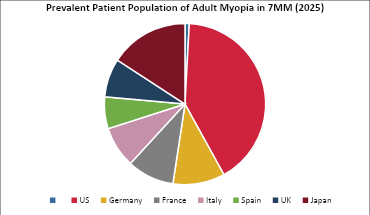
DelveInsight's ‘Adult Myopia– Epidemiology Forecast – 2036’ report delivers an in-depth understanding of the Adult Myopia, historical and forecasted epidemiology, in the United States, EU4 (Germany, Spain, Italy, and France) and the United Kingdom, and Japan.
|
Study Period |
2022–2036 |
|
Historical Year |
2022–2025 |
|
Forecast Period |
2026–2036 |
|
Base Year |
2026 |
|
Geographies Covered |
|
|
Adult Myopia Epidemiology CAGR (Forecast period) |
~XXX% (2026–2036) |
|
Adult Myopia Epidemiology Segmentation Analysis |
Patient Burden Assessment
|
Adult Myopia Understanding and Diagnosis Algorithm
Adult Myopia Overview and Diagnosis
Myopia is a common refractive disorder primarily caused by excessive axial elongation of the eye, resulting in blurred distance vision due to light focusing in front of the retina. The condition typically develops during childhood but may progress into adulthood and is influenced by both genetic and environmental factors, including prolonged near work, increased screen exposure, urbanization, and reduced outdoor activity. Myopia is generally defined as a spherical equivalent refractive error of ≤ −0.5 diopters (D), while high myopia is associated with an increased risk of serious ocular complications such as retinal detachment, glaucoma, myopic macular degeneration, and irreversible vision loss. The rising global prevalence of myopia, particularly in East and Southeast Asia, has made it a significant public health concern.
Further details are provided in the report.
Adult Myopia Diagnosis
Diagnosis of Myopia is primarily based on ophthalmic evaluation, including visual acuity assessment, refractive error testing, and refraction measurements using retinoscopy, phoropters, or automated refractive devices. Cycloplegic refraction is commonly used, particularly in children and younger adults, to improve diagnostic accuracy by minimizing accommodative interference. Additional assessments such as axial length measurement, retinal examination, corneal evaluation, and intraocular pressure testing may be performed to identify high myopia, pathologic myopia, and associated ocular complications including retinal degeneration and glaucoma.
Further details are provided in the report.
Adult Myopia Epidemiology
Key Findings from Adult Myopia Epidemiological Analysis and Forecast
- Myopia and high myopia are projected to show a significant increase in prevalence globally, affecting nearly 5 billion people and 1 billion people, respectively, by 2050.
- Average progression rates demonstrated a gradual decline with advancing age; however, the most substantial and clinically significant myopia progression was observed between 20 and 30 years of age.
- The prevalence of myopia ranges between 1% and 78.4% across studies reported in the 21st century. Although myopia is more prevalent in East Asia, global prevalence has increased from 1.4 billion in 2000 and is projected to reach 4.8 billion by 2050.
- Myopia progression is likely to continue into early adulthood. At age 18, although nearly 75% of myopes are stable, around 25% continue progressing, and approximately 20% of individuals in their 20s may experience progression of at least 1 diopter (D).
- According to WHO-based prevalence projections, myopia and high myopia are expected to affect 52% (4.9 billion) and 10% (925 million) of the global population, respectively, by 2050, representing a major increase from 2010 estimates of 27% (1.9 billion) and 2.8% (170 million), respectively.
Scope of the Report
- The report covers a segment of a descriptive overview of adult myopia, explaining their causes, signs and symptoms, and pathogenesis.
- Comprehensive insight has been provided into the epidemiology segments and forecasts, the future growth potential of the diagnosis rate, and disease progression.
Report Insights
Adult Myopia Patient Population Forecast
Report Key Strengths
- Epidemiology‑based (Epi‑based) Bottom‑up Forecasting
- 11-year Forecast
- Patient Burden Trends (by geography)
FAQs
- What are the disease risks, burdens, and unmet needs of adult myopia? What will be the growth opportunities across the 7MM concerning the patient population with adult myopia?
- What is the historical and forecasted adult myopia patient pool in the US, EU4 (Germany, France, Italy, and Spain), the UK, and Japan?
Reasons to Buy
- Insights on patient burden/disease prevalence, evolution in diagnosis, and factors contributing to the change in the epidemiology of the disease during the forecast years.
- To understand key opinion leaders’ perspectives around the diagnostic challenges to overcome barriers in the future.
- Detailed insights on various factors hampering disease diagnosis and other existing diagnostic challenges.