Adult Myopia Market Summary
- The Adult Myopia Therapeutics Market Report offers an in-depth analysis of the Adult Myopia market size, epidemiology, emerging drug therapies, key companies, and pipeline landscape, highlighting significant growth opportunities during the 2022–2036 study period.
- The leading Adult Myopia Companies include Genentech, Bayer AG, and others.
Adult Myopia Market & Epidemiology Analysis
- Myopia is a highly prevalent refractive disorder characterized by excessive axial elongation of the eye, causing distant objects to appear blurred due to light focusing in front of the retina. Progressive and high myopia are associated with increased risks of irreversible ocular complications and visual impairment.
- Myopia Progression typically begins during childhood and adolescence, but it can continue into adulthood. Individuals with high myopia are at greater risk of continued progression in adulthood, potentially increasing their long-term risk of myopia-related complications.
- Clinical presentation commonly includes blurred distance vision, eyestrain, headaches, difficulty with night vision, and progressive refractive deterioration. In severe or pathologic myopia, patients may develop retinal degeneration, Retinal Detachment, Glaucoma, Myopic Macular Degeneration, and myopic choroidal neovascularization (mCNV), which can result in permanent vision loss.
- Diagnosis of myopia is primarily based on visual acuity assessment, refractive error testing, cycloplegic refraction, and ophthalmic examination. Additional evaluations, including axial length measurement, retinal imaging, and intraocular pressure testing help identify high myopia and associated retinal complications.
- The global prevalence of myopia and high myopia continues to rise significantly, driven by increasing near-work activities, prolonged screen exposure, urbanization, educational intensity, reduced outdoor activity, and genetic susceptibility, creating a substantial public health and economic burden worldwide.
- Management of myopia focuses on refractive correction, slowing disease progression, and prevention of long-term ocular complications through a combination of optical, pharmacological, behavioral, and surgical interventions.
- Current treatment approaches include spectacles, contact lenses, orthokeratology, multifocal/peripheral defocus lenses, refractive surgeries such as LASIK and SMILE, and low-dose atropine therapy for myopia progression control.
- Market momentum is supported by rising disease awareness and increasing screening efforts; however, there remains no widely approved disease-modifying pharmacological therapy.
- Despite ongoing advancements, progressive and pathologic myopia continue to represent major unmet clinical needs due to increasing global prevalence, lack of approved disease-modifying pharmacologic therapies in several markets, risk of irreversible retinal complications, delayed intervention, and challenges associated with long-term disease monitoring and adherence.
Adult Myopia Market Size and Forecast in the 7MM
| 2025 Adult Myopia Market Size | ~USD XX million |
| 2036 Projected Adult Myopia Market Size | ~USD XX million |
| Adult Myopia Growth Rate (2026–2036) | XX% CAGR |
Key Factors Driving the Adult Myopia Market Growth
-
Rising Prevalence
Myopia is the most common ophthalmic condition worldwide, and its prevalence has risen rapidly due to increased screen time and reduced outdoor activity. Several environmental risk factors linked to socioeconomic status and lifestyle have been identified and are strongly associated with this trend.
-
Increased awareness
Over the years, public awareness of myopia has increased alongside the rapid global rise in its prevalence. Greater awareness can help reduce the overall disease burden by promoting early screening, prevention, and effective management, making it an essential component of public health strategies for myopia control.
-
Absence of an approved therapy
To date, there are no approved pharmacological therapies for myopia, representing a major unmet clinical need and a substantial untapped opportunity for pharmaceutical companies. The current treatment landscape for adult myopia is limited to optical devices and surgical interventions, both of which are associated with inherent limitations and challenges. This creates significant scope for the development of novel therapeutic options capable of addressing the shortcomings of existing interventions while offering more effective and accessible long-term management.
DelveInsight's ‘Adult Myopia Market Insights, Epidemiology and Market Forecast – 2036’ report delivers an in-depth understanding of the Adult Myopia, historical and forecasted epidemiology, as well as the Adult Myopia therapeutics market trends in the United States, EU4 (Germany, Spain, Italy, and France), and the United Kingdom, and Japan.
The Adult Myopia market report delivers a comprehensive analysis of the current treatment landscape, including standards of care, clinical practices, and evolving therapeutic algorithms. It evaluates adult myopia patient burden trends, revenue & market share dynamics, peak patient share & therapy uptake analysis, and provides an in-depth market size assessment, and growth rate projections (Historical & Forecast 2022–2036) across global regions. The report highlights key unmet medical needs in adult myopia and maps the competitive and clinical landscape to uncover high‑value opportunities, providing a clear outlook on future market growth potential.
Scope of the Adult Myopia Therapeutics Market Report | |
| Study Period | 2022–2036 |
| Historical Year | 2022–2025 |
| Forecast Period | 2026–2036 |
| Base Year | 2026 |
| Geographies Covered |
ü North America: The US; ü Europe: Germany, France, Italy, and Spain and the UK; ü Asia-Pacific: Japan |
| Adult Myopia Market CAGR | Request for Sample Page |
| Adult Myopia Epidemiology Segmentation Analysis |
Patient Burden Assessment
|
| Adult Myopia Off-Label Therapies |
|
| Adult Myopia Market |
Segmented By
|
| Analysis |
|
Adult Myopia Disease Understanding
Adult Myopia Overview and Diagnosis
Myopia is a common refractive disorder primarily caused by excessive axial elongation of the eye, resulting in blurred distance vision due to light focusing in front of the retina. The condition typically develops during childhood but may progress into adulthood and is influenced by both genetic and environmental factors, including prolonged near work, increased screen exposure, urbanization, and reduced outdoor activity.
Myopia is generally defined as a spherical equivalent refractive error of ≤ −0.5 diopters (D), while high myopia is associated with an increased risk of serious ocular complications such as retinal detachment, glaucoma, myopic macular degeneration, and irreversible vision loss. The rising global prevalence of myopia, particularly in East and Southeast Asia, has made it a significant public health concern.
Adult Myopia Diagnosis
Diagnosis of Myopia is primarily based on ophthalmic evaluation, including visual acuity assessment, refractive error testing, and refraction measurements using retinoscopy, phoropters, or automated refractive devices. Cycloplegic refraction is commonly used, particularly in children and younger adults, to improve diagnostic accuracy by minimizing accommodative interference. Additional assessments such as axial length measurement, retinal examination, corneal evaluation, and intraocular pressure testing may be performed to identify high myopia, pathologic myopia, and associated ocular complications including retinal degeneration and glaucoma.
Further details are provided in the report....
Adult Myopia Treatment
Treatment of Myopia primarily focuses on correcting refractive error, slowing myopia progression, and preventing long-term ocular complications. Standard management includes spectacles and contact lenses, while refractive procedures such as LASIK, PRK, SMILE, and implantable collamer lenses (ICL) may be used in eligible adults to improve visual acuity. In progressive myopia, particularly in younger patients and young adults, interventions such as low-dose atropine eye drops, orthokeratology, and peripheral defocus contact lenses may help slow axial elongation and disease progression. Lifestyle modifications, including increased outdoor activity and reduction of prolonged near work, are also recommended. Regular ophthalmic monitoring is important to detect complications such as retinal detachment, glaucoma, and myopic macular degeneration.
Further details related to country-based variations are provided in the report...
Adult Myopia Unmet Needs
The section “unmet needs of Adult Myopia” outlines the critical gaps between the current state of patient care, diagnosis, and the ideal & effective management of the disease. It highlights the obstacles experienced by patients, clinicians, and researchers and identifies potential solutions for future progress.
- Lack of effective disease-modifying therapies
- Limited understanding of adult myopia progression
- Need for improved patient awareness and adherence
- Need for advanced diagnostic and monitoring tools
- Development of novel therapeutic agents, and others…..
Note: Comprehensive unmet needs insights in Adult Myopia and their strategic implications are provided in the full report...
Adult Myopia Epidemiology
The Adult Myopia epidemiology section provides insights about the historical and current Adult Myopia patient pool and forecasted trends for individual seven major countries. It helps to recognize the causes of current and forecasted trends by exploring numerous studies and views of key opinion leaders. This part of the Adult Myopia market report also provides the diagnosed patient pool and their trends along with assumptions undertaken.
Key Findings from Adult Myopia Epidemiological Analysis and Forecast
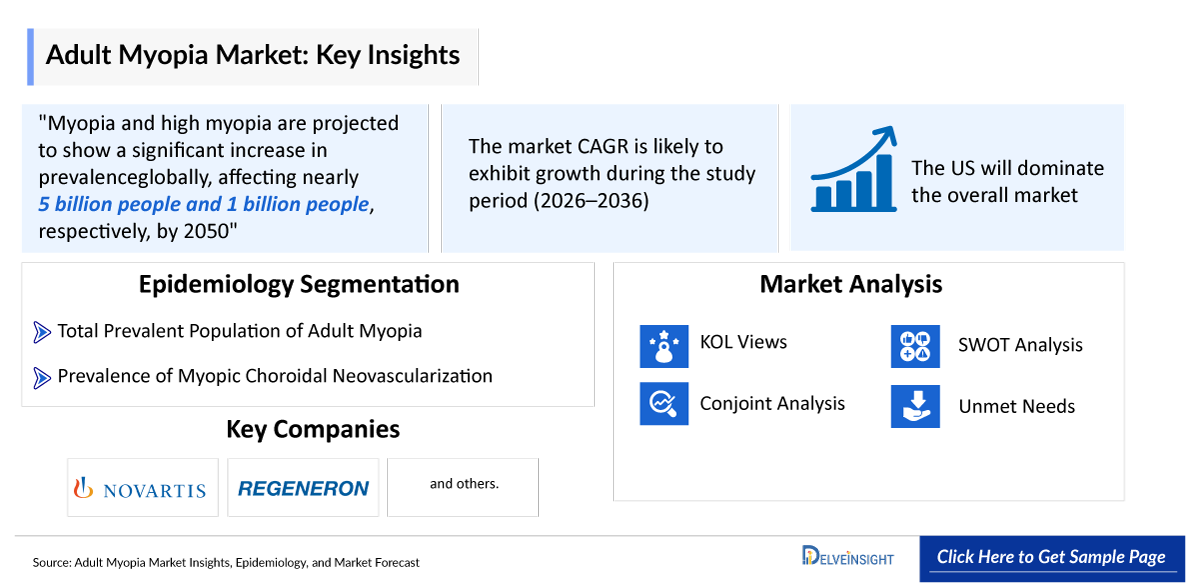
- Myopia and high myopia are projected to show a significant increase in prevalence globally, affecting nearly 5 billion people and 1 billion people, respectively, by 2050.
- Average progression rates demonstrated a gradual decline with advancing age; however, the most substantial and clinically significant myopia progression was observed between 20 and 30 years of age.
- The prevalence of myopia ranges between 1% and 78.4% across studies reported in the 21st century. Although myopia is more prevalent in East Asia, global prevalence has increased from 1.4 billion in 2000 and is projected to reach 4.8 billion by 2050.
- Myopia progression is likely to continue into early adulthood. At age 18, although nearly 75% of myopes are stable, around 25% continue progressing, and approximately 20% of individuals in their 20s may experience progression of at least 1 diopter (D).
- According to WHO-based prevalence projections, myopia and high myopia are expected to affect 52% (4.9 billion) and 10% (925 million) of the global population, respectively, by 2050, representing a major increase from 2010 estimates of 27% (1.9 billion) and 2.8% (170 million), respectively.
Adult Myopia Epidemiology Segmentation
- Total Adult Myopia Prevalent Population
- Prevalence of Myopic Choroidal Neovascularization
Adult Myopia Drug Analysis & Competitive Landscape
The Adult Myopia drug chapter provides a detailed, market-focused review of the emerging Adult Myopia Pipeline across Phase I–III clinical trials. It covers the Adult Myopia mechanism of action, clinical trial data, regulatory approvals, patents, collaborations, and strategic partnerships for each therapy, along with their advantages, limitations, and recent developments. This section offers critical insights into the adult myopia treatment landscape, supporting market assessment, competitive analysis, and growth forecasting for the adult myopia therapeutics market.
Adult Myopia Market Outlook
The Adult Myopia Market is evolving from conventional optical correction approaches toward pharmacological and targeted disease-modifying strategies, although spectacles, contact lenses, orthokeratology, and refractive surgeries such as LASIK continue to remain the primary standard of care. Despite available corrective interventions, progressive and high myopia remain associated with significant risks of irreversible ocular complications, including mCNV, retinal degeneration, glaucoma, and vision loss, highlighting a major unmet clinical need.
The current treatment landscape is increasingly focused on therapies aimed at slowing axial elongation and preventing pathologic complications. Low-dose atropine remains the most extensively studied pharmacological intervention for myopia control and has demonstrated efficacy in reducing myopia progression, although it continues to be used off-label and is not yet approved by major regulatory agencies for this indication. Growing clinical interest in selective antimuscarinic therapies and next-generation pharmacologic agents is expected to further expand the therapeutic landscape over the coming years.
In patients with pathologic myopia and mCNV, anti-VEGF therapies such as Ranibizumab, Aflibercept, and off-label bevacizumab remain the most effective treatment options for controlling neovascularization and preserving visual function. Ranibizumab became the first approved anti-VEGF therapy for subfoveal mCNV in several global markets, while aflibercept offers higher VEGF-binding affinity and potentially longer intraocular activity.
Key Findings from Adult Myopia Market Forecast Report
- The Adult Myopia Therapeutics Market is expected to expand significantly due to the rapidly increasing prevalence of myopia and high myopia, particularly in East and Southeast Asia.
- Current guidelines indicate that optical correction remains the standard of care for myopia across all age groups, while adult management is primarily risk-based and monitoring-focused, with no established disease-modifying therapy recommended for routine control of progression.
- Pharmacological myopia control strategies, particularly low-dose atropine and emerging antimuscarinic therapies, are expected to gain increasing clinical and commercial attention during the forecast period.
- Growing emphasis on early intervention and long-term myopia management strategies is driving increased adoption of diagnostic monitoring tools such as axial length measurement and retinal imaging, supporting more proactive disease tracking.
- The market is witnessing a gradual shift toward value-based care models, where demand is increasing for therapies and technologies that demonstrate measurable impact on slowing progression and reducing lifetime risk of vision-threatening complications.
Major Adult Myopia Companies
Genentech, Bayer AG, and others.
Adult Myopia Drug Class/Insights into Leading Emerging and Marketed Therapies (2022–2036 Forecast)
The Adult Myopia Treatment Market landscape spans from vision correction to long-term disease management, moving beyond simple refractive solutions toward strategies that address disease progression and prevent vision-threatening complications. While optical correction remains the foundation for restoring visual acuity, increasing focus is placed on slowing axial elongation and reducing the risk of irreversible retinal damage.
- Optical control therapies: Include spectacles, progressive addition lenses, executive bifocals, multifocal/peripheral defocus contact lenses, and orthokeratology. Among currently available optical approaches, executive bifocals, orthokeratology, and peripheral plus contact lenses have demonstrated clinically meaningful reductions in myopia progression and axial elongation in published studies. Extended depth-of-focus lenses are also emerging as promising options for long-term myopia control.
- Pharmacological myopia-control therapies: Include low-dose atropine eye drops, currently the most extensively studied pharmacologic intervention for myopia progression control. Clinical studies have demonstrated that 0.01% atropine can reduce myopia progression by approximately 50–60% with relatively fewer adverse effects compared with higher concentrations. Other investigational therapies such as 7-methylxanthine are also being explored for their ability to reduce axial elongation and slow disease progression.
- Surgical and advanced retinal therapies: Include refractive procedures such as LASIK, PRK, SMILE, and implantable collamer lenses (ICL) for visual correction in eligible adults. In highly progressive or pathologic myopia, posterior scleral reinforcement (PSR) and investigational scleral strengthening approaches are being evaluated to reduce excessive ocular elongation and prevent retinal complications. In patients with mCNV, anti-VEGF therapies such as Ranibizumab, Aflibercept, and off-label Bevacizumab remain the standard treatment for preserving visual function.
Optical correction remains the mainstay of care, while myopia-control approaches such as low-dose atropine and other emerging pharmacologic options are being used in selected cases to help slow progression. Alongside this, anti-VEGF therapies continue to be central in managing advanced complications, particularly mCNV.
Adult Myopia Drug Uptake
This section focuses on the uptake rate of potential Adult Myopia drugs expected to be launched in the market during the forecast period (2026–2036). The analysis covers the Adult Myopia drug’s uptake, performance at peak, factors affecting performance during prime years of growth, patient uptake by therapy, and anticipated sales generated by each drug.
The uptake of therapies in Myopia is expected to vary across optical correction therapies, pharmacological myopia-control treatments, and advanced surgical and retinal therapies. At present, there are no approved disease-modifying pharmacological therapies for myopia, and the pipeline remains relatively limited.
Low-dose atropine is expected to see rising uptake, particularly among pediatric and young adult patients with progressive myopia. Emerging therapies, including selective antimuscarinics, 7-methylxanthine, advanced peripheral defocus lenses, and scleral strengthening procedures, are likely to gain gradual adoption as long-term efficacy and safety evidence matures. Uptake will depend on their ability to slow axial elongation, improve tolerability, minimize adverse effects, and prevent progression to high/pathologic myopia.
Detailed insights of emerging therapies' drug uptake is included in the report...
Adult Myopia Market Access and Reimbursement
Reimbursement is a crucial factor that affects the drug’s access to the market. Often, the decision to reimburse comes down to the price of the drug relative to the benefit it produces in treated patients. To reduce the healthcare burden of these high-cost therapies, many payment models are being considered by payers and other industry insiders.
NOTE: Further Details are provided in the final report...
Adult Myopia Therapies Price Scenario & Trends
Pricing and analogue assessment of Adult Myopia therapies highlights evolving price dynamics structures. This section summarizes the cost of approved treatments, the closest and most appropriate analogue selection for emerging therapies, and understanding of how pricing influences market access, adherence, and long-term uptake.
Further details are provided in the final report...
Industry Experts and Physician Views for Adult Myopia
To keep up with Adult Myopia market trends, we take Key Opinion Leaders (KOLs) and Subject Matter Experts (SMEs) opinions working in the domain through primary research to fill the data gaps and validate our secondary research. Industry experts were contacted for insights on the emerging adult myopia therapies, evolving treatment landscape, patient adherence to conventional therapies, therapy switching trends, drug adoption and uptake, accessibility challenges, and epidemiology and real-world prescription patterns in adult myopia, including MD, PhD, Instructor, Postdoctoral Researcher, Professor, Researcher, and others.
DelveInsight’s analysts connected with 10+ KOLs to gather insights at the country level. Centers such as the Department of Ophthalmology, Keio University School of Medicine and Department of Ophthalmology, University Medical Center of the Johannes Gutenberg-University Mainz etc., were contacted. Their opinion helps understand and validate current and emerging Adult Myopia therapies, highlight unmet medical needs, provide epidemiological context, and support strategic decisions for market access, therapy adoption, and pipeline prioritization in adult myopia.
|
Region |
Key Opinion Leaders (KOLs) and Subject Matter Experts (SMEs) |
|
Japan |
“In Japan, all the children aged 6 years or more are subject to mandatory screening ophthalmologic exams. Therefore, very few are supposed to be unaware of their myopia. Also, in Japan, recommendation for outdoor works, 0.01% atropine eyedrops, special eyeglasses such as multifocal glasses and violet-light glasses, multifocal contact lenses, orthokeratology, and crocetin supplement are choices of treatment for myopic suppression.” |
|
Germany |
“Most individuals with myopia in Germany are diagnosed and have glasses. This might not be true in some minorities (migrants, for example) or in the elderly living in nursing homes. I am not aware of any pharmacological treatment of myopia. Lucentis targeting vascular endothelial growth factor to prevent vascularization would be rather a treatment of late effects in extreme myopic eyes than a treatment of myopia itself.” |
Adult Myopia Report Qualitative Analysis: SWOT and Conjoint Analysis
We perform qualitative and market Intelligence analysis using various approaches, such as SWOT analysis and conjoint analysis. In the SWOT analysis of Adult Myopia, strengths, weaknesses, opportunities, and threats in terms of disease diagnosis, patient awareness, patient burden, competitive landscape, cost-effectiveness, and geographical accessibility of therapies are provided.
Conjoint analysis analyzes emerging therapies based on relevant attributes such as safety, efficacy, frequency of administration, route of administration, and order of entry. Scoring is given based on these parameters to analyze the effectiveness of therapy.
The team of analysts analyzes promising emerging therapies based on relevant attributes such as safety, efficacy, frequency of administration, route of administration, and order of entry. In efficacy, the trial’s primary and secondary outcome measures are evaluated, whereas the therapies’ safety is evaluated, wherein the acceptability, tolerability, and adverse events are majorly observed. In addition, the scoring is also based on the route of administration, order of entry, probability of success, and the addressable patient pool for each therapy. According to these parameters, the final weightage score and the ranking of the emerging therapies are decided.
Adult Myopia Market Report Scope
- The Adult Myopia Therapeutics Market Report covers a segment of key events, an executive summary, a descriptive overview, explaining their causes, signs and symptoms, pathogenesis, and currently available treatments.
- Comprehensive insight has been provided into the epidemiology segments and forecasts, the future growth potential of the diagnosis rate, and disease progression along treatment guidelines.
- Additionally, an all-inclusive account of both the current and emerging treatments, along with the elaborate profiles of late-stage and prominent therapies, will have an impact on the current treatment landscape.
- A detailed review of the Adult Myopia Therapeutics Market, historical and forecasted Adult Myopia Treatment Market Size, Adult Myopia Drugs Market Share by therapies, detailed assumptions, and rationale behind our approach is included in the report, covering the 7MM drug outreach.
- The Adult Myopia Therapeutics Market Report provides an edge while developing business strategies by understanding trends through SWOT analysis and expert insights/KOL views, patient journey, and treatment preferences that help in shaping and driving the 7MM Adult Myopia Drugs Market.
Adult Myopia Market Report Insights
- Adult Myopia Patient Population Forecast
- Adult Myopia Therapeutics Market Size
- Adult Myopia Pipeline Analysis
- Adult Myopia Market Size and Trends
- Adult Myopia Market Opportunity (Current and Forecasted)
Adult Myopia Market Report Key Strengths
- Adult Myopia Epidemiology‑based (Epi‑based) Bottom‑up Forecasting
- Artificial Intelligence (AI)-Enabled Market Research Report
- 11-Year Forecast
- Adult Myopia Market Outlook (North America, Europe, Asia-Pacific)
- Adult Myopia Patient Burden Trends (By Geography)
- Adult Myopia Treatment Addressable Market (TAM)
- Adult Myopia Competitive Landscape
- Adult Myopia Major Companies Insights
- Adult Myopia Price Trends and Analogue Assessment
- Adult Myopia Therapies Drug Adoption/Uptake
- Adult Myopia Therapies Peak Patient Share Analysis
Adult Myopia Market Report Assessment
- Adult Myopia Current Treatment Practices
- Adult Myopia Unmet Needs
- Adult Myopia Clinical Development Analysis
- Adult Myopia Emerging Drugs Product Profiles
- Adult Myopia Market Attractiveness
- Adult Myopia Qualitative Analysis (SWOT and Conjoint Analysis)
- Adult Myopia Market Drivers
- Adult Myopia Market Barriers
Key Questions Answered in the Adult Myopia Market Report
Adult Myopia Therapeutics Market Insights
- What was the Adult Myopia market size, the market size by therapies, the market share (%) distribution in 2025, and what would it look like by 2036? What are the contributing factors for this growth?
- What are the anticipated pricing variations among different geographies for the emerging therapies in the future?
- What can be the future treatment paradigm of Adult Myopia?
- What are the disease risks, burdens, and unmet needs of Adult Myopia? What will be the growth opportunities across the 7MM concerning the Adult Myopia patient population?
- Who is the major future competitor in the market, and how will the competitors affect their market share?
- What are the current options for the treatment of Adult Myopia? What are the current guidelines for treating Adult Myopia in the US, Europe, and Japan?
Reasons to Buy Adult Myopia Market Forecast Report
- The Adult Myopia Therapeutics Market Report will help in developing business strategies by understanding the latest trends and changing treatment dynamics driving the Adult Myopia Drugs Market.
- Bottom up forecasting builds from the affected population to product forecasts, delivering a robust, data driven approach ideal for new therapies and novel classes.
- Insights on patient burden/disease Adult Myopia Incidence, evolution in diagnosis, and factors contributing to the change in the epidemiology of the disease during the forecast years.
- Understand the existing market opportunities in varying geographies and the growth potential over the coming years.
- Identifying strong upcoming players in the market will help devise strategies to help get ahead of competitors.
- Detailed analysis and ranking of class-wise potential current and emerging therapies under the conjoint analysis section to provide visibility around leading classes.
- To understand KOLs’ perspectives on the accessibility, acceptability, and compliance-related challenges of existing treatment to overcome barriers in the future.
- Detailed insights into the unmet needs of the existing market so that the upcoming players can strengthen their development and launch strategy.
- This Artificial Intelligence (AI) enabled report summarizes and simplifies complex datasets within the report into clear, actionable insights for stakeholders, investors, and healthcare providers, enabling faster, data driven decisions.
Stay updated with us for Recent Articles