
AL Amyloidosis Epidemiology
- AL amyloidosis is characterized by progressive multisystem involvement, with approximately 42% of patients presenting with involvement of three or more organs at diagnosis, most commonly affecting the kidneys (46%) and heart (40%), while cardiac and renal involvement further increases during disease progression to nearly 63% and 60%, respectively.
- Approximately 43–47% of AL amyloidosis patients present with advanced Stage IIIa or IIIb disease at diagnosis in the US and Germany, highlighting substantial delays in disease recognition and the high burden of severe cardiac involvement at initial presentation.
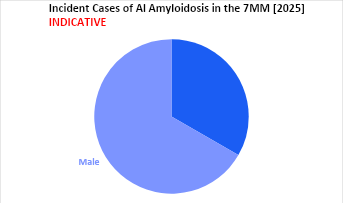
- AL amyloidosis primarily affects individuals aged 50–80 years, with males accounting for nearly two-third of the patient population.
- Delayed diagnosis remains a major challenge in AL amyloidosis, as the disease often presents with non-specific symptoms that mimic more common conditions, leading to advanced organ involvement at the time of diagnosis. Consequently, prognosis remains poor, with nearly 30% of patients dying within the first year following diagnosis.
AL Amyloidosis Epidemiology Forecast in the 7MM
- 2025 Incident Cases of AL Amyloidosis: ~XX Cases
- 2036 Projected Incident Cases of AL Amyloidosis: ~ XX Cases
- AL Amyloidosis Growth Rate (2026–2036): XX% CAGR
DelveInsight's ‘AL Amyloidosis– Market Insights, Epidemiology and Market Forecast – 2036’ report delivers an in-depth understanding of the AL amyloidosis, historical and forecasted epidemiology, as well as the AL amyloidosis market trends in the United States, EU4 (Germany, Spain, Italy, and France) and the United Kingdom, and Japan.
The AL Amyloidosis market report delivers a comprehensive analysis of the current treatment landscape, including standards of care, clinical practices, and evolving therapeutic algorithms. It evaluates, AL amyloidosis patient burden trends, revenue & market share dynamics, peak patient share & therapy uptake analysis, and provides an in-depth market size assessment, and growth rate projections (Historical & Forecast 2022–2036) across global regions. The report highlights key unmet medical needs in AL amyloidosis and maps the competitive and clinical landscape to uncover high‑value opportunities, providing a clear outlook on future market growth potential.
|
Study Period |
2022–2036 |
|
Historical Year |
2022–2025 |
|
Forecast Period |
2026–2036 |
|
Base Year |
2026 |
|
Geographies Covered |
|
|
AL Amyloidosis Epidemiology CAGR (Forecast period) |
XX% (2026–2036) |
|
AL Amyloidosis Epidemiology Segmentation Analysis |
Patient Burden Assessment
|
AL Amyloidosis Understanding and Diagnosis
AL Amyloidosis Overview and Diagnosis
Primary or light chain (AL) amyloidosis, the most common type of systemic amyloidosis, occurs when the free light chains normally associated with immunoglobulins are produced in excess by clonal or frankly malignant plasma cells. Although AL amyloidosis is not considered a cancer, it shares some similar characteristics and treatments with multiple myeloma. AL amyloidosis is most commonly diagnosed when the affected patient has less than 10% bone marrow plasma cells, the quantity required to make a diagnosis of myeloma, but may also occur in association with full-blown multiple myeloma, non-Hodgkin’s lymphoma, Waldenström’s macroglobulinemia, chronic lymphocytic leukemia, Sjogren’s syndrome, and Behçet syndrome.
Diagnosis
Diagnosis of systemic AL amyloidosis begins with detection of monoclonal proteins using serum and urine immunofixation, serum free light chain testing, and 24-hour urine protein assessment. If abnormalities are identified, tissue biopsy with Congo red staining is performed to confirm amyloid deposition, while organ biomarkers and imaging help evaluate organ involvement. Abdominal fat pad and bone marrow biopsies are commonly used surrogate sites, with combined sensitivity of ~85%, although organ biopsy may still be required in suspected cases. Following confirmation, accurate amyloid typing, preferably through mass spectrometry–based proteomics is essential to distinguish AL amyloidosis from other amyloid subtypes such as ATTR amyloidosis.
Further details are provided in the report.
AL Amyloidosis Epidemiology
Key Findings from AL Amyloidosis Epidemiological Analysis and Forecast
- In the United States, AL amyloidosis is the most common form of amyloidosis, with approximately 4,500 new cases diagnosed annually.
- In 2025, among age-specific cases, the prevalence of advanced-stage AL amyloidosis increased progressively with age, accounting for ~23% in patients aged 40–49 years, ~29% in 50–59 years, ~31% in 60–69 years, ~40% in 70–79 years, and ~36% in patients aged 80 years and older, in the United States.
- Among stage-specific cases of AL amyloidosis, Stage II disease is the most prevalent (~45%), followed by Stage IIIa (~21%), and Stage IIIb (~19%), indicating that a substantial proportion of patients are diagnosed at advanced stages of disease progression.
- In the gender-specific cases of AL amyloidosis, males get slightly more affected often than females.
- AL amyloidosis was identified as the most common amyloidosis subtype in Japan, accounting for ~48% of reported cases.
Scope of the Report
- The report covers a segment of key events, an executive summary, a descriptive overview of AL amyloidosis, explaining their causes, signs and symptoms, and pathogenesis.
- Comprehensive insight has been provided into the epidemiology segments and forecasts, the future growth potential of the diagnosis rate, and disease progression along treatment guidelines.
Report Insights
AL Amyloidosis Patient Population Forecast
Report Key Strengths
- Epidemiology‑based (Epi‑based) Bottom‑up Forecasting
- Artificial Intelligence (AI)-Enabled Market Research Report
- 11-Year Forecast
FAQs
- What are the disease risks, burdens, and unmet needs of AL amyloidosis? What will be the growth opportunities across the 7MM concerning the patient population with AL amyloidosis?
- What is the historical and forecasted AL amyloidosis patient pool in the US, EU4 (Germany, France, Italy, and Spain), the UK, and Japan?
Reasons to Buy
- Insights on patient burden/disease prevalence, evolution in diagnosis, and factors contributing to the change in the epidemiology of the disease during the forecast years.
- To understand key opinion leaders’ perspectives around the diagnostic challenges to overcome barriers in the future.
- Detailed insights on various factors hampering disease diagnosis and other existing diagnostic challenges.
- This Artificial Intelligence (AI)-enabled report summarize and simplify complex datasets with in the report into clear, actionable insights for stakeholders, investors, and healthcare providers, enabling faster, data-driven decisions.