alpha thalassemia pipeline insight pipeline insight
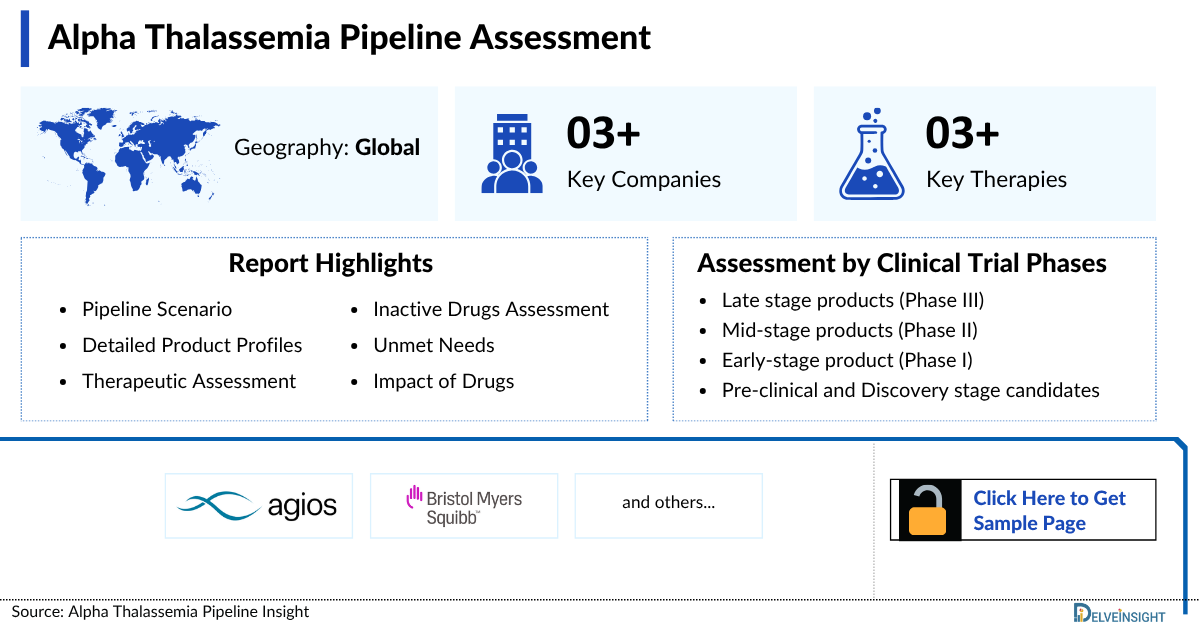
DelveInsight’s, “Alpha Thalassemia Pipeline Insight, 2026” report provides comprehensive insights about 3+ companies and 3+ pipeline drugs in Alpha Thalassemia pipeline landscape. It covers the pipeline drug profiles, including clinical and nonclinical stage products. It also covers the therapeutics assessment by product type, stage, route of administration, and molecule type. It further highlights the inactive pipeline products in this space.
Geography Covered
- Global coverage
Alpha Thalassemia Understanding
Alpha Thalassemia Overview
Although a-thalassemia is one of the most common inherited genetic disorders worldwide rather than a rare condition, its severe clinical forms, including HbH disease and Hb Bart's hydrops fetalis, are often underrecognized in regions where the disease is uncommon. The high prevalence of a-thalassemia in tropical and subtropical populations is largely attributed to the protective advantage of the carrier state against Plasmodium falciparum malaria. However, increasing global migration has expanded the presence of affected individuals beyond endemic regions, leading to underdiagnosis in countries such as those in Northern Europe and North America. Consequently, greater awareness among clinicians is essential to improve timely recognition, diagnosis, and management of these clinically significant forms of a-thalassemia.
a-Thalassemia results from reduced or absent production of a-globin chains due to defects in the four a-globin genes located on chromosome 16 or, less commonly, in their upstream regulatory elements. The disorder most frequently arises from deletions involving one (a?-thalassemia) or both (a°-thalassemia) a-globin genes, while non-deletional mutations, including point mutations, insertions, deletions, and variants affecting gene expression, mRNA processing, translation, or protein stability, can also impair a-globin synthesis and often produce more severe clinical phenotypes. Large deletions involving both a-globin genes or critical regulatory elements abolish a-globin production and are associated with severe conditions such as Hb Bart’s hydrops fetalis. The spectrum and prevalence of a-thalassemia mutations vary considerably across ethnic populations, making ancestry an important consideration in selecting appropriate molecular diagnostic strategies, including targeted deletion analysis and gene sequencing.
a-Thalassemia is caused by reduced or absent a-globin chain production due to mutations affecting the a-globin genes or their regulatory elements on chromosome 16. Most cases result from deletions of one (a?-thalassemia) or both (a°-thalassemia) a-globin genes, while non-deletional mutations that disrupt gene expression or protein synthesis can lead to more severe disease manifestations. Extensive deletions involving both a-globin genes or key regulatory regions eliminate a-globin production and are associated with severe disorders such as Hb Bart’s hydrops fetalis. As the mutation spectrum varies significantly across different ethnic populations, population-specific molecular testing, including deletion analysis and gene sequencing, plays a crucial role in accurate diagnosis.
The diagnosis of a-thalassemia begins with laboratory investigations, including a complete blood count (CBC) with red cell indices, high-performance liquid chromatography (HPLC) or hemoglobin electrophoresis, and, where required, measurement of the a/ß-globin chain synthesis ratio. Patients typically present with varying degrees of microcytic, hypochromic anemia, with disease severity correlating to the number of affected a-globin genes. HPLC and capillary electrophoresis are valuable for detecting HbH and Hb Bart’s, while Brilliant Cresyl Blue staining helps identify HbH inclusion bodies, particularly in HbH disease. Although a/ß-globin chain synthesis analysis directly assesses globin production, it has largely been replaced by molecular diagnostics due to its complexity. Modern molecular testing, including gap-PCR, targeted DNA sequencing, Multiplex Ligation-dependent Probe Amplification (MLPA), and, in selected cases, Southern blot analysis, enables accurate detection of both common deletions and non-deletional mutations, making genetic testing the cornerstone of definitive diagnosis.
Management of a-thalassemia depends on disease severity. Individuals with a-thalassemia trait generally require no specific treatment, as they are asymptomatic or have only mild anemia; however, coexisting nutritional deficiencies such as iron, folate, or vitamin B12 deficiency should be identified and treated appropriately, while unnecessary iron supplementation should be avoided to prevent iron overload. HbH disease exhibits variable clinical severity, with deletional forms typically causing milder disease that may require occasional transfusions during illness, whereas non-deletional forms are often more severe and may necessitate regular transfusions, splenectomy, and monitoring for iron overload, particularly in chronically transfused patients. Hb Bart’s hydrops fetalis syndrome is the most severe form of a-thalassemia and is associated with significant fetal and maternal complications. Although early intrauterine transfusions and hematopoietic stem cell transplantation have enabled survival in selected cases, outcomes remain challenging, underscoring the importance of genetic counseling, prenatal diagnosis, and informed reproductive decision-making for at-risk couples.
"Alpha Thalassemia Pipeline Insight, 2026" report by DelveInsight outlays comprehensive insights of present scenario and growth prospects across the indication. A detailed picture of the Alpha Thalassemia pipeline landscape is provided which includes the disease overview and Alpha Thalassemia treatment guidelines. The assessment part of the report embraces, in depth Alpha Thalassemia commercial assessment and clinical assessment of the pipeline products under development. In the report, detailed description of the drug is given which includes mechanism of action of the drug, clinical studies, NDA approvals (if any), and product development activities comprising the technology, Alpha Thalassemia collaborations, licensing, mergers and acquisition, funding, designations and other product related details.
Alpha Thalassemia Pipeline Report Highlights
The companies and academics are working to assess challenges and seek opportunities that could influence Alpha Thalassemia R&D. The therapies under development are focused on novel approaches to treat/improve Alpha Thalassemia.
Alpha Thalassemia Emerging Drugs Chapters
This segment of the Alpha Thalassemia report encloses its detailed analysis of various drugs in different stages of clinical development, including Phase III, II, I, Preclinical and Discovery. It also helps to understand clinical trial details, expressive pharmacological action, agreements and collaborations, and the latest news and press releases.
Alpha Thalassemia Emerging Drugs
HGI-002: Shenzhen Hemogen Therapeutic
HGI-002 Injection is an investigational autologous hematopoietic stem cell gene therapy developed by Shenzhen Hemogen for the treatment of transfusion-dependent a-thalassemia. The therapy involves harvesting a patient's own hematopoietic stem cells, genetically modifying them ex vivo using a lentiviral vector carrying a functional a-globin (HBA) gene, and reinfusing the corrected cells following conditioning therapy. By restoring a-globin expression and re-establishing the physiological balance between a- and ß-globin chains, HGI-002 is designed to improve hemoglobin production, reduce ineffective erythropoiesis, and ultimately achieve long-term transfusion independence. The therapy is currently being evaluated in an open-label, Early Phase I clinical trial to assess its safety, engraftment, and efficacy in patients with transfusion-dependent a-thalassemia, with key endpoints including successful hematopoietic stem cell engraftment, reduction in transfusion burden, and sustained transfusion independence.
Further product details are provided in the report...
Alpha Thalassemia Therapeutic Assessment
This segment of the report provides insights about the different Alpha Thalassemia drugs segregated based on following parameters that define the scope of the report, such as:
Major Players in Alpha Thalassemia
There are approx. 3+ key companies which are developing the therapies for Alpha Thalassemia. The companies which have their Alpha Thalassemia drug candidates in the most advanced stage, i.e. Phase I include, Shenzhen Hemogen Therapeutic.
Alpha Thalassemia Pipeline Phases
DelveInsight’s report covers around 3+ products under different phases of clinical development like
- Late stage products (Phase III)
- Mid-stage products (Phase II)
- Early-stage product (Phase I) along with the details of
- Pre-clinical and Discovery stage candidates
- Discontinued & Inactive candidates
Alpha Thalassemia Drugs Route of Administration
Alpha Thalassemia pipeline report provides the therapeutic assessment of the pipeline drugs by the Route of Administration. Products have been categorized under various ROAs such as
- Oral
- Intravenous
- Subcutaneous
- Parenteral
- Topical
Alpha Thalassemia Drugs Molecule Type
Products have been categorized under various Molecule types such as
- Recombinant fusion proteins
- Small molecule
- Monoclonal antibody
- Peptide
- Polymer
- Gene therapy
Product Type
- Drugs have been categorized under various product types like Mono, Combination and Mono/Combination.
Alpha Thalassemia Pipeline Development Activities
The Alpha Thalassemia pipeline report provides insights into different therapeutic candidates in Phase III, II, I, preclinical and discovery stage. It also analyses Alpha Thalassemia therapeutic drugs key players involved in developing key drugs.
Alpha Thalassemia Clinical Trials and Development Activities
The Alpha Thalassemia clinical trial analysis report covers the detailed information of collaborations, acquisition and merger, licensing along with a thorough therapeutic assessment of emerging Alpha Thalassemia drugs.
Alpha Thalassemia Pipeline Report Insights
- Alpha Thalassemia Pipeline Analysis
- Alpha Thalassemia Therapeutic Assessment
- Alpha Thalassemia Unmet Needs
- Impact of Alpha Thalassemia Drugs
Alpha Thalassemia Pipeline Report Assessment
- Alpha Thalassemia Pipeline Product Profiles
- Alpha Thalassemia Therapeutic Assessment
- Alpha Thalassemia Pipeline Assessment
- Inactive Alpha Thalassemia drugs assessment
- Alpha Thalassemia Unmet Needs
Explore the Alpha Thalassemia Market Insight, Epidemiology and Market Forecast – 2036 to understand disease trends, patient populations, treatment dynamics, and market opportunities.
Key Questions Answered in the Alpha Thalassemia Pipeline Report:
- Current Treatment Scenario and Emerging Therapies:
- How many companies are developing Alpha Thalassemia drugs?
- How many Alpha Thalassemia drugs are developed by each company?
- How many emerging drugs are in mid-stage, and late-stage of development for the treatment of Alpha Thalassemia?
- What are the key collaborations (Industry–Industry, Industry–Academia), Mergers and acquisitions, licensing activities related to the Alpha Thalassemia therapeutics?
- What are the recent trends, drug types and novel technologies developed to overcome the limitation of existing therapies?
- What are the clinical studies going on for Alpha Thalassemia and their status?
- What are the key designations that have been granted to the emerging drugs?
Key Alpha Thalassemia Companies
- Shenzhen Hemogen Therapeutic
- Reforgene Medicine
Key Alpha Thalassemia Pipeline Drugs
- HGI-002
- RM004



