alpha thalassemia epidemiology forecast
Alpha Thalessemia Trends
- According to Delveinsight analysis, the total number of prevalent cases of alpha thalassemia was found to be approximately 1500 cases in the United States in 2025.
- The total diagnosed prevalent cases of alpha thalassemia in the 7MM in 2025 was found to be approximately 4000 cases.
- Alpha Thalassemia represents one of the most common inherited hemoglobin disorders globally, with a substantial carrier burden distributed across the 7MM. The epidemiological landscape includes silent carriers, alpha-thalassemia trait, Hemoglobin H Disease, and severe alpha-thalassemia major cases, creating marked heterogeneity in disease presentation and diagnosed burden.
- The overall prevalence of Alpha Thalassemia within the 7MM is influenced by population migration, ethnic diversity, and expanded genetic screening practices. Although historically concentrated in specific geographic regions, demographic shifts and interethnic population mixing have contributed to broader disease distribution across the United States and European countries.
- A large proportion of alpha thalassemia cases remain undiagnosed or underrecognized, particularly among silent carriers and individuals with mild alpha-thalassemia trait due to limited symptoms and overlap with iron deficiency anemia. This diagnostic gap may lead to underestimation of the true disease burden.
- The United States is expected to experience a gradual increase in diagnosed Alpha Thalassemia cases during the forecast period, driven by increasing population diversity, migration from historically high- prevalence regions, improved newborn screening, and broader access to molecular diagnostic testing.
- Within EU4 and the UK, increasing migration patterns and enhanced prenatal screening programs are expected to influence diagnosed prevalence trends and improve identification of genetically at-risk populations. Enhanced carrier screening initiatives are likely to support earlier disease recognition and family-based counseling approaches.
- Japan is expected to represent a comparatively smaller share of alpha thalassemia cases within the 7MM; however, may contribute to gradual increases in diagnosis rates during the forecast period.
- The epidemiological burden of clinically significant Alpha Thalassemia, increasing awareness and improvements in genetic testing capabilities particularly Hemoglobin H Disease and transfusion-dependent disease, is anticipated to increase modestly due to improved survival, earlier diagnosis, and advances in disease monitoring and supportive care strategies.
- Future epidemiological trends across the 7MM are expected to be increasingly shaped by expanded newborn screening programs, molecular diagnostics, genetic counseling, and prenatal testing strategies, which may improve identification of both symptomatic and carrier populations.
Alpha Thalessemia Epidemiology Forecast in the United States
- 2025 Prevalent Cases of Alpha Thalessemia: ~XX Cases
- 2036 Prevalent Cases of Alpha Thalessemia: ~XX Cases
- Alpha Thalessemia Growth Rate (2026–2036): XX% CAGR
DelveInsight's ‘Alpha Thalessemia Epidemiology Forecast – 2036’ report delivers an in-depth understanding of the alpha thalessemia, historical and forecasted epidemiology in the United States, EU4 (Germany, Spain, Italy, and France) and the United Kingdom, and Japan.
|
Study Period |
2022–2036 |
|
Historical Year |
2022–2025 |
|
Forecast Period |
2026–2036 |
|
Base Year |
2026 |
|
Geographies Covered |
|
|
Alpha Thalessemia Epidemiology CAGR (Study period/Forecast period) |
XX% (2026-2036) |
|
Alpha Thalessemia Epidemiology Segmentation Analysis |
Patient Burden Assesment
|
Alpha Thalessemia Understanding and Diagnosis Algorithm
Alpha Thalessemia Overview
Alpha Thalassemia is an inherited hematologic disorder characterized by reduced or absent alpha-globin chain production resulting from deletions or mutations affecting alpha-globin genes. Disruption of normal alpha-globin synthesis leads to an imbalance in globin chain production, causing ineffective erythropoiesis and varying degrees of hemolytic anemia. Disease severity is determined by the number of affected alpha-globin genes and ranges from asymptomatic silent carrier states and alpha-thalassemia trait to more severe forms including Hemoglobin H Disease and alpha thalassemia major with hydrops fetalis syndrome. Across the 7MM, the epidemiological burden of Alpha Thalassemia continues to evolve due to migration patterns, population diversity, and broader adoption of genetic screening initiatives. Clinical manifestations vary according to disease severity and may include anemia, fatigue, pallor, jaundice, splenomegaly, growth abnormalities, skeletal complications, and transfusion dependence in more severe disease forms.
Alpha Thalessemia Diagnosis
Diagnosis of Alpha Thalassemia typically begins with clinical assessment and laboratory evaluation in individuals presenting with anemia, microcytosis, or a suggestive family history. Initial diagnostic investigations commonly include complete blood count (CBC), peripheral blood smear analysis, and red blood cell indices demonstrating microcytic hypochromic anemia. Hemoglobin analysis through electrophoresis, high-performance liquid chromatography (HPLC), or capillary electrophoresis may provide supportive diagnostic information; however, these methods may demonstrate limited sensitivity in certain alpha-thalassemia subtypes. Molecular genetic testing remains the gold standard for confirming alpha-globin gene deletions or mutations and differentiating genotype-specific disease severity. Across the 7MM, expanding use of newborn screening, prenatal testing, carrier screening, and genetic counseling programs is expected to improve early diagnosis and identification of severe disease forms, including hydrops fetalis syndrome.
Further details are provided in the report.......
Alpha Thalessemia Epidemiology
Key Findings from Alpha Thalessemia Epidemiological Analysis and Forecast
- The total diagnosed prevalent cases of α-thalassemia in the 7MM range from approximately 4,000 in 2025.
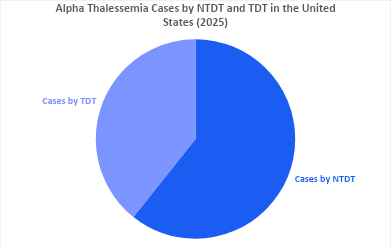
- In the United States, the proportion of non-transfusion-dependent thalassemia (NTDT) and transfusion-dependent thalassemia (TDT) cases were ~900 and ~600 cases respectively, in 2025.
- Among the EU 4 and the UK countries in 2025, Italy had the highest diagnosed prevalent cases of α-thalassemia with approximately 1,000 cases, followed by Spain (~500 cases) and Germany (~300 cases). In contrary, France had the lowest cases (~200 cases) in 2025.
- In 2025, a higher percentage of NTDT was observed in the EU4 and the UK compared to TDT.
- Japan accounted for nearly 400 diagnosed prevalent α-thalassemia cases in 2025.
Scope of the Report
- The report covers a segment of an executive summary, a descriptive overview of Alpha Thalessemia, explaining its causes, signs and symptoms, and pathogenesis.
- Comprehensive insight has been provided into the epidemiology segments and forecasts, the future growth potential of the diagnosis rate, and disease progression.
Report Insights
Alpha Thalessemia Patient Population Forecast
Report Key Strengths
- Epidemiology‑based (epi‑based) Bottom‑up Forecasting
- 11-year Forecast
- Patient Burden Trends (by geography)
FAQs
- What are the disease risks, burdens, and unmet needs of alpha thalessemia? What will be the growth opportunities across the 7MM concerning the patient population with alpha thalessemia?
- What is the historical and forecasted alpha thalessemia patient pool in the US, EU4 (Germany, France, Italy, and Spain), the UK, and Japan?
Reasons to Buy
- Insights on patient burden/disease prevalence, evolution in diagnosis, and factors contributing to the change in the epidemiology of the disease during the forecast years.
- To understand key opinion leaders’ perspectives around the diagnostic challenges to overcome barriers in the future.
- Detailed insights on various factors hampering disease diagnosis and other existing diagnostic challenges.