Anal Cancer Market Summary
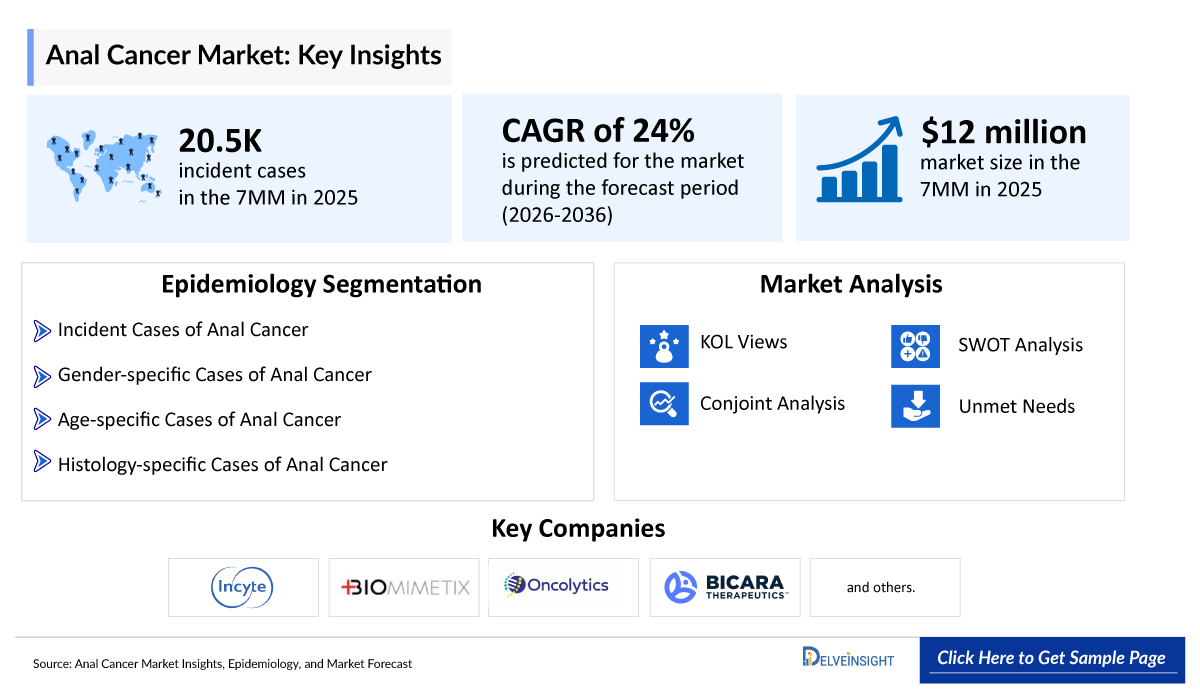
- The Anal Cancer Market Size, valued at approximately USD 12 million in 2025, is projected to reach nearly USD 120 million by 2036, growing at a CAGR of 24% during 2026–2036.
- The leading Anal Cancer Companies developing therapies in the treatment market include - Incyte Corporation, BioMimetix, Oncolytics Biotech, Bicara Therapeutics, and others.
Anal Cancer Market & Epidemiology Insights
- According to DelveInsight estimates, in 2025, the 7 MM accounted for the Anal Cancer market size, i.e., approximately USD 12 million, although recent analyses suggest potential upside driven by increasing adoption of novel and targeted therapies.
- In 2025, EU4 and the UK accounted for nearly 50% of the anal cancer market size among the 7MM, which is expected to increase by 2036.
- Anal cancer is a rare tumor, comprising about 2% of gastrointestinal cancers and under 7% of anorectal cancers. It typically arises between the anorectal junction and anal verge. Risk factors include HPV infection, HIV, tobacco use, immunosuppression, female sex, and older age.
- First-line chemoradiotherapy typically combines mitomycin with 5-fluorouracil or capecitabine and uses intensity-modulated radiotherapy (IMRT). Surgery is generally reserved for locally recurrent cases.
- Nivolumab (OPDIVO) and pembrolizumab (KEYTRUDA) are considered second-line immunotherapy options for patients who do not respond to initial treatments.
- Ongoing clinical trials investigate various treatments, including immunotherapy alone or in combination, radiotherapies, targeted therapies, and novel agents like programmed death-ligand 1 (PD-L1), epidermal growth factor receptor (EGFR), and circulating tumor DNA.
- Chemoradiotherapy (CRT) remains the standard of care for localized anal cancer, with ongoing research focusing on targeted therapies, immunotherapies, and novel chemotherapeutic agents to improve treatment outcomes.
- Emerging therapies such as ficerafusp alfa, BMX‑001, are advancing in clinical trials for anal cancer, reflecting growing innovation across immunotherapy and tumor-protective strategies.
- In August 2025, Invion Limited announced that the US Food and Drug Administration (FDA) granted Orphan Drug Designation to INV043 for the treatment of anal cancer, providing incentives to support the development of this therapy for a rare disease.
Anal Cancer Market Size and Forecast in the 7MM
- 2025 Anal Cancer Market Size: ~USD 12 million
- 2036 Projected Anal Cancer Market Size: ~USD 120 million
- Anal Cancer Growth Rate (2026–2036): ~24% CAGR
DelveInsight's ‘Anal Cancer Market Insights, Epidemiology and Market Forecast – 2036’ report delivers an in-depth understanding of the anal cancer, historical and forecasted epidemiology, as well as anal cancer market trends in the United States, EU4 (Germany, Spain, Italy, and France) and the United Kingdom, and Japan.
The Anal Cancer market report delivers a comprehensive analysis of the current treatment landscape, including standards of care, clinical practices, and evolving therapeutic algorithms. It evaluates anal cancer patient burden trends, revenue & market share dynamics, peak patient share & therapy uptake analysis, and provides an in-depth market size assessment and growth rate projections (Historical & Forecast 2022–2036) across global regions. The report highlights key unmet medical needs in anal cancer and maps the competitive and clinical landscape to uncover high‑value opportunities, providing a clear outlook on future market growth potential.
|
Scope of the Anal Cancer Market Report | |
|
Study Period |
2022–2036 |
|
Historical Year |
2022–2025 |
|
Forecast Period |
2026–2036 |
|
Base Year |
2026 |
|
Geographies Covered |
|
|
Anal Cancer Market CAGR (Study period/Forecast period) |
~24% (2026 ̶ 2036) |
|
Anal Cancer Epidemiology Segmentation Analysis |
Patient Burden Assessment
|
|
Anal Cancer Companies |
|
|
Anal Cancer Therapies |
|
|
Anal Cancer Market |
Segmented by
|
|
Analysis |
|
Key Factors Driving the Anal Cancer Market
- Rising Incidence of HPV-Associated Anal Cancer: The increasing prevalence of human papillomavirus (HPV) infections, particularly HPV-16, remains a major driver of the anal cancer market, as HPV is responsible for the majority of anal cancer cases. Rising incidence among immunocompromised populations, including individuals with HIV, is further contributing to disease burden.
- Growing Awareness and Improved Diagnosis Rates: Increasing awareness regarding anal cancer symptoms, screening in high-risk populations, and improvements in diagnostic techniques are supporting earlier detection and expanding the treatable patient population.
- Advancements in Chemoradiation and Multimodal Treatment Approaches: Chemoradiation remains the standard of care for localized anal cancer, and advancements in radiation techniques, along with optimized chemotherapy regimens, are improving treatment outcomes while reducing treatment-related complications.
- Expansion of Immunotherapy in Advanced Disease: The growing adoption of immune checkpoint inhibitors for recurrent or metastatic anal cancer is expanding treatment options for patients with limited alternatives after chemotherapy failure, creating new market opportunities.
Anal Cancer Understanding
Anal Cancer Overview
Anal cancer is relatively rare, comprising only approximately 2.5% of gastrointestinal tumors; however, the incidence of anal cancer has been steadily increasing in recent years, with a notable rise observed over the past three to four decades.
The rectum and the anal canal are structurally connected. The rectum begins at the point where the taenia converges and extends to the upper border of the puborectalis muscle; the anal canal starts at the upper border of the puborectalis muscle and extends to the anal verge. Rectal and anal cancers are different types of tumors. Adenocarcinomas are the most common form of rectal cancer, whereas anal cancers are generally squamous-cell carcinomas (SCCs) that arise from the squamous mucosa of the anal canal. SCCs are the most common type of anal cancer; other rare types include adenocarcinomas, anal melanoma, basal cell carcinoma, and others. Many behavioral risk factors, such as an increased number of sexual partners and anoreceptive intercourse, are mediated through HPV infection acquisition. Important non-sexual risk factors include chronic immunosuppression and cigarette smoking.
Most anal cancers seem to be linked to infection with HPV. While HPV infection seems to be important in the development of anal cancer, the vast majority of people with HPV infections do not get anal cancer. A great deal of research is being done to learn how HPV might cause anal cancer. There is good evidence that HPV causes many anal squamous cell carcinomas. But the role of this virus in causing anal adenocarcinomas is less certain.
Anal Cancer Diagnosis
The initial diagnostic evaluation of anal cancer includes digital rectal examination (DRE) and proctoscopy with biopsy. According to joint guidelines from the European Society for Medical Oncology, the European Society of Surgical Oncology, and the European Society of Radiotherapy and Oncology (ESMO-ESSO-ESTRO), as well as guidelines from the American Society of Colon and Rectal Surgeons, MRI of the pelvis and endoanal ultrasound (EAUS) should be used for the standard management of anal cancer. If MRI is not available, EAUS is recommended as an alternative. However, EAUS should be reserved for small T1 lesions because of its limited field of view, which may restrict the identification of regional lymph nodes.
CT scans of the chest, abdomen, and pelvis with intravenous contrast is commonly used to evaluate distant metastatic disease and lymphadenopathy. CT offers several advantages in the assessment of ASCC. The 18F-FDG PET/CT technique exhibits sensitivity in detecting the primary tumor; however, its ability to fully characterize the tumor is limited. The 18F-FDG PET/CT technique is currently recommended for radiation treatment planning because of its ability to detect nodal disease. PET/CT is more sensitive than CT alone in identifying nodes; however, it has modest specificity, leading to false-positive findings in cases of inflammatory conditions.
Further details are provided in the report.
Anal Cancer Treatment
The landscape of treatment for this cancer is rapidly evolving with novel combination strategies, including immunotherapy, radiation therapy, and biomarker-guided therapy. The recent focus on locoregional Squamous Cell Cancer of the Anus (SCCA) management is to tailor treatment according to tumor burden and minimize treatment-related toxicities.
Mitomycin plus either infusional 5-fluorouracil (5-FU) or capecitabine is used for first-line CRT, and intensity-modulated radiotherapy (IMRT) is the preferred modality for radiation for locoregional anal cancer. Locally recurrent disease is managed with surgical resection. Systemic treatment is first-line for metastatic SCCA and immunotherapy, with nivolumab and pembrolizumab being included as second-line agents. Current and future clinical trials are evaluating treatments for SCCA, including immunotherapy alone or in combination regimens, radiotherapies, targeted treatments, and novel agents.
Another critical aspect of SCCA is the personalization of CRT and immunotherapies based on molecular characterization and biomarkers such as the programmed death-ligand 1 (PD-L1), epidermal growth factor receptor (EGFR), and circulating tumor DNA.
Further details related to country-based variations are provided in the report.
Anal Cancer Unmet Needs
The section “unmet needs of Anal Cancer” outlines the critical gaps between the current state of patient care, diagnosis, and the ideal & effective management of the disease. It highlights the obstacles experienced by patients, clinicians, and researchers and identifies potential solutions for future progress.
- Limited Treatment Options for Advanced and Metastatic Disease
- High Recurrence Rates and Poor Long-Term Outcomes
- Treatment-Related Toxicities
- Lack of Targeted and Biomarker-Driven Therapies
- Limited Immunotherapy Response in Broader Patient Populations
- Limited Efficacy of Current Chemotherapy Regimens and others….
Comprehensive unmet needs insights in Anal Cancer and their strategic implications are provided in the full report.
Anal Cancer Epidemiology
The Anal Cancer epidemiology section provides insights about the historical and current Anal Cancer patient pool and forecasted trends for individual seven major countries. It helps to recognize the causes of current and forecasted trends by exploring numerous studies and views of key opinion leaders. This part of the Anal Cancer market report also provides the diagnosed patient pool and their trends along with assumptions undertaken.
Key Findings from Anal Cancer Epidemiological Analysis and Forecast
- According to DelveInsight’s estimates, in 2025, there were nearly 20,500 incident cases of anal cancer in the 7MM, out of which the US accounted for the highest incident cases in 2025.
- In EU4 and the UK, females accounted for more incident cases of anal cancer, i.e., nearly 70%, as compared to males with incident cases of nearly 30%, in 2025.
- In 2025, among EU4 and the UK, Germany accounted for the highest number of cases of anal cancer, whereas Spain accounted for the least number of cases.
- As per the analysis, in the United States in 2025, anal cancer was found to be more incident in patients aged 65 years and above (~60%), followed by patients aged 50-64 years (~37%), and it was lowest in patients below 50 years (~4%).
- In 2025, Japan accounted for approximately 1,200 incident cases of anal cancer accounted for approximately, which was significantly lower compared to the EU4 and the US.
- In Japan, HPV negative (~1, 100 cases) cases of anal cancer were found to be more incident than HPV positive (~100 cases) in 2025.
Anal Cancer Epidemiology Segmentation
- Total Incident Cases of Anal Cancer
- Gender-specific Cases of Anal Cancer
- Age-specific Cases of Anal Cancer
- Histology-specific Cases of Anal Cancer
- HPV Status-specific Cases of Anal Cancer
- Stage-specific Cases of Anal Cancer
- Line-wise Treated Cases of Anal Cancer
Anal Cancer Key Players Drug Updates
- In October 2025, Oncolytics Biotech announced updated clinical data for Pelareorep in combination with atezolizumab in previously treated metastatic anal cancer, demonstrating an objective response rate of ~30%, which was more than double historical response rates seen with currently available therapies.
- In August 2025, Invion Limited announced that the US FDA granted Orphan Drug Designation to INV043 for the treatment of anal cancer, providing incentives to support the development of this therapy for a rare disease.
- In May 2025, Incyte announced that the FDA had approved ZYNYZ, making it the first and only approved first-line treatment for advanced anal cancer patients in the US. In addition, the FDA approved ZYNYZ as a single agent for the treatment of adult patients with locally recurrent or metastatic SCAC with disease progression on or intolerance to platinum-based chemotherapy.
Anal Cancer Drug Chapters & Competitive Analysis
The Anal Cancer drug chapter provides a detailed, market-focused review of approved therapies and the emerging pipeline across Phase I–III Anal Cancer clinical trials. It covers the mechanism of action, clinical trial data, regulatory approvals, patents, collaborations, and strategic partnerships for each therapy, along with their advantages, limitations, and recent developments. This section offers critical insights into the anal cancer treatment landscape, supporting market assessment, competitive analysis, and growth forecasting for the anal cancer therapeutics market.
Approved Therapies for Anal Cancer
Retifanlimab-dlwr (ZYNYZ): Incyte
ZYNYZ is a humanized monoclonal antibody targeting programmed death receptor-1 (PD-1), indicated in combination with carboplatin and paclitaxel for the first-line treatment of adult patients with inoperable locally recurrent or metastatic squamous cell carcinoma of the anal canal (SCAC) and as a single agent for the treatment of adult patients with locally recurrent or metastatic SCAC with disease progression or intolerance to platinum-based chemotherapy in the US.
ZYNYZ is marketed by Incyte in the United States. In 2017, Incyte entered into an exclusive collaboration and license agreement with MacroGenics for global rights to ZYNYZ.
In May 2025, Incyte announced that the US FDA approved ZYNYZ, a humanized monoclonal antibody targeting PD-1, for use in combination with carboplatin and paclitaxel as a first-line treatment for adults with inoperable, locally recurrent, or metastatic SCAC. Additionally, ZYNYZ received approval as a monotherapy for adults with locally recurrent or metastatic SCAC who have progressed on or are intolerant to platinum-based chemotherapy.
Anal Cancer Marketed/Approved Therapies | ||||||
|
Drug/Therapy |
Company |
Indication |
Molecule Type |
RoA |
MoA |
Marketed Region |
|
Retifanlimab-dlwr (ZYNYZ) |
Incyte |
Advanced recurrent/ metastatic SCCA |
Monoclonal antibody |
IV |
PD-1 inhibitor |
US: 2025 |
Anal Cancer Pipeline Analysis
Ficerafusp alfa: Bicara Therapeutics
Ficerafusp alfa (BCA101) is a first-in-class bifunctional antibody that combines two clinically validated targets: an epidermal growth factor receptor (EGFR) directed monoclonal antibody with a domain that binds to human transforming growth factor beta (TGF-β). Through this dual-targeting mechanism, ficerafusp alfa has the potential to exert potent anti-tumor activity by simultaneously blocking both cancer cell-intrinsic EGFR survival and proliferation, as well as the immunosuppressive TGF-β signaling within the tumor microenvironment.
In January 2026, Bicara Therapeutics committed to bringing transformative bifunctional therapies to patients with solid tumors, provided a 2026 corporate outlook and strategy for continued growth, building upon the clinical success of ficerafusp alfa, the first and only bifunctional epidermal growth factor receptor (EGFR)-directed antibody combined with a TGF-β ligand trap designed to drive increased tumor penetration and improve survival outcomes.
In January 2025, Bicara Therapeutics shared findings from the Phase I/Ib dose expansion study of ficerafusp alfa combined with pembrolizumab in patients with second-line or later SCAC.
BMX-001: BioMimetix
BioMimetix is pioneering the advancement of BMX-001, a novel class of small molecules known as redox-active metalloporphyrins (MnPs), which have demonstrated robust anti-inflammatory effects. The mechanism of action of BMX-001 involves a dual impact on tumor cells and normal tissues. In tumor cells, BMX-001 inhibits the NF-κB and HIF-1𝛂 pathways, leading to heightened tumor cell destruction, angiogenesis inhibition, and decreased long-term tumor proliferation.
BMX-001 successfully crosses the blood–brain barrier, providing a viable solution for a condition with limited treatment options and serving as a platform for cancer treatment. Clinical trials have evidenced the clinical efficacy and safety of BMX-001, demonstrating a 6.6-month survival benefit in a substantial, randomized, controlled trial. These findings are further supported by preclinical studies showcasing BMX-001's efficacy in inhibiting tumors across various cancer types, such as neck cancer, breast cancer, and anal cancer.
Currently, the company is recruiting patients in its Phase I/II clinical trial of patients with newly diagnosed anal cancer.
Comparison of Anal Cancer Emerging Drugs Under Development | |||||||
|
Drug Name |
Company |
Highest Phase |
Indication |
RoA |
MoA |
Molecule Type |
Anticipated Launch in the US |
|
Ficerafusp alfa (BCA101) |
Bicara Therapeutics |
II/III |
Recurrent/metastatic SCAC/ HPV-driven solid tumors |
IV |
Bifunctional EGFR/TGF-β fusion protein |
Monoclonal antibody |
2028 |
|
BMX-001 |
BioMimetix |
I/II |
Newly diagnosed anal cancer |
SC |
NFkB and HIF-1a inhibitor |
Small Molecule |
Information is available in the full report |
|
Note: Launch insights are provisional and may change with future report updates or the occurrence of major key catalysts. | |||||||
Note: A detailed emerging therapies assessment will be provided in the final report
Anal Cancer Key Players, Market Leaders, and Emerging Companies
- Incyte Corporation
- BioMimetix
- Bicara therapeutics
- Oncolytics Biotech, and others
Anal Cancer Market Outlook
The first-line treatment option for locoregional anal cancer is combination CRT. The exception is early-stage perianal disease excluding the anal sphincter and superficially invasive SCC of the anus, for which wide local excision is a treatment option.
In anal cancer, the treatment paradigm has shifted from surgery to combined chemoradiation therapy. With this shift, the function of the anus could be preserved. After several randomized trials of induction chemotherapy, maintenance chemotherapy, and planned treatment breaks, the combination of MMC, 5-FU, and RT, without induction or maintenance chemotherapy or treatment breaks, remains the standard of care. Over the past decade, intensity-modulated radiotherapy (IMRT) has replaced older treatment techniques as the standard of care.
Moreover, strategies to decrease radiation-associated toxicities are an additional focus of current research on SCCA. A potential strategy to decrease hematologic toxicity is bone marrow-sparing IMRT. Immunotherapy is presently recommended as a second-line treatment option in the metastatic setting, but is currently being explored in the locoregional setting. Immune checkpoint inhibitors (ICI) have been an active focus of recently published studies on patients with locoregional SCCA.
Nevertheless, the treatment landscape is undergoing substantial changes with ongoing research and studies encompassing chemotherapy, immunotherapy, radiation therapy, and innovative combinations throughout the different stages of ASCC. These advancements in therapeutic exploration are indicative of a dynamic and evolving field with the potential to enhance treatment options and outcomes for individuals with anal cancer.
Further details will be provided in the report….
Drug Class/Insights into Leading Emerging and Marketed Therapies in Anal Cancer (2022–2036 Forecast)
The anal cancer treatment landscape is broadly segmented into cytotoxic chemotherapy, radiotherapy, surgery, immune checkpoint inhibitors, and emerging targeted/immunomodulatory therapies, with treatment selection primarily based on disease stage, recurrence status, and patient eligibility.
For localized and locoregional anal cancer, CRT remains the standard of care and accounts for the largest share of treated patients. This segment includes antimetabolite chemotherapy agents such as 5-fluorouracil (5-FU) and capecitabine, combined with the antitumor antibiotic mitomycin, alongside radiation therapy—particularly intensity-modulated radiotherapy (IMRT), which improves treatment precision and reduces toxicity. Surgical interventions, including local excision and abdominoperineal resection (APR), are typically reserved for persistent, recurrent, or invasive disease.
In the recurrent/metastatic setting, systemic chemotherapy has historically dominated treatment, particularly platinum-based chemotherapy such as carboplatin combined with the taxane paclitaxel, which emerged as the preferred first-line regimen following the InterAACT trial.
The market has recently shifted toward immunotherapy, particularly PD-1 inhibitors. In 2025, ZYNYZ by Incyte became the first FDA-approved therapy for inoperable locally recurrent or metastatic SCAC, significantly expanding the role of immunotherapy. Other PD-1 inhibitors, such as Nivolumab and Pembrolizumab, continue to be used in later-line and refractory settings.
The emerging pipeline is increasingly focused on next-generation targeted therapies, bifunctional antibodies, immunostimulatory agents, radioprotective therapies, oncolytic immunotherapies, and photodynamic therapies. Key candidates include Ficerafusp alfa (BCA101) (EGFR/TGF-β bifunctional antibody), BMX-001 (redox-active radioprotective small molecule), Pelareorep (oncolytic immunotherapy), and INV043 (photodynamic therapy). These therapies aim to improve response durability, reduce CRT-related toxicity, and address unmet needs in advanced disease.
Overall, the anal cancer market is expected to gradually transition from a predominantly CRT-driven landscape toward greater adoption of immunotherapy-based and targeted treatment approaches, particularly in recurrent/metastatic disease, while localized treatment continues to rely heavily on established chemoradiation protocols.
Further details will be provided in the report….
Anal Cancer Drug Uptake
This section focuses on the uptake rate of potential Anal Cancer drugs expected to be launched in the market during the forecast period (2026–2036). The analysis covers the anal cancer market's uptake by drugs, patient uptake by therapy, and sales of each drug.
The uptake of therapies in anal cancer is expected to vary across chemoradiotherapy, systemic chemotherapy, immunotherapy, and emerging targeted/immuno-oncology therapies. For localized and locoregional disease, concurrent chemoradiotherapy continues to dominate frontline treatment due to its curative potential and long-established clinical use. Standard regimens including 5-fluorouracil (5-FU)/capecitabine + mitomycin alongside radiation therapy remain widely adopted, while surgery is generally limited to persistent or recurrent cases after chemoradiation failure.
In the recurrent/metastatic setting, systemic chemotherapy regimens such as carboplatin + paclitaxel continue to maintain significant uptake due to strong physician familiarity and historical use as the standard first-line treatment. However, their market share is expected to gradually decline with the increasing adoption of immunotherapy-based regimens.
The biggest shift in uptake is expected from ZYNYZ by Incyte, which received US FDA approval in May 2025 as the first approved first-line immunotherapy for inoperable locally recurrent or metastatic SCAC, in combination with carboplatin/paclitaxel and as monotherapy in platinum-refractory patients. Its uptake is expected to grow rapidly due to strong survival benefits, first-mover advantage, and recent geographic expansion through approvals in Japan (December 2025) and Europe (March 2026).
Emerging therapies such as Pelareorep, Ficerafusp alfa (BCA101), BMX-001, and INV043 are expected to witness gradual uptake over the forecast period following clinical success and regulatory approvals. Their adoption will depend on their ability to improve response durability, reduce recurrence, and offer better outcomes in treatment-resistant patients.
Overall, treatment uptake is expected to increasingly shift toward immunotherapy and targeted combinations in advanced disease, while chemo radiotherapy will continue to remain the backbone of treatment in early-stage anal cancer.
Further detailed analysis of emerging therapies' drug uptake in the report…
Market Access and Reimbursement of Anal Cancer
-
The United States
|
The US Reimbursement for Anal Cancer | |
|
Drug |
Access Program |
|
Retifanlimab-dlwr (ZYNYZ) |
|
Reimbursement is a crucial factor that affects the drug’s access to the market. Often, the decision to reimburse comes down to the price of the drug relative to the benefit it produces in treated patients. To reduce the healthcare burden of these high-cost therapies, many payment models are being considered by payers and other industry insiders.
Further details are provided in the final report….
Anal Cancer Therapies Price Scenario & Trends
Pricing and analogue assessment of Anal Cancer therapies highlights evolving price dynamics structures. This section summarizes the cost of approved treatments, the closest and most appropriate analogue selection for emerging therapies, and understanding of how pricing influences market access, adherence, and long-term uptake.
Further details are provided in the final report….
Industry Experts and Physician Views for Anal Cancer
To keep up with anal cancer market trends, we take Key Opinion Leaders (KOLs) and Subject Matter Experts (SMEs) opinions working in the domain through primary research to fill the data gaps and validate our secondary research. Industry experts were contacted for insights on the Anal Cancer emerging therapies, evolving treatment landscape, patient adherence to conventional therapies, therapy switching trends, drug adoption and uptake, accessibility challenges, and epidemiology and real-world prescription patterns in anal cancer, including MD, PhD, Instructor, Postdoctoral Researcher, Professor, Researcher, and others.
DelveInsight’s analysts connected with 10+ KOLs to gather insights; however, interviews were conducted with 6+ KOLs in the 7MM. Centers such as the Anal Cancer Foundation, Princeton University, Aichi Medical University, etc., were contacted. Their opinion helps understand and validate current and emerging anal cancer therapies, highlight unmet medical needs, provide epidemiological context, and support strategic decisions for market access, therapy adoption, and pipeline prioritization in anal cancer.
|
Region |
Key Opinion Leaders (KOLs) and Subject Matter Experts (SMEs) |
|
United States |
“Anal cancer is strongly associated with HPV infection, particularly involving genotypes HPV-16 and HPV-18. The viral proteins E6 and E7, integral to HPV oncogenesis in squamous epithelia, play a significant role in disease development.” |
|
Japan |
“Anal cancer prognosis is primarily determined by tumor size and nodal status. Early-stage patients (T1 or T2) have over 85% 5-year survival rates, even with nodal involvement, if no adjacent organ invasion or distant metastases are present.” |
Anal Cancer Report Qualitative Analysis: SWOT and Conjoint Analysis
We perform qualitative and market Intelligence analysis using various approaches, such as SWOT analysis and conjoint analysis. In the SWOT analysis of Anal Cancer, strengths, weaknesses, opportunities, and threats in terms of disease diagnosis, patient awareness, patient burden, competitive landscape, cost-effectiveness, and geographical accessibility of therapies are provided.
Conjoint analysis analyzes emerging therapies based on relevant attributes such as safety, efficacy, frequency of administration, route of administration, and order of entry. Scoring is given based on these parameters to analyze the effectiveness of therapy.
The team of analysts analyzes promising emerging therapies based on relevant attributes such as safety, efficacy, frequency of administration, route of administration, and order of entry. In efficacy, the trial’s primary and secondary outcome measures are evaluated, whereas the therapies’ safety is evaluated, wherein the acceptability, tolerability, and adverse events are mainly observed. In addition, the scoring is also based on the route of administration, order of entry, probability of success, and the addressable patient pool for each therapy. According to these parameters, the final weightage score and the ranking of the emerging therapies are decided.
Scope of the Anal Cancer Market Report
- The Anal Cancer Market report covers a segment of key events, an executive summary, a descriptive overview of anal cancer, explaining its causes, signs and symptoms, pathogenesis, and currently available treatments.
- Comprehensive insight has been provided into the epidemiology segments and forecasts, the future growth potential of the diagnosis rate, and disease progression along treatment guidelines.
- Additionally, an all-inclusive account of both the current and emerging treatments, along with the elaborative profiles of late-stage and prominent therapies, will have an impact on the current Anal Cancer treatment landscape.
- A detailed review of the anal cancer market, historical and forecasted market size, market share by therapies, detailed assumptions, and rationale behind our approach is included in the report, covering the 7MM drug outreach.
- The Anal Cancer Market report provides an edge while developing business strategies by understanding trends through SWOT analysis and expert insights/KOL views, patient journey, and treatment preferences that help in shaping and driving the 7MM anal cancer market.
Anal Cancer Market Report Insights
- Anal Cancer Patient Population Forecast
- Anal Cancer Therapeutics Market Size
- Anal Cancer Pipeline Analysis
- Anal Cancer Market Size and Trends
- Anal Cancer Market Opportunity (Current and Forecasted)
Anal Cancer Market Report Key Strengths
- Epidemiology‑based (Epi‑based) Bottom‑up Forecasting
- Artificial Intelligence (AI)-enabled Market Research Report
- 11-year forecast
- Anal Cancer Market Outlook (North America, Europe, Asia-Pacific)
- Patient Burden Trends (by geography)
- Anal Cancer Treatment Addressable Market (TAM)
- Anal Cancer Competitive Landscape
- Anal Cancer Major Companies Insights
- Anal Cancer Price Trends and Analogue Assessment
- Anal Cancer Therapies Drug Adoption/Uptake
- Anal Cancer Therapies Peak Patient Share Analysis
Anal Cancer Market Report Assessment
- Anal Cancer Current Treatment Practices
- Anal Cancer Unmet Needs
- Anal Cancer Clinical Development Analysis
- Anal Cancer Emerging Drugs Product Profiles
- Anal Cancer Market Attractiveness
- Anal Cancer Qualitative Analysis (SWOT and Conjoint Analysis)
- Anal Cancer Market Drivers
- Anal Cancer Market Barriers
FAQs Related to Anal Cancer Market Report:
Anal Cancer Market Insights
- What was the Anal Cancer market size, the market size by therapies, market share (%) distribution in 2025, and what would it look like by 2036? What are the contributing factors for this growth?
- What are the anticipated pricing variations among different geographies for the emerging therapies in the future?
- What can be the future treatment paradigm of anal cancer?
- What are the disease risks, burdens, and unmet needs of Anal Cancer? What will be the growth opportunities across the 7MM concerning the Anal Cancer patient population?
- Who is the major future competitor in the market, and how will the competitors affect their market share?
- What are the current options for the treatment of anal cancer? What are the current guidelines for treating Anal Cancer in the US, Europe, and Japan?
Reasons to Buy the Anal Cancer Market Forecast Report
- The Anal Cancer Market report will help in developing business strategies by understanding the latest trends and changing treatment dynamics driving the Anal Cancer market.
- Bottom-up forecasting builds from the affected population to product forecasts, delivering a robust, data-driven approach ideal for new therapies and novel classes.
- Insights on patient burden/disease incidence, evolution in diagnosis, and factors contributing to the change in the epidemiology of the disease during the forecast years.
- Understand the existing market opportunities in varying geographies and the growth potential over the coming years.
- Identifying strong upcoming players in the market will help devise strategies to help get ahead of competitors.
- Detailed analysis and ranking of class-wise potential current and emerging therapies under the conjoint analysis section to provide visibility around leading classes.
- To understand KOLs’ perspectives on the accessibility, acceptability, and compliance-related challenges of existing treatment to overcome barriers in the future.
- Detailed insights into the unmet needs of the existing market so that the upcoming players can strengthen their development and launch strategy.
- This Artificial Intelligence (AI)-enabled report summarize and simplify complex datasets within the report into clear, actionable insights for stakeholders, investors, and healthcare providers, enabling faster, data-driven decisions.