Analytical Instrumentation Market Summary
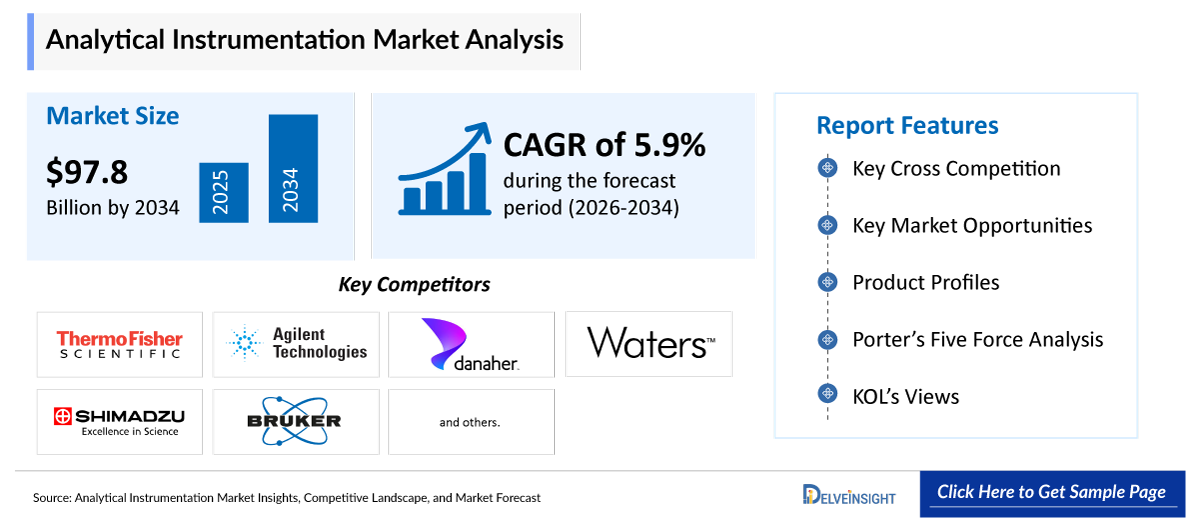
- The global analytical instrumentation market size was valued at USD 58.3 billion in 2025 and is projected to reach USD 97.8 billion by 2034.
- The market is expected to expand at a CAGR of 5.9% during the forecast period 2026-2034, supported by rising research and development investment across pharmaceutical and biotechnology industries, tightening quality control and regulatory compliance requirements in manufacturing and environmental testing, the expansion of precision medicine and multi-omics research, and continued innovation in high-resolution mass spectrometry, chromatography, and spectroscopy platforms.
- By product type, the chromatography instruments segment dominated the analytical instrumentation market with a 28% share in 2025.
- By application, the pharmaceutical and biotechnology segment dominated the analytical instrumentation market with a 41% share in 2025.
- By end-user, the pharmaceutical and biotechnology companies segment dominated the analytical instrumentation market with a 38% share in 2025.
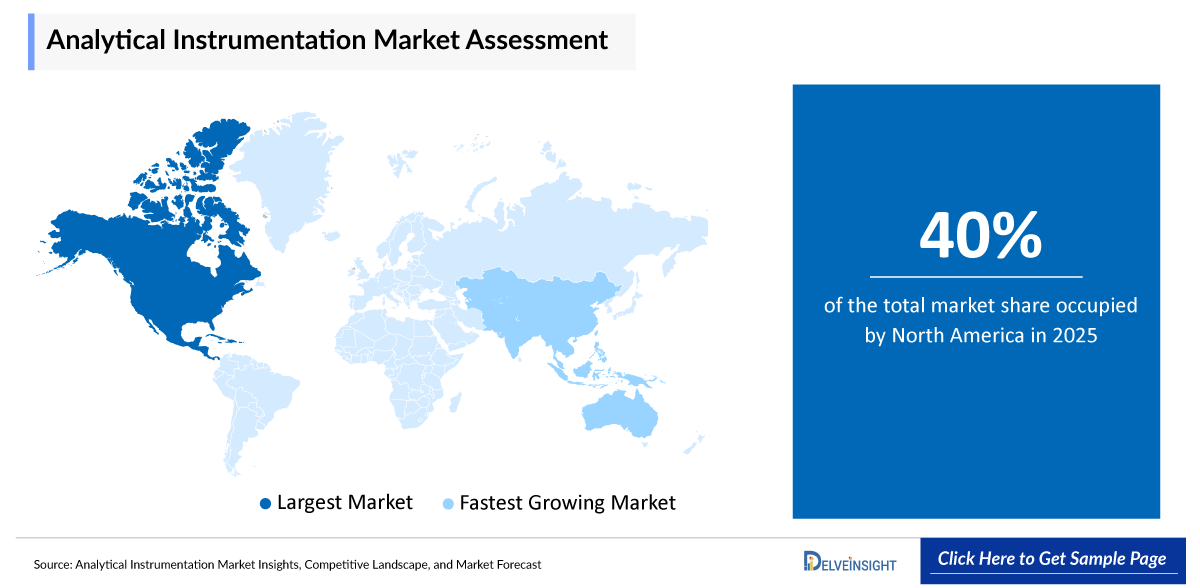
- North America accounted for the largest share of the analytical instrumentation market at 40% in 2025, while Asia-Pacific is anticipated to register the fastest growth through 2034.
Analytical instrumentation encompasses the instruments, software, and consumables used to identify, quantify, and characterize the chemical, biological, and physical properties of samples across pharmaceutical, biotechnology, environmental, food and beverage, chemical, and academic research settings.
The scope encompasses chromatography systems, including high-performance and ultra-high-performance liquid chromatography and gas chromatography, from Agilent Technologies, Waters, Shimadzu, and Thermo Fisher Scientific; mass spectrometry platforms, including triple quadrupole, time-of-flight, and Orbitrap systems, from Thermo Fisher Scientific, Agilent, Waters, Bruker, Danaher's SCIEX, and Shimadzu; molecular and elemental spectroscopy instruments, including UV-Vis, FTIR, NMR, ICP-MS, ICP-OES, and atomic absorption systems, from Agilent, PerkinElmer, Bruker, Thermo Fisher Scientific, and Analytik Jena; analytical microscopy systems from ZEISS, Bruker, and Thermo Fisher Scientific; and general laboratory analytical instruments, including titrators, balances, and pH meters, from Mettler-Toledo and Metrohm. The market spans applications in pharmaceutical and biotechnology research and quality control, environmental testing, food and beverage safety testing, clinical diagnostics, and chemical and petrochemical analysis.
Analytical Instrumentation Market Key Growth Drivers
- Rising research and development investment across pharmaceutical and biotechnology industries, driving demand for high-precision analytical platforms in drug discovery, development, and quality control.
- Tightening quality control and regulatory compliance requirements in pharmaceutical manufacturing, environmental testing, and food safety that mandate validated analytical methods and instrumentation.
- Expansion of precision medicine and multi-omics research, including proteomics, genomics, and metabolomics that drives adoption of high-resolution mass spectrometry and chromatography platforms.
- Continued technological innovation in chromatography, mass spectrometry, and spectroscopy that improves sensitivity, throughput, and ease of use, expanding the addressable application base.
- Growing enforcement of environmental contaminant testing, including PFAS monitoring in drinking water, that requires advanced mass spectrometry and elemental analysis instrumentation.
- Expansion of biopharmaceutical manufacturing capacity and biosimilar development, which increases demand for analytical instrumentation supporting biologics characterization and release testing.
- Increasing adoption of automation, artificial intelligence-enabled spectral analysis, and cloud-connected laboratory informatics that enhance instrument throughput and data interpretation.
Key Companies in Analytical Instrumentation Market
The leading participants in the analytical instrumentation market include the following:
- Thermo Fisher Scientific Inc.
- Agilent Technologies, Inc.
- Danaher Corporation
- Waters Corporation
- Shimadzu Corporation
- Bruker Corporation
- PerkinElmer, Inc. (New Mountain Capital)
- Bio-Rad Laboratories, Inc.
- Mettler-Toledo International Inc.
- Merck KGaA (MilliporeSigma), and others
For illustrative purposes, only the top 10 companies are listed in the Table of Contents. The report may include analysis and references to additional companies relevant to the market assessment.
Analytical Instrumentation Market Size
The following table summarizes the headline market metrics for the global analytical instrumentation market across the base year and the forecast horizon.
|
Report Metrics |
Details |
|
2025 Market Size |
USD 58.3 billion |
|
2034 Projected Market Size |
USD 97.8 billion |
|
Growth Rate (2026-2034) |
5.9% CAGR |
|
Largest Market |
North America (40% share in 2025) |
|
Fastest Growing Market |
Asia-Pacific |
|
Market Structure |
Moderately Consolidated |
All market values are expressed in USD and represent DelveInsight estimates synthesized from primary and secondary research.
Factors Contributing to the Growth of the Analytical Instrumentation Market
Analytical Instrumentation Market Drivers
- Rising Research and Development Investment in Pharmaceutical and Biotechnology: The foundational driver of the analytical instrumentation market is the sustained growth in research and development investment across the pharmaceutical and biotechnology industries, which rely on chromatography, mass spectrometry, and spectroscopy platforms at every stage of drug discovery, development, and manufacturing. Therapeutic proteins, biologics, and increasingly complex modalities such as cell and gene therapies require extensive chemical and biophysical characterization, performed using high-performance liquid chromatography, capillary electrophoresis, and mass spectrometry. As pharmaceutical and biotechnology companies expand pipelines and biopharmaceutical manufacturing capacity, demand for validated, high-throughput analytical instrumentation grows correspondingly, sustaining the position of pharmaceutical and biotechnology research as the largest application for analytical instrumentation across the forecast period.
- Tightening Quality Control and Regulatory Compliance Requirements: Tightening quality control and regulatory compliance requirements across pharmaceutical manufacturing, environmental testing, and food safety sustain demand for validated analytical instrumentation and compliance-enabling software. Regulatory frameworks including 21 CFR Part 11 in the United States require electronic records and audit trail capability, and vendors including Agilent have developed dedicated compliance software and workflows to support these requirements. As regulatory scrutiny intensifies across pharmaceutical, food, and environmental testing industries, laboratories increasingly invest in instrumentation and software that streamline compliance, sustaining demand for analytical instrumentation upgrades and replacement across the forecast period.
- Expansion of Precision Medicine and Multi-Omics Research: The expansion of precision medicine and multi-omics research, spanning proteomics, genomics, and metabolomics, is a powerful driver of demand for high-resolution mass spectrometry and chromatography platforms. Advanced instruments, including Thermo Fisher Scientific's Orbitrap mass spectrometers and Waters' ACQUITY Premier UPLC systems featuring MaxPeak surface technology designed to reduce analyte adsorption for peptide and oligonucleotide workflows, support the growing complexity of biomarker discovery and precision therapeutic development. As biopharmaceutical companies and academic research centers increase investment in multi-omics platforms to support personalized medicine and biomarker-driven drug development, demand for high-resolution analytical instrumentation grows across the forecast period.
- Continued Technological Innovation across Instrument Platforms: Continued innovation in chromatography, mass spectrometry, and spectroscopy technology improves the sensitivity, throughput, and usability of analytical instruments, expanding their addressable application base. Recent examples include Thermo Fisher Scientific's Dionex Inuvion ion chromatography system, Waters' MaxPeak surface UPLC technology, and Bruker's continued investment in trapped-ion-mobility spectrometry for complex proteomic separation. As vendors introduce instruments with improved analytical performance, automation, and integrated data science capability, laboratories replace legacy instrumentation and adopt new platforms, sustaining innovation-led demand across the forecast period.
- Growing Enforcement of Environmental Contaminant Testing: Growing enforcement of environmental contaminant testing, particularly for per- and polyfluoroalkyl substances (PFAS) in drinking water and groundwater, drives demand for advanced mass spectrometry and elemental analysis instrumentation. Regulatory actions, including United States Environmental Protection Agency enforceable maximum contaminant levels for specific PFAS compounds and Australian groundwater-monitoring programs mandating PFAS detection at trace concentrations, require testing primarily performed using liquid chromatography-mass spectrometry and high-resolution inductively coupled plasma mass spectrometry. As environmental regulatory scrutiny of emerging contaminants intensifies across major markets, demand for the mass spectrometry and elemental spectroscopy instrumentation capable of trace-level detection grows across the forecast period.
- Expansion of Biopharmaceutical Manufacturing and Biosimilar Development: The expansion of biopharmaceutical manufacturing capacity and the growth of biosimilar development increase demand for analytical instrumentation supporting biologics characterization, process analytical technology, and batch release testing. Chromatography systems purpose-built for biomolecule separation, including instrumentation from Sartorius following its acquisition of Novasep's chromatography portfolio, support continuous biologics manufacturing and the characterization of oligonucleotides, peptides, and insulin analogs. As biopharmaceutical manufacturing capacity expands globally and biosimilar approvals increase, demand for analytical instrumentation across development and manufacturing quality control grows across the forecast period.
Analytical Instrumentation Market Market Restraints
The analytical instrumentation market faces several interrelated restraints that temper its growth. The foremost is the high capital cost of advanced chromatography, mass spectrometry, and spectroscopy instruments, which requires substantial upfront investment and constrains adoption among smaller laboratories, academic institutions, and organizations in cost-sensitive and lower-resource markets. The requirement for specialized technical expertise to operate, maintain, and interpret data from advanced instrumentation limits adoption where skilled analytical chemists and laboratory scientists are in short supply. Instrument qualification, validation, and ongoing calibration requirements under regulatory frameworks add operational cost and complexity, particularly for laboratories operating in regulated pharmaceutical and clinical environments. The long replacement cycles typical of capital-intensive analytical instrumentation, often extending seven years or longer, moderate the pace of upgrade-driven demand relative to consumables and services. Global supply chain and semiconductor component constraints affecting sophisticated detector and electronics manufacturing can extend instrument lead times and affect vendor delivery commitments. Together, these factors moderate the pace of adoption and require vendors to demonstrate total cost of ownership advantages, ease of use, and robust global service networks to sustain growth.
Analytical Instrumentation Market Segment Analysis
The global analytical instrumentation market is segmented by product type (chromatography instruments, mass spectrometry instruments, spectroscopy instruments, analytical microscopes, and other laboratory analytical instruments), by application (pharmaceutical and biotechnology, environmental testing, food and beverage testing, clinical diagnostics, chemical and petrochemical, academic and research, and others), by end-user (pharmaceutical and biotechnology companies, contract research and manufacturing organizations, academic and research institutes, food and beverage industry, environmental testing agencies and government laboratories, and chemical and petrochemical industry), and by geography (North America, Europe, Asia-Pacific, and the Rest of the World).
By Product Type
Dominant Subsegment: Chromatography Instruments.
The chromatography instruments category is expected to dominate the market. The chromatography instruments segment accounted for a 28% share of the analytical instrumentation market in 2025. Chromatography instruments, including high-performance and ultra-high-performance liquid chromatography systems from Agilent, Waters, Shimadzu, and Thermo Fisher Scientific, and gas chromatography systems from the same vendors, are the leading product category because chromatographic separation is a foundational and near-universal step in pharmaceutical, environmental, and food safety analysis, and because the category benefits from continuous platform innovation such as Waters' MaxPeak surface UPLC technology and Thermo Fisher Scientific's Dionex ion chromatography systems. The dominance of the segment reflects the breadth of chromatography applications across virtually every end-market served by analytical instrumentation and the depth of the installed base and consumables revenue associated with chromatography columns and reagents. While mass spectrometry, spectroscopy, and analytical microscopy are substantial and, in several cases, faster-growing categories, particularly as multi-omics and trace contaminant detection expand, the breadth of application and installed base depth of chromatography instruments sustain the leadership of the segment across the forecast period.
By Application
Dominant Subsegment: Pharmaceutical and Biotechnology.
The pharmaceutical and biotechnology category is expected to dominate the market. The pharmaceutical and biotechnology segment accounted for a 41% share of the analytical instrumentation market in 2025. Pharmaceutical and biotechnology applications, spanning drug discovery, formulation development, biologics characterization, and manufacturing quality control, are the leading application because pharmaceutical companies represent the largest and most consistent purchasers of high-end chromatography, mass spectrometry, and spectroscopy instrumentation, and because regulatory requirements mandate extensive analytical testing throughout the drug development and manufacturing lifecycle. The dominance of the segment reflects the scale of global pharmaceutical and biotechnology research and development investment, the expansion of biopharmaceutical and biosimilar manufacturing capacity, and the breadth of analytical techniques required to characterize increasingly complex therapeutic modalities. While environmental testing, food and beverage testing, clinical diagnostics, and chemical and petrochemical applications are significant and, in the case of environmental and clinical testing, faster-growing applications, the scale and consistency of pharmaceutical and biotechnology industry demand sustain the leadership of the segment across the forecast period.
By End-User
Dominant Subsegment: Pharmaceutical and Biotechnology Companies.
The pharmaceutical and biotechnology companies category is expected to dominate the market. The pharmaceutical and biotechnology companies segment accounted for a 38% share of the analytical instrumentation market in 2025. Pharmaceutical and biotechnology companies are the principal purchasers of analytical instrumentation because they operate extensive research and development, quality control, and manufacturing analytical laboratories across the drug development lifecycle, and because they maintain the capital budgets and regulatory compliance infrastructure required to invest in and maintain advanced chromatography, mass spectrometry, and spectroscopy platforms. The dominance of the segment reflects the scale of global pharmaceutical and biotechnology R&D and manufacturing investment and the multi-instrument analytical workflows required across discovery, development, and commercial manufacturing. While contract research and manufacturing organizations, academic and research institutes, and food and beverage, environmental, and chemical industry end-users are significant and, in the case of contract organizations, a growing end-user category as pharmaceutical companies outsource development and manufacturing, the scale of direct pharmaceutical and biotechnology company investment sustains the leadership of the segment across the forecast period.
Analytical Instrumentation Market Region Analysis
Dominant Region: North America
North America accounted for a 40% share of the global analytical instrumentation market in 2025, representing the highest regional market share globally. The leadership of the region reflects the concentration of leading manufacturers including Thermo Fisher Scientific, Agilent Technologies, Danaher, and Waters, the scale of pharmaceutical and biotechnology research and manufacturing investment, robust academic and government research funding, and the depth of environmental and food safety regulatory enforcement. The United States is the largest national market, supported by the concentration of analytical instrumentation manufacturers, extensive biopharmaceutical manufacturing capacity, and Environmental Protection Agency enforcement of emerging contaminant testing requirements. The concentration of vendors, research investment, and regulatory enforcement reinforce the position of North America as the largest regional market across the forecast period.
Fastest Growing Region: Asia-Pacific
Asia-Pacific is projected to register the fastest compound annual growth rate through 2034. The region is expanding and modernizing its pharmaceutical, biotechnology, and industrial manufacturing infrastructure, increasing government research funding, and adopting advanced analytical instrumentation from a growing base. China, Japan, and India are the principal national markets, supported by the expansion of biopharmaceutical manufacturing and generic and biosimilar drug production, rapid industrialization requiring chemical and environmental testing capacity, and rising government investment in scientific research infrastructure. As pharmaceutical, biotechnology, and industrial manufacturing capacity expands and as government research funding increases, the region increases its adoption of analytical instrumentation from a growing base, positioning Asia-Pacific as the fastest-growing regional market and attracting continued manufacturing and commercial investment from the leading global vendors, exemplified by Agilent Technologies' 2025 expansion of its Singapore manufacturing facility.
Analytical Instrumentation Market Regional Commentary
North America
North America leads the market, supported by the concentration of leading vendors, the scale of pharmaceutical and biotechnology research investment, and robust regulatory enforcement of environmental and food safety testing requirements. The United States dominates the region through its concentration of manufacturers and biopharmaceutical research and manufacturing capacity.
Europe
Europe is a substantial market shaped by strong pharmaceutical manufacturing and research infrastructure, established environmental and chemical regulatory frameworks, and the presence of vendors including Merck KGaA, Bruker, and Sartorius. Germany, the United Kingdom, France, Italy, and Spain are the principal national markets, and Germany in particular anchors the region's chemical, pharmaceutical, and precision instrumentation manufacturing base.
Asia-Pacific
Asia-Pacific is the fastest-growing region, driven by the expansion of pharmaceutical and biotechnology manufacturing capacity, rapid industrialization requiring chemical and environmental testing, and rising government research investment across China, Japan, and India.
Rest of World
The Rest of World, spanning Latin America, the Middle East, and Africa, represents an emerging opportunity as industrial and research infrastructure expands, with petrochemical expansion in Saudi Arabia and the United Arab Emirates driving investment in gas chromatography and elemental spectroscopy, and food testing and mining applications shaping demand in Brazil and Argentina.
Analytical Instrumentation Market Competitive Landscape
The global analytical instrumentation market is classified as Moderately Consolidated. A group of diversified life science and analytical instrumentation companies holds a substantial share of the market through vertically integrated portfolios spanning hardware, software, consumables, and services, secured through multiyear service and consumables agreements with pharmaceutical, biotechnology, and industrial customers, while specialist vendors compete on differentiated platforms within specific instrument categories. Competition centers on the breadth of the instrument portfolio across chromatography, mass spectrometry, and spectroscopy, the depth of the global service and applications support network, integration of automation and artificial intelligence-enabled data analysis, and regulatory compliance software capability.
The competitive landscape is evaluated across the following dimensions:
- Market concentration: Moderately consolidated, with Thermo Fisher Scientific, Agilent Technologies, Danaher, Waters, and Shimadzu collectively controlling roughly 45% of 2025 market revenue, alongside specialist vendors including Bruker, PerkinElmer, Bio-Rad Laboratories, Mettler-Toledo, and Merck KGaA.
- Leading players: Thermo Fisher Scientific and Agilent Technologies are identified as the principal participants across chromatography and mass spectrometry, with Waters, Danaher's SCIEX, Bruker, and Shimadzu forming a strong second tier, and Bio-Rad Laboratories and Mettler-Toledo leading in specialized life science and precision measurement instrumentation respectively.
- Geographic reach: Thermo Fisher Scientific, Agilent Technologies, Danaher, and Waters operate global commercial, manufacturing, and service organizations, while specialist vendors including PerkinElmer, Analytik Jena, and Metrohm maintain more concentrated footprints centered on specific regions and application niches.
- Product portfolio strength: Competitive advantage rests on the breadth across chromatography, mass spectrometry, molecular and elemental spectroscopy, and analytical microscopy, and on the integration of hardware, software, and consumables into unified laboratory workflows.
- Pipeline strength: Development is concentrated in high-resolution and hybrid mass spectrometry, artificial intelligence-enabled spectral analysis, automated sample preparation, and miniaturized and portable analytical platforms.
- Strategic partnerships: Collaboration spans distribution and technology partnerships, laboratory informatics integration, and clinical and academic research collaborations supporting new application development.
- M&A activity: Consolidation has shaped the field, exemplified by Thermo Fisher Scientific's December 2025 acquisition of CorEvitas for USD 912 million to expand clinical research capabilities, Sartorius's acquisition of Novasep's chromatography business, and the 2023 restructuring of PerkinElmer into a private, New Mountain Capital-owned analytical instrumentation company and the publicly traded life sciences and diagnostics company Revvity.
- Innovation focus: Innovation is concentrated in high-resolution and hybrid mass spectrometry platforms, trapped-ion-mobility spectrometry, artificial intelligence-enabled data science integration, and next-generation chromatography surface technology such as Waters' MaxPeak surfaces.
- Regulatory standing: Compliance with 21 CFR Part 11 electronic records requirements, environmental testing method validation, and pharmacopeial and industry association analytical method standards are decisive competitive credentials across regulated pharmaceutical, environmental, and food safety end-markets.
Analytical Instrumentation Market Recent Developmental Activities
- In December 2025, Thermo Fisher Scientific completed the USD 912 million acquisition of CorEvitas, expanding its clinical research capabilities and positioning its mass spectrometry platforms for expanded biomarker discovery applications. Strategic significance: the acquisition reinforced Thermo Fisher Scientific's position at the intersection of analytical instrumentation and clinical research data.
- In November 2025, Agilent Technologies invested USD 150 million to enlarge its Singapore manufacturing facility, adding approximately 50,000 square feet of HPLC-column cleanroom manufacturing capacity. Strategic significance: the investment expanded Agilent's Asia-Pacific manufacturing footprint to support regional chromatography consumables demand.
- In October 2025, Waters launched the ACQUITY Premier UPLC system featuring MaxPeak surface technology designed to reduce analyte adsorption by approximately 90%, targeting peptide and oligonucleotide analytical workflows. Strategic significance: the launch reinforced Waters' position in biopharmaceutical and nucleic acid therapeutic characterization.
- In 2024 and 2025, Bruker filed multiple patents anchored on trapped-ion-mobility spectrometry technology, advancing separation capability for complex proteomic analysis. Strategic significance: the developments reinforced Bruker's differentiated position in high-resolution mass spectrometry for omics research.
- In February 2024, Thermo Fisher Scientific launched its Dionex Inuvion ion chromatography system in the United States. Strategic significance: the launch expanded Thermo Fisher Scientific's ion chromatography portfolio for water quality and environmental testing applications.
- In March 2023, PerkinElmer completed the divestiture of its Applied, Food and Enterprise Services businesses, comprising its atomic and molecular spectroscopy and chromatography instrumentation portfolio, to New Mountain Capital for up to USD 2.45 billion, while the remaining life sciences and diagnostics business became the publicly traded company Revvity. Strategic significance: the restructuring separated the historical PerkinElmer analytical instrumentation franchise into a standalone, privately held company focused on applied, food, and environmental analytical markets.
- In 2024 and 2025, niche vendors expanded handheld and portable analytical instrumentation, with systems under 15 kilograms priced below USD 100,000 recording approximately 22% sales growth as airports and border agencies adopted on-site narcotic and explosive screening. Strategic significance: the growth of portable instrumentation signaled an emerging competitive front outside the traditional laboratory-based analytical instrumentation market.
- In 2024 and 2025, the leading vendors advanced artificial intelligence-enabled spectral analysis, automated sample preparation, and cloud-connected laboratory informatics across chromatography, mass spectrometry, and spectroscopy platforms. Strategic significance: the convergence of the leaders on these axes confirmed them as the defining themes of competition and signaled a market advancing toward more automated, data-integrated, and higher-throughput analytical instrumentation.
Analytical Instrumentation Market Segmentation
- Analytical Instrumentation Market Assessment by Product Type
- Chromatography Instruments
- Mass Spectrometry Instruments
- Spectroscopy Instruments (Molecular and Elemental)
- Analytical Microscopes
- Other Laboratory Analytical Instruments
- Analytical Instrumentation Market Assessment by Application
- Pharmaceutical and Biotechnology
- Environmental Testing
- Food and Beverage Testing
- Clinical Diagnostics
- Chemical and Petrochemical
- Academic and Research
- Others
- Analytical Instrumentation Market Assessment by End-User
- Pharmaceutical and Biotechnology Companies
- Contract Research and Manufacturing Organizations
- Academic and Research Institutes
- Food and Beverage Industry
- Environmental Testing Agencies and Government Laboratories
- Chemical and Petrochemical Industry
Analytical Instrumentation Market Assessment by Geography
- North America Analytical Instrumentation Market Assessment
- United States Analytical Instrumentation Market Size in USD million (2023-2034)
- Canada Analytical Instrumentation Market Size in USD million (2023-2034)
- Mexico Analytical Instrumentation Market Size in USD million (2023-2034)
- Europe Analytical Instrumentation Market Assessment
- Germany Analytical Instrumentation Market Size in USD million (2023-2034)
- United Kingdom Analytical Instrumentation Market Size in USD million (2023-2034)
- France Analytical Instrumentation Market Size in USD million (2023-2034)
- Italy Analytical Instrumentation Market Size in USD million (2023-2034)
- Spain Analytical Instrumentation Market Size in USD million (2023-2034)
- Rest of Europe Analytical Instrumentation Market Size in USD million (2023-2034)
- Asia-Pacific Analytical Instrumentation Market Assessment
- China Analytical Instrumentation Market Size in USD million (2023-2034)
- Japan Analytical Instrumentation Market Size in USD million (2023-2034)
- India Analytical Instrumentation Market Size in USD million (2023-2034)
- Australia Analytical Instrumentation Market Size in USD million (2023-2034)
- South Korea Analytical Instrumentation Market Size in USD million (2023-2034)
- Rest of Asia-Pacific Analytical Instrumentation Market Size in USD million (2023-2034)
- Rest of the World Analytical Instrumentation Market Assessment
- Middle East Analytical Instrumentation Market Size in USD million (2023-2034)
- Africa Analytical Instrumentation Market Size in USD million (2023-2034)
- South America Analytical Instrumentation Market Size in USD million (2023-2034)
Analytical Instrumentation Market Recent Industry Trends and Milestones (2023-2026):
|
Category |
Key Developments |
|
Analytical Instrumentation Market Product Advancement |
The period was defined by the advancement of high-resolution mass spectrometry, next-generation chromatography surface technology, and artificial intelligence-enabled data analysis. Waters advanced its MaxPeak surface UPLC technology, Bruker advanced trapped-ion-mobility spectrometry, Thermo Fisher Scientific advanced its Dionex ion chromatography and Orbitrap mass spectrometry platforms, and Agilent expanded its global manufacturing capacity for chromatography consumables. |
|
Analytical Instrumentation Market Product Expansion |
Product expansion advanced along three axes. The first is high-resolution and hybrid mass spectrometry for multi-omics and biomarker research. The second is next-generation chromatography surface and column technology for biomolecule and nucleic acid therapeutic characterization. The third is portable and handheld analytical instrumentation for field-based screening applications. |
|
Analytical Instrumentation Market Investment |
Investment was shaped by portfolio consolidation and manufacturing capacity expansion among diversified life science instrumentation companies. Thermo Fisher Scientific's acquisition of CorEvitas reinforced its clinical research and biomarker discovery capability, Agilent's Singapore facility expansion reinforced Asia-Pacific manufacturing capacity, and the 2023 restructuring of PerkinElmer separated its analytical instrumentation and life sciences and diagnostics businesses into distinct, independently capitalized companies. |
|
Company Strategy |
The unifying strategic theme is the delivery of vertically integrated hardware, software, and consumables workflows supported by global service networks and increasingly differentiated by artificial intelligence and data science capability. Thermo Fisher Scientific, Agilent Technologies, and Danaher are advancing broad multi-technique portfolios, Waters and Bruker are advancing differentiated chromatography and mass spectrometry platforms, and Shimadzu, PerkinElmer, Bio-Rad Laboratories, Mettler-Toledo, and Merck KGaA are competing across specialized instrumentation and precision measurement categories. |
|
Emerging Technologies |
The defining emerging technologies are high-resolution and trapped-ion-mobility mass spectrometry for complex proteomic and multi-omics separation; next-generation chromatography surface materials that reduce analyte adsorption for biomolecule and oligonucleotide workflows; artificial intelligence-enabled spectral analysis and cloud-connected laboratory informatics; and portable, field-deployable analytical instrumentation for on-site screening applications. Across these, the trajectory is toward analytical instrumentation that is more sensitive, more automated, and more tightly integrated with data science and regulatory compliance software. |
Analytical Instrumentation Market Startup Funding and Investment Trends
Investment in the analytical instrumentation field has concentrated on technologies that extend analytical capability into higher-resolution, higher-throughput, and field-deployable formats, namely high-resolution and trapped-ion-mobility mass spectrometry, next-generation chromatography surface and column technology, and portable and handheld analytical platforms. Because the market is moderately consolidated among Thermo Fisher Scientific, Agilent Technologies, Danaher, Waters, and Shimadzu with vertically integrated portfolios spanning hardware, software, consumables, and services, innovators pursue differentiated high-resolution, portable, or application-specific technologies that serve defined analytical needs or that a larger company can absorb. The table below summarizes representative companies advancing analytical instrumentation innovation.
|
Company |
Total Funding |
Funding Stage |
Main Product/Offering |
Core Technology |
|
Analytik Jena AG |
Privately held (Endress+Hauser Group) |
Commercial stage |
Atomic absorption and ICP spectroscopy, PCR and analytical instruments |
Elemental and molecular spectroscopy |
|
Metrohm AG |
Privately held |
Commercial stage |
Titration, ion chromatography, and spectroscopy instruments |
Electrochemical and chromatographic analysis |
|
Request for unlocking the report of the @ Analytical Instrumentation Market Insights | ||||
Key Takeaways from the Analytical Instrumentation Market Report Study
- Market size analysis for the current analytical instrumentation market size (2025), and market forecast for 9 years (2026 to 2034).
- Top key product and technology developments, mergers, acquisitions, partnerships, and joint ventures that happened over the last 3 years.
- Key companies dominating the global analytical instrumentation market.
- Various opportunities available for competitors in the analytical instrumentation market space.
- What are the top-performing segments in 2025? How will these segments perform in 2034?
- Which are the top-performing regions and countries in the current analytical instrumentation market scenario?
- Which are the regions and countries where companies should concentrate their opportunities for analytical instrumentation market growth in the future?
Target audience who can benefit from this analytical instrumentation market report study
- Analytical instrumentation and laboratory equipment providers
- Research organizations and consulting companies
- Pharmaceutical, environmental, and food safety-related organizations, associations, forums, and other alliances
- Government and corporate offices
- Start-up companies, venture capitalists, and private equity firms
- Distributors and traders dealing in analytical instrumentation
- Various end-users who want to know more about the analytical instrumentation market and the latest technological developments in the analytical instrumentation market.

