
Atrophic Vaginitis Epidemiology
Atrophic Vaginitis Trends
- In 2025, the total prevalent cases of Atrophic Vaginitis in the United States were estimated to be approximately 39 million, representing the largest patient population among the 7MM.
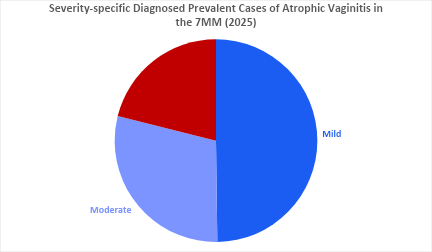
- Accordingsecondary annalysis, a cross-sectional Internet survey of women aged 40-75 years in the United States and Europe. All postmenopausal women aged 40-75 years were included in the analyses. vulvovaginal atrophy (VVA) symptom severity (none, mild, moderate, severe) was assessed using the Menopause Rating Scale. The study reported that the ~50-60% of the patients presented with mild VVA symptoms, 25-35% had moderate disease and only 15% -25% had severe disease.
- Approximately 50% of postmenopausal women experience symptoms of VVA, although only a minority seek medical attention. The study highlighted that vaginal dryness, dyspareunia, and irritation are among the most frequently reported symptoms, with prevalence increasing with age and years since menopause.
- Among postmenopausal women in the United States, nearly 45% reported experiencing symptoms of VVA. Vaginal dryness was the most frequently reported symptom (approximately 55%), followed by painful intercourse (44%) and vaginal irritation (37%), highlighting the significant impact of VVA on women's quality of life, sexual function, and overall well-being.
- The primary diagnostic challenge lies in the overlap of its symptoms with other conditions, such as urinary tract infections (UTIs), vulvovaginal candidiasis, and lichen sclerosus. Many of these conditions share symptoms like vaginal dryness, irritation, and urinary frequency, which can lead to misdiagnosis if not carefully differentiated.
Atrophic Vaginitis Epidemiology Forecast in the United States
- 2025 Prevalent Cases of Atrophic Vaginitis: ~XXXX
- 2036 Projected Prevalent Cases of Atrophic Vaginitis: XXXX
- Atrophic Vaginitis Growth Rate (2026–2036): XX% CAGR
DelveInsight's ‘Atrophic Vaginitis Epidemiology Forecast – 2036’ report delivers an in-depth understanding of the atrophic vaginitis, historical and forecasted epidemiology in the United States, EU4 (Germany, Spain, Italy, and France) and the United Kingdom, and Japan.
|
Study Period |
2022–2036 |
|
Historical Year |
2022–2025 |
|
Forecast Period |
2026–2036 |
|
Base Year |
2026 |
|
Geographies Covered |
|
|
Atrophic Vaginitis CAGR (Study period/Forecast period) |
XX% (2026-2036) |
|
Atrophic Vaginitis Epidemiology Segmentation Analysis |
Patient Burden Assesment
|
Atrophic Vaginitis Understanding and Diagnosis Algorithm
Atrophic Vaginitis Overview and Diagnosis
Atrophic Vaginitis, also known as GSM, is a chronic condition caused by declining estrogen levels, leading to thinning, dryness, inflammation, and reduced elasticity of vaginal tissues. It most commonly affects postmenopausal women but can also occur following surgical menopause, ovarian insufficiency, postpartum hormonal changes, or anti-estrogen therapy. Common symptoms include vaginal dryness, irritation, burning, dyspareunia, urinary urgency, dysuria, and recurrent urinary tract infections. The condition can significantly impair sexual health, emotional well-being, and overall quality of life. Despite its high prevalence, Atrophic Vaginitis remains substantially underdiagnosed and undertreated due to limited awareness, social stigma, and inadequate routine screening.
Atrophic Vaginitis Diagnosis
Diagnosis of Atrophic Vaginitis is primarily based on clinical history, symptom assessment, and gynecological examination. Patients commonly present with vaginal dryness, irritation, dyspareunia, and recurrent urinary symptoms. Physical examination may reveal thin, pale vaginal mucosa, reduced lubrication, loss of vaginal elasticity, and decreased vaginal rugae. Vaginal pH testing and microscopic evaluation of vaginal epithelial cells may be used to support the diagnosis and assess the degree of atrophy. Laboratory investigations are generally performed only to exclude infections or other gynecological conditions with similar symptoms.
Further details are provided in the report.
Atrophic Vaginitis Epidemiology
Key Findings from Atrophic Vaginitis Epidemiological Analysis and Forecast
- In 2025, the total prevalent cases of Atrophic Vaginitis in the United States were estimated to be approximately 40 million, representing the largest patient population among the 7MM.
- According to DelveInsight's analysis, the majority of prevalent Atrophic Vaginitis cases in 2025 across the 7MM were mild, followed by moderate cases, while severe cases accounted for least number of cases. All severity segments are projected to increase steadily throughout the forecast period.
- In the EU4 and the UK countries, the diagnosed prevalent population of Atrophic Vaginitis was highest in Germany, with approximately in 2025, followed by Italy. The lowest number of diagnosed prevalent cases was observed in Spain in 2025.
- In 2025, the United States were receiving prescription treatment for Atrophic Vaginitis, accounting for nearly 40% of the treated population across the 7MM. This treated population is anticipated to increase steadily throughout the forecast period.
- An estimated 10–40 percent of postmenopausal women have symptoms of atrophic vaginitis, also referred to as urogenital atrophy. Despite the prevalence of symptoms, only 20–25 percent of symptomatic women seek medical attention.
Scope of the Report
The report covers a segment of an executive summary, a descriptive overview of atrophic vaginitis, explaining its causes, signs and symptoms, and pathogenesis.
- Comprehensive insight has been provided into the epidemiology segments and forecasts, the future growth potential of the diagnosis rate, and disease progression.
Report Insights
Atrophic Vaginitis Patient Population Forecast
Report Key Strengths
- Epidemiology‑based (epi‑based) Bottom‑up Forecasting
- 11-year Forecast
- Patient Burden Trends (by geography)
FAQs
- What are the disease risks, burdens, and unmet needs of atrophic vaginitis? What will be the growth opportunities across the 7MM concerning the patient population with atrophic vaginitis?
- What is the historical and forecasted atrophic vaginitis patient pool in the US, EU4 (Germany, France, Italy, and Spain), the UK, and Japan?
Reasons to Buy
- Insights on patient burden/disease prevalence, evolution in diagnosis, and factors contributing to the change in the epidemiology of the disease during the forecast years.
- To understand key opinion leaders’ perspectives around the diagnostic challenges to overcome barriers in the future.
- Detailed insights on various factors hampering disease diagnosis and other existing diagnostic challenges.