
Autoimmune Uveitis Market Summary
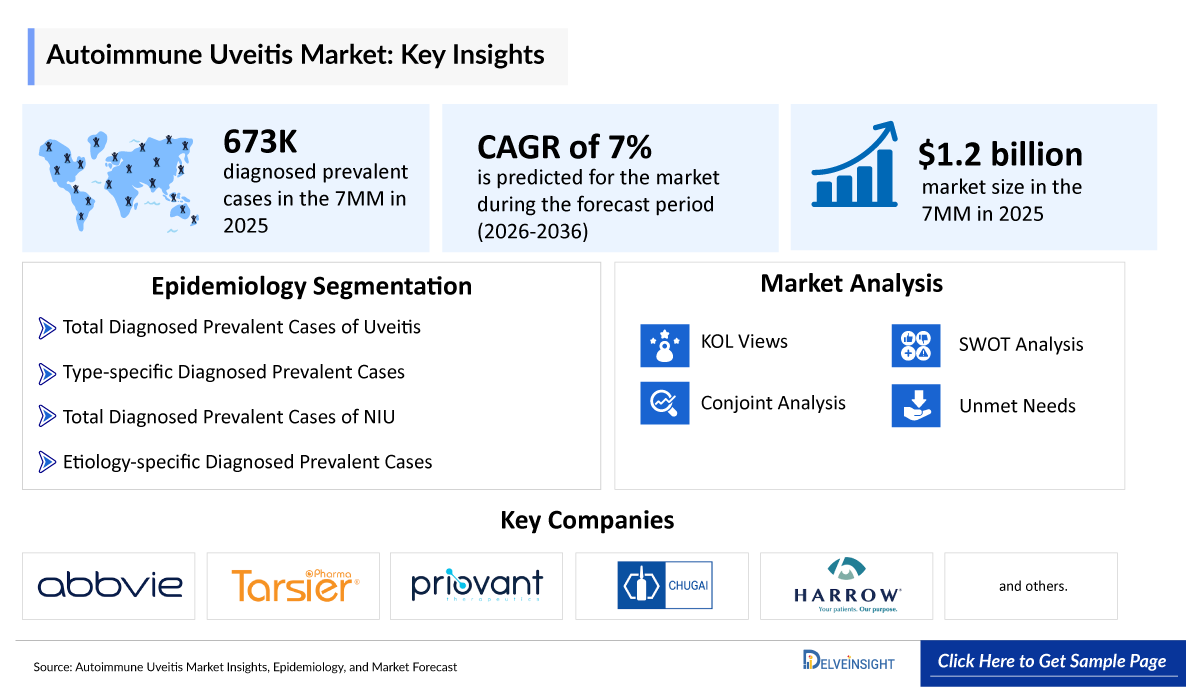
- The Autoimmune Uveitis Therapeutics Market Size was valued at ~USD 1.2 billion in 2025 and is projected to experience steady growth through 2036, driven by increasing disease awareness, advancements in targeted therapies, and improved diagnosis. The market is expected to expand at a CAGR of ~7% during the 2026–2036 forecast period.
- The leading Autoimmune Uveitis Companies include AbbVie, Tarsier Pharma, Priovant Therapeutics, Chugai Pharmaceuticals, Harrow, Novaliq, VivaVision Biotech, and others.
Autoimmune Uveitis Market & Epidemiology Analysis
- According to DelveInsight estimates, in 2025, the United States accounted for the autoimmune uveitis treatment market size, i.e., ~USD 700 million, although recent analyses suggest potential upside driven by increasing adoption of novel and targeted therapies.
- Autoimmune uveitis is an inflammatory process of uveal components due to an autoimmune reaction to self-antigens or is caused by an innate inflammatory reaction secondary to an external stimulus.
- Autoimmune uveitis is a prevalent disease that principally affects young people and may lead to significant visual limitation or total blindness. Autoimmune uveitis presents more frequently as anterior uveitis and is associated with systemic disease. Diagnosis of the underlying condition is the key to treating both uveitis and the systemic disease.
- Autoimmune uveitis is a rare inflammatory eye disorder caused by immune system dysfunction affecting the uveal tract, accounting for ~30,000 new cases of legal blindness annually in the US Despite its rarity, it is the fourth leading cause of blindness among young individuals in developed countries and can be sight-threatening if not treated early.
- The majority of Autoimmune Uveitis Patients were estimated in the US followed by EU4 and the UK and Japan.
- The distribution of autoimmune uveitis subtypes impacts treatment approaches, prognosis, and resource allocation within healthcare systems. Diagnosed prevalent cases of Autoimmune Uveitis are highest for anterior noninfectious uveitis (aNIU) during the study period, followed by Pan-Uveitis and Posterior Uveitis in the 7MM.
- Corticosteroid eye drops remain the first-line treatment and gold standard for acute non-infectious uveitis (NIU), while systemic immunomodulatory and biologics are generally reserved as second- or third-line therapies to reduce long-term steroid exposure and improve disease control.
- Adalimumab (HUMIRA) is the only FDA-approved biologic available in the market. The larger market is covered by Biologics, making up the total autoimmune uveitis market of around USD 800 million in 2025, in the 7MM.
Request to unlock the sample page of the "Autoimmune Uveitis Treatment Market"
Autoimmune Uveitis and Forecast in the 7MM
| 2025 Autoimmune Uveitis Market Size | ~USD 1,200 Million |
| 2036 Autoimmune Uveitis Market Size | ~USD XXX million |
| Autoimmune Uveitis Growth Rate (2026–2036) | ~7% CAGR |
Key Factors Driving the Autoimmune Uveitis Market
-
Autoimmune Uveitis Patient Pool and Rising Prevalence
Autoimmune uveitis is a rare inflammatory eye disorder that can lead to vision impairment and, in severe cases, blindness. In 2025, the total diagnosed prevalent cases in the 7MM were highest in the US. Among subtypes, aNIU had the highest prevalence, followed by pan-uveitis and posterior uveitis. The subtype distribution significantly impacts treatment approaches, prognosis, and healthcare resource allocation.
-
Autoimmune Uveitis Market Growth and Treatment Landscape
Current treatment focuses on controlling inflammation and preventing vision loss, with biologics dominating the landscape due to their efficacy in moderate to severe cases. The market is expected to grow significantly through 2036, driven by emerging therapies and increasing disease awareness.
-
Autoimmune Uveitis Emerging Therapies
Emerging therapies in development include TRS01, OCS-02, and EYS606, which aim to provide targeted, effective treatment options beyond existing biologics. These investigational agents focus on improving efficacy, reducing dosing frequency, and minimizing systemic side effects, addressing unmet needs in patients who are refractory to current therapies.
DelveInsight's "Autoimmune Uveitis Market Insights, Epidemiology and Market Forecast – 2036" report delivers an in-depth understanding of the autoimmune uveitis, historical and forecasted epidemiology, as well as autoimmune uveitis therapeutics market trends in the United States, EU4 (Germany, Spain, Italy, and France) and the United Kingdom, and Japan.
The Autoimmune Uveitis Treatment Market Report delivers a comprehensive analysis of the current treatment landscape, including standards of care, clinical practices, and evolving therapeutic algorithms. It evaluates autoimmune uveitis patient burden trends, revenue & market share dynamics, peak patient share & therapy uptake analysis, and provides an in-depth market size assessment and growth rate projections (Historical & Forecast 2022–2036) across global regions. The report highlights key unmet medical needs in autoimmune uveitis and maps the competitive and clinical landscape to uncover high value opportunities, providing a clear outlook on future market growth potential.
Scope of the Autoimmune Uveitis Market Report | |
| Study Period | 2022–2036 |
| Historical Year | 2022–2025 |
| Forecast Period | 2026–2036 |
| Base Year |
2026 |
| Geographies Covered |
|
| Autoimmune Uveitis Market CAGR | ~7% (2026 ̶ 2036) (Forecast Period) |
| Autoimmune Uveitis Epidemiology Segmentation Analysis |
Patient Burden Assessment
|
| Autoimmune Uveitis Companies |
|
| Autoimmune Uveitis Therapies |
|
| Autoimmune Uveitis Market |
Segmented by
|
| Analysis |
|
Autoimmune Uveitis Disease Understanding
Autoimmune Uveitis Overview
Autoimmune uveitis is an inflammatory process of uveal components due to an autoimmune reaction to self-antigens or is caused by an innate inflammatory reaction secondary to an external stimulus. It can present as an isolated entity or be associated with a systemic autoimmune or auto-inflammatory disease. In most cases, it affects the uvea but can also impact other parts of the eyes. It is categorized as infectious or noninfectious. NIU can occur with systemic autoimmune disease and autoimmune diseases localized to the eye.
Symptoms of NIU include ocular pain, photophobia, lacrimation, and redness. Common symptoms of uveitis are blurred vision, photophobia, eye pain, floaters (floating spots), headache, and injected conjunctiva; usually, children can be asymptomatic.
Autoimmune Uveitis Diagnosis
Autoimmune Uveitis Diagnosis begins with a comprehensive symptom review and a thorough exam of both the anterior and posterior segments. A systemic workup is initiated that includes laboratory testing for infectious and noninfectious etiologies, and a chest X-ray is also performed. Once this foundation has been laid, ancillary testing, including Optical Coherence Tomography and fluorescein angiography, can provide valuable insight.
The patient then goes to the general physician, who refers the patient to the ophthalmologist, who then ask the patient to go for diagnostic test such as, slit lamp examination, funduscopic exam, visual acuity test, and ocular pressure test to confirm the disease. There is no universally accepted approach for the evaluation of uveitis. If the history, physical examination, and basic laboratory tests do not suggest a specific diagnosis, serologic studies for syphilis and chest radiography for sarcoidosis and tuberculosis are recommended.
Further details are provided in the report...
Autoimmune Uveitis Treatment
Management of autoimmune uveitis focuses on controlling ocular inflammation, preserving vision, preventing disease recurrence, and minimizing long-term complications. Corticosteroids remain the cornerstone of treatment, while immunosuppressive agents are used for chronic or refractory disease to reduce steroid dependence. Adalimumab (HUMIRA) is the only approved systemic biologic for non-infectious uveitis, and localized corticosteroid therapies provide sustained anti-inflammatory effects with reduced systemic exposure.
Further details related to country-based variations are provided in the report...
Autoimmune Uveitis Unmet Needs
The section “unmet needs of Autoimmune Uveitis” outlines the critical gaps between the current state of patient care, diagnosis, and the ideal & effective management of the disease. It highlights the obstacles experienced by patients, clinicians, and researchers and identifies potential solutions for future progress.
- Heavy reliance on long-term corticosteroid therapy and associated side effects
- Lack of curative treatment options
- High risk of disease recurrence and chronic relapses
- Limited approved biologic therapies for autoimmune uveitis
- Need for targeted therapies with improved long-term efficacy and safety and others
Comprehensive unmet needs insights in autoimmune uveitis and their strategic implications are provided in the full report...
Autoimmune Uveitis Epidemiology
The Autoimmune Uveitis epidemiology section provides insights about the historical and current Autoimmune Uveitis patient pool and forecasted trends for seven major countries. It helps to recognize the causes of current and forecasted trends by exploring numerous studies and views of key opinion leaders. This part of the Autoimmune Uveitis Therapeutics Market Report also provides the diagnosed patient pool and their trends along with assumptions undertaken.
Key Findings from Autoimmune Uveitis Epidemiological Analysis and Forecast
- According to DelveInsight’s estimates, in 2025, there were nearly 673, 000 diagnosed prevalent cases of autoimmune uveitis in the 7MM.
- In the 7MM, the US accounted for the highest number of diagnosed prevalent cases of uveitis, with nearly 377, 000 in 2025.
- In 2025, NIU accounted for the highest proportion of diagnosed prevalent cases of uveitis in the US, with approximately 90% of cases, while infectious uveitis accounted for the least, with around 10% of cases.
- Idiopathic uveitis represented the largest etiological segment in Japan in 2025, accounting for a substantially higher number of cases than other uveitis subtypes.
- Among EU4, Germany accounted for the largest number of diagnosed prevalent cases of uveitis followed by France, whereas Italy accounted for the lowest cases in 2025.
- NIU affects approximately 121 per 100,000 people. It primarily affects people between the age of 20 and 60. Anterior uveitis is the most prevalent type accounting for 81% of uveitis patients, and about half of the cases are either recurring or chronic.
Autoimmune Uveitis Epidemiology Segmentation
- Total Diagnosed Prevalent Cases of Autoimmune Uveitis
- Type-specific Diagnosed Prevalent Cases of Autoimmune Uveitis
- Total Diagnosed Prevalent of NIU by Anatomical Location
- Total Diagnosed Prevalent Cases of Autoimmune Uveitis
- Etiology-specific Diagnosed Prevalent Cases of Autoimmune Uveitis
- Total Treated Cases of Autoimmune Uveitis
Autoimmune Uveitis Market Recent Breakthroughs and Developments
- In January 2026, Novaliq received US FDA IND clearance for NOV05 (topical tacrolimus eye drops) to initiate the Phase II EYETAC trial in patients with non-infectious anterior uveitis. The therapy is designed to provide localized immunosuppression while reducing systemic steroid exposure and associated side effects.
- In October 2025, Celltrion announced that the FDA approved an expanded pediatric indication for adalimumab-aaty (YUFLYMA) for children aged 2 years and older with non-infectious uveitis, further expanding access to anti-TNF therapy.
- In September 2025, Priovant Therapeutics announced that the US FDA granted Fast Track Designation to brepocitinib for non-anterior non-infectious uveitis. The company continues enrollment in the Phase III CLARITY trial evaluating the TYK2/JAK1 inhibitor in patients with active uveitis.
- In April 2025, VivaVision Biotech announced positive topline Phase II results for VVN461 in non-infectious anterior uveitis, demonstrating non-inferior efficacy versus prednisolone acetate along with favorable safety outcomes. The company plans to advance the therapy into Phase III development.
Autoimmune Uveitis Drug Analysis & Competitive Analysis
The Autoimmune Uveitis drug chapter provides a detailed, market-focused review of approved therapies and the emerging Autoimmune Uveitis pipeline across Phase I–III clinical trials. It covers the Autoimmune Uveitis mechanism of action, clinical trial data, regulatory approvals, patents, collaborations, and strategic partnerships for each therapy, along with their advantages, limitations, and recent developments. This section offers critical insights into the autoimmune uveitis treatment landscape, supporting market assessment, competitive analysis, and growth forecasting for the autoimmune uveitis therapeutics market.
Autoimmune Uveitis Approved Therapies
-
Adalimumab (HUMIRA): AbbVie
HUMIRA is the commercially available preparation of adalimumab being developed by AbbVie Inc. for treating noninfectious intermediate, posterior, and panuveitis; it acts by binding to tumor necrosis factor-alpha (TNF-a). It limits the autoimmune response by preventing the induction of inflammatory cytokines, thereby reducing inflammation and disease activity. Adalimumab remains the only FDA-approved systemic biologic specifically indicated for non-infectious intermediate, posterior, and panuveitis, making it a key marketed therapy in autoimmune uveitis.
Despite increasing biosimilar competition, HUMIRA has maintained a strong presence in the immunology market and continues to be an important treatment option for patients with severe or refractory uveitis requiring systemic biologic therapy. Its long-standing clinical experience, established efficacy in reducing uveitic flares and preserving vision, and broad physician familiarity have supported its adoption across major markets. However, the entry of adalimumab biosimilars and the emergence of next-generation targeted therapies may gradually impact its market share over the forecast period, while simultaneously expanding patient access through reduced treatment costs.
|
Autoimmune uveitis Marketed/Approved Therapies | ||
|
|
Indication |
|
|
|
Non-infectious Intermediate, Posterior, and Panuveitis (NIIPPU) / Non-infectious Uveitis |
|
|
|
Visualization during vitrectomy and treatment of ocular inflammatory conditions unresponsive to topical corticosteroids, including uveitis-related inflammation |
|
Autoimmune Uveitis Pipeline Analysis
-
TRS01: Tarsier Pharma
TRS01 is a polypeptide conjugate with a dual mechanism of action; the investigational agent induces anti-inflammatory macrophages and inhibits the nuclear factor-kB (Nf-kB) signaling pathway by toll-like receptor 4 (TLR4). TRS is a proprietary, bio-inspired platform for treating blinding ocular diseases.
In March 2025, TRS01 is a polypeptide conjugate with a dual mechanism of action; the investigational agent induces anti-inflammatory macrophages and inhibits the nuclear factor-kB (Nf-kB) signaling pathway by TLR4. TRS is a proprietary, bio-inspired platform for treating blinding ocular diseases. The positive findings of this TRS01 clinical trial point to significant advancements in developing a new class of clinically significant ocular therapeutics, with efficacy at least comparable to corticosteroids, with lesser to no side effects. Hence, it might have the potential to outperform other corticosteroids in the noninfectious uveitis treatment market.
-
Brepocitinib: Priovant Therapeutics
Priovant’s lead investigational medicine is brepocitinib, a dual TYK2/JAK1 inhibitor administered as a once-daily oral therapy. Brepocitinib is in late-stage development for several highly morbid autoimmune diseases with few or no approved targeted therapies, across which it has generated multiple successful Phase II and Phase III results. Priovant is also evaluating brepocitinib in a Phase III study in non-infectious uveitis (NIU), with results expected in the second half of 2026.
Comparison of Autoimmune Uveitis Emerging Drugs Under Development | |||||||
|
Drug Name |
Company |
Highest Phase |
Indication |
RoA |
MoA |
Molecule Type |
Anticipated Launch in the US |
|
Brepocitinib |
Priovant Therapeutics |
III |
Dermatomyositis (lead indication); also in development for Non-Infectious Uveitis, Lichen Planopilaris, and Cutaneous Sarcoidosis |
Oral |
Dual TYK2/JAK1 inhibitor; suppresses pro-inflammatory cytokine signaling including type I/II IFN, IL-6, IL-12, and IL-23 pathways |
Small Molecule |
Information is available in the full report |
|
TRS01 |
Tarsier Pharma |
III |
Non-infectious anterior uveitis / autoimmune uveitis |
Topical |
Dual mechanism: induces anti-inflammatory macrophages and inhibits the TLR4/NF-kB signaling pathway to reduce ocular inflammationchemoradiation toxicity, and inhibits NF-κB/HIF-1α pathways |
Polypeptide conjugate |
Information is available in the full report |
|
RAY121 |
Chugai Pharmaceutical |
Ib |
Antiphospholipid Syndrome (APS), Bullous Pemphigoid (BP), Behçet's Syndrome (BS), Dermatomyositis (DM), Immune-Mediated Necrotizing Myopathy (IMNM), and Immune Thrombocytopenia (ITP) |
Subcutaneous Injection |
Complement C1s inhibitor; selectively inhibits the classical complement pathway |
Monoclonal antibody |
Information is available in the full report |
|
Note: Launch insights are provisional and may change with future report updates or the occurrence of major key catalysts. | |||||||
Note: A detailed emerging therapies assessment will be provided in the final report...
Autoimmune Uveitis Market Outlook
The autoimmune uveitis market is expected to witness notable growth during the forecast period, driven by increasing disease awareness, improving diagnostic capabilities, and the rising need for effective therapies that can prevent irreversible vision loss and improve long-term quality of life. Uveitis often affects individuals during their most productive working years and remains a major cause of visual impairment and blindness, creating a significant clinical and economic burden. Current treatment continues to rely heavily on corticosteroids as the first-line standard of care, including topical eye drops, periocular injections, intravitreal formulations, and oral corticosteroids for severe inflammation. However, prolonged steroid use is associated with major complications such as cataracts, glaucoma, elevated intraocular pressure, and systemic adverse effects, creating strong demand for safer long-term alternatives.
To reduce steroid dependence, immunomodulatory therapies such as methotrexate, azathioprine, mycophenolate mofetil, cyclosporine, tacrolimus, and sirolimus are increasingly being used as steroid-sparing agents, although most remain off-label for non-infectious uveitis. The approval of Adalimumab by AbbVie marked a major advancement as the first approved systemic biologic for non-infectious intermediate, posterior, and panuveitis, significantly improving treatment options for refractory patients.
Despite these advancements, the market continues to face challenges related to frequent disease recurrence, limited approved biologics, treatment resistance, and the lack of curative therapies. These unmet needs are accelerating pipeline innovation, with emerging therapies such as TRS01 (Tarsier Pharma), brepocitinib (Priovant Therapeutics), RAY121 (Chugai Pharmaceuticals) and investigational sirolimus-based therapies being developed to provide safer, targeted, and more durable treatment options. With growing interest in topical biologics, gene therapies, localized drug delivery systems, and steroid-sparing approaches, the autoimmune uveitis market is expected to expand significantly over the coming years.
Autoimmune Uveitis Companies
- Abbvie
- Tarsier Pharma
- Priovant Therapeutics
- Chugai Pharmaceuticals
- Harrow
- Novaliq
- VivaVision Biotech, and others
Further details will be provided in the report...
Autoimmune Uveitis Drug Class/Insights into Leading Emerging and Marketed Therapies (2022–2036 Forecast)
The autoimmune uveitis market comprises corticosteroids and anti-inflammatory therapies, immunomodulatory and steroid-sparing agents, TNF-a inhibitors and biologic immunotherapies, JAK/TYK2 pathway inhibitors and targeted immune modulators, and localized ocular drug delivery therapies. These drug classes aim to control intraocular inflammation, preserve vision, reduce recurrence, minimize corticosteroid exposure, and improve long-term disease management across anterior, intermediate, posterior, and panuveitis.
Corticosteroids and anti-inflammatory therapies: Corticosteroids remain the cornerstone of autoimmune uveitis treatment due to their rapid anti-inflammatory effects. These therapies are administered through topical, periocular, intravitreal, and systemic routes depending on disease severity. Representative therapies include triamcinolone acetonide (TRIESENCE), dexamethasone intravitreal implant (OZURDEX), and oral prednisone.
TNF-a inhibitors and biologic immunotherapies: Biologics target key inflammatory cytokines involved in autoimmune ocular inflammation and have transformed treatment for refractory patients. Representative therapies include adalimumab (HUMIRA), the only FDA-approved systemic biologic for non-infectious intermediate, posterior, and panuveitis, along with emerging biologic candidates such as OCS-02 (anti-TNFa).
Conventional corticosteroids and immunosuppressive agents currently dominate the autoimmune uveitis treatment landscape; however, targeted biologics, JAK/TYK2 inhibitors, and advanced localized drug delivery systems are expected to drive future innovation by providing safer, more durable, and steroid-sparing treatment options.
Further details will be provided in the report...
Autoimmune Uveitis Drug Uptake
This section focuses on the uptake rate of potential Autoimmune Uveitis drugs expected to be launched in the market during the forecast period (2026–2036). The analysis evaluates treatment adoption across corticosteroids, immunomodulatory therapies (IMTs), biologics, and emerging targeted therapies, along with their impact on patient uptake and market sales.
Corticosteroids are expected to remain the backbone of autoimmune uveitis management, maintaining the highest patient uptake due to their rapid efficacy, broad applicability across disease subtypes, and established treatment guidelines. Products such as TRIESENCE and OZURDEX are anticipated to sustain strong utilization, particularly in patients requiring localized treatment. Immunomodulatory therapies including methotrexate, azathioprine, mycophenolate mofetil, cyclosporine, tacrolimus, and sirolimus will continue to serve as important steroid-sparing options, supporting steady uptake in chronic and recurrent disease despite widespread off-label use.
The biologics segment is expected to witness significant growth, led by Adalimumab (HUMIRA), which remains the only approved systemic biologic for non-infectious intermediate, posterior, and panuveitis. Its established efficacy and physician familiarity are expected to support continued adoption, although biosimilar competition may moderate revenue growth. Emerging therapies such as brepocitinib (Priovant Therapeutics), RAY121 (Chugai Pharmaceutical), VVN461 (VivaVision Biotech), TRS01 (Tarsier Pharma) are expected to gradually gain market share by offering targeted, steroid-sparing approaches with improved long-term safety profiles. Overall, treatment uptake is anticipated to progressively shift toward biologics, JAK/TYK2 inhibitors, and localized targeted therapies, while corticosteroids continue to dominate acute disease management throughout the forecast period.
Further detailed analysis of emerging therapies' drug uptake in the report...
Autoimmune Uveitis Market Access and Reimbursement Scenario
The United States
The US Reimbursement for Autoimmune Uveitis | |
|
Drug |
Access Program |
|
Adalimumab (HUMIRA) |
· AbbVie Patient Support/HUMIRA Complete Program · Co-pay assistance program · Patient assistance support · Medicare reimbursement support |
Reimbursement is a crucial factor that affects the drug’s access to the market. Often, the decision to reimburse comes down to the price of the drug relative to the benefit it produces in treated patients. To reduce the healthcare burden of these high-cost therapies, many payment models are being considered by payers and other industry insiders.
Further details are provided in the final report...
Autoimmune Uveitis Therapies Price Scenario & Trends
Pricing and analogue assessment of autoimmune uveitis therapies highlights evolving price dynamics structures. This section summarizes the cost of approved treatments, closest and most appropriate analogue selection for emerging therapies, and understanding of how pricing influences market access, adherence, and long-term uptake.
Further details are provided in the final report...
Industry Experts and Physician Views for Autoimmune Uveitis
To keep up with autoimmune uveitis market trends, we take Key Opinion Leaders (KOLs) and Subject Matter Experts (SMEs) opinions working in the domain through primary research to fill the data gaps and validate our secondary research. Industry experts were contacted for insights on the Autoimmune Uveitis emerging therapies, evolving treatment landscape, patient adherence to conventional therapies, therapy switching trends, drug adoption and uptake, accessibility challenges, and epidemiology and real-world prescription patterns in autoimmune uveitis, including MD, PhD, Instructor, Postdoctoral Researcher, Professor, Researcher, and others.
DelveInsight’s analysts connected with 10+ KOLs to gather insights; however, interviews were conducted with 6+ KOLs in the 7MM. Centers such as the University of Nebraska Medical Center Omaha, Hannover Medical School, University of Liverpool, etc. were contacted. Their opinion helps understand and validate current and emerging autoimmune uveitis therapies, highlight unmet medical needs, provide epidemiological context, and support strategic decisions for market access, therapy adoption, and pipeline prioritization in autoimmune uveitis.
|
Region |
Key Opinion Leaders (KOLs) and Subject Matter Experts (SMEs) |
|
United States |
“Apart from systemic therapies, many US retina specialists use intraocular triamcinolone acetonide. The dexamethasone intravitreal implant is gaining use in NIU and retinal vascular diseases. Intravitreal triamcinolone acetonide effectively decreases inflammation in NIU, including autoimmune uveitis.” |
|
Germany |
“In Europe, cyclosporine, mycophenolate, azathioprine, and methotrexate are the common immunomodulatory therapies for autoimmune uveitis. For patients whose uveitis is refractory to traditional immunosuppressants, infliximab and adalimumab are the anti-TNF-α biologics often used.” |
Autoimmune Uveitis Report Qualitative Analysis: SWOT and Conjoint Analysis
We perform qualitative and market Intelligence analysis using various approaches, such as SWOT analysis and conjoint analysis. In the SWOT analysis of Autoimmune Uveitis, strengths, weaknesses, opportunities, and threats in terms of disease diagnosis, patient awareness, patient burden, competitive landscape, cost-effectiveness, and geographical accessibility of therapies are provided.
Conjoint analysis analyzes emerging therapies based on relevant attributes such as safety, efficacy, frequency of administration, route of administration, and order of entry. Scoring is given based on these parameters to analyze the effectiveness of therapy.
The team of analysts analyzes promising emerging therapies based on relevant attributes such as safety, efficacy, frequency of administration, route of administration, and order of entry. In efficacy, the trial’s primary and secondary outcome measures are evaluated, whereas the therapies’ safety is evaluated, wherein the acceptability, tolerability, and adverse events are majorly observed. In addition, the scoring is also based on the route of administration, order of entry, probability of success, and the addressable patient pool for each therapy. According to these parameters, the final weightage score and the ranking of the emerging therapies are decided.
Scope of the Autoimmune Uveitis Market Report
- The report covers a segment of key events, an executive summary, a descriptive overview of autoimmune uveitis, explaining its causes, signs and symptoms, pathogenesis, and currently available treatments.
- Comprehensive insight has been provided into the epidemiology segments and forecasts, the future growth potential of the diagnosis rate, and disease progression along treatment guidelines.
- Additionally, an all-inclusive account of both the current and emerging treatments, along with the elaborative profiles of late-stage and prominent therapies, will have an impact on the current treatment landscape.
- A detailed review of the anal cancer market, historical and forecasted market size, market share by therapies, detailed assumptions, and rationale behind our approach is included in the report, covering the 7MM drug outreach.
- The report provides an edge while developing business strategies by understanding trends through SWOT analysis and expert insights/KOL views, patient journey, and treatment preferences that help in shaping and driving the 7MM anal cancer market.
Autoimmune Uveitis Market Report Insights
- Autoimmune Uveitis Patient Population Forecast
- Autoimmune Uveitis Therapeutics Market Size
- Autoimmune Uveitis Pipeline Analysis
- Autoimmune Uveitis Market Size and Trends
- Autoimmune Uveitis Market Opportunity (Current and forecasted)
Autoimmune Uveitis Market Report Key Strengths
- Autoimmune Uveitis Epidemiology based (Epi based) Bottom up Forecasting
- Artificial Intelligence (AI)-enabled Market Research Report
- 11-year forecast
- Autoimmune Uveitis Market Outlook (North America, Europe, Asia-Pacific)
- Autoimmune Uveitis Patient Burden Trends (by geography)
- Autoimmune Uveitis Treatment Addressable Market (TAM)
- Autoimmune Uveitis Competitive Landscape
- Autoimmune Uveitis Major Companies Insights
- Autoimmune Uveitis Price Trends and Analogue Assessment
- Autoimmune Uveitis Therapies Drug Adoption/Uptake
- Autoimmune Uveitis Therapies Peak Patient Share analysis
Autoimmune Uveitis Market Report Assessment
- Autoimmune Uveitis Current Treatment Practices
- Autoimmune Uveitis Unmet Needs
- Autoimmune Uveitis Clinical Development Analysis
- Autoimmune Uveitis Emerging Drugs Product Profiles
- Autoimmune Uveitis Market Attractiveness
- Autoimmune Uveitis Qualitative Analysis (SWOT and Conjoint Analysis)
- Autoimmune Uveitis Market Drivers
- Autoimmune Uveitis Market Barriers
Key Questions Answered in the Autoimmune Uveitis Market Report
Autoimmune Uveitis Market Insights
- What was the autoimmune uveitis market size, the market size by therapies, market share (%) distribution in 2025, and what would it look like by 2036? What are the contributing factors for this growth?
- What are the anticipated pricing variations among different geographies for the emerging therapies in the future?
- What can be the future treatment paradigm of autoimmune uveitis?
- What are the disease risks, burdens, and unmet needs of autoimmune uveitis? What will be the growth opportunities across the 7MM concerning the autoimmune uveitis patient population?
- Who is the major future competitor in the market, and how will the competitors affect their market share?
- What are the current options for the treatment of autoimmune uveitis? What are the current guidelines for treating autoimmune uveitis in the US, Europe, and Japan?
Reasons to Buy Autoimmune Uveitis Market Forecast Report
- The report will help in developing business strategies by understanding the latest trends and changing treatment dynamics driving the autoimmune uveitis market.
- Bottom up forecasting builds from the affected population to product forecasts, delivering a robust, data driven approach ideal for new therapies and novel classes.
- Insights on patient burden/disease incidence, evolution in diagnosis, and factors contributing to the change in the epidemiology of the disease during the forecast years.
- Understand the existing market opportunities in varying geographies and the growth potential over the coming years.
- Identifying strong upcoming players in the market will help devise strategies to help get ahead of competitors.
- Detailed analysis and ranking of class-wise potential current and emerging therapies under the conjoint analysis section to provide visibility around leading classes.
- To understand KOLs’ perspectives on the accessibility, acceptability, and compliance-related challenges of existing treatment to overcome barriers in the future.
- Detailed insights on the unmet needs of the existing market so that the upcoming players can strengthen their development and launch strategy.
- This Artificial Intelligence (AI) enabled report summarize and simplify complex datasets within the report into clear, actionable insights for stakeholders, investors, and healthcare providers, enabling faster, data driven decisions.
Stay updated with us for Recent Articles @ New DelveInsight Blogs
.png&w=256&q=75)


