.png&w=256&q=75)
Behcet's Disease Pipeline
DelveInsight’s, “Behcet’s Disease Pipeline Insight, 2026” report provides comprehensive insights about 3+ companies and 3+ pipeline drugs in Behcet’s Disease pipeline landscape. It covers the pipeline drug profiles, including clinical and nonclinical stage products. It also covers the therapeutics assessment by product type, stage, route of administration, and molecule type. It further highlights the inactive pipeline products in this space.
Geography Covered
- Global coverage
Behcet’s Disease Understanding
Behcet’s Disease Overview
Behçet's disease is a rare, chronic, relapsing multisystem inflammatory disorder characterized by recurrent oral and genital ulcers, uveitis, skin lesions, arthritis, vascular inflammation, and neurological or gastrointestinal involvement. Current treatment primarily relies on corticosteroids, conventional immunosuppressants, and biologics such as TNF inhibitors, with therapy tailored according to disease severity and organ involvement. Despite these options, there remains a significant unmet need for targeted therapies that provide durable disease control with improved safety. Behcet disease was first described in 1937 by Hulusi Behçet from Istanbul, who described three patients with oral and genital ulcerations, uveitis, and erythema nodosum. Symptoms like recurrent painful oral ulcers are the hallmark symptom, occurring in nearly all patients and often representing the first clinical manifestation of the disease. Genital ulcers are common, typically painful, and may heal with scarring, distinguishing them from oral lesions. Eye involvement, including uveitis and retinal vasculitis, can cause eye pain, redness, blurred vision, and, if untreated, may lead to permanent vision loss. Skin and joint manifestations include acne-like lesions, erythema nodosum, and episodes of arthritis or arthralgia, most frequently affecting the knees and ankles. Systemic involvement may affect the blood vessels, nervous system, and gastrointestinal tract, leading to symptoms such as thrombosis, headaches, neurological deficits, abdominal pain, diarrhea.
Behçet's disease is a chronic, relapsing, multisystem autoinflammatory and autoimmune vasculitis resulting from an abnormal immune response in genetically predisposed individuals, particularly those carrying the HLA-B51 allele. Environmental triggers, such as microbial infections, are thought to initiate immune activation in susceptible individuals. The disease is characterized by dysregulated innate and adaptive immunity, with excessive activation of neutrophils, T helper (Th1 and Th17) cells, and increased production of pro-inflammatory cytokines including tumor necrosis factor-alpha (TNF-α), interleukin (IL)-1, IL-6, IL-17, and IL-23. This persistent inflammatory response leads to endothelial dysfunction and widespread inflammation.
Behçet's disease is diagnosed clinically, as there is no single definitive laboratory test. Diagnosis is based on characteristic symptoms such as recurrent oral ulcers accompanied by genital ulcers, eye inflammation, skin lesions, or a positive pathergy test, using established classification criteria (e.g., the International Criteria for Behçet's Disease [ICBD]). Laboratory tests and imaging are primarily used to exclude other conditions and assess the extent of organ involvement. Treatment is individualized according to disease severity and the organs involved, with the primary goals of controlling inflammation, preventing relapses, and minimizing organ damage. Mild mucocutaneous disease is typically managed with topical corticosteroids and colchicine, while moderate-to-severe disease may require systemic corticosteroids, immunosuppressants (e.g., azathioprine, cyclosporine, methotrexate), or biologics such as TNF-α inhibitors and IL-17/IL-1 pathway inhibitors. Long-term management often involves a multidisciplinary approach with regular monitoring for disease progression and treatment-related adverse effects.
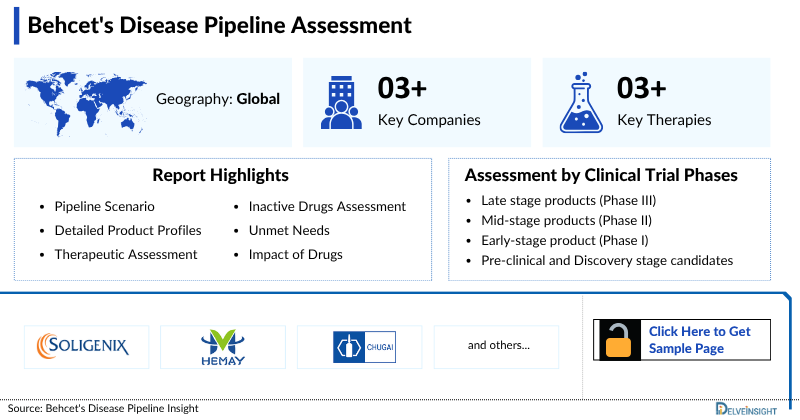
"Behcet’s Disease Pipeline Insight, 2026" report by DelveInsight outlays comprehensive insights of present scenario and growth prospects across the indication. A detailed picture of the Behcet’s Disease pipeline landscape is provided which includes the disease overview and Behcet’s Disease treatment guidelines. The assessment part of the report embraces, in depth Behcet’s Disease commercial assessment and clinical assessment of the pipeline products under development. In the report, detailed description of the drug is given which includes mechanism of action of the drug, clinical studies, NDA approvals (if any), and product development activities comprising the technology, Behcet’s Disease collaborations, licensing, mergers and acquisition, funding, designations and other product related details.
Behcet’s Disease Pipeline Report Highlights
- The companies and academics are working to assess challenges and seek opportunities that could influence Behcet’s Disease R&D. The therapies under development are focused on novel approaches to treat/improve Behcet’s Disease.
Behcet’s Disease Emerging Drugs Analysis
This segment of the Behcet’s Disease report encloses its detailed analysis of various drugs in different stages of clinical development, including Phase III, II, I, Preclinical and Discovery. It also helps to understand clinical trial details, expressive pharmacological action, agreements and collaborations, and the latest news and press releases.
Behcet’s Disease Emerging Drugs
Dusquetide (SGX945): Soligenix
Dusquetide (SGX945) is a first-in-class intravenous formulation Innate Defense Regulator (IDR) peptide being developed by Soligenix for the treatment of Behçet's disease, particularly recurrent oral ulcers. The peptide is designed to modulate the innate immune response, promoting the resolution of inflammation while enhancing tissue repair without broadly suppressing the immune system. By restoring immune homeostasis, dusquetide has the potential to reduce the frequency and severity of oral ulcer episodes and improve patients' quality of life. Dusquetide is a drug composed of 5 amino acids, naturally occurring molecules which make up the proteins in the body. Therefore, metabolism of dusquetide results in additional building blocks for body and is not known to interfere with any other drugs the person might be taking.
SGX945 is a rapid 4-minute injection administered twice per week to enhance the rate of resolution of aphthous ulcers, including oral and genital ulcers. Soligenix has a strong intellectual property position in the IDR technology platform, including composition of matter for dusquetide and related analogs. Dusquetide was developed pursuant to discoveries made by Professors B. Brett Finlay, PhD and Robert Hancock, PhD of the University of British Columbia, Canada. The drug is currently being evaluated in Phase II clinical development for Behçet's disease.
Further product details are provided in the report……..
Behcet’s Disease Drug Therapeutic Assessment
This segment of the report provides insights about the different Behcet’s Disease drugs segregated based on following parameters that define the scope of the report, such as:
- Major Behcet’s Disease Players in Behcet’s Disease
- There are approx. 3+ key companies which are developing the therapies for Behcet’s Disease. The companies which have their Behcet’s Disease drug candidates in the most advanced stage, i.e. Phase II include, Soligenix.
Behcet’s Disease Clinical Trial Phases
DelveInsight’s report covers around 3+ products under different phases of clinical development like
- Late stage products (Phase III)
- Mid-stage products (Phase II)
- Early-stage product (Phase I) along with the details of
- Pre-clinical and Discovery stage candidates
- Discontinued & Inactive candidates
Behcet’s Disease Drug Route of Administration
Behcet’s Disease pipeline report provides the therapeutic assessment of the pipeline drugs by the Route of Administration. Products have been categorized under various ROAs such as
- Oral
- Intravenous
- Subcutaneous
- Parenteral
- Topical
Behcet’s Disease Product Molecule Type
Products have been categorized under various Molecule types such as
- Recombinant fusion proteins
- Small molecule
- Monoclonal antibody
- Peptide
- Polymer
- Gene therapy
Behcet’s Disease Product Type
Drugs have been categorized under various product types like Mono, Combination and Mono/Combination.
Behcet’s Disease Clinical Trial Activities
The Behcet’s Disease Pipeline report provides insights into different Behcet’s Disease Clinical Trial within Phase III, II, I, preclinical and discovery stage. It also analyses Behcet’s Disease therapeutic drugs key players involved in developing key drugs.
Behcet’s Disease Pipeline Development Activities
The Behcet’s Disease Clinical Trial Analysis report covers the detailed information of collaborations, acquisition and merger, licensing along with a thorough therapeutic assessment of emerging Behcet’s Disease drugs.
Behcet’s Disease Report Insights
- Behcet’s Disease Pipeline Analysis
- Behcet’s Disease Therapeutic Assessment
- Behcet’s Disease Unmet Needs
- Impact of Behcet’s Disease Drugs
Behcet’s Disease Report Assessment
- Behcet’s Disease Pipeline Product Profiles
- Behcet’s Disease Therapeutic Assessment
- Behcet’s Disease Pipeline Assessment
- Behcet’s Disease Inactive drugs assessment
- Behcet’s Disease Market Unmet Needs
Key Questions Answered in the Behcet’s Disease Pipeline Report
- Current Treatment Scenario and Emerging Therapies:
- How many companies are developing Behcet’s Disease drugs?
- How many Behcet’s Disease drugs are developed by each company?
- How many emerging drugs are in mid-stage, and late-stage of development for the treatment of Behcet’s Disease?
- What are the key collaborations (Industry–Industry, Industry–Academia), Mergers and acquisitions, licensing activities related to the Behcet’s Disease therapeutics?
- What are the recent trends, drug types and novel technologies developed to overcome the limitation of existing therapies?
- What are the clinical studies going on for Behcet’s Disease and their status?
- What are the key designations that have been granted to the emerging drugs?
Behcet’s Disease Key Players
- Soligenix
- Ganzhou Hemay Pharmaceutical Co., Ltd
- Chugai Pharmaceutical
Behcet’s Disease Key Products
- Dusquetide (SGX945)
- Mufemilast (Hemay005)
- RAY121