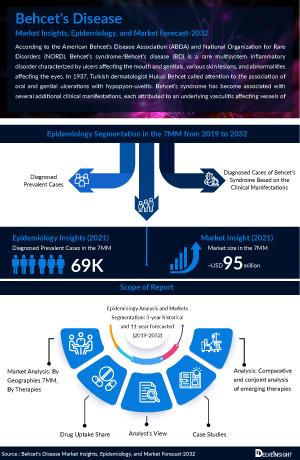
Behcet's Disease Market
- In 2023, the total Behcet’s Syndrome market size in the 7MM was approximately USD 140 thousand million, out of which the US accounted for approximately USD 60 thousand million.
- Behçet's syndrome has a strong genetic component, with certain human leukocyte antigen (HLA) alleles being associated with increased susceptibility. As populations mix and genetic testing becomes more accessible, individuals with the genetic predisposition may be identified earlier. Furthermore, today’s sedentary lifestyle including diet, stress levels, and exposure to pollutants, could potentially influence the development or exacerbation of Behçet's syndrome by 2034.
- As the medical knowledge and diagnostic techniques improve, more cases of Behçet's syndrome may be accurately identified. A better understanding of the disease's varied presentations and symptoms could lead to earlier diagnosis during the forecast period (2024-2034).
- Approved Behçet's syndrome treatment include OTEZLA for addressing oral ulcers linked to the condition. Additionally, in Japan, HUMIRA and REMICADE have been approved to manage complications associated with Behçet's syndrome. Other therapies utilized off-label for symptom relief comprise corticosteroids, azathioprine, and colchicine.
- Moreover, Behçet's syndrome manifests differently in each patient, with symptoms ranging from oral ulcers and skin lesions to severe eye inflammation and neurological complications. This heterogeneity complicates clinical trials and the development of targeted treatments, as interventions that work for one subset of patients may not be effective for others. Currently, there are no specific biomarkers for Behçet's syndrome, making diagnosis challenging and monitoring treatment efficacy difficult. The absence of reliable biomarkers hampers drug development efforts, as it's harder to assess treatment response and measure outcomes in clinical trials.
- The sparse pipeline for emerging drugs targeting Behçet's syndrome underscores significant unmet needs in treatment. Improved therapies are needed to address the complex and varied symptoms of the disease, especially for patients who do not respond adequately to current treatment options.
- Amgen's OTEZLA (apremilast) is under investigation for potential use in pediatric patients anticipated to be launched during the forecast period (2024-2034).
.jpg)
Request for unlocking the CAGR of the "Behcet’s Syndrome Drugs Market"
DelveInsight’s “Behcet’s Syndrome Market Insights, Epidemiology, and Market Forecast – 2034” report delivers an in-depth understanding of Behcet’s Syndrome, historical and forecasted epidemiology, as well as the Behcet’s Syndrome market trends in the United States, EU4 (Germany, France, Italy, and Spain) and the United Kingdom, and Japan.
The Behcet’s Syndrome Drugs Market Report provides current treatment practices, emerging drugs, Behcet’s Syndrome market share of individual therapies, and current and forecasted 7MM Behcet’s Syndrome market size from 2020 to 2034. The report also covers Behcet’s Syndrome treatment market practices/algorithms and Behcet’s Syndrome unmet needs to curate the best opportunities and assess the market’s potential.
|
Study Period |
2020–2034 |
|
Forecast Period |
2024–2034 |
|
Geographies Covered |
|
|
Behcet's Syndrome Epidemiology |
|
|
Behcet's Syndrome Drugs Market |
|
|
Behcet's Syndrome Drugs Market Analysis |
|
|
Behcet's Syndrome Companies |
|
|
Behcet's Syndrome Drugs Market Growth Barriers |
The scarcity and intricate nature of Behçet's syndrome pose obstacles for pharmaceutical firms and healthcare providers in managing treatments and facilitating patient access and acceptance of therapies. Additionally, the sparse pipeline exacerbates these challenges. |
Behcet's Syndrome Treatment Market
According to the American Behcet’s Disease Association (ABDA) and National Organization for Rare Disorders (NORD), Behcet’s syndrome/Behcet’s disease is a rare chronic autoimmune disorder characterized by inflammation of blood vessels throughout the body. It typically affects multiple systems, including the skin, eyes, mouth, genitals, joints, blood vessels, and sometimes even the central nervous system. The disease is recognized worldwide, but there are significant differences in the epidemiological, genetic, and clinical characteristics of the disorder between ethnic groups and in different geographic locations. The exact cause of Behçet's syndrome is unknown, but it's believed to involve a combination of genetic predisposition and environmental triggers.
Continued in the report…..
Behcet's syndrome diagnosis
Diagnosing Behçet's syndrome can be challenging because its symptoms overlap with those of other conditions. There's no specific test for Behçet's, so diagnosis is typically based on clinical symptoms and exclusion of other possible causes.
Continued in the report…..
Behcet's syndrome treatment
Behcet’s Syndrome Treatment is dependent on the site and severity of manifestations; OTEZLA (apremilast), an oral selective phosphodiesterase 4 (PDE4) inhibitor, is the first and only approved treatment by the US Food and Drug Administration (FDA) for oral ulcers associated with Behcet’s syndrome. OTEZLA was approved in 2019 as a 30 mg twice-daily therapy for adult patients in the US. In Japan, infliximab (2007) and HUMIRA (adalimumab; 2013) were approved for managing systemic and intestinal Behcet’s syndrome, and TNF inhibitors are considered the drug of choice in refractory cases of the disease. Pharmacological management involves using various off-label therapies like corticosteroids and other immunosuppressants. Surgery is usually indicated for treating systemic arterial aneurysms because of the risk of rupture, but isolated arterial occlusions may be asymptomatic and not require surgery.
Continued in the report…..
Behcet's Syndrome Epidemiology
As the market is derived using a patient-based model, the Behcet’s syndrome epidemiology chapter in the report provides historical as well as forecasted epidemiology segmented by total diagnosed prevalent cases of Behcet’s syndrome, diagnosed cases of Behcet’s syndrome based on the age of onset, and clinical manifestations associated with Behcet’s syndrome in the 7MM covering the United States, EU4 countries (Germany, France, Italy, and Spain) and the United Kingdom, and Japan from 2020 to 2034.
· As per DelveInsight’s analysis, in 2023, the total diagnosed prevalent cases of Behcet's syndrome in the 7MM is estimated to be approximately 73 thousand cases. These cases are anticipated to rise during the forecasted period (2024-2034) primarily due to increased awareness among healthcare providers and the public regarding Behcet's syndrome which will enhance its identification and diagnosis.
· In 2023, the US accounted for approximately 20 thousand diagnosed prevalent cases of Behcet's syndrome. Out of which nearly 83% of patients were young adults, while around 17% were pediatric. These cases are expected to increase by 2034 with an increasingly sedentary lifestyle that leads to infectious agents or other triggers that might play a role in the development of Behçet's syndrome in the US.
· Among EU4 and the UK, in 2023 Italy has the highest number of diagnosed prevalent cases of Behcet's syndrome, which were approximately 7 thousand cases followed by France and Spain with nearly 5 thousand, and 6 thousand cases respectively. As per DelveInsight’s estimates, these are expected to change during the forecast period (2024-2034).
· In 2023, Japan accounted for the highest cases i.e. nearly 33 thousand diagnosed prevalent cases of Behcet's syndrome. Out of which there were approximately 5 thousand cases of oral ulcers, 4 thousand cases of genital ulcers, 3 thousand cases of skin manifestations, 3 thousand cases of arthritis, and others, in 2023. These cases are expected to increase by 2034 with migration and urbanization in Japan which will lead to changes in disease prevalence.
.jpg)
Unlock comprehensive insights! Click Here to Purchase the Full Report @ Behcet’s Syndrome Prevalence
Behcet’s Syndrome Drug Chapters
The drug chapter segment of the Behcet’s Syndrome therapeutics market report encloses a detailed analysis of Behcet’s Syndrome-marketed drugs and late-stage (Phase III and Phase II) pipeline drugs. It also helps understand Behcet’s Syndrome clinical trial details, expressive pharmacological action, agreements and collaborations, approval and patent details, advantages and disadvantages of each included drug and the latest news and press releases.
Behcet’s Syndrome Marketed Drugs
- OTEZLA (apremilast): Amgen
OTEZLA (apremilast) is a small oral molecule and is the first and only FDA-approved treatment for oral ulcers associated with Behcet syndrome. It acts by inhibiting PDE4 specific for cyclic adenosine monophosphate (cAMP). As a result, inhibition of PDE4 leads to a persistent elevation of cAMP and subsequently diminished T-cell secretion of pro-inflammatory cytokines and other mediators, including TNF-alpha, IFN, nitric oxide synthase, IL-2, IL-17, and IL-23. Through modulation of cAMP levels, PDE4 may regulate the pro-inflammatory actions of monocytes, T-cells, and neutrophils. The pivotal Phase III study showed a reduction in the number and pain of oral ulcers associated with Behcet’s syndrome. The recommended dose of apremilast is 30 mg taken orally twice daily (BID), approximately 12 hours apart (morning and evening), with no food restrictions. An initial titration schedule is required, and no re-titration is required after initial titration.
In July 2019, the US FDA 2020 approved OTEZLA to treat oral ulcers linked with Behçet’s syndrome in adults who may benefit from systemic therapies. This approval followed its authorization in Japan in September 2019 and Europe in February 2020.
Get More Insights of the Report @ OTEZLA Market
- REMICADE (infliximab): Janssen Pharmaceutical/Mitsubishi Tanabe Pharma
Infliximab is a chimeric monoclonal antibody (mAb) against TNF, a cytokine whose production is from peripheral blood monocytes and is involved in the symptoms of Behcet syndrome, particularly the activity of ocular symptoms such as uveitis. The usual dosage of infliximab to treat refractory uveoretinitis associated with Behcet’s syndrome is 5 mg/kg administered as an IV infusion at Weeks 0, 2, and 6, then every 8 weeks thereafter, and the dosage of infliximab for the intestinal Behcet’s syndrome, neuro-Behcet’s syndrome, vascular-Behcet’s syndrome is 5 mg/kg administered as an IV infusion at Weeks 0, 2, and 6, then every 8 weeks thereafter. If a patient has an inadequate or attenuated response at Week 6 or later, the dose may be increased to 10 mg/kg.
For More Insights of the Report @ REMICADE Market
- HUMIRA (adalimumab): AbbVie/Eisai
HUMIRA (adalimumab) is a completely humanized IgG1 monoclonal anti-TNF-α antibody that binds to TNF-α (free and membrane-bound) and prevents it from binding to its receptors. Adalimumab was a potentially effective treatment for intestinal Behcet’s syndrome in Japanese patients who are refractory to conventional treatments. The usual adult dosage of HUMIRA for intestinal Behcet’s syndrome is an initial dose of 160 mg, followed by 80 mg 2 weeks later, and then 40 mg once every 2 weeks starting 4 weeks after the initial dose is administered subcutaneously.
See More Insights of the Report @ HUMIRA Market
Behcet’s Syndrome Emerging Drugs
- OTEZLA (apremilast): Amgen
OTEZLA is a small oral molecule and is the first and only FDA-approved treatment for oral ulcers associated with Behcet’s syndrome. It acts by inhibiting PDE4 specific for cyclic adenosine monophosphate (cAMP). The drug has already received approval for treating oral ulcers linked to Behcet’s syndrome in adults, and it's now undergoing investigation in a Phase III trial (BEAN) trial to evaluate its efficacy in pediatric patients who have active oral ulcers associated with Behçet's Disease.
Behcet's Syndrome Drug Market Insights
While there's no cure, management focuses on easing symptoms and averting complications, typically through medication to quell inflammation, handle symptoms, and dampen the immune system. Common drug categories encompass corticosteroids, which swiftly tackle inflammation during flare-ups, though prolonged use can yield significant side effects. Immunomodulators like azathioprine, methotrexate, and cyclosporine regulate the immune response and reduce inflammation over the long term. Biologic therapies include TNF-alpha Inhibitors such as adalimumab, infliximab, and etanercept, which target tumor necrosis factor-alpha implicated in Behcet's syndrome, along with Interleukin Inhibitors like anakinra and ustekinumab, which address other involved cytokines in the inflammatory process. Furthermore, colchicine is commonly used to reduce inflammation and prevent recurrent attacks of symptoms like oral and genital ulcers.
Behçet’s Syndrome Market Outlook
The Behçet’s syndrome treatment is directed toward the specific symptoms that are apparent in each individual. Specific therapies for Behçet’s syndrome are symptomatic and supportive. The severity of the condition as well as the patient’s age and sex may all affect treatment decisions. Spontaneous remission over time is common for individuals with Behçet’s syndrome. Oral and genital ulcerations may be treated with topical application of corticosteroid-containing preparations to the affected areas to assist in aborting developing attacks.
Mouthwash containing a local anesthetic such as lidocaine or diphenhydramine may temporarily relieve pain. For recurrent attacks, colchicine can be effective in preventing recurring attacks of oral and genital ulcers. Moreover, the approval of novel therapies, such as OTEZLA (apremilast), for the management of specific symptoms like oral ulcers, signals a promising shift toward targeted treatment approaches. More aggressive therapies such as azathioprine, thalidomide, interferon-alpha, and anti-TNF agents may be considered.
Individuals who have arthritis associated with Behçet’s may respond to nonsteroidal anti-inflammatory drugs (NSAIDs) and colchicine. Treatment with azathioprine and anti-TNF agents can be used for more aggressive or refractory disease. Identification of eye inflammation requires close collaboration with an ophthalmologist as treatment is based on the location of eye inflammation and its severity. Behçet’s syndrome treatment may include eye drops containing corticosteroids to relieve pain.
For more aggressive or refractory diseases, oral corticosteroids combined with an immunosuppressant drug such as azathioprine or anti-TNF are used to control the progression of eye disease. Sulfasalazine, azathioprine, and corticosteroids may be administered to treat inflammatory bowel disease and gastrointestinal lesions associated with Behçet’s. Central nervous system and vascular abnormalities may be treated with corticosteroids as well, often in conjunction with immunosuppressive agents.
In patients with clotting of major blood vessels, systemic anticoagulants and immunosuppressants should be considered. Inflammation of the joints, skin, and/or mucous membranes or other organs may be reduced with oral corticosteroid drugs. However, corticosteroids do not prevent recurring episodes of symptoms and may not reduce damage when used alone. Therefore, immunosuppressive agents such as azathioprine, methotrexate, cyclosporine, or chlorambucil may be employed for improved control of inflammation and organ protection. Experience is evolving with the use of interferon-alpha and with agents that inhibit tumor necrosis factor (TNF) in the treatment of Behçet’s disease.
While the Behcet's Syndrome Drugs Market faces hurdles due to the scarcity of new therapeutic options in development, Amgen's OTEZLA (apremilast) is under investigation for potential use in pediatric patients anticipated to be launched during the forecast period (2024-2034).
- According to DelveInsight, the overall the Behcet’s Syndrome market dynamics are anticipated to change during the forecast period (2024-2034) owing to advancements in medical research and technology. Improved understanding of the disease's underlying mechanisms may lead to the development of more targeted and effective treatments. Additionally, increased awareness among healthcare professionals and the general public.
- In 2023, the total Behcet’s Syndrome market size in the 7MM was approximately USD 140 thousand million, out of which the US accounted for approximately USD 60 thousand million.
- Among the EU4 and the UK, Italy holds the highest Behçet’s syndrome market size of around USD 10 thousand million followed by France, and Spain with approximately USD 9 thousand million, and USD 8 thousand million respectively. These numbers are expected to change during the forecast period (2024-2034) driven by the ongoing research and development efforts that may lead to the discovery of more effective medications and therapies for treating Behcet’s Syndrome.
- The Behcet’s Syndrome market size in Japan accounted for nearly 34% of the total 7MM market size in 2023, these numbers are expected to change by 2034.
.jpg)
Continued in report…
Behcet’s Syndrome Drugs Uptake
This section focuses on the uptake rate of potential Behçet’s syndrome drugs expected to be launched in the Behçet’s syndrome Drugs Market during 2020–2034. For example, Amgen’s OTEZLA, is a small oral molecule that acts by inhibiting PDE4 specific for cyclic adenosine monophosphate (cAMP). The drug has already received approval for treating oral ulcers linked to Behcet’s syndrome in adults, and it's now undergoing investigation in pediatric patients who have active oral ulcers associated with Behçet's Disease.
Further detailed analysis of emerging therapies drug uptake in the report…
Behcet’s Syndrome Pipeline Development Activities
The Behçet’s syndrome pipeline segment provides insights into different therapeutic candidates in Phase III, Phase II, and Phase I. It also analyzes key Behçet’s syndrome Companies involved in developing targeted therapeutics.
Pipeline Development Activities
The Behçet’s syndrome pipeline covers information on collaborations, acquisitions and mergers, licensing, and patent details for Behçet’s syndrome emerging therapies.
Take Your Research to the Next Level! Click Here to Get Access to the Full Pipeline Report @ Bechet's Syndrome Treatment Drugs
KOL Views
To keep up with current Behçet’s syndrome market trends, we take KOLs and SMEs’ opinions working in the domain through primary research to fill the data gaps and validate our secondary research. Industry Experts contacted for insights on evolving Behcet’s Syndrome's treatment landscape, patient reliance on conventional therapies, patient therapy switching acceptability, and drug uptake, along with challenges related to accessibility, including Medical/scientific writers, Medical Professionals, Professors, Directors, and Others.
DelveInsight’s analysts connected with 50+ KOLs to gather insights; however, interviews were conducted with 15+ KOLs in the 7MM. Centers like the University of Birmingham Research, the University of Washington, the Center for Immunity and Immunotherapies US, and the University of Milan, were contacted. Their opinion helps understand and validate current and emerging therapy treatment patterns or Behcet’s Syndrome market trends. This will support the clients in potential upcoming novel treatments by identifying the overall scenario of the market and the unmet needs.
|
Region |
KOL Views |
|
The US |
Many variables (e.g. the organ involved, and the severity of this involvement, the duration of the involvement, the frequency of the attacks, the patient's age and gender) affect the treatment success. The primary aim should be the rapid suppression of inflammatory attacks and the prevention of new ones to prevent irreversible organ damage, especially in the early, active disease stages. |
|
The US |
Since there is no diagnostic laboratory marker for Behcet's syndrome, diagnosis is based on clinical manifestations. The diagnosis of Behcet's syndrome is made in the presence of any two recurrent genital ulcers, typical ocular involvement, typical cutaneous lesions, or positive skin pathergy test in addition to recurrent oral ulcers |
|
The UK |
I would estimate perhaps 10% of patients will require therapy for severe organ involvement (ocular, neurological, vascular, or mucocutaneous)–we are currently undertaking further research in our primary care record (CPRD) to look at the evolution of the key disease features over time toward the final diagnosis of BS and the overlap with inflammatory bowel disease (UC/Crohn’s). |
Physician’s View
According to physicians, a primary challenge in Behçet's Syndrome treatment lies in the heterogeneity of symptoms and disease manifestations among patients. Behçet's syndrome can affect multiple organ systems, including the skin, eyes, mouth, gastrointestinal tract, and nervous system, presenting a complex clinical picture and has no cure. This variability makes it difficult to develop standardized treatment approaches that effectively address the diverse needs of patients. Furthermore, the lack of specific biomarkers for Behçet's syndrome complicates diagnosis and monitoring of disease progression, often leading to delays in appropriate treatment initiation.
Qualitative Analysis
We perform Qualitative and market Intelligence analysis using various approaches, such as SWOT analysis and Attribute Analysis. In the SWOT analysis, strengths, weaknesses, opportunities, and threats in terms of disease diagnosis, patient awareness, patient burden, competitive landscape, cost-effectiveness, and geographical accessibility of therapies are provided. These pointers are based on the Analyst’s discretion and assessment of the patient burden, cost analysis, and existing and evolving Behcet’s Syndrome treatment landscape.
Attribute Analysis analyzes multiple emerging therapies based on relevant attributes such as safety, efficacy, frequency of administration, route of administration, and order of entry. Scoring is given based on these parameters to analyze the effectiveness of therapy. In efficacy, the trial’s primary and secondary outcome measures are evaluated; for instance, in Behcet’s Syndrome trials, one of the most important primary outcome measures is complete eschar removal.
Further, the therapies’ safety is evaluated wherein the acceptability, tolerability, and adverse events are majorly observed, and it sets a clear understanding of the side effects posed by the drug in the trials. In addition, the scoring is also based on the route of administration, order of entry and designation, probability of success, and the addressable patient pool for each therapy. According to these parameters, the final weightage score and the ranking of the emerging therapies are decided.
Behcet’s Syndrome Market Access and Reimbursement
The high cost of therapies for the Behcet’s Syndrome treatment is a major factor restraining the growth of the Behcet’s Syndrome Drugs Market. Because of the high cost, the economic burden is increasing, leading the patient to escape from proper treatment. The reimbursement challenges related to medical care and treatment for individuals with Behcet’s Syndrome can be significant as they often require specialized medical attention, covering the costs of diagnosis, treatment, and ongoing care. Health insurance plans may not fully cover limited coverage of some medical treatments, and therapies specific to Behcet’s Syndrome. This can result in high out-of-pocket expenses for families seeking the best care for their loved ones. Moreover, it requires specialized care from healthcare providers with expertise. Finding and accessing such specialists may be challenging, and the associated costs may not always be fully reimbursed by insurance.
Further details will be provided in the report.
Behcet’s Syndrome Therapeutics Market Report Scope
- The Behcet’s Syndrome therapeutics market report covers a segment of key events, an executive summary, descriptive overview, explaining its causes, signs and symptoms, pathogenesis, and currently available therapies.
- Comprehensive insight has been provided into the Behcet’s Syndrome epidemiology segments and forecasts, the future growth potential of diagnosis rate, disease progression, and treatment guidelines.
- Additionally, an all-inclusive account of the current and emerging therapies, along with the elaborative profiles of late-stage and prominent therapies, will impact the current treatment landscape.
- A detailed review of the Behcet’s Syndrome Drugs Market, historical and forecasted Behcet’s Syndrome market size, Behcet’s Syndrome market share by therapies, detailed assumptions, and rationale behind our approach is included in the report, covering the 7MM drug outreach.
- The Behcet’s Syndrome therapeutics market report provides an edge while developing business strategies, by understanding trends, through SWOT analysis and expert insights/KOL views, patient journey, and treatment preferences that help shape and drive the 7MM Behcet’s Syndrome Drugs Market.
Behcet’s Syndrome Therapeutics Market Report Insights
- Patient-based Behcet’s Syndrome Market Forecasting
- Therapeutic Approaches
- Behcet’s Syndrome Pipeline Analysis
- Behcet’s Syndrome Market Size
- Behcet’s Syndrome Market Trends
- Existing and Future Behcet’s Syndrome Drugs Market Opportunity
Behcet’s Syndrome Therapeutics Market Report Key Strengths
- 11 years Behcet’s Syndrome Market Forecast
- The 7MM Coverage
- Behcet’s Syndrome Epidemiology Segmentation
- Key Cross Competition
- Attribute analysis
- Behcet’s Syndrome Drugs Uptake
- Key Behcet’s Syndrome Market Forecast Assumptions
Behcet’s Syndrome Treatment Market Report Assessment
- Current Behcet’s Syndrome Treatment Market Practices
- Behcet’s Syndrome Unmet Needs
- Behcet’s Syndrome Pipeline Product Profiles
- Behcet’s Syndrome Drugs Market Attractiveness
- Qualitative Analysis (SWOT and Attribute Analysis)
Key Questions
Behcet’s Syndrome Drugs Market Insights
- What was the Behcet’s Syndrome market share (%) distribution in 2020 and what it would look like in 2034?
- What was the total Behcet’s Syndrome market size by therapies, and Behcet’s Syndrome market share (%) distribution in 2020, and what would it look like by 2034? What are the contributing factors for this growth?
- How will OTEZLA affect the treatment paradigm of pediatric Behcet’s Syndrome?
- How will OTEZLA (apremilast) compete with upcoming products?
- Which drug is going to be the largest contributor by 2034?
- What are the pricing variations among different geographies for approved and marketed therapies?
- How would future opportunities affect the market dynamics and subsequent analysis of the associated trends?
Behcet’s Syndrome Epidemiology Insights
- What are the disease risks, burdens, and Behcet’s Syndrome unmet needs? What will be the growth opportunities across the 7MM concerning the patient population with Behcet’s Syndrome?
- What is the historical and forecasted Behcet’s Syndrome patient pool in the United States, EU4 (Germany, France, Italy, and Spain) the United Kingdom, and Japan?
- Out of the above-mentioned countries, which country would have the highest Behcet’s Syndrome diagnosed prevalent population during the forecast period (2023–2034)?
- What factors are factors contributing to the growth of Behcet’s Syndrome cases?
Current Behcet’s Syndrome Treatment Market Scenario, Marketed Drugs, and Emerging Therapies
- What are the current options for the Behcet’s Syndrome treatment? What are the current guidelines for treating Behcet’s Syndrome in the US and Europe?
- How many companies are developing therapies for the Behcet’s Syndrome treatment?
- How many emerging therapies are in the mid-stage and late stage of development for treating Behcet’s Syndrome?
- What are the recent novel therapies, targets, mechanisms of action, and technologies developed to overcome the limitations of existing therapies?
- What is the cost burden of current treatment on the patient?
- Patient acceptability in terms of preferred treatment options as per real-world scenarios?
- What are the country-specific accessibility issues of approved therapies?
- What is the 7MM historical and forecasted Behcet’s Syndrome Drugs Market?
Reasons to Buy
- The Behcet’s Syndrome market size report will help develop business strategies by understanding the latest trends and changing treatment dynamics driving the Behcet’s Syndrome Drugs Market.
- Insights on patient burden/disease prevalence, evolution in diagnosis, and factors contributing to the change in the epidemiology of the disease during the forecast years.
- Understand the existing market opportunities in varying geographies and the growth potential over the coming years.
- Distribution of historical and current patient share based on real-world prescription data in the US, EU4 (Germany, France, Italy, and Spain) the United Kingdom, and Japan.
- Identifying strong upcoming players in the Behcet’s Syndrome Drugs Market will help devise strategies to help get ahead of competitors.
- Detailed analysis and ranking of class-wise potential current and emerging therapies under the conjoint analysis section to provide visibility around leading classes.
- Highlights of access and reimbursement policies for Behcet’s Syndrome, barriers to accessibility of approved therapy, and patient assistance programs.
- To understand Key Opinion Leaders’ perspectives around the accessibility, acceptability, and compliance-related challenges of existing treatment to overcome barriers in the future.
- Detailed insights on the Behcet’s Syndrome unmet needs of the existing market so that the upcoming players can strengthen their development and launch strategy.
Access Exclusive Data Now! Click here to Read More about the Related Articles
.png&w=256&q=75)