-infection-market.png&w=256&q=75)
BK virus Infection Market Summary
- The Bk Virus Infection market is anticipated to witness a substantial positive shift owing to better uptake of existing drugs, the expected market launch of T-cell therapy, and raised awareness.
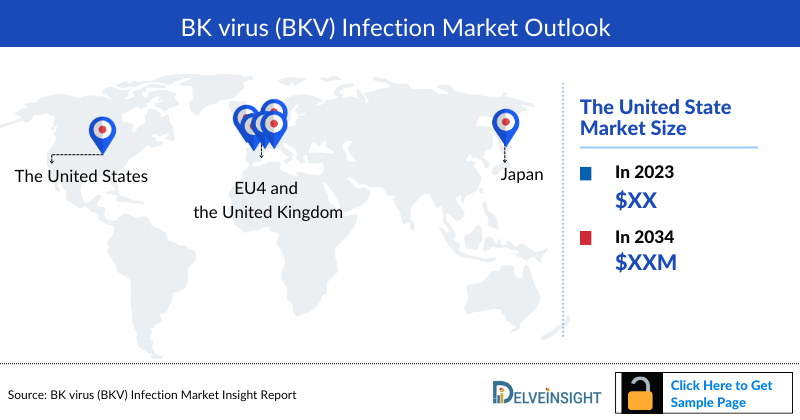
- The United States accounted for the largest Bk Virus Infection market size, in comparison to EU4 (Germany, Spain, Italy, France), the United Kingdom, and Japan.
Bk Virus Infection Market and Epidemiology Analysis
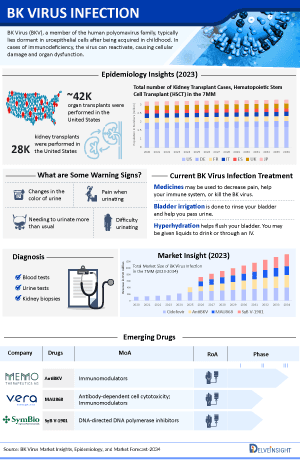
- BK Virus (BKV), a member of the human polyomavirus family, typically lies dormant in uroepithelial cells after being acquired in childhood. In cases of immunodeficiency, the virus can reactivate, causing cellular damage and organ dysfunction.
- Currently, there are no approved drugs specifically for the treatment of BK Virus Infection. However, managing BKV often involves reducing calcineurin inhibitors while employing mTOR (mechanistic target of rapamycin) inhibitors and leflunomide as common strategies.
- In December 2023, AlloVir announced that it has discontinued its three Phase III posoleucel studies following separate, pre-planned DSMB futility analyses concluding the studies were unlikely to meet their primary endpoints. The company will prioritize capital preservation and review strategic options.
- Moreover, AiCuris is planning to start clinical trial for AIC468, supported by the preclinical data and first-in-human trial is anticipated to start mid-2024.
- Some of the Bk Virus Infection drugs in the pipeline include AntiBKV (Memo Therapeutics), MAU868 (Vera Therapeutics), SyB V-1901 (SymBio Pharmaceuticals), and others.
Request for unlocking the CAGR of the BK Virus Infection Drug Market
Factors affecting Bk Virus Infection Market Growth
Rising Organ Transplant Procedures
BK virus infections are particularly prevalent in kidney transplant recipients. With the increasing number of organ transplant procedures globally, especially kidney transplants, the risk of BK virus reactivation has grown, driving the demand for better diagnostic and therapeutic solutions.
Immunosuppressive Therapy Use
Post-transplant patients often require immunosuppressive drugs to prevent organ rejection. These medications can weaken the immune system, increasing susceptibility to BK virus reactivation. The widespread use of immunosuppressants is a major driver of market growth for BK virus diagnostics and treatment options.
Growing Awareness of BK Virus Complications
Healthcare professionals are becoming more aware of the long-term complications of BK virus infection, such as nephropathy and graft loss. This awareness is leading to earlier diagnosis and more frequent monitoring, fueling the demand for advanced diagnostic tests and antiviral therapies.
Advancements in Diagnostic Technologies
The development of sensitive and rapid molecular diagnostic techniques, such as PCR-based assays, has improved BK virus detection. Enhanced diagnostic accuracy drives the adoption of these technologies in hospitals and clinical laboratories.
Increase in Immunocompromised Populations
Beyond transplant patients, populations with compromised immune systems such as cancer patients undergoing chemotherapy or individuals with HIV/AIDS are at risk of BK virus infection. The growing number of immunocompromised patients contributes to increased market demand.
Rising Focus on Personalized Medicine
Personalized approaches to monitoring and managing BK virus infection, tailored to individual patient risk profiles, are gaining traction. This trend is encouraging the development of specialized diagnostics and targeted therapies, further driving market expansion.
Expansion of Healthcare Infrastructure
Improving healthcare infrastructure in emerging markets is enhancing access to organ transplantation, immunosuppressive therapies, and advanced diagnostic facilities. This expansion indirectly supports market growth by increasing the number of patients at risk of BK virus infection.
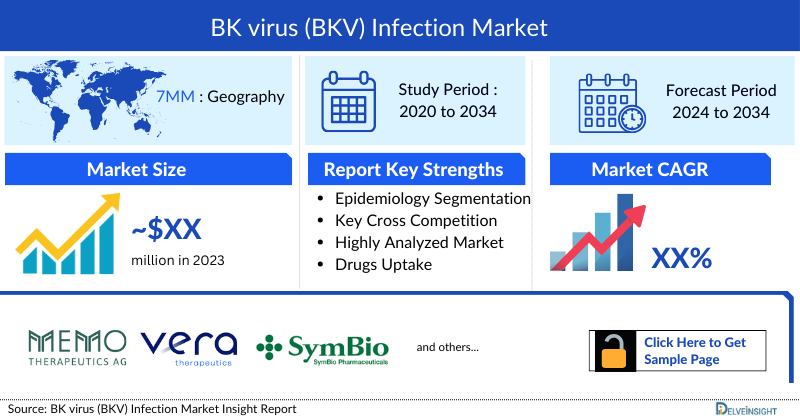
DelveInsight's “BK Virus Infection Market Insights, Epidemiology and Market Forecast – 2034” report delivers an in-depth understanding of BK Virus Infection, historical and forecasted epidemiology as well as the BK Virus Infection market trends in the United States, EU4 (Germany, Spain, Italy, and France) and the United Kingdom, and Japan.
BK Virus Infection Drug Market report provides real-world prescription pattern analysis, emerging drugs, market share of individual therapies, and historical and forecasted 7MM BK Virus Infection market size from 2020 to 2034. The report also covers current BK Virus Infection treatment market practices/algorithms and BK Virus Infection unmet needs to curate the best opportunities and assess the market’s underlying potential.
Scope of the Bk Virus Infection Market | |
|
Study Period |
2020–2034 |
|
Forecast Period |
2024–2034 |
|
Geographies Covered |
|
|
BK Virus Infection Epidemiology |
Segmented by:
|
|
BK Virus Infection Drug Market |
Segmented by:
|
|
BK Virus Infection Drug Market Analysis |
|
BK Virus Infection Treatment Market: Overview
BK Virus (BKV) Infection, primarily acquired in childhood, often lies dormant in the uroepithelium and renal tubular cells. In immunosuppressed individuals, such as renal transplant recipients, it can reactivate, leading to kidney dysfunction and graft loss. While typically asymptomatic or causing mild respiratory illness, BK reactivation can result in tubular cell lysis and viruria. It's rare in healthy individuals but can also affect bone marrow transplant recipients, causing BK virus nephropathy or hemorrhagic cystitis.
BKV infection diagnosis relies on quantifying plasma and/or urinary BKV DNA, along with urinary decoy cells in cytology, with or without allograft dysfunction. While kidney biopsy remains the gold standard for definitive diagnosis, it's estimated to be missed in nearly 30% of cases due to the virus predominantly affecting the medulla and causing focal disease. Definitive diagnosis via biopsy requires characteristic cytopathic changes and positive immunohistochemistry for BKV or cross-reacting SV40 large T antigen antibodies. A presumptive diagnosis is considered with a plasma BK viral load ≥10,000 copies/ml.
Further details related to country-based variations in diagnosis are provided in the report
BK Virus Infection Treatment
BK viral infection post-transplant poses challenges and can lead to kidney dysfunction. The primary approach involves reducing immunosuppression by adjusting drug dosage, opting for lower-risk agents, and minimizing steroid use. Therapeutic options like leflunomide and intravenous immune globulin (IVIG), which enhance neutralizing antibodies against BKV, are utilized. Cidofovir is effective but limited by nephrotoxicity. Regular monitoring of viral load and kidney function is essential for early detection and management of reactivation and kidney dysfunction.
BK Virus Infection Epidemiology Analysis
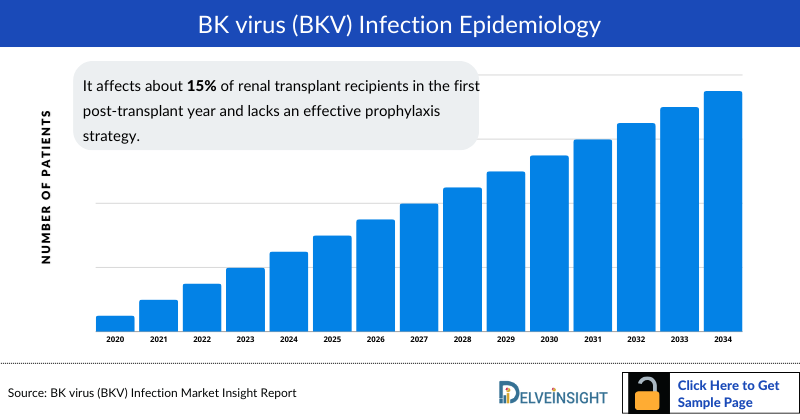
The BK Virus Infection epidemiology chapter in the report provides historical as well as forecasted in the 7MM covering the United States, EU4 countries (Germany, France, Italy, and Spain), the United Kingdom, and Japan from 2024 to 2034. The BK Virus Infection epidemiology is segmented with detailed insights into Total Number of Kidney Transplant Cases, Hematopoietic Stem Cell Transplant (HSCT), Total Incident Cases of BKV Infections, Total Cases of BKV Infection by Viral Genotype, and Treatable Cases of BKV Infection.
- BK Polyomavirus reactivation can manifest as viruria in 30–40%, viremia in 10–20%, and BK polyomavirus-associated nephropathy (BKPyVAN) in 1–10% of recipients.
- Genotype I constitutes approximately 80% of the total cases, making it the most prevalent, followed by genotype IV, which accounts for around 15% of the total cases.
- Hemorrhagic cystitis occurs in up to 70% of allogeneic bone marrow transplant patients, while the detection rate of BK virus after transplant ranges from 50% to 80%.
Unlock comprehensive insights! Click Here to Purchase the Full Report @ BK Virus Infection Prevalence
BK Virus Infection Market Recent Developments and Breakthroughs
- On November 1, 2024, AiCuris Anti-infective Cures initiated its first-in-human Phase I trial of AIC468, an antisense oligonucleotide aimed at treating BK virus (BKV) infections in kidney transplant (KT) recipients. This study will assess the tolerability, safety, and pharmacokinetics of AIC468 in healthy participants. Conducted in Germany, the double-blind, randomized, placebo-controlled trial will involve 72 healthy volunteers aged 18 to 64.
BK Virus Infection Drug Analysis
The drug chapter segment of the BK Virus Infection drug market report encloses a detailed analysis of BK Virus Infection marketed drugs and late-stage (Phase III and Phase II) BK Virus Infection pipeline drugs. It also deep dives into the BK Virus Infection pivotal clinical trials details, recent and expected market approvals, patent details, the latest BK Virus Infection news, and recent deals and collaborations.
BK Virus Infection Emerging Drugs
-
AntiBKV: Memo Therapeutics
AntiBKV is a BK virus-neutralizing antibody isolated from humans for the treatment of BK virus infection after renal transplantation. The antibody has the properties such as highly virus neutralizing, Pico-molar affinity and optimal safety profile due to human origin (negative/positive selection) and known viral target. The product has received Fast-track Designation from the US FDA in May 2023.
In June 2023, Memo Therapeutics initiated pivotal Phase II/III for treatment of BKV infection in renal transplant patients. The Phase II part is a randomized, placebo-controlled trial designed to evaluate the therapeutic efficacy of AntiBKV in 60 renal transplant patients with BK viremia. The primary endpoint is the proportion of participants without detectable BKV. The data from Phase II is expected in 1H 2025.
-
MAU868: Vera Therapeutics
MAU868 is a potent, human monoclonal antibody (immunoglobulin G, IgG1/λ isotype subclass) that neutralizes all four BKV serotypes. It recognizes a conformational epitope on the viral capsid protein, VP1, which is responsible for binding to and the infection of new cells. Vera holds an exclusive worldwide license from Amplyx Pharmaceuticals, a wholly owned subsidiary of Pfizer for the development and commercialization of MAU868 in all indications.
Final results from the Phase II clinical trial of MAU868 versus placebo showed that MAU868 was well tolerated and demonstrated clinically meaningful reductions in BK antiviral activity through 36 weeks in kidney transplant patients with BK viremia.
Note: Detailed emerging therapies assessment will be provided in the final report.
|
Therapy Name |
Company Name |
ROA |
MOA |
Phases |
Any Special Status |
|
AntiBKV |
Memo Therapeutics |
IV |
BK virus-neutralizing antibody |
II/III |
Fast-track Designation |
|
MAU868 |
Vera Therapeutics |
IV |
monoclonal antibody |
II |
N/A |
|
SyB V-1901 |
SymBio Pharmaceuticals |
Injection |
Lipid conjugate of cidofovir (CDV) |
II |
N/A |
BK Virus Infection Market Outlook
Key BK Virus Infection companies such as Memo Therapeutics, Vera Therapeutics, SymBio Pharmaceuticals, and others are evaluating their lead candidates in different stages of clinical development, respectively. They aim to investigate their products for the treatment of BK Virus (BKV) Infection.
Key findings from Bk Virus Infection Market
- Adjusting the dosing regimen of immunosuppressants, such as minimizing calcineurin inhibitors and incorporating mTOR inhibitors and leflunomide is mostly used for the treatment of BKV infection.
- BK-specific T-cell therapy and vaccines are emerging options for the management and prevention of BKV infection.
- Emerging studies may shape the future of BKV infection management by prioritizing treatment efficacy while minimizing adverse effects, ultimately optimizing graft and patient survival.
BK Virus Infection Drugs Uptake
This section focuses on the uptake rate of potential BK Virus Infection drugs expected to be launched in the market during 2024–2034, which depends on the competitive landscape, safety, and efficacy data along with order of entry. It is important to understand that the key BK Virus Infection companies evaluating their novel therapies in the pivotal and confirmatory trials should remain vigilant when selecting appropriate comparators to stand the greatest chance of a positive opinion from regulatory bodies, leading to approval, smooth launch, and rapid uptake.
Further detailed analysis of emerging therapies drug uptake in the report…
BK Virus Infection Clinical Trial Activities
The BK Virus Infection pipeline segment provides insights into different therapeutic candidates in Phase III and Phase II stages. It also analyzes key BK Virus Infection companies involved in developing targeted therapeutics.
Bk Virus Infection Pipeline Development Activities
The BK Virus Infection pipeline segment covers information on collaborations, acquisitions and mergers, licensing, and patent details for BK Virus Infection emerging therapies.
Take Your Research to the Next Level! Click Here to Get Access to the Full Pipeline Report @ BK Virus Infection Drugs
Latest KOL Views on BK Virus Infection
To keep up with the real-world scenario in current and emerging market trends, we take opinions from Key Industry leaders working in the domain through primary research to fill the data gaps and validate our secondary research. Industry Experts were contacted for insights on the evolving BK Virus Infection treatment market landscape, patient reliance on conventional therapies, patient therapy switching acceptability, and drug uptake along with challenges related to accessibility.
DelveInsight’s analysts connected with 20+ KOLs to gather insights; however, interviews were conducted with 10+ KOLs in the 7MM. Their opinion helps understand and validate current and emerging treatment patterns of BK Virus (BKV) Infection. This will support the clients in potential upcoming novel treatments by identifying the overall scenario of the market and the unmet needs.
Qualitative Analysis
We perform Qualitative and BK Virus Infection drug market Intelligence analysis using various approaches, such as SWOT analysis and Conjoint Analysis. In the SWOT analysis, strengths, weaknesses, opportunities, and threats in terms of gaps in disease diagnosis, patient awareness, physician acceptability, competitive landscape, cost-effectiveness, and geographical accessibility of therapies are provided.
Conjoint Analysis analyzes multiple approved and emerging therapies based on relevant attributes such as safety, efficacy, frequency of administration, route of administration, and order of entry. Scoring is given based on these parameters to analyze the effectiveness of therapy.
Further, the therapies’ safety is evaluated wherein the acceptability, tolerability, and adverse events are majorly observed, and it sets a clear understanding of the side effects posed by the drug in the trials. In addition, the scoring is also based on the probability of success, and the addressable patient pool for each therapy. According to these parameters, the final weightage score and the ranking of the emerging therapies are decided.
BK Virus Infection Market Access and Reimbursement
The BK Virus Infection drug market report further provides detailed insights on the country-wise accessibility and reimbursement scenarios, cost-effectiveness scenario of currently used therapies, programs making accessibility easier and out-of-pocket costs more affordable, insights on patients insured under federal or state government prescription drug programs, etc.
BK Virus Infection Market Size Report Scope
- The BK Virus Infection market size report covers a segment of key events, an executive summary, descriptive overview, explaining its causes, signs and symptoms, pathogenesis, and currently available therapies.
- Comprehensive insight has been provided into the BK Virus Infection epidemiology segments and forecasts, the future growth potential of diagnosis rate, and disease progression along with country specific treatment guidelines.
- Additionally, an all-inclusive account of both the current and emerging therapies, along with the elaborative profiles of late-stage and prominent therapies, will have an impact on the current treatment landscape.
- A detailed review of the BK Virus Infection drug market, historical and forecasted BK Virus Infection market size, BK Virus Infection market share by therapies, detailed assumptions, and rationale behind our approach is included in the report, covering the 7MM drug outreach.
- The BK Virus Infection market size report provides an edge while developing business strategies, by understanding trends, through SWOT analysis and expert insights/KOL views, patient journey, and treatment preferences that help in shaping and driving the 7MM BK Virus Infection market.
BK Virus Infection Market Forecast Report Insights
- Patient-based BK Virus Infection Market Forecasting
- Therapeutic Approaches
- BK Virus Infection Pipeline Analysis
- BK Virus Infection Market Size
- BK Virus Infection Market Trends
- Existing and future BK Virus Infection Drug Market Opportunity
BK Virus Infection Market Forecast Report Key Strengths
- 11 Years- BK Virus Infection Market Forecast
- 7MM Coverage
- BK Virus Infection Epidemiology Segmentation
- Inclusion of Country specific treatment guidelines
- KOL’s feedback on approved and emerging therapies
- Key Cross Competition
- Conjoint analysis
- BK Virus Infection Drugs Uptake
- Key BK Virus Infection Market Forecast Assumptions
BK Virus Infection Treatment Market Report Assessment
- Current BK Virus Infection Treatment Market Practices
- BK Virus Infection Unmet Needs
- BK Virus Infection Pipeline Product Profiles
- BK Virus Infection Drug Market Attractiveness
- Qualitative Analysis (SWOT and Conjoint Analysis)
FAQs from the Bk Virus Infection Market Report
- What is the growth rate of the 7MM BK Virus Infection treatment market?
- What was the BK Virus Infection market size, the market size by therapies, BK Virus Infection market share (%) distribution in 2020, and what would it look like in 2034? What are the contributing factors/key catalysts for this growth?
- Is there any unexplored patient setting that can open the window for growth in the future?
- What are the pricing variations among different geographies for approved and off-label therapies?
- How would the market drivers, barriers, and future opportunities affect the BK Virus Infection market dynamics and subsequent analysis of the associated trends? Although multiple expert guidelines recommend testing for targetable mutations before therapy initiation, why do barriers to testing remain high?
- What are the current and emerging options for the BK Virus Infection treatment?
- How many companies are developing therapies for the BK Virus Infection treatment?
- What are the recent novel therapies, targets, mechanisms of action, and technologies developed to overcome the limitations of existing therapies?
- Patient/physician acceptability in terms of preferred treatment options as per real-world scenarios?
- What are the country-specific accessibility issues of expensive, recently approved therapies?
Reasons to buy the BK Virus Infection Market Report
- The BK Virus Infection market size report will help in developing business strategies by understanding the latest trends and changing treatment dynamics driving the BK Virus Infection Drug Market.
- Insights on patient burden/disease prevalence, evolution in diagnosis, and factors contributing to the change in the epidemiology of the disease during the forecast years
- Understand the existing market opportunities in varying geographies and the growth potential over the coming years.
- Distribution of historical and current patient share based on real-world prescription data along with reported sales of approved products in the US, EU4 (Germany, France, Italy, and Spain), the United Kingdom, and Japan.
- Identifying strong upcoming BK Virus Infection companies in the market will help devise strategies to help get ahead of competitors.
- Detailed analysis and ranking of class-wise potential current and emerging therapies under the conjoint analysis section to provide visibility around leading classes.
- Highlights of access and reimbursement policies of approved therapies, barriers to accessibility of expensive off-label therapies, and patient assistance programs.
- To understand Key Opinion Leaders’ perspectives around the accessibility, acceptability, and compliance-related challenges of existing treatment to overcome barriers in the future.
- Detailed insights on the BK Virus Infection unmet needs of the existing market so that the upcoming players can strengthen their development and launch strategy.
Stay Updated with Us:-
-infection-pipeline-report.png&w=256&q=75)