
Brain Cancer Epidemiology
Brain Cancer Insights and Trends
- According to DelveInsight’s estimates, the total incident cases of brain cancer in the 7MM were approximately 62,800 in 2025
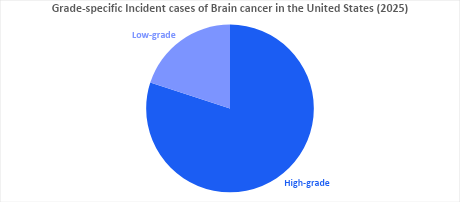
- In the US, between low grade (Grade I and Grade II) and high grade (Grade III and Grade IV), high grade accounted for the highest number of incident cases, around 16,000, while low grade accounted for approximately 7,000 cases.
- In EU4 and the UK, brain cancer cases in 2025 were predominantly higher in males, accounting for approximately 58% of the cases, while females represented around 42% of those affected.
- In 2025, among the type-specific brain tumors, GBM accounted for the highest number of cases, i.e., around 52%, in 2025, followed by the cases of diffuse astrocytoma with approximately 15% of the total brain cancer cases in Japan.
- Brain cancers include primary brain tumors, which start in the brain and rarely spread to other parts of the body, and secondary tumors (or metastases), which are caused by cancers that began in another part of the body.
- The most common types of primary tumors in adults are meningiomas and astrocytomas, such as glioblastomas. In children, the most common types of brain tumors include medulloblastomas, low-grade astrocytomas (pilocytic), ependymomas, craniopharyngiomas, and brainstem gliomas.
Brain Cancer Epidemiology Forecast in the 7MM
-
2025 Incident Cases of Brain Cancer: ~62,800
-
Brain Cancer Growth Rate (2026–2036): 0.9% CAGR
DelveInsight's ‘Brain Cancer Epidemiology Forecast – 2036’ report delivers an in-depth understanding of the brain cancer, historical and forecasted epidemiology in the United States, EU4 (Germany, Spain, Italy, and France) and the United Kingdom, and Japan.
|
Study Period |
2022–2036 |
|
Historical Year |
2022–2025 |
|
Forecast Period |
2026–2036 |
|
Base Year |
2026 |
|
Geographies Covered |
|
|
Brain Cancer Epidemiology CAGR (Forecast period) |
0.9% (2026-2036) |
|
Brain Cancer Epidemiology Segmentation Analysis |
Patient Burden Assessment
|
Brain Cancer: Understanding and Diagnosis Algorithm
Brain Cancer Overview
A brain tumor, known as an intracranial tumor, central nervous system (CNS) tumors represent a group of diseases that have in common the abnormal development of mass lesions in the brain, spinal cord, or its coverings. A brain tumor can be classified into two main groups, i.e., primary and metastatic. A primary brain tumor is often described as “low grade” or “high grade”. A low-grade tumor generally grows slowly, but it can turn into a high-grade tumor, whereas a high-grade tumor is more likely to grow faster. Secondary brain tumors, also called brain metastases, are much more common than primary tumors in adults. The most common types of primary tumors in adults are meningiomas and astrocytomas, such as glioblastomas. In children, the most common types of brain tumors include medulloblastomas, low-grade astrocytomas (pilocytic), ependymomas, craniopharyngiomas, and brainstem gliomas. Brain tumors in children usually come from different tissues than those affecting adults. Treatments that are fairly well-tolerated by the adult brain (such as radiation therapy) may prevent normal development of a child’s brain, especially in children younger than age five.
Brain Cancer Diagnosis
Brain cancer diagnosis is a multi-step process that combines clinical evaluation, advanced imaging, and molecular testing to accurately identify and characterize tumors. It typically begins with a detailed neurological examination to assess symptoms such as headaches, seizures, cognitive changes, or motor deficits. Imaging techniques, particularly contrast-enhanced MRI (the gold standard) and CT scans, are used to determine the tumor’s size, location, and extent, as well as its impact on surrounding brain structures. Advanced imaging modalities, including functional MRI (fMRI), MR spectroscopy, and PET scans, further help differentiate tumor types and guide surgical planning.
A definitive diagnosis is established through biopsy or surgical resection, allowing for histopathological examination of tumor tissue. In recent years, molecular diagnostics have become integral to classification, with biomarkers such as IDH mutation, MGMT promoter methylation, and 1p/19q co-deletion playing a crucial role in diagnosis, prognosis, and treatment selection. Additionally, emerging techniques like next-generation sequencing (NGS) and liquid biopsy are improving diagnostic precision and enabling more personalized treatment approaches. Overall, advancements in imaging and molecular profiling are significantly enhancing early detection, disease stratification, and clinical decision-making in brain cancer.
Further details are provided in the report...
Brain Cancer Epidemiology
Key Findings from Brain Cancer Epidemiological Analysis and Forecast
- According to DelveInsight’s estimates, the total incident cases of brain cancer in the 7MM were approximately 62,800 in 2025.
- It is observed that brain tumors are found to be more common in males (~58%) as compared to females (~42%) in the United States.
- Among EU4 and the UK, Germany accounted for the highest number of glioma cases, followed by France, whereas Spain had the lowest number of cases in 2025.
- In 2025, among brain tumors in other parts of the central nervous system in the United States, glioblastoma was more common in adults than in pediatrics, followed by anaplastic astrocytoma, which was also found to be more prevalent in adults than in pediatrics.
- In the United States, among all the age groups, 40–64 years accounted for the highest number of brain tumor cases, i.e., around 44%, in 2025, followed by the age group≥65 years (39%).
Scope of the Report
-
The report covers a segment of an executive summary, a descriptive overview of Brain cancer, explaining its causes, signs and symptoms, and pathogenesis.
-
Comprehensive insight has been provided into the epidemiology segments and forecasts, the future growth potential of the diagnosis rate, and disease progression.
Report Insights
Brain Cancer Patient Population Forecast
Report Key Strengths
- Epidemiology‑based (epi‑based) Bottom‑up Forecasting
- 11-year Forecast
- Patient Burden Trends (by geography)
Explore comprehensive Brain Cancer market insights, emerging therapies, epidemiology trends, and forecast opportunities shaping the industry through 2036 globally.
FAQs
- What are the disease risks, burdens, and unmet needs of brain cancer? What will be the growth opportunities across the 7MM concerning the patient population with brain cancer?
- What is the historical and forecasted brain cancer patient pool in the US, EU4 (Germany, France, Italy, and Spain), the UK, and Japan?
Reasons to Buy
- Insights on patient burden/disease prevalence, evolution in diagnosis, and factors contributing to the change in the epidemiology of the disease during the forecast years.
- To understand key opinion leaders’ perspectives on the diagnostic challenges to overcome barriers in the future.
- Detailed insights into various factors hampering disease diagnosis and other existing diagnostic challenges.