
Buerger's Disease Epidemiology Forecast - 2036
Buerger Disease Insights and Trends
- Buerger disease, also known as thromboangiitis obliterans (TAO), is a rare, progressive, nonatherosclerotic inflammatory vascular disorder that primarily affects the small- and medium-sized arteries and veins of the upper and lower extremities, causing vessel blockage, reduced blood flow, blood clot formation, tissue damage, infection, and in severe cases gangrene, typically beginning in the feet and later involving the hands and small veins of the limbs.
- The exact cause of Buerger disease remains unknown, but tobacco exposure is essential for disease onset and progression, with possible links to immune dysfunction, tobacco hypersensitivity, endothelial abnormalities, and genetic susceptibility associated with HLA-A9, HLA-B5, and HLA-54.
- Increased prevalence of HLA-A9, HLA-A54, and HLA-B5 is observed in these patients, which suggests a genetic predisposition to the disease.
- The prevalence of Buerger disease has diminished over the past 5 years because of decreased smoking and adherence to more stringent diagnostic criteria.
- Among patients with Buerger disease who continue smoking after diagnosis, the prognosis is significantly worse, with around 43% requiring one or more amputations within an average follow-up period of 7.6 years, reflecting the strong association between ongoing tobacco exposure, persistent vascular inflammation, progressive ischemia, and eventual limb loss.
Buerger Disease Epidemiology Forecast in the 7MM
- 2025 Diagnosed Prevalent Cases of Buerger Disease: ~ XXXX million
- 2036 Projected Diagnosed Prevalent Cases of Buerger Disease: ~ XXXX million
- Buerger Disease Growth Rate (2026–2036): ~XX CAGR
DelveInsight's ‘Buerger Disease Epidemiology Forecast - 2036’ report delivers an in-depth understanding of Buerger Disease, historical and forecasted epidemiology, in the United States, EU4 (Germany, Spain, Italy, and France) and the United Kingdom, and Japan.
|
Study Period |
2022–2036 |
|
Historical Year |
2022–2025 |
|
Forecast Period |
2026–2036 |
|
Base Year |
2026 |
|
Geographies Covered |
|
|
Buerger Disease Epidemiology CAGR (Forecast period) |
~XX% (2026–2036) |
|
Buerger Disease Epidemiology Segmentation Analysis |
Patient Burden Assessment
|
Buerger Disease Understanding and Diagnosis Algorithm
Buerger Disease Overview and Diagnosis
Buerger disease is a rare, progressive, nonatherosclerotic inflammatory vascular disorder that primarily affects the small- and medium-sized arteries and veins of the upper and lower extremities, leading to reduced blood flow, ischemia, pain, ulcers, and in severe cases tissue damage and gangrene. The disease is strongly associated with tobacco use, which is considered essential for disease initiation and progression.
Diagnosis of Buerger disease is primarily based on clinical evaluation and exclusion of other vascular disorders. Diagnostic assessment includes a detailed smoking history, vascular examination, Doppler ultrasound, angiography to identify characteristic segmental vessel occlusions and corkscrew collateral vessels, and blood tests to rule out autoimmune diseases, diabetes, and other causes of peripheral vascular disease. Early diagnosis and smoking cessation are critical to slowing disease progression and preventing complications such as chronic ulcers, infection, and limb amputation.
Further details are provided in the report.......
Buerger Disease Epidemiology
Key Findings from Buerger Disease Epidemiological Analysis and Forecast
- The prevalence of Buerger disease has diminished over the past 5 years because of decreased smoking and adherence to more stringent diagnostic criteria.
- Most patients with Buerger disease are aged 20-45 years. It does not occur in the pediatric or elderly population.
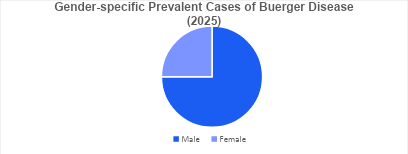
- It is more common in men with a male-to-female ratio of 3:1; however, a rise in the cases among women is being observed, which could be attributable to the growing trend of smoking in women.
- Less than 5% of TAO patients are non-smokers. These cases might be triggered by cold, frostbite, trauma of extremities, or even abuse of sympathomimetic drugs. The use of drugs such as cocaine, cannabis, and amphetamines may mimic TAO, showing a similar arteriographic pattern.
Scope of the Report
- The report covers a segment of a descriptive overview of Buerger disease, explaining its causes, signs and symptoms, and pathogenesis.
- Comprehensive insight has been provided into the epidemiology segments and forecasts, the future growth potential of the diagnosis rate, and disease progression.
Report Insights
Buerger Disease Patient Population Forecast
Report Key Strengths
- Epidemiology‑based (Epi‑based) Bottom‑up Forecasting
- 11-year Forecast
- Patient Burden Trends (by geography)
FAQs
- What are the disease risks, burdens, and unmet needs of Buerger disease? What will be the growth opportunities across the 7MM concerning the patient population with Buerger disease?
- What is the historical and forecasted Buerger disease patient pool in the US, EU4 (Germany, France, Italy, and Spain), the UK, and Japan?
Reasons to Buy
- Insights on patient burden/disease prevalence, evolution in diagnosis, and factors contributing to the change in the epidemiology of the disease during the forecast years.
- To understand key opinion leaders’ perspectives on the diagnostic challenges to overcome barriers in the future.
- Detailed insights into various factors hampering disease diagnosis and other existing diagnostic challenges