
Buerger's Disease Market
Buerger Disease Insights and Trends
- Buerger disease, also known as thromboangiitis obliterans (TAO), is a rare, progressive, nonatherosclerotic inflammatory vascular disorder that primarily affects the small- and medium-sized arteries and veins of the upper and lower extremities, causing vessel blockage, reduced blood flow, blood clot formation, tissue damage, infection, and in severe cases gangrene, typically beginning in the feet and later involving the hands and small veins of the limbs.
- The exact cause of Buerger disease remains unknown, but tobacco exposure is essential for disease onset and progression, with possible links to immune dysfunction, tobacco hypersensitivity, endothelial abnormalities, and genetic susceptibility associated with HLA-A9, HLA-B5, and HLA-54.
- Common symptoms of Buerger disease include pale, red, or bluish fingers and toes, cold hands or feet, burning or tingling pain in the extremities, pain in the legs, ankles, or feet while walking, and skin changes or painful sores on the fingers or toes.
- The prevalence of Buerger disease has diminished over the past 5 years because of decreased smoking and adherence to more stringent diagnostic criteria.
- Treatment of Buerger disease primarily involves immediate smoking cessation to stop disease progression, along with medications such as antiplatelet agents and vasodilators to improve blood flow, wound care to manage ulcers and prevent infection, and in severe cases, surgical procedures like sympathectomy or bypass grafting to restore circulation.
- Although there are currently no FDA-approved therapies for Buerger disease, commonly used treatments include vasodilators such as calcium channel blockers, antiplatelet agents like cilostazol and clopidogrel, pentoxifylline, and prostacyclin or prostaglandin derivatives to help improve blood flow and manage symptoms.
- The emerging landscape of Buerger disease remains limited, with ATI-1013 from Antidote Therapeutics currently representing the only pipeline candidate in the preclinical stage, while broader therapeutic development activity remains minimal.
Buerger disease Market Size and Forecast in the 7MM
- 2025 Buerger Disease Market Size: XX million
- 2036 Projected Buerger Disease Market Size: XX million
- Buerger Disease Growth Rate (2026–2036): XX% CAGR
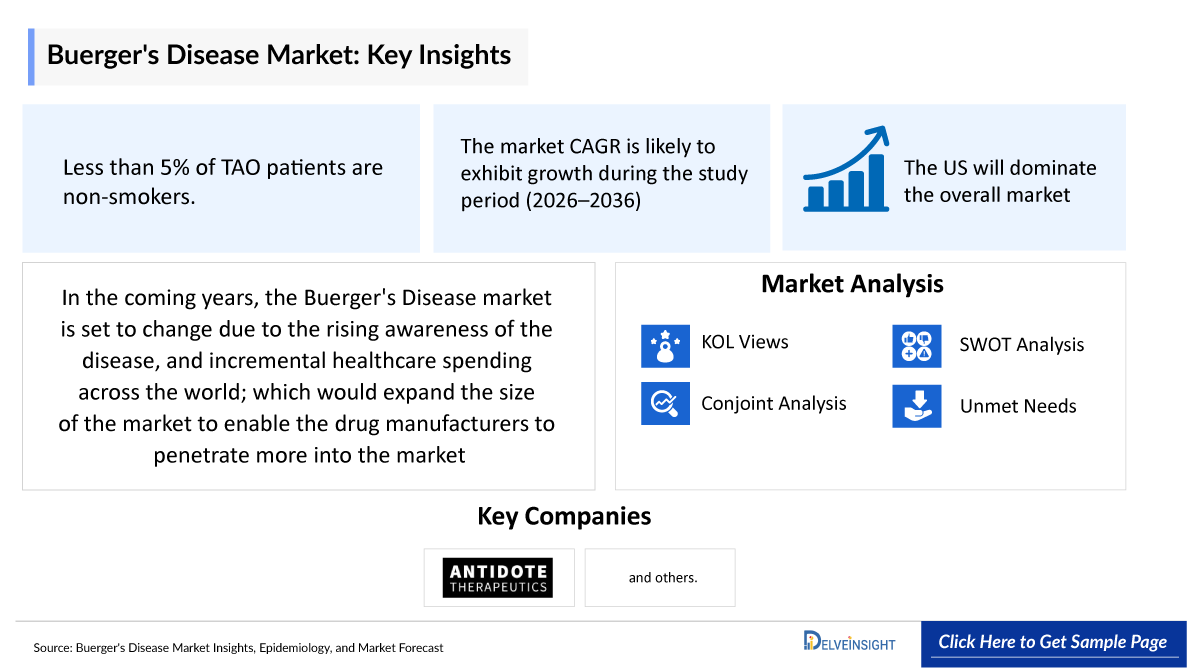
DelveInsight's ‘Buerger Disease Market Insights, Epidemiology and Market Forecast – 2036’ report delivers an in-depth understanding of the Buerger disease, historical and forecasted epidemiology, as well as the Buerger disease market trends in the United States, EU4 (Germany, Spain, Italy, and France) and the United Kingdom, and Japan.
The buerger disease market report delivers a comprehensive analysis of the current treatment landscape, including standards of care, clinical practices, and evolving therapeutic algorithms. It evaluates the burden of Berger disease patient trends, revenue & market share dynamics, peak patient share & therapy uptake analysis, and provides an in-depth market size assessment, and growth rate projections (Historical & Forecast 2022–2036) across global regions. The report highlights key unmet medical needs in buerger disease and maps the competitive and clinical landscape to uncover high‑value opportunities, providing a clear outlook on future market growth potential.
|
Study Period |
2022–2036 |
|
Historical Year |
2022–2025 |
|
Forecast Period |
2026–2036 |
|
Base Year |
2026 |
|
Geographies Covered |
|
|
Buerger Disease Market CAGR (Forecast period) |
XX% (2026–2036) |
|
Buerger Disease Epidemiology Segmentation Analysis |
Patient Burden Assessment
|
|
Buerger Disease Therapies |
|
|
Buerger Disease Companies |
|
|
Buerger Disease Market |
Segmented by
|
|
Analysis |
|
|
|
Key Factors Driving the Buerger Disease Market
Increasing Tobacco Consumption and Smoking-Related Risk
Tobacco use remains the primary risk factor for Buerger disease, with rising smoking rates and continued use of tobacco products in developing countries contributing to disease incidence and progression, thereby increasing the demand for symptom management and supportive therapies.
Growing Awareness and Advancements in Vascular Care
Improved awareness of peripheral vascular disorders, advancements in diagnostic techniques, and increasing access to vascular care are supporting earlier diagnosis and better disease management, driving interest in novel therapeutic approaches for Buerger disease.
Buerger Disease Understanding and Treatment Algorithm
Buerger Disease Overview and Diagnosis
Buerger disease is a rare, progressive, nonatherosclerotic inflammatory vascular disorder that primarily affects the small- and medium-sized arteries and veins of the upper and lower extremities, leading to reduced blood flow, ischemia, pain, ulcers, and in severe cases tissue damage and gangrene. The disease is strongly associated with tobacco use, which is considered essential for disease initiation and progression.
Diagnosis of Buerger disease is primarily based on clinical evaluation and exclusion of other vascular disorders. Diagnostic assessment includes a detailed smoking history, vascular examination, Doppler ultrasound, angiography to identify characteristic segmental vessel occlusions and corkscrew collateral vessels, and blood tests to rule out autoimmune diseases, diabetes, and other causes of peripheral vascular disease. Early diagnosis and smoking cessation are critical to slowing disease progression and preventing complications such as chronic ulcers, infection, and limb amputation.
Note: Further details are provided in the report...
Current Buerger Disease Treatment Landscape
Treatment of Buerger disease primarily focuses on immediate and complete smoking cessation, which is the most critical step to halt disease progression. Supportive pharmacological management may include vasodilators such as calcium channel blockers, antiplatelet agents, pentoxifylline, and prostacyclin analogs to improve peripheral blood flow and reduce ischemic symptoms. In advanced cases, surgical options such as sympathectomy or revascularization procedures may be considered to restore circulation and prevent complications like ulcers, infection, and gangrene. Emerging approaches, including regenerative therapies and novel vasodilatory agents, are being explored to improve long-term outcomes and limb preservation.
Note: Further details related to country-based variations are provided in the report.
Buerger Disease Unmet Needs
The section “unmet needs of buerger disease” outlines the critical gaps between the current state of patient care, diagnosis, and the ideal & effective management of the disease. It highlights the obstacles experienced by patients, clinicians, and researchers and identifies potential solutions for future progress.
- Lack of Approved Disease-Specific Therapies
- Limited Effective Options for Advanced Disease
- Poor Long-Term Outcomes and High Amputation Risk, and others…..
Note: Comprehensive unmet needs insights in Buerger Disease and their strategic implications are provided in the full report.
Buerger Disease Epidemiology
Key Findings from Buerger Disease Epidemiological Analysis and Forecast
- The prevalence of Buerger disease has diminished over the past 5 years because of decreased smoking and adherence to more stringent diagnostic criteria.
- Most patients with Buerger disease are aged 20-45 years. It does not occur in the pediatric or elderly population.
- It is more common in men with a male-to-female ratio of 3:1; however, a rise in the cases among women is being observed, which could be attributable to the growing trend of smoking in women.
- Less than 5% of TAO patients are non-smokers. These cases might be triggered by cold, frostbite, trauma of extremities, or even abuse of sympathomimetic drugs. The use of drugs such as cocaine, cannabis, and amphetamines may mimic TAO, showing a similar arteriographic pattern.
Buerger Disease Drug Analysis & Competitive Landscape
The buerger disease drug chapter provides a detailed, market-focused review of the emerging pipeline across Phase I-III clinical trials and preclinical trials. It covers the mechanism of action, clinical trial data, regulatory approvals, patents, collaborations, and strategic partnerships for each therapy, along with their advantages, limitations, and recent developments. This section offers critical insights into the buerger disease treatment landscape, supporting market assessment, competitive analysis, and growth forecasting for the buerger disease therapeutics market.
Note: Detailed marketed therapies assessment will be provided in the final report.
Buerger Disease Pipeline Analysis
ATI-1013: Antidote Therapeutics
A fully human anti-nicotine monoclonal antibody designed to selectively bind and neutralize nicotine through a ligand-binding mechanism of action, thereby preventing nicotine from exerting its biological effects. It is currently being evaluated in preclinical trials.
Note: Detailed emerging therapies assessment will be provided in the final report.
Buerger Disease Key Players, Market Leaders, and Emerging Companies
- Antidote Therapeutics, and others
Buerger Disease Drug Updates
- In September 2018, Antidote Therapeutics announced that the US FDA had granted Orphan Drug Designation to ATI-1013, a fully human anti-nicotine monoclonal antibody developed for the treatment of Buerger disease.
Buerger Disease Market Outlook
The treatment landscape for Buerger disease remains highly limited and is primarily centered on smoking cessation, symptomatic management, and supportive vascular care rather than approved disease-modifying therapies. Currently used treatments, including vasodilators, antiplatelet agents, pentoxifylline, and prostacyclin analogs, aim to improve peripheral blood flow, reduce ischemic pain, and delay complications such as ulcers and gangrene. Surgical interventions such as sympathectomy and bypass procedures may be considered in severe cases, although their long-term efficacy remains variable due to the diffuse and distal nature of the disease. These approaches only partially address major unmet needs, including persistent ischemia, recurrent disease progression, and high risk of limb amputation.
The emerging pipeline for Buerger disease is sparse, with limited investigational therapies currently under development. ATI-1013, a fully human anti-nicotine monoclonal antibody designed to bind and neutralize nicotine, represents a novel mechanism aimed at addressing the tobacco-driven pathology underlying disease progression. By targeting nicotine exposure, the therapy has the potential to support smoking cessation efforts and reduce continued vascular inflammation associated with tobacco use. However, the candidate remains in the preclinical stage, reflecting the early and underdeveloped state of the therapeutic landscape. The absence of late-stage clinical programs and approved targeted therapies continues to highlight the significant unmet need for effective disease-modifying treatments capable of improving long-term vascular outcomes and preventing amputations in patients with Buerger disease.
-
According to estimates, among the 7MM, the United States was expected to capture the largest market size for Buerger disease by 2036.
-
Regional market dynamics for Buerger disease indicated that the United States led in market revenue, while the markets in Japan and the European Union showed gradual growth driven by improving disease awareness, increasing diagnosis rates, and ongoing interest in novel therapeutic approaches.
Further details will be provided in the report….
Drug Class/Insights into Leading Emerging and Marketed Therapies in Buerger Disease (2022–2036 Forecast)
The Buerger disease market is gradually evolving toward targeted and regenerative therapeutic approaches aimed at improving peripheral blood flow, reducing vascular inflammation, preventing disease progression, and lowering the risk of ulcers, gangrene, and limb amputation while addressing the limitations of current supportive treatment options.
Buerger Disease Drug Uptake
This section focuses on the uptake rate of potential drugs expected to be launched in the market during the forecast period (2026–2036). The analysis covers the buerger disease drug’s uptake, performance at peak, factors affecting performance during prime years of growth, patient uptake by therapy, and anticipated sales generated by each drug.
Detailed insights of emerging therapies' drug uptake is included in the report
Market Access and Reimbursement of Approved Therapies in Buerger Disease
The report further provides detailed insights on the country-wise accessibility and reimbursement scenarios, cost-effectiveness scenario of approved therapies, programs making accessibility easier and out-of-pocket costs more affordable, insights on patients insured under federal or state government prescription drug programs, etc.
Reimbursement is a crucial factor that affects the drug’s access to the market. Often, the decision to reimburse comes down to the price of the drug relative to the benefit it produces in treated patients. To reduce the healthcare burden of these high-cost therapies, many payment models are being considered by payers and other industry insiders.
NOTE: Further Details are provided in the final report….
Buerger Disease Therapies Price Scenario & Trends
Pricing and analogue assessment of buerger disease therapies highlights evolving price dynamics structures. This section summarizes the cost of approved treatments, the closest and most appropriate analogue selection for emerging therapies, and the understanding of how pricing influences market access, adherence, and long-term uptake.
Industry Experts and Physician Views for Buerger Disease
To keep up with the Burger disease market trends, we take Key Opinion Leaders (KOLs) and Subject Matter Experts (SMEs) opinions working in the domain through primary research to fill the data gaps and validate our secondary research. Industry experts were contacted for insights on the buerger disease emerging therapies, evolving treatment landscape, patient adherence to conventional therapies, therapy switching trends, drug adoption and uptake, accessibility challenges, and epidemiology and real-world prescription patterns in buerger disease, including MD, PhD, Instructor, Postdoctoral Researcher, Professor, Researcher, and others.
DelveInsight’s analysts connected with 15+ KOLs to gather insights at the country level. Centers such as Bascom Palmer Eye Institute, Institut de la Vision, University Hospital Cologne Department of Ophthalmology, etc., were contacted. Their opinion helps understand and validate current and emerging buerger disease therapies, highlight unmet medical needs, provide epidemiological context, and support strategic decisions for market access, therapy adoption, and pipeline prioritization in buerger disease.
|
Region |
Key Opinion Leaders (KOLs) and Subject Matter Experts (SMEs) |
|
United States |
“Strict and permanent smoking cessation is the cornerstone of managing Buerger disease, as continued tobacco exposure significantly increases the risk of disease progression, recurrent ischemia, and limb amputation despite supportive treatment.” |
|
Germany |
“Substantial unmet need for effective disease-modifying therapies, noting that current treatment options mainly provide symptomatic relief and that emerging approaches targeting vascular repair and nicotine dependence may improve long-term outcomes in the future.” |
Qualitative Analysis SWOT and Conjoint Analysis
We perform qualitative and market Intelligence analysis using various approaches, such as SWOT analysis and conjoint analysis.
In the SWOT analysis of buerger disease, strengths, weaknesses, opportunities, and threats in terms of disease diagnosis, patient awareness, patient burden, competitive landscape, cost-effectiveness, and geographical accessibility of therapies are provided.
Conjoint analysis analyzes emerging therapies based on relevant attributes such as safety, efficacy, frequency of administration, route of administration, and order of entry. Scoring is given based on these parameters to analyze the effectiveness of therapy.
The team of analysts analyzes promising emerging therapies based on relevant attributes such as safety, efficacy, frequency of administration, route of administration, and order of entry. In efficacy, the trial’s primary and secondary outcome measures are evaluated, whereas the therapies’ safety is evaluated, wherein the acceptability, tolerability, and adverse events are mainly observed. In addition, the scoring is also based on the route of administration, order of entry, probability of success, and the addressable patient pool for each therapy. According to these parameters, the final weightage score and the ranking of the emerging therapies are decided.
Buerger Disease Scope of the Report
- The report covers a segment of key events, an executive summary, a descriptive overview of Burger disease, explaining its causes, signs and symptoms, pathogenesis, and currently available treatments.
- Comprehensive insight has been provided into the epidemiology segments and forecasts, the future growth potential of the diagnosis rate, and disease progression along treatment guidelines.
- Additionally, an all-inclusive account of both the current and emerging treatments, along with the elaborative profiles of late and early stage and prominent therapies, will have an impact on the current treatment landscape.
- A detailed review of the Buerger disease market, historical and forecasted market size, market share by therapies, detailed assumptions, and rationale behind our approach is included in the report, covering the 7MM drug outreach.
- The report provides an edge while developing business strategies by understanding trends through SWOT analysis and expert insights/KOL views, patient journey, and treatment preferences that help in shaping and driving the 7MM Berger disease market.
Buerger Disease Report Insights
- Buerger Disease Patient Population Forecast
- Buerger Disease Therapeutics Market Size
- Buerger Disease Pipeline Analysis
- Buerger Disease Market Size and Trends
- Buerger Disease Market Opportunity (Current and forecasted)
Buerger Disease Report Key Strengths
- Epidemiology‑based (Epi‑based) Bottom‑up Forecasting
- Artificial Intelligence (AI)-Enabled Market Research Report
- 11-Year Forecast
- Buerger Disease Market Outlook (North America, Europe, Asia-Pacific)
- Patient Burden Trends (By Geography)
- Buerger Disease Treatment Addressable Market (TAM)
- Buerger Disease Competitive Landscape
- Buerger Disease Major Companies Insights
- Buerger Disease Price Trends and Analogue Assessment
- Buerger Disease Therapies Drug Adoption/Uptake
- Buerger Disease Therapies Peak Patient Share Analysis
Buerger Disease Report Assessment
- Buerger Disease Current Treatment Practices
- Buerger Disease Unmet Needs
- Buerger Disease Clinical Development Analysis
- Buerger Disease Emerging Drugs Product Profiles
- Buerger Disease Market Attractiveness
- Buerger Disease Qualitative Analysis (SWOT and Conjoint Analysis)
FAQs
Market Insights
- What was the Buerger disease market size, the market size by therapies, market share (%) distribution in 2025, and what would it look like by 2036? What are the contributing factors for this growth?
- What are the anticipated pricing variations among different geographies for the emerging therapies in the future?
- What can be the future treatment paradigm of Buerger disease?
- What are the disease risks, burdens, and unmet needs of Buerger disease? What will be the growth opportunities across the 7MM concerning the patient population with Buerger disease?
- Who is the major future competitor in the market, and how will the competitors affect their market share?
- What are the current options for the treatment of Buerger disease? What are the current guidelines for treating Buerger disease in the US, Europe, and Japan?
Reasons to Buy
- The report will help in developing business strategies by understanding the latest trends and changing treatment dynamics driving the Buerger disease market.
- Bottom-up forecasting builds from the affected population to product forecasts, delivering a robust, data-driven approach ideal for new therapies and novel classes.
- Insights on patient burden/disease incidence, evolution in diagnosis, and factors contributing to the change in the epidemiology of the disease during the forecast years.
- Understand the existing market opportunities in varying geographies and the growth potential over the coming years.
- Identifying strong upcoming players in the market will help devise strategies to help get ahead of competitors.
- Detailed analysis and ranking of class-wise potential emerging therapies under the conjoint analysis section to provide visibility around leading classes.
- To understand KOLs’ perspectives on the accessibility, acceptability, and compliance-related challenges of existing treatment to overcome barriers in the future.
- Detailed insights into the unmet needs of the existing market so that the upcoming players can strengthen their development and launch strategy.
- This Artificial Intelligence (AI)-enabled report summarize and simplify complex datasets within the report into clear, actionable insights for stakeholders, investors, and healthcare providers, enabling faster, data-driven decisions.