Burns Pipeline Summary
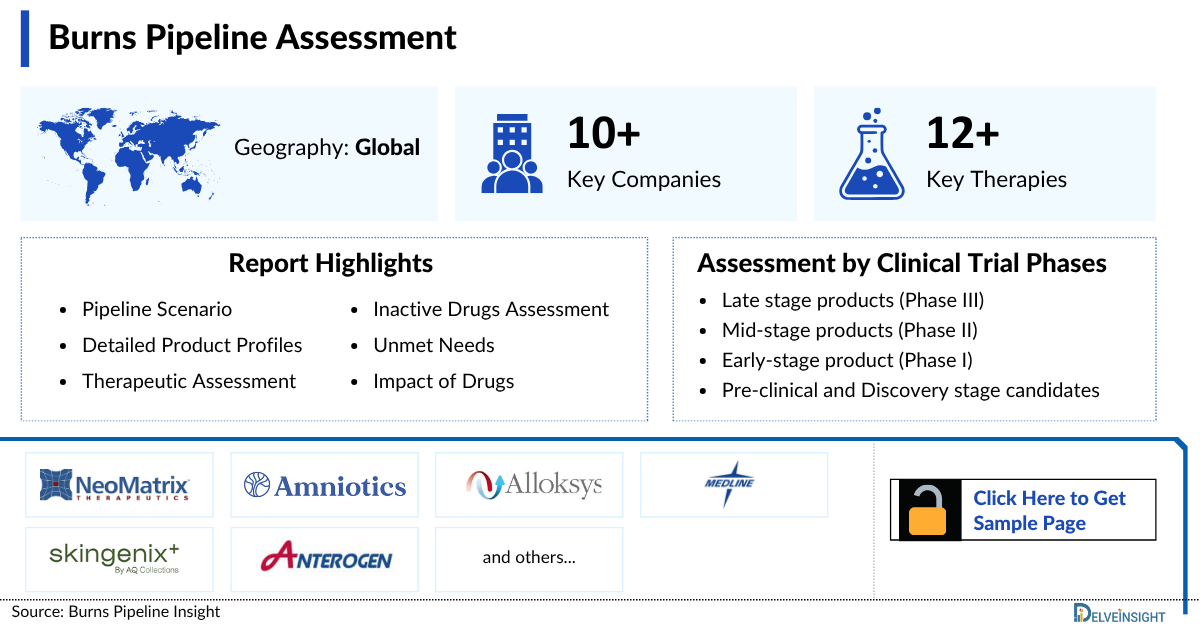
DelveInsight’s, “Burns Pipeline Insight, 2026” report provides comprehensive insights about 10+ companies and 12+ pipeline drugs in Burns pipeline landscape. It covers the pipeline drug profiles, including clinical and nonclinical stage products. It also covers the therapeutics assessment by product type, stage, route of administration, and molecule type. It further highlights the inactive pipeline products in this space.
Geography Covered
- Global coverage
Burns Disease Understanding
Burns Overview
Burn injuries represent a major medical challenge due to the skin's essential role as the body's primary protective barrier. Damage to the skin disrupts its ability to prevent fluid loss and microbial invasion, increasing the risk of infection, sepsis, prolonged healing, and lifelong functional and cosmetic complications. While the skin possesses regenerative capacity through epithelial cells located in its deeper structures, severe burns can significantly impair the healing process. Burn management has evolved considerably over centuries, progressing from early wound care practices to modern advances in fluid resuscitation, infection control, early wound excision, skin grafting, keratinocyte culture, and bioengineered skin substitutes, leading to improved survival and patient outcomes. Despite these advances, important gaps remain in understanding burn pathophysiology, highlighting the need for further research to establish standardized and more effective treatment strategies. Prompt initiation of appropriate burn care is critical to reducing complications, shortening hospitalization, and accelerating recovery. This review provides a comprehensive overview of the physiological changes that occur following burn injuries and the current therapeutic approaches, based on an extensive analysis of relevant clinical and scientific literature.
Burn injuries occur when the skin is exposed to thermal, electrical, chemical, radiation, or frictional sources. The severity of a burn depends on multiple factors, including the extent of body surface area affected, the location of the injury, the intensity of the heat source, and the duration of exposure. Together, these factors influence wound severity, clinical outcomes, and the risk of morbidity and mortality.
- Local Effects of Burn Injuries: Burn injuries cause coagulative necrosis of the skin and underlying tissues, with the severity of damage determined by the temperature, duration of exposure, and energy of the causative agent. The burn wound is classically divided into three zones: the zone of coagulation, where irreversible tissue necrosis occurs; the zone of stasis, characterized by reduced perfusion and inflammation with the potential for either recovery or progression to necrosis; and the zone of hyperemia, where increased blood flow supports tissue viability and healing unless compromised by severe hypoperfusion or sepsis.
- Systemic Effects of Burn Injuries: Extensive burns trigger widespread physiological disturbances that extend far beyond the injury site. Severe burns can lead to burn shock, characterized by hypovolemia, impaired tissue perfusion, edema, cardiovascular dysfunction, and reduced organ blood flow, increasing the risk of multi-organ failure. A pronounced hypermetabolic and hypercatabolic response, driven by inflammatory mediators and stress hormones, substantially elevates energy expenditure while promoting muscle protein breakdown, insulin resistance, hyperglycemia, and loss of lean body mass. Burn injuries also impair the function of major organ systems, including the cardiovascular, renal, gastrointestinal, hepatic, endocrine, and immune systems, resulting in compromised wound healing, nutrient absorption, hormonal imbalance, immune suppression, and increased susceptibility to infection and sepsis. These complex systemic responses highlight the need for timely fluid resuscitation, nutritional support, metabolic management, and comprehensive multidisciplinary care to improve clinical outcomes.
Although no current therapy can completely reverse the complex physiological responses triggered by burn injuries, a combination of pharmacological and supportive interventions can effectively improve outcomes and reduce complications. Immediate cooling of the burn with water at an appropriate temperature helps limit tissue damage and relieve pain, while early fluid resuscitation remains the cornerstone of managing severe burns to prevent hypovolemic shock and preserve organ perfusion. Airway protection and lung-protective ventilation are essential for patients with inhalation injuries. Early surgical excision, wound closure, reconstructive procedures, and the use of advanced skin substitutes promote faster healing, reduce infection risk, minimize scarring, and improve functional and cosmetic outcomes. Accurate burn depth assessment using technologies such as Laser Doppler Imaging further supports timely clinical decision-making. Preventing and promptly treating sepsis through infection control measures, early wound management, and targeted antimicrobial therapy is critical to reducing mortality. Additional supportive strategies, including maintenance of body temperature, rehabilitation to prevent contractures, hormonal and metabolic modulation, and early high-protein enteral nutrition, help counteract hypermetabolism, preserve lean body mass, enhance wound healing, and accelerate recovery. Together, these multidisciplinary treatment approaches form the foundation of modern burn care, improving survival, functional recovery, and long-term quality of life.
"Burns Pipeline Insight, 2026" report by DelveInsight outlays comprehensive insights of present scenario and growth prospects across the indication. A detailed picture of the Burns pipeline landscape is provided which includes the disease overview and Burns treatment guidelines. The assessment part of the report embraces, in depth Burns commercial assessment and clinical assessment of the pipeline products under development. In the report, detailed description of the drug is given which includes mechanism of action of the drug, clinical studies, NDA approvals (if any), and product development activities comprising the technology, Burns collaborations, licensing, mergers and acquisition, funding, designations and other product related details.
Burns Pipeline Report Highlights
The companies and academics are working to assess challenges and seek opportunities that could influence Burns R&D. The therapies under development are focused on novel approaches to treat/improve Burns.
Burns Emerging Drugs Chapters
This segment of the Burns report encloses its detailed analysis of various drugs in different stages of clinical development, including Phase III, II, I, Preclinical and Discovery. It also helps to understand clinical trial details, expressive pharmacological action, agreements and collaborations, and the latest news and press releases.
Burns Emerging Drugs
NMT-cP12: NeoMatrix Therapeutics
NeoMatrix Therapeutics’ NMT-cP12 is a fibronectin-derived peptide designed to promote wound healing by limiting burn wound progression into deeper skin layers. In preclinical studies, the therapy demonstrated the potential to reduce tissue damage following the initial burn, thereby decreasing the need for surgical intervention and minimizing scarring. As a potential first-in-class treatment, NMT-cP12 may improve clinical outcomes by accelerating recovery, reducing hospitalization, and lowering the risk of long-term functional impairment in burn patients. According to company’s pipeline the drug is in Phase II stage of its development for the treatment of burns.
KJ101: Shanghai Bao Pharmaceuticals
KJ101 is an investigational recombinant human chymotrypsin developed by Shanghai Bao Pharmaceuticals using a proprietary recombinant yeast fermentation platform as a next-generation alternative to animal-derived chymotrypsin. Designed for the treatment of burns, particularly deep second-degree burn injuries, it enzymatically removes necrotic tissue and promotes wound debridement, thereby facilitating faster wound healing while potentially reducing the need for surgical intervention. The recombinant formulation offers advantages such as higher purity, improved biosafety, consistent manufacturing quality, and elimination of risks associated with animal-derived products. In addition to burns, KJ101 is being evaluated for other acute and chronic wounds, including traumatic injuries, surgical incisions, pressure ulcers, and diabetic foot ulcers. The therapy is currently in Phase II clinical development in China, where its safety, efficacy, wound healing, and debridement potential are being assessed in patients with deep second-degree burns.
Further product details are provided in the report...
Burns Therapeutic Assessment
This segment of the report provides insights about the different Burns drugs segregated based on following parameters that define the scope of the report, such as:
Major Players in Burns
There are approx. 10+ key companies which are developing the therapies for Burns. The companies which have their Burns drug candidates in the most advanced stage, i.e. Phase II include, NeoMatrix Therapeutics.
Phases
DelveInsight’s report covers around 12+ products under different phases of clinical development like
- Late stage products (Phase III)
- Mid-stage products (Phase II)
- Early-stage product (Phase I) along with the details of
- Pre-clinical and Discovery stage candidates
- Discontinued & Inactive candidates
Route of Administration
Burns pipeline report provides the therapeutic assessment of the pipeline drugs by the Route of Administration. Products have been categorized under various ROAs such as
- Oral
- Intravenous
- Subcutaneous
- Parenteral
- Topical
Molecule Type
Products have been categorized under various Molecule types such as
- Recombinant fusion proteins
- Small molecule
- Monoclonal antibody
- Peptide
- Polymer
- Gene therapy
Product Type
- Drugs have been categorized under various product types like Mono, Combination and Mono/Combination.
Burns Pipeline Development Activities
The Burns Pipeline report provides insights into different therapeutic candidates in Phase III, II, I, preclinical and discovery stage. It also analyses Burns therapeutic drugs key players involved in developing key drugs.
Burns Pipeline Clinical Trials and Development Activities
The Burns clinical trials analysis report covers the detailed information of collaborations, acquisition and merger, licensing along with a thorough therapeutic assessment of emerging Burns drugs.
Burns Pipeline Report Insights
- Burns Pipeline Analysis
- Burns Therapeutic Assessment
- Burns Unmet Needs
- Impact of Burns Drugs
Burns Pipeline Report Assessment
- Burns Pipeline Product Profiles
- Burns Therapeutic Assessment
- Burns Pipeline Assessment
- Inactive Burns Pipeline drugs assessment
- Burns Unmet Needs
Key Questions Answered in the Burns Pipeline Report:
- Current Treatment Scenario and Emerging Therapies:
- How many companies are developing Burns drugs?
- How many Burns drugs are developed by each company?
- How many emerging drugs are in mid-stage, and late-stage of development for the treatment of Burns?
- What are the key collaborations (Industry–Industry, Industry–Academia), Mergers and acquisitions, licensing activities related to the Burns therapeutics?
- What are the recent trends, drug types and novel technologies developed to overcome the limitation of existing therapies?
- What are the clinical studies going on for Burns and their status?
- What are the key designations that have been granted to the emerging drugs?
Key Burns Companies
- NeoMatrix Therapeutics
- Skingenix Inc.
- Shanghai Bao Pharmaceuticals
- AEGLE Therapeutics
- Provectus Biopharmaceuticals
- Beam Alliance
- AMR Bio
Key Burns Pipeline
- NMT-cP12
- NMT-Cnp8
- MW-III
- KJ-101
- AGLE-102
- PV-10
- XF-73