
Cancer Monoclonal Antibodies Market
Overview
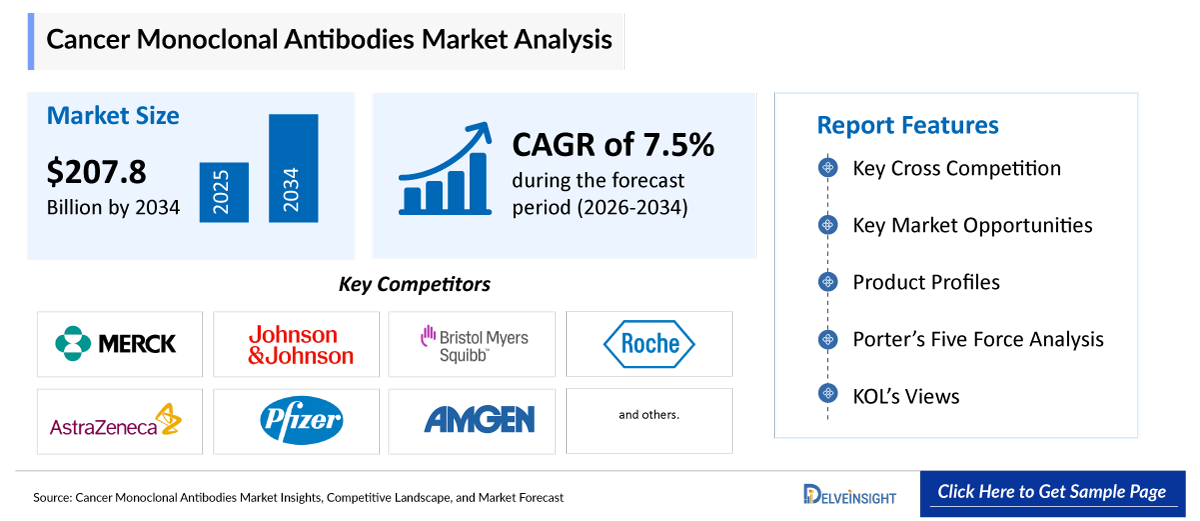
• The Cancer Monoclonal Antibodies market is estimated at USD 108.4 billion in 2025 and is projected to reach USD 207.8 billion by 2034. Growth is anchored in the rising global cancer burden, the entrenched clinical dominance of immune checkpoint inhibition, and the rapid commercial expansion of antibody-drug conjugates and T-cell-engaging bispecific antibodies.
• The global Cancer Monoclonal Antibodies market is growing at a CAGR of 7.5% during the forecast period from 2026 to 2034.
• By product type, the naked monoclonal antibodies segment dominated the Cancer Monoclonal Antibodies market with a 62% share in 2025.
• By target antigen, the immune checkpoint targets segment dominated the Cancer Monoclonal Antibodies market with a 46% share in 2025.
• By cancer type, the lung cancer segment dominated the Cancer Monoclonal Antibodies market with a 26% share in 2025.
• By route of administration, the intravenous segment dominated the Cancer Monoclonal Antibodies market with an 82% share in 2025.
• By end user, the hospitals and cancer treatment centers segment dominated the Cancer Monoclonal Antibodies market with a 54% share in 2025.
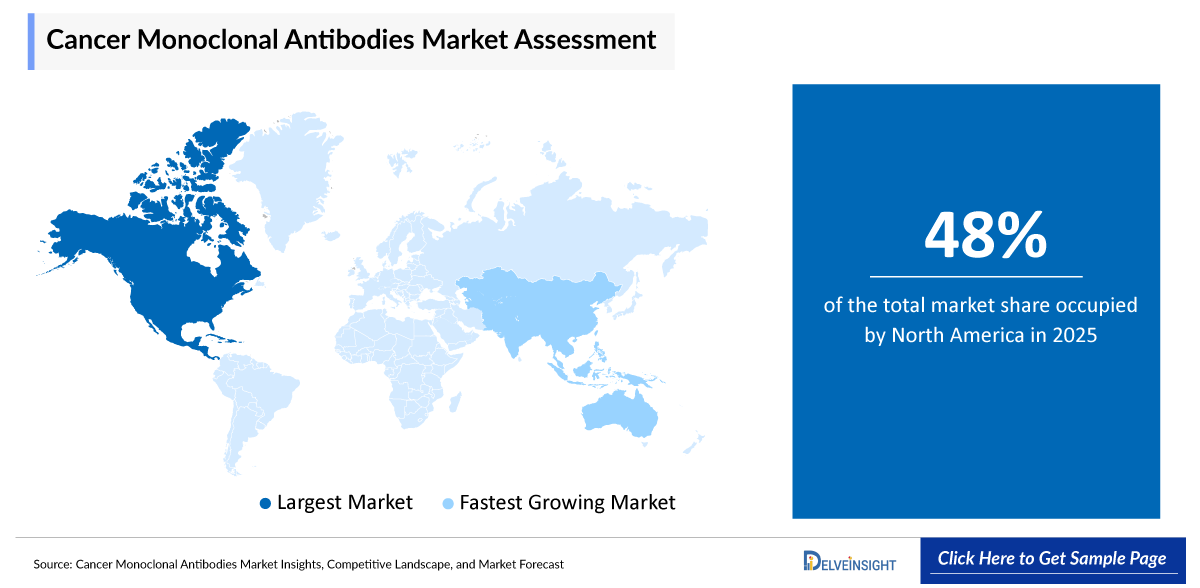
• North America dominated the global Cancer Monoclonal Antibodies market revenue with a 48% share in 2025, representing the highest regional market share globally.
Cancer monoclonal antibodies are laboratory-engineered immunoglobulins designed to bind a single defined epitope on a tumour cell, an immune cell, or a component of the tumour microenvironment, and to convert that binding event into a therapeutic effect. Mechanisms include blockade of immune checkpoints such as PD-1, PD-L1, and CTLA-4 to release T-cell suppression; inhibition of oncogenic growth-factor signalling through HER2, EGFR, and VEGF; recruitment of immune effector function through antibody-dependent cellular cytotoxicity and complement activation against CD20, CD38, and other lineage antigens; targeted delivery of cytotoxic payloads through antibody-drug conjugates that pair a tumour-selective antibody with a cleavable linker and a topoisomerase inhibitor or microtubule disruptor; and physical redirection of T cells to tumour cells through bispecific T-cell engagers binding CD3 alongside CD20, BCMA, DLL3, or GPRC5D. The market spans naked antibodies, antibody-drug conjugates, bispecific antibodies, and biosimilars, delivered intravenously or, increasingly, subcutaneously with recombinant hyaluronidase, across lung, breast, haematological, gastrointestinal, genitourinary, and skin cancers. Since rituximab and trastuzumab established the modality, the field has evolved from single-target cytostatic blockade into a multimodal therapeutic platform that now anchors first-line standard of care across most major tumour types and constitutes the largest single class of oncology medicines by revenue.
Cancer Monoclonal Antibodies Market Key Growth Drivers
• The escalating global cancer burden, with the World Health Organization and the International Agency for Research on Cancer reporting 20.6 million new cases and 10 million deaths each year and projecting 35 million cases by 2050, is expanding the treated population.
• Immune checkpoint inhibition remains the commercial centre of oncology, with Merck reporting Keytruda and Keytruda Qlex sales of USD 31.7 billion in 2025, a 7% increase, on continued uptake in earlier-stage lung cancer.
• Antibody-drug conjugates are scaling rapidly, with combined Enhertu sales recorded by AstraZeneca and Daiichi Sankyo reaching USD 3,575 million in the first nine months of 2025 against USD 2,729 million in the comparable period of 2024.
• T-cell-engaging bispecific antibodies have crossed into commercial scale, with 15 bispecific antibodies now approved by the United States Food and Drug Administration and tarlatamab converting to traditional approval in extensive-stage small cell lung cancer in November 2025.
• Subcutaneous reformulation is extending franchise economics and shifting care to lower-cost settings, exemplified by Darzalex Faspro, Opdivo Qvantig, Keytruda Qlex, and Rybrevant Faspro.
• Indication expansion into earlier lines, perioperative regimens, and combination backbones is enlarging eligible patient volumes well beyond the metastatic setting where the class originated.
• Sustained capital formation and licensing, including venture rounds for next-generation bispecific antibody-drug conjugates and large upfront acquisitions of antibody platforms, is replenishing the pipeline ahead of the pembrolizumab patent cliff in 2028.
Key Companies in Cancer Monoclonal Antibodies Market
The competitive landscape is led by the following originators, platform developers, and biosimilar manufacturers:
• Merck & Co., Inc.
• Johnson & Johnson
• Bristol Myers Squibb Company
• F. Hoffmann-La Roche Ltd
• AstraZeneca plc
• Daiichi Sankyo Company, Limited
• Pfizer Inc.
• Amgen Inc.
• AbbVie Inc.
• Sanofi S.A.
Factors Contributing to the Growth of the Cancer Monoclonal Antibodies Market
Market Drivers
Escalating Global Cancer Burden and Expanding Treated Population
The foundational driver of the cancer monoclonal antibodies market is the relentless growth of the global cancer burden. The World Health Organization, in the Global Status Report on Cancer 2026 prepared jointly with the International Agency for Research on Cancer, reports an estimated 20.6 million new cancer cases and 10 million deaths each year, making cancer the second leading cause of death worldwide after cardiovascular disease and claiming 26,000 lives every day. Demographic projections indicate annual incidence will reach 35 million by 2050, a 77% increase on the 20 million cases recorded in 2022, with the sharpest proportional increases in low and medium human-development-index countries. Lung cancer remains the most commonly diagnosed malignancy at 12.4% of all cases, followed by female breast cancer at 11.6% and colorectal cancer at 9.6%, and each of these tumour types is now managed with monoclonal antibody regimens as standard of care. Population ageing, improved diagnostic penetration, and expanding screening programmes convert prevalence into treated patients, while rising survival extends duration of therapy. Because antibodies now anchor first-line treatment across the highest-incidence tumours, epidemiological expansion translates directly into unit volume growth, anchoring market expansion through 2034.
Entrenched Clinical Dominance of Immune Checkpoint Inhibition
Immune checkpoint inhibition is the commercial and clinical centre of gravity of the market. Merck reported full-year 2025 sales of Keytruda and Keytruda Qlex of USD 31.7 billion, a 7% increase both nominally and excluding foreign exchange, following growth of 18% to USD 29.5 billion in 2024, with management attributing momentum to rapid uptake in earlier-stage non-small cell lung cancer alongside sustained metastatic demand. Bristol Myers Squibb reported first-quarter 2025 Opdivo revenue of USD 2,265 million and guided to high-single-digit to low-double-digit full-year growth for Opdivo together with Opdivo Qvantig, while Yervoy revenue rose 7% and the fixed-dose LAG-3 combination Opdualag grew 23%. A single antibody, pembrolizumab, now represents 29% of the entire class by revenue. The durability of this position reflects an unusually broad label spanning many tumour types, an established safety profile, and integration into perioperative and adjuvant regimens where treated volumes are far larger than in the metastatic setting. Checkpoint blockade also functions as the combination backbone onto which antibody-drug conjugates and bispecifics are layered, reinforcing the segment across the forecast period.
Market Restraints
Despite formidable momentum, the cancer monoclonal antibodies market faces constraints that will materially shape growth. The most consequential is loss of exclusivity: pembrolizumab, which alone accounts for 29% of class revenue, faces United States patent expiry in 2028, and the resulting erosion will absorb much of the growth generated elsewhere in the portfolio. Biosimilar competition is broadening from the first-generation antibodies rituximab, trastuzumab, and bevacizumab into newer assets, with the Food and Drug Administration approving pertuzumab-dpzb in November 2025 as the first interchangeable biosimilar to pertuzumab. Pricing and reimbursement pressure is intensifying through government negotiation programmes, reference pricing in Europe, and payer scrutiny of incremental benefit, compressing net prices even where volumes rise. Safety and tolerability impose real ceilings: T-cell engagers carry cytokine release syndrome and neurotoxicity risks that require step-up dosing, monitoring, and restricted distribution; deruxtecan-based conjugates carry interstitial lung disease risk; and belantamab mafodotin carries ocular toxicity requiring ophthalmic surveillance, having previously been withdrawn after a failed confirmatory trial. Manufacturing is technically demanding and capital intensive, with conjugate production requiring highly potent active pharmaceutical ingredient suites, specialized conjugation and fill-finish capacity, and analytical characterization that few facilities can supply, while cold-chain distribution constrains reach in emerging markets. Supply chains for linkers, payloads, and single-use consumables remain concentrated among a few qualified vendors, and tariff and geopolitical dynamics introduce cost volatility. Clinical risk is elevated, since confirmatory trials have failed and accelerated approvals have been withdrawn. Access remains deeply unequal, with infusion infrastructure, trained oncology workforce, and diagnostic biomarker testing scarce precisely in the low and medium human-development-index countries where incidence is rising fastest. Together these factors moderate net revenue conversion even as treated volumes expand.
Cancer Monoclonal Antibodies Market Segment Analysis
The Cancer Monoclonal Antibodies Market by Product Type (Naked Monoclonal Antibodies, Antibody-Drug Conjugates, Bispecific Antibodies, Biosimilar Monoclonal Antibodies), Target Antigen (Immune Checkpoint Targets, HER2, CD20, CD38, EGFR, VEGF and VEGFR, BCMA, Others), Cancer Type (Lung Cancer, Breast Cancer, Haematological Malignancies, Gastrointestinal Cancers, Genitourinary Cancers, Melanoma and Skin Cancers, Others), Route of Administration (Intravenous, Subcutaneous), End User (Hospitals and Cancer Treatment Centers, Specialty Oncology Clinics, Ambulatory Infusion Centers, Others), and Geography (North America, Europe, Asia-Pacific, Rest of World).
By Product Type
Dominant Subsegment: Naked Monoclonal Antibodies. The naked monoclonal antibodies category is expected to dominate the market.
Dominant: Naked Monoclonal Antibodies ~ 62%
The naked monoclonal antibodies segment accounted for a 62% share of the Cancer Monoclonal Antibodies market in 2025. Unconjugated antibodies dominate because the largest-selling oncology medicines in the world belong to this class. Pembrolizumab generated USD 31.7 billion for Merck in 2025, and daratumumab generated USD 14.35 billion for Johnson & Johnson, a 23% increase, with nivolumab, ipilimumab, atezolizumab, durvalumab, cetuximab, and isatuximab adding materially. These agents benefit from broad multi-tumour labels, established long-term safety records, integration into treatment guidelines, and manufacturing processes that are mature and comparatively inexpensive relative to conjugates. Their position is reinforced by combination centrality: checkpoint inhibitors serve as the backbone onto which conjugates and engagers are added, so growth in adjacent segments frequently pulls naked antibody volume with it. Subcutaneous reformulations including Keytruda Qlex, Opdivo Qvantig, and Darzalex Faspro further extend the segment’s economics. Antibody-drug conjugates and bispecific antibodies are growing considerably faster from smaller bases and will capture a rising share of incremental value, while biosimilars expand unit volume at compressed prices. Naked antibodies nevertheless retain clear leadership across the forecast period on installed clinical position, although pembrolizumab exclusivity loss in 2028 will temper the segment’s trajectory in the later forecast years.
By Target Antigen
Dominant Subsegment: Immune Checkpoint Targets. The immune checkpoint targets category is expected to dominate the market.
Dominant: Immune Checkpoint Targets (PD-1, PD-L1, CTLA-4) ~ 46%
The immune checkpoint targets segment accounted for a 46% share of the Cancer Monoclonal Antibodies market in 2025. Antibodies directed against PD-1, PD-L1, and CTLA-4 dominate because checkpoint blockade is the single most widely deployed mechanism in modern oncology, approved across many tumour types and embedded in first-line, adjuvant, and perioperative regimens. Pembrolizumab and nivolumab anchor the segment, supported by ipilimumab, atezolizumab, durvalumab, cemiplimab, and the LAG-3 combination Opdualag, which grew 23% in the first quarter of 2025. Clinical rationale is exceptionally broad, since immune evasion through checkpoint engagement is a shared hallmark of solid tumours rather than a lineage-specific vulnerability, allowing a single molecule to serve heterogeneous indications. Regulatory momentum continues, with earlier-stage lung cancer driving the majority of pembrolizumab growth in 2025. HER2 is the next largest target, energized by trastuzumab deruxtecan and zanidatamab, followed by CD38, where daratumumab has become the largest oncology asset at Johnson & Johnson, then CD20, EGFR, VEGF, and the emerging BCMA and DLL3 engager targets. Checkpoint targets retain leadership in 2025 through breadth of label and depth of combination use.
Cancer Monoclonal Antibodies Market Region Analysis
Dominant Region: North America
Dominant: North America ~ 48% (Largest)
North America accounted for a 48% share of the global Cancer Monoclonal Antibodies market revenue in 2025, representing the highest regional market share globally. The region’s dominance is driven less by patient volume than by price and access velocity. United States net prices for oncology antibodies exceed those in every other major market, buy-and-bill reimbursement supports rapid uptake in hospital and infusion settings, and Medicare Part B coverage underwrites administration of high-cost infused biologics. Merck reports that United States demand anchored Keytruda growth, and Bristol Myers Squibb recorded 15% United States growth for Opdivo in the first quarter of 2025. The Food and Drug Administration typically approves oncology antibodies ahead of other agencies and operates accelerated approval, breakthrough therapy, and priority voucher pathways that compress time to market, with 19 antibody therapeutics receiving first marketing approval globally in 2025 and the majority reaching United States patients first. The region also concentrates originator headquarters, comprehensive cancer centres capable of administering step-up bispecific regimens, dense biomarker testing infrastructure, and the venture and strategic capital funding for next-generation conjugates. Countervailing pressure from government price negotiation and the 2028 pembrolizumab patent cliff will temper growth, but North America retains clear leadership across the forecast period. Source: company disclosures and United States FDA, 2024-2026.
Fastest Growing Region: Asia-Pacific
Asia-Pacific is the fastest-growing region in the Cancer Monoclonal Antibodies market. The region’s elevated CAGR reflects the largest and fastest-expanding cancer patient population globally, rising treatment penetration from a low base, and rapid domestic innovation. China, Japan, India, and South Korea are broadening national reimbursement of checkpoint inhibitors and biosimilars, converting previously untreated patients into treated volume. Emerging-market Enhertu revenue grew 67% in the first nine months of 2025, among the fastest growth of any geography for the asset. Domestic developers have become net exporters of innovation: Innovent Biologics and BeiGene have built competitive checkpoint and bispecific portfolios, and Western companies are in-licensing Chinese-originated bispecific antibodies and conjugates at pace, with several high-profile venture rounds in 2026 built explicitly on assets acquired from Chinese pharmaceutical firms. Celltrion and Samsung Bioepis supply biosimilar trastuzumab, rituximab, and bevacizumab at prices that expand access across the region. Lower clinical trial costs, expanding oncology infrastructure, and government cancer control programmes position Asia-Pacific as the principal source of incremental volume through 2034.
Regional Commentary
North America
North America accounted for a 48% share of the global Cancer Monoclonal Antibodies market revenue in 2025. The United States dominates through premium net pricing, buy-and-bill reimbursement, first-in-world regulatory approvals, and the densest concentration of comprehensive cancer centres, while Canada contributes through public formulary coverage and participation in multinational trials.
Europe
Europe represents the second-largest regional market, led by Germany, France, the United Kingdom, Italy, and Spain. Uptake is high, but net pricing is compressed by health technology assessment, reference pricing, and tendering, and biosimilar penetration of trastuzumab, rituximab, and bevacizumab is deeper than in the United States. The region hosts significant originator capability through Roche, AstraZeneca, Sanofi, Novartis, and Genmab.
Asia-Pacific
Asia-Pacific is the fastest-growing region, propelled by the largest global cancer incidence, expanding national reimbursement, and a maturing domestic industry led by Innovent Biologics, BeiGene, Daiichi Sankyo, and Celltrion. Rapid emerging-market uptake of antibody-drug conjugates and extensive Western in-licensing of Chinese-originated bispecifics are reshaping global pipeline economics.
Rest of World
The Rest of World region, spanning the Middle East, Africa, and South America, remains constrained by infusion infrastructure, biomarker testing availability, and affordability. Incidence in low and medium human-development-index countries is projected to rise fastest, and biosimilar availability alongside sovereign oncology investment is gradually widening access, although the gap between epidemiological need and treated volume remains the widest of any region.
Cancer Monoclonal Antibodies Market Competitive Landscape
The Cancer Monoclonal Antibodies market is classified as Consolidated. A small group of originators controls the overwhelming majority of revenue, with Merck alone accounting for 29% of the class through pembrolizumab, and Johnson & Johnson, Bristol Myers Squibb, Roche, AstraZeneca with Daiichi Sankyo, and Pfizer holding the balance of the leading franchises. Concentration is reinforced by the capital intensity of late-stage oncology development, the breadth of label required to compete in checkpoint inhibition, and manufacturing barriers in conjugate production. The competitive frontier lies in antibody-drug conjugates and bispecific engagers, where venture-backed specialists and Chinese developers originate assets that incumbents acquire or license ahead of the 2028 pembrolizumab patent cliff.
The competitive landscape can be evaluated across the following dimensions:
• Market concentration: Consolidated, with a single asset representing 29% of class revenue and the top five originators holding the majority.
• Leading players: Merck & Co., Johnson & Johnson, Bristol Myers Squibb, F. Hoffmann-La Roche, and AstraZeneca, with Daiichi Sankyo, followed by Pfizer, Amgen, AbbVie, and Sanofi.
• Geographic reach: Leaders operate global development, regulatory, and commercial networks; Innovent Biologics, BeiGene, and Celltrion anchor Asia-Pacific supply and increasingly export innovation.
• Product portfolio strength: Incumbents hold multi-tumour checkpoint labels, HER2 and CD38 franchises, and expanding conjugate and engager portfolios spanning naked, conjugated, and bispecific formats.
• Pipeline strength: 26 antibody therapeutics were in regulatory review and 209 in the late-stage commercial pipeline entering 2026, concentrated in bispecific conjugates and T-cell engagers.
• Strategic partnerships: The AstraZeneca and Daiichi Sankyo alliance on Enhertu and Datroway, Merck’s subcutaneous licence with Alteogen, and extensive Western in-licensing of Chinese-originated bispecifics.
• M&A activity: Gilead Sciences agreed to pay USD 3.1 billion upfront for Tubulis, and pipeline optionality ahead of the patent cliff is driving acquisition of privately held engager and conjugate developers.
• Manufacturing capabilities: Conjugate production requires highly potent active pharmaceutical ingredient suites, site-specific conjugation, and specialized fill-finish, constituting the principal barrier to entry.
• Innovation focus: Bispecific antibody-drug conjugates, dual-payload conjugates, next-generation topoisomerase I payloads, subcutaneous co-formulation, and off-the-shelf T-cell engagement in solid tumours.
Cancer Monoclonal Antibodies Market Recent Developmental Activities
In April 2026, Sidewinder Therapeutics closed an oversubscribed USD 137 million Series B financing co-led by Frazier Life Sciences and Novartis Venture Fund, bringing total funding to USD 162 million, to advance bispecific antibody-drug conjugates targeting receptor co-complexes in squamous cell and gastrointestinal cancers. Strategic significance: Signals that bispecific conjugation is the primary venture thesis for the next generation of cancer antibodies.
In February 2026, Merck & Co., Inc. reported full-year 2025 sales of Keytruda and Keytruda Qlex of USD 31.7 billion, growth of 7% both nominally and excluding foreign exchange, including USD 40 million from subcutaneous Keytruda Qlex, alongside positive results from 18 Phase 3 trials during the year. Strategic significance: Confirms checkpoint inhibition as the commercial anchor of the class while establishing the subcutaneous transition ahead of 2028 exclusivity loss.
Cancer Monoclonal Antibodies Market Segmentation
Cancer Monoclonal Antibodies Market by Product Type
• Naked Monoclonal Antibodies
• Antibody-Drug Conjugates
• Bispecific Antibodies
• Biosimilar Monoclonal Antibodies
Cancer Monoclonal Antibodies Market by Target Antigen
• Immune Checkpoint Targets (PD-1, PD-L1, CTLA-4)
• HER2
• CD20
• CD38
• EGFR
• VEGF and VEGFR
• BCMA
• Others
Cancer Monoclonal Antibodies Market by Cancer Type
• Lung Cancer
• Breast Cancer
• Haematological Malignancies
• Gastrointestinal Cancers
• Genitourinary Cancers
• Melanoma and Skin Cancers
• Others
Cancer Monoclonal Antibodies Market by Route of Administration
• Intravenous
• Subcutaneous
Cancer Monoclonal Antibodies Market by End User
• Hospitals and Cancer Treatment Centers
• Specialty Oncology Clinics
• Ambulatory Infusion Centers
• Others
Cancer Monoclonal Antibodies Market by Geography
• North America Cancer Monoclonal Antibodies Market
▪ United States Cancer Monoclonal Antibodies Market Size in USD million (2023-2034)
▪ Canada Cancer Monoclonal Antibodies Market Size in USD million (2023-2034)
▪ Mexico Cancer Monoclonal Antibodies Market Size in USD million (2023-2034)
• Europe Cancer Monoclonal Antibodies Market
▪ Germany Cancer Monoclonal Antibodies Market Size in USD million (2023-2034)
▪ United Kingdom Cancer Monoclonal Antibodies Market Size in USD million (2023-2034)
▪ France Cancer Monoclonal Antibodies Market Size in USD million (2023-2034)
▪ Italy Cancer Monoclonal Antibodies Market Size in USD million (2023-2034)
▪ Spain Cancer Monoclonal Antibodies Market Size in USD million (2023-2034)
▪ Rest of Europe Cancer Monoclonal Antibodies Market Size in USD million (2023-2034)
• Asia-Pacific Cancer Monoclonal Antibodies Market
▪ China Cancer Monoclonal Antibodies Market Size in USD million (2023-2034)
▪ Japan Cancer Monoclonal Antibodies Market Size in USD million (2023-2034)
▪ India Cancer Monoclonal Antibodies Market Size in USD million (2023-2034)
▪ Australia Cancer Monoclonal Antibodies Market Size in USD million (2023-2034)
▪ South Korea Cancer Monoclonal Antibodies Market Size in USD million (2023-2034)
▪ Rest of Asia-Pacific Cancer Monoclonal Antibodies Market Size in USD million (2023-2034)
• Rest of the World (RoW) Cancer Monoclonal Antibodies Market
▪ Middle East Cancer Monoclonal Antibodies Market Size in USD million (2023-2034)
▪ Africa Cancer Monoclonal Antibodies Market Size in USD million (2023-2034)
▪ South America Cancer Monoclonal Antibodies Market Size in USD million (2023-2034)
Key Takeaways from the Cancer Monoclonal Antibodies Market Report Study
• Market size analysis for the current cancer monoclonal antibodies market size (2025), and market forecast for 9 years (2026 to 2034).
• Top key product/technology developments, mergers, acquisitions, partnerships, and joint ventures that happened over the last 3 years.
• Key companies dominating the global cancer monoclonal antibodies market.
• Various opportunities available for competitors in the cancer monoclonal antibodies market space.
• What are the top-performing segments in 2025? How will these segments perform in 2034?
• Which are the top-performing regions and countries in the current cancer monoclonal antibodies market scenario?
• Which are the regions and countries where companies should concentrate their opportunities for cancer monoclonal antibodies market growth in the future?
Target audience who can benefit from this cancer monoclonal antibodies market report study
• Cancer Monoclonal Antibodies product providers
• Research organizations and consulting companies
• Cancer Monoclonal Antibodies-related organizations, associations, forums, and other alliances
• Government and corporate offices
• Start-up companies, venture capitalists, and private equity firms
• Distributors and traders dealing in cancer monoclonal antibodies
• Various end-users who want to know more about the cancer monoclonal antibodies market and the latest technological developments in the cancer monoclonal antibodies market