
Cardiac Assist Devices Market Summary
Overview
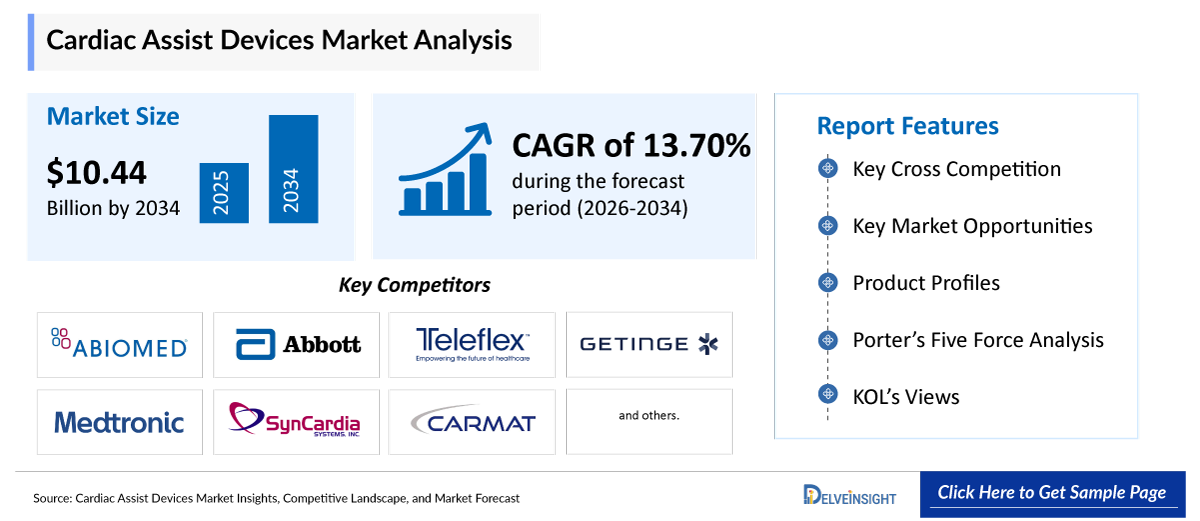
• The global cardiac assist devices market was valued at USD 3.29 billion in 2025 and is projected to reach USD 10.44 billion by 2034.
• The market is expected to expand at a CAGR of 13.70% during the forecast period 2026-2034, supported by the rising burden of cardiovascular disease, the scarcity of heart donors, technological innovation and miniaturization, and a surge in product launches and regulatory approvals.
• By product, the ventricular assist devices segment dominated the cardiac assist devices market with a 62% share in 2025.
• By type, the implantable segment dominated the cardiac assist devices market with a 61% share in 2025.
• By therapy, the destination therapy segment dominated the cardiac assist devices market with a 47% share in 2025.
• By end-user, the hospitals segment dominated the cardiac assist devices market with a 68% share in 2025.
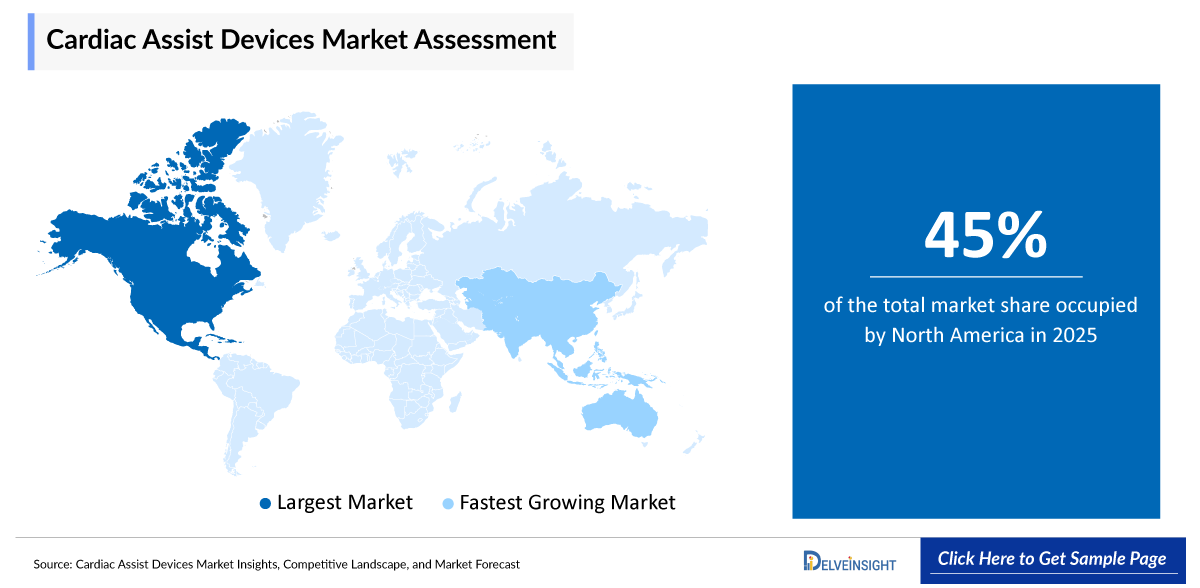
• North America accounted for the largest share of the cardiac assist devices market at 45% in 2025, while Asia-Pacific is anticipated to register the fastest growth through 2034.
Cardiac assist devices are mechanical circulatory support systems that partially or completely take over the pumping function of a failing heart, sustaining systemic perfusion in patients whose native cardiac output is inadequate. The category comprises three principal product classes. Ventricular assist devices are blood pumps that support one or both ventricles, encompassing left ventricular assist devices, which unload the left ventricle and are by far the most widely implanted; biventricular assist devices, which support both ventricles; and right ventricular assist devices, which address isolated right heart failure. Total artificial hearts replace both native ventricles and valves outright in patients with irreversible biventricular failure. Intra-aortic balloon pumps provide counterpulsation support that improves coronary perfusion and reduces afterload, and remain the most widely used temporary circulatory support device. These devices are deployed across three therapeutic intents: bridge-to-transplant, which sustains a candidate until a donor organ becomes available; bridge-to-candidacy, which stabilizes a patient whose transplant eligibility is uncertain; and destination therapy, which provides permanent support for patients ineligible for transplantation. The market is defined by a structural imbalance between the very large population with advanced heart failure and the fixed, scarce supply of donor hearts, which has progressively repositioned mechanical support from a temporary bridge toward a definitive long-term therapy. Contemporary innovation centers on full implantability and wireless energy transfer, magnetically levitated pumps that reduce thrombosis, miniaturized percutaneous systems, and the integration of artificial intelligence for flow optimization and remote monitoring.
Cardiac Assist Devices Market Key Growth Drivers
• Rising burden of cardiovascular disease, with the British Heart Foundation reporting that 620 million people, or one in thirteen individuals, live with heart and circulatory diseases globally.
• Scarcity of heart donors, with the Health Resources and Services Administration reporting 3,436 patients on the United States heart transplant waiting list in 2024 and 17 deaths each day among those awaiting an organ.
• Technological innovation and miniaturization, including smaller implantable left ventricular assist devices, percutaneous pumps, and improved biocompatible materials.
• Aging populations and rising life expectancy, which enlarge the geriatric segment most prone to cardiovascular complications and end-stage heart failure.
• Shift toward minimally invasive and percutaneous implantation techniques that reduce recovery time and broaden the eligible patient population.
• Enhanced reimbursement and improving healthcare infrastructure, particularly in emerging markets, are increasing access to mechanical circulatory support.
• Integration of remote monitoring, telemedicine, and artificial intelligence for flow optimization, predictive analytics, and early intervention.
Key Companies in Cardiac Assist Devices Market
The competitive field is anchored by a small group of large medical technology companies holding the commercial durable and percutaneous support franchises, supported by specialized developers advancing total artificial hearts and next-generation pump architectures. The leading participants in the cardiac assist devices market include the following:
• Abbott Laboratories
• Abiomed Inc.
• Teleflex Incorporated
• Getinge AB
• Medtronic plc
• SynCardia Systems LLC
• CARMAT SA
• Berlin Heart GmbH
• CorWave SA
• BiVACOR Inc.
Factors Contributing to the Growth of the Cardiac Assist Devices Market
Market Drivers
Rising Burden of Cardiovascular Disease
The foundational driver of the cardiac assist devices market is the immense and expanding global burden of cardiovascular disease, which generates the population of patients whose hearts ultimately fail. The British Heart Foundation reported in 2024 that 620 million people worldwide, or one in thirteen individuals, live with heart and circulatory diseases, with a prevalence of 100 million in Europe and 340 million across Asia and Australia in 2021. Coronary or ischemic heart disease, the most commonly diagnosed cardiovascular condition worldwide, affects an estimated 200 million people globally, comprising 110 million men and 80 million women, while 56 million women and 45 million men are stroke survivors and at least 13 million people live with congenital heart disease. Coronary heart disease involves narrowing or blockage of the coronary arteries and reduced blood flow to the myocardium, which frequently progresses to heart failure severe enough to require mechanical circulatory support to maintain cardiac output and organ perfusion. In the United States, the Centers for Disease Control and Prevention reported that 4.9% of adults were diagnosed with coronary heart disease in 2022, that 12.1 million individuals were projected to have atrial fibrillation by 2023, and that over 795,000 people experience a stroke each year. Because advanced heart failure is the terminal common pathway of these conditions, their rising prevalence translates directly into an expanding pool of candidates for cardiac assist devices.
Scarcity of Heart Donors
The structural scarcity of donor hearts is the single most distinctive driver of this market, because it converts mechanical circulatory support from an adjunct into the only available option for a large and growing population. Heart transplantation is widely regarded as the definitive therapeutic option for end-stage heart failure, but only a small fraction of eligible patients receive one, because the supply of donor organs is fixed by factors entirely independent of clinical demand. The Health Resources and Services Administration reported that in 2024 there were 103,223 men, women, and children on the United States national transplant waiting list, that 17 people die each day while waiting for an organ transplant, and that 3,436 patients were specifically awaiting a heart transplant. The World Economic Forum reported 3,500 patients waiting for a heart transplant in the United States in 2021, indicating a persistent and unresolved gap. The consequences are direct: donor scarcity, long waiting times, and an increasing number of clinically unstable candidates have driven the development and adoption of cardiac assist devices as both a bridge to transplantation and, increasingly, a permanent alternative to it. Because the donor supply cannot expand to meet demand, this driver is structural rather than cyclical, and it underpins the migration of ventricular assist devices from bridge-to-transplant into destination therapy, which is the principal source of volume growth in the durable support segment.
Market Restraints
Despite a compelling clinical rationale and a structurally expanding patient population, the cardiac assist devices market faces material constraints that temper the pace of adoption. The most significant is device-related complication risk. Driveline infection remains the principal source of morbidity in durable support, arising from the percutaneous lead that connects an implanted pump to its external controller and power source, and it has driven device recalls. Pump thrombosis and thromboembolic events persist despite magnetic levitation and improved hemocompatible surfaces, requiring lifelong anticoagulation that itself carries bleeding risk, while gastrointestinal bleeding, right heart failure after left-sided support, and mechanical component failure add further hazard. The second constraint is cost. The pump alone is expensive, and the total episode encompassing implantation, prolonged intensive care, and lifelong follow-up places the therapy among the costliest in cardiovascular medicine, which limits adoption where budgets are fixed and reimbursement is unfavorable. Low reimbursement in developing countries is a particular barrier, and high costs continue to limit adoption in low- and middle-income countries where the cardiovascular burden is nonetheless rising fastest. The third constraint is regulatory. Cardiac assist devices are among the highest-risk device classes, requiring premarket approval supported by extensive clinical evidence, and stringent regulatory requirements lengthen development timelines and raise the cost of innovation. Trial recruitment for emerging systems has faced delays, slowing the pathway to market. The fourth constraint is infrastructure and capability: implantation and management require specialized centers, trained multidisciplinary teams, and accredited programs that exist in limited numbers, so capacity rather than demand often determines volume. Finally, the imposition of import tariffs on medical devices and components has increased costs and disrupted supply chains, prompting strategic shifts in manufacturing and sourcing. Together, these factors ensure that growth, while structurally supported, proceeds unevenly across geography and care setting.
Cardiac Assist Devices Market Segment Analysis
The global cardiac assist devices market is segmented by product into ventricular assist devices (left ventricular assist devices, biventricular assist devices, and right ventricular assist devices), total artificial hearts, and intra-aortic balloon pumps; by type into transcutaneous and implantable; by therapy into bridge-to-transplant (BTT), bridge-to-candidacy (BTC), and destination therapy (DT); by end-user into hospitals, cardiac centers, and ambulatory surgical centers; and by geography into North America, Europe, Asia-Pacific, and the Rest of the World.
By Product
Dominant Subsegment: Ventricular Assist Devices.
The ventricular assist devices category is expected to dominate the market.
Dominant: Ventricular Assist Devices ~ 62%
The ventricular assist devices segment accounted for a 62% share of the cardiac assist devices market in 2025. Ventricular assist devices dominate the product structure, and within this category, left ventricular assist devices hold the leading position owing to their pivotal role in managing severe heart failure and their widespread adoption in clinical practice. Left ventricular assist devices serve as a critical bridge to heart transplantation for patients with end-stage heart failure, offering life-saving support by augmenting the pumping capability of the heart and restoring blood flow to vital organs, and they are increasingly used as destination therapy for patients who are not transplant candidates, which has substantially expanded their reach. Following implantation, patients experience meaningful improvement in functional status and can resume daily activities including driving, and the devices deliver intermediate to long-term treatment for severe heart failure. Their prominence rests on demonstrated improvement in patient outcomes, on advances in technology that have enhanced device performance and patient comfort, and on a growing population with chronic heart conditions. Biventricular assist devices serve the smaller cohort requiring support of both ventricles, and right ventricular assist devices address isolated right heart failure, an area that has advanced with dedicated percutaneous platforms. Total artificial hearts constitute a specialized segment for irreversible biventricular failure and represent a significant frontier of innovation, while intra-aortic balloon pumps remain the most widely used temporary support modality by unit volume but contribute proportionally less value given their lower price. Ventricular assist devices are expected to retain their leading position throughout the forecast period.
By Type
Dominant Subsegment: Implantable.
The implantable category is expected to dominate the market.
Dominant: Implantable ~ 61%
The implantable segment accounted for a 61% share of the cardiac assist devices market in 2025. Implantable devices dominate the type structure by value because durable ventricular assist devices and total artificial hearts, which are surgically placed within the body for months to years, command prices an order of magnitude above temporary transcutaneous systems and are supported by an episode of care encompassing implantation, intensive care, and lifelong follow-up. The implantable category is where the therapeutic centre of gravity has settled, because the structural scarcity of donor hearts has progressively repositioned durable support from a temporary bridge toward long-term and permanent therapy, and only implantable architectures can sustain a patient for the years that destination therapy requires. Contemporary implantable devices are continuous-flow, magnetically levitated pumps whose elimination of mechanical bearings has substantially reduced pump thrombosis, and the frontier of the segment is full implantability with wireless or transcutaneous energy transfer, which addresses the driveline that remains the principal source of infection. The transcutaneous category encompasses intra-aortic balloon pumps and percutaneous ventricular assist devices delivered through a catheter, and it leads on unit volume given the very large number of temporary support procedures performed in cardiogenic shock and during high-risk percutaneous coronary intervention. It is also the faster-growing category as miniaturized percutaneous platforms mature and as minimally invasive approaches expand. Implantable devices are expected to retain the majority of market value throughout the forecast period.
Cardiac Assist Devices Market Region Analysis
Dominant Region: North America
Dominant: North America ~ 45% (Largest)
North America accounted for a 45% share of the global cardiac assist devices market in 2025. The region combines a very high prevalence of cardiac disease with an acute shortage of heart donors, extensive government initiatives and awareness programs, and the presence of the key manufacturers engaged in mergers, acquisitions, and product launches, making it the principal market for mechanical circulatory support. The donor gap is the defining regional dynamic: the Health Resources and Services Administration reported that in 2024 there were 103,223 men, women, and children on the United States national transplant waiting list, that 17 people die each day while awaiting an organ, and that 3,436 patients were specifically on the heart transplant waiting list, a situation that emphasizes the gap between donor supply and demand and drives the need for interim and permanent alternatives. The clinical burden is correspondingly large, with the Centers for Disease Control and Prevention reporting that 4.9% of adults were diagnosed with coronary heart disease in 2022, that 12.1 million individuals were projected to have atrial fibrillation by 2023, and that over 795,000 people experience a stroke each year, of which 610,000 are first-time events and 185,000, or one in four, are recurrent. Public awareness programs, including American Heart Month promoted by the American Heart Association and the Centers for Disease Control and Prevention, emphasize screening and prevention and expand referral into advanced heart failure pathways. Regulatory activity is concentrated in the region, with investigational device exemptions and premarket approvals advancing total artificial hearts and next-generation ventricular assist systems. North America is expected to retain its dominant position throughout the forecast period.
Fastest Growing Region: Asia-Pacific
Asia-Pacific is projected to register the fastest compound annual growth rate in the cardiac assist devices market through 2034. The region offers substantial untapped potential, combining rising cardiovascular disease rates, expanding healthcare access, and favorable pricing models with populations of enormous scale. The British Heart Foundation reported a prevalence of heart and circulatory disease of 340 million across Asia and Australia in 2021, a burden that dwarfs other regions in absolute terms and that has historically been served by a fraction of the mechanical circulatory support capacity available in North America and Europe. The constraint in the region has been affordability and infrastructure rather than clinical need, and both are changing: advanced cardiac centers are being established across China, India, and Southeast Asia, insurance coverage is expanding, healthcare expenditure is rising, and domestic manufacturers are developing cost-effective devices suited to regional price points. Japan combines an exceptionally aged population with a mature cardiovascular care system, high procedural standards, and an established base of implanting centers, and it has been an early adopter of durable support with distinctive local device development. South Korea and Australia contribute high-value, guideline-driven markets with strong transplant and mechanical support programs. India represents the largest long-term opportunity, with a very large heart failure population and a growing domestic medical device industry. Because the regional base is small relative to the burden, growth rates are expected to exceed the global average across every product and therapy segment.
Regional Commentary
North America
North America leads on value, implanting capacity, and regulatory activity. The United States is the reference market for premarket approval and investigational device exemption pathways, the site of most first-in-human and pivotal studies, and the home of the leading manufacturers. Demand is driven by the donor gap, with 3,436 patients on the heart transplant waiting list in 2024, and by a large coronary heart disease, atrial fibrillation, and stroke burden. Reimbursement for destination therapy underpins the durable support segment. Canada contributes established transplant and mechanical support programs, while Mexico is an expanding but access-constrained market. Near-term dynamics are shaped by full implantability, percutaneous platforms, and tariff-driven supply chain adjustment.
Europe
Europe represents the second-largest regional market, with France, Germany, the United Kingdom, Italy, and Spain accounting for the majority of regional value, and the British Heart Foundation reporting prevalence of 100 million across the region in 2021. Europe has been a leading center of cardiac assist device innovation, hosting CARMAT in France, Berlin Heart in Germany, and CorWave in France, and it has served as the launch market for several advanced systems, including a fully implantable left ventricular assist device approved in 2025 and CE Mark approvals for advanced devices. National health technology assessment and tender-based procurement gate adoption and produce heterogeneous access across member states, while the in vitro and medical device regulations impose substantial evidentiary requirements.
Asia-Pacific
Asia-Pacific is the fastest-growing region, propelled by a cardiovascular burden of 340 million across Asia and Australia, expanding healthcare access, and favorable pricing models. Japan combines an aged population with a mature cardiovascular care system and an established implant base; China and India are building advanced cardiac centers and expanding coverage from a small base, offering the largest long-term opportunity; and South Korea and Australia contribute high-value, guideline-driven markets. Domestic manufacturers are developing cost-effective devices suited to regional price points. Because capacity rather than clinical need has been the binding constraint, infrastructure and reimbursement expansion unlock demand directly, and growth exceeds the global average across every segment.
Rest of World
The Rest of the World comprises the Middle East, Africa, and South America. Access is highly stratified. The Gulf Cooperation Council states and the larger South American markets, particularly Brazil, have established cardiac surgery and transplant programs and are investing in advanced heart failure capability, representing growing markets, while much of Africa lacks the implanting infrastructure, intensive care capacity, and financing required for mechanical circulatory support despite a rising cardiovascular burden. High costs continue to limit adoption in low- and middle-income countries. Regional growth will be driven by investment in tertiary cardiac centers, government health initiatives, and the availability of lower-cost devices from emerging market manufacturers.
Cardiac Assist Devices Market Competitive Landscape
The global cardiac assist devices market is classified as Consolidated. A small number of large medical technology companies control the commercial durable and percutaneous support franchises, and barriers to entry are exceptionally high, reflecting the premarket approval pathway required for these highest-risk device classes, the cost and duration of pivotal clinical evidence, the manufacturing precision required for implantable blood pumps, and the specialized implanting center relationships that incumbents have built over decades. A long tail of specialized developers advances total artificial hearts and next-generation architectures, but few reach commercial scale. The competitive landscape is evaluated across the following dimensions:
• Market concentration: Highly concentrated, with the durable left ventricular assist device and percutaneous support franchises each led by a single dominant participant and the intra-aortic balloon pump segment shared among a small group.
• Leading players: Abbott Laboratories leads durable ventricular assist devices, Abiomed Inc. leads percutaneous mechanical circulatory support, and Teleflex Incorporated and Getinge AB lead intra-aortic balloon pumps, with SynCardia Systems LLC, CARMAT SA, and Berlin Heart GmbH holding specialized positions.
• Geographic reach: The leading participants maintain global commercial and clinical support organizations concentrated on accredited implanting centers, while European developers including CARMAT, Berlin Heart, and CorWave anchor regional innovation and pursue international registration.
• Product portfolio strength: Competitive advantage rests on coverage across the acuity spectrum, spanning temporary percutaneous support, durable implantable pumps, and total artificial hearts, together with the controllers, drivelines, and monitoring systems that surround them.
• Pipeline strength: Development is concentrated in fully implantable systems with wireless energy transfer, magnetically levitated pumps and rotary total artificial hearts, miniaturized percutaneous platforms, modular transcatheter architectures, and pediatric devices.
• Strategic partnerships: Collaboration between device makers and artificial-intelligence-driven monitoring startups for remote ventricular assist device management, and academic and industry partnerships to develop miniaturized cardiac pumps, are active vectors of innovation.
• M&A activity: Large device makers have acquired niche startups specializing in minimally invasive assist devices, and strategic transactions continue to strengthen cardiac assist and extracorporeal membrane oxygenation portfolios.
• Manufacturing capabilities: Participants operate specialized implantable pump manufacturing, and capacity expansion has been a strategic priority, exemplified by the opening of a second production facility by CARMAT in France.
• Innovation focus: Innovation centers on full implantability and wireless energy transfer to eliminate driveline infection, magnetic levitation to reduce thrombosis, restoration of physiological pulsatility, and artificial-intelligence-based flow optimization and remote monitoring.
Cardiac Assist Devices Market Recent Developmental Activities
In July 2025, CorWave SA announced the first implantation in the world of its novel Left Ventricular Assist System based on wave membrane technology, marking a significant advance in cardiac assist innovation. The biomimetic wave-membrane architecture restores physiological pulsatility, distinguishing it from the continuous-flow rotary pumps that define contemporary durable support. Strategic significance: first-in-human implantation validated an entirely new pump architecture and positioned the company at the frontier of an innovation cycle focused on physiological flow, offering a potential route past the hemocompatibility limitations of rotary designs.
In April 2025, European regulators approved a new fully implantable left ventricular assist device, a milestone that enhances long-term, portable support for patients with advanced heart failure by removing the percutaneous driveline. Strategic significance: full implantability addresses driveline infection, the principal source of morbidity in durable mechanical circulatory support, and its regulatory acceptance in Europe establishes a precedent that reshapes the competitive standard for the entire durable segment and accelerates the industry-wide pivot toward wireless energy transfer.
Cardiac Assist Devices Market Segmentation
Cardiac Assist Devices Market Assessment by Product
• Ventricular Assist Devices
▪ Left Ventricular Assist Devices (LVAD)
▪ Biventricular Ventricular Assist Devices (BIVAD)
▪ Right Ventricular Assist Devices (RVAD)
• Total Artificial Hearts
• Intra-Aortic Balloon Pumps
Cardiac Assist Devices Market Assessment by Type
• Transcutaneous
• Implantable
Cardiac Assist Devices Market Assessment by Therapy
• Bridge-To-Transplant (BTT)
• Bridge-To-Candidacy (BTC)
• Destination Therapy (DT)
Cardiac Assist Devices Market Assessment by End-User
• Hospitals
• Cardiac Centers
• Ambulatory Surgical Centers
Cardiac Assist Devices Market Assessment by Geography
• North America
▪ United States Cardiac Assist Devices Market Size in USD million (2023-2034)
▪ Canada Cardiac Assist Devices Market Size in USD million (2023-2034)
▪ Mexico Cardiac Assist Devices Market Size in USD million (2023-2034)
• Europe
▪ France Cardiac Assist Devices Market Size in USD million (2023-2034)
▪ Germany Cardiac Assist Devices Market Size in USD million (2023-2034)
▪ United Kingdom Cardiac Assist Devices Market Size in USD million (2023-2034)
▪ Italy Cardiac Assist Devices Market Size in USD million (2023-2034)
▪ Spain Cardiac Assist Devices Market Size in USD million (2023-2034)
▪ Rest of Europe Cardiac Assist Devices Market Size in USD million (2023-2034)
• Asia-Pacific
▪ China Cardiac Assist Devices Market Size in USD million (2023-2034)
▪ Japan Cardiac Assist Devices Market Size in USD million (2023-2034)
▪ India Cardiac Assist Devices Market Size in USD million (2023-2034)
▪ Australia Cardiac Assist Devices Market Size in USD million (2023-2034)
▪ South Korea Cardiac Assist Devices Market Size in USD million (2023-2034)
▪ Rest of Asia-Pacific Cardiac Assist Devices Market Size in USD million (2023-2034)
• Rest of the World
▪ Middle East Cardiac Assist Devices Market Size in USD million (2023-2034)
▪ Africa Cardiac Assist Devices Market Size in USD million (2023-2034)
▪ South America Cardiac Assist Devices Market Size in USD million (2023-2034)
Key Takeaways from the Cardiac Assist Devices Market Report Study
• Market size analysis for the current cardiac assist devices market size (2025), and market forecast for 9 years (2026 to 2034).
• Top key product/technology developments, mergers, acquisitions, partnerships, and joint ventures that happened over the last 3 years.
• Key companies dominating the global cardiac assist devices market.
• Various opportunities available for competitors in the cardiac assist devices market space.
• What are the top-performing segments in 2025? How will these segments perform in 2034?
• Which are the top-performing regions and countries in the current cardiac assist devices market scenario?
• Which are the regions and countries where companies should concentrate their opportunities for cardiac assist devices market growth in the future?
Target audience who can benefit from this cardiac assist devices market report study
• Cardiac Assist Devices product providers
• Research organizations and consulting companies
• Cardiac Assist Devices-related organizations, associations, forums, and other alliances
• Government and corporate offices
• Start-up companies, venture capitalists, and private equity firms
• Distributors and traders dealing in cardiac assist devices
• Various end-users who want to know more about the cardiac assist devices market and the latest technological developments in the cardiac assist devices market