CAR T-Cell Therapy for Non-Hodgkin's Lymphoma Pipeline Summary
- The CAR T-Cell Therapy for Non-Hodgkin's Lymphoma Pipeline is advancing rapidly, with several biopharmaceutical companies developing innovative therapies aimed at improving disease control, reducing symptom burden, and addressing unmet patient needs.
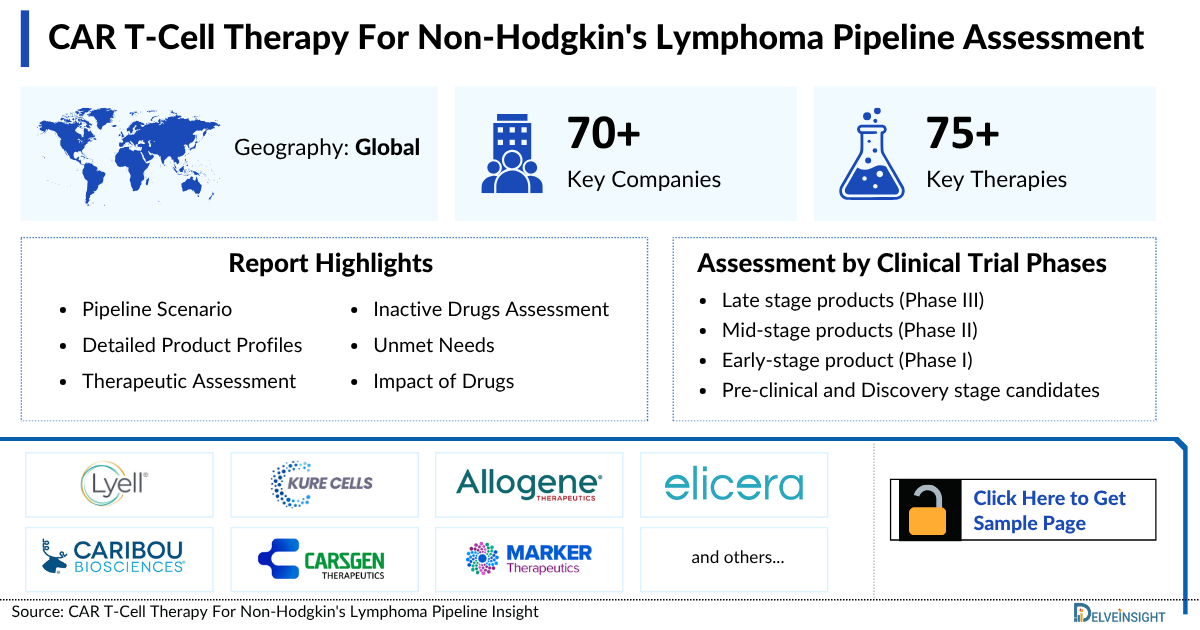
- The leading CAR T-Cell Therapy for Non-Hodgkin's Lymphoma Companies include Lyell Immunopharma, Inc., Kure Cells, INC, Allogene Therapeutics, Elicera Therapeutics, Caribou Biosciences, CARSGEN Therapeutics, Marker Therapeutics, Inc., Orcar Bio, Imugene Limited, Cellectis Editing Life, Luminary Therapeutics, Allotera Therapeutics, Prescient Therapeutics, March Biosciences, Legend Biotech, Miltenyi Biomedicine, Imviva Biotech, AvenCell, Umoja Biopharma, and others.
Request for unlocking the Sample Page of the “CAR T-Cell Therapy for Non-Hodgkin's Lymphoma Pipeline”
Key Factors Driving the Growth of CAR T-Cell Therapy for Non-Hodgkin's Lymphoma Pipeline
-
High Unmet Medical Need
The high unmet medical need in Non-Hodgkin’s Lymphoma, particularly among patients with relapsed or refractory disease, is a major factor driving the CAR T-cell therapy pipeline. Patients who have progressed after multiple lines of treatment often have limited therapeutic options, encouraging the development of innovative cellular therapies.
-
Proven Clinical Efficacy of CAR T-Cell Therapy
The success of approved CAR T-cell therapies in B-cell malignancies has demonstrated the potential of this treatment approach to generate deep and durable responses. Positive clinical outcomes are encouraging further investment and research into CAR T-cell therapies for different NHL subtypes.
-
Expansion Into Earlier Lines of Treatment
CAR T-cell therapies are increasingly being evaluated in earlier lines of Non-Hodgkin's Lymphoma treatment, including second-line settings. Expanding their use beyond heavily pretreated patients could increase the eligible patient population and potentially improve outcomes by treating patients before extensive disease progression.
-
Development of Next-Generation CAR T-Cell Therapies
The development of next-generation CAR T-cell therapies is contributing significantly to pipeline growth. Researchers are designing CAR constructs with improved T-cell persistence, enhanced tumor recognition, greater antitumor activity, and reduced T-cell exhaustion to overcome limitations associated with existing therapies.
-
Emergence of Novel Antigen Targets
While CD19 remains a key target for CAR T-cell therapy in B-cell NHL, researchers are investigating additional tumor-associated antigens. Multi-target and dual-target CAR T-cell therapies are also being explored to minimize antigen escape and improve treatment durability.
-
Growth of Allogeneic CAR T-Cell Therapies
Allogeneic or off-the-shelf CAR T-cell therapies are gaining attention because they could overcome several limitations associated with individualized autologous treatments. These approaches may reduce manufacturing time, improve treatment accessibility, and potentially lower production costs.
DelveInsight’s “CAR T-Cell Therapy for Non-Hodgkin’s Lymphoma Pipeline Insight, 2026” report provides comprehensive insights about 70+ companies and 75+ pipeline drugs in CAR T-Cell Therapy for Non-Hodgkin’s Lymphoma pipeline landscape. It covers the CAR T-Cell Therapy for Non-Hodgkin's Lymphoma Pipeline drug profiles, including clinical and nonclinical stage products. It also covers the therapeutics assessment by product type, stage, route of administration, and molecule type. It further highlights the inactive pipeline products in this space.
Geography Covered
- Global coverage
CAR T-Cell Therapy for Non-Hodgkin’s Lymphoma Disease Understanding
CAR T-Cell Therapy for Non-Hodgkin’s Lymphoma Overview
Non-Hodgkin lymphoma is a diverse group of malignant lymphoid cancers that originate from B- or T-lymphocyte precursors and mature lymphocytes, encompassing multiple subtypes such as diffuse large B-cell lymphoma (DLBCL), follicular lymphoma, mantle cell lymphoma, Burkitt lymphoma, primary CNS lymphoma, mycosis fungoides, and marginal zone lymphoma. Accounting for approximately 4% of all cancer diagnoses in the United States, the incidence of NHL has risen markedly since 1975.
Although conventional chemotherapy and combination treatment regimens remain the standard of care, clinical outcomes are often suboptimal, with many patients experiencing poor prognosis and up to half of those with DLBCL developing relapsed or refractory disease. These limitations have accelerated the development of innovative therapeutic approaches, including immunomodulatory agents, B-cell receptor signaling inhibitors, epigenetic modulators, monoclonal antibodies, BCL-2 inhibitors, checkpoint inhibitors, adoptive T-cell therapies, and particularly chimeric antigen receptor (CAR)-T cell therapy, which offers a more personalized treatment strategy for patients with difficult-to-treat NHL.
CAR-T cells are engineered with four key components: an antigen-binding domain, a hinge region, a transmembrane domain, and intracellular signaling domains that work together to recognize and eliminate cancer cells. The antigen-binding domain is typically derived from a single-chain variable fragment (scFv) of an antibody, enabling specific target recognition. The hinge region provides structural flexibility and optimally positions the receptor on the cell surface, while the transmembrane domain anchors the receptor and influences its stability, with the CD28 transmembrane domain demonstrating superior membrane stability.
The intracellular signaling domain comprises the CD3 signaling chain along with one or more costimulatory molecules, such as CD28, 4-1BB, OX40, CD27, ICOS, or glucocorticoid-induced TNF receptor, which collectively activate downstream signaling pathways that drive T-cell activation, proliferation, cytokine release, cytotoxic activity, and recruitment of additional immune cells.
CAR-T cell therapies are classified into four generations based on their structural and functional advancements. First-generation CAR-T cells contained only the CD3? signaling domain and showed limited clinical efficacy due to inadequate T-cell activation and persistence. To overcome these limitations, second- and third-generation CARs incorporated one and two costimulatory domains, respectively, significantly enhancing T-cell expansion, persistence, and antitumor activity.
Fourth-generation CAR-T cells further improve efficacy and safety by incorporating additional genetic elements, such as cytokines (e.g., IL-7, IL-12, IL-15, IL-18, and IL-23), chemokines, or suicide genes. These modifications enhance immune responses, broaden antitumor activity through CAR-independent mechanisms, and improve safety by enabling controlled elimination of CAR-T cells, thereby reducing on-target, off-tumor toxicity.
Resistance to CAR-T cell therapy is driven by both extrinsic and intrinsic mechanisms. Extrinsic resistance arises from loss of target antigens, such as CD19, and the immunosuppressive tumor microenvironment, both of which reduce CAR-T cell recognition and activity. Approaches to overcome these challenges include multi-antigen targeting and the development of "armored" CAR-T cells designed to function in hostile tumor environments.
Intrinsic resistance is caused by CAR-T cell senescence and exhaustion, leading to reduced proliferation and antitumor activity, often accompanied by increased expression of inhibitory receptors such as PD-1, TIGIT, and LAG-3. Novel strategies, including TIGIT blockade and the use of less exhausted CAR-T cell populations, are being explored to enhance the durability and efficacy of CAR-T therapy in non-Hodgkin lymphoma.
Anti-CD19 CAR-T cell therapy has emerged as a promising treatment for aggressive B-cell non-Hodgkin lymphoma, the most common NHL subtype. Three pivotal phase III trials, ZUMA-7, TRANSFORM, and BELINDA, evaluated second-generation CAR-T therapies in patients with relapsed or refractory disease. ZUMA-7 and TRANSFORM demonstrated that axicabtagene ciloleucel (axi-cel) and lisocabtagene maraleucel (liso-cel), respectively, significantly improved event-free survival and response rates compared with standard therapy.
In contrast, BELINDA showed that tisagenlecleucel (tisa-cel) did not significantly outperform standard of care, despite encouraging results in the earlier JULIET phase II trial. Overall, these studies highlight the substantial clinical benefit of anti-CD19 CAR-T therapy while emphasizing variability in efficacy across different CAR-T products.
Despite their remarkable clinical efficacy, CAR-T therapies are associated with significant on-target toxicities, most notably cytokine release syndrome, immune effector cell-associated neurotoxicity (ICANS), and B-cell aplasia. CRS results from rapid CAR-T cell activation and the excessive release of inflammatory cytokines, creating a systemic inflammatory response that can be life-threatening, although it is effectively managed with the anti-IL-6 antibody tocilizumab.
ICANS, characterized by symptoms such as headache, altered mental status, and seizures, is believed to arise from CAR-T cell infiltration into the central nervous system and/or systemic inflammation, with corticosteroids serving as the standard treatment. Additionally, CD19-targeted CAR-T therapies can cause B-cell aplasia by depleting both malignant and healthy B cells; however, this toxicity is generally manageable with appropriate supportive care.
"CAR T-Cell Therapy for Non-Hodgkin’s Lymphoma Pipeline Insight, 2026" report by DelveInsight outlays comprehensive insights of present scenario and growth prospects across the indication. A detailed picture of the CAR T-Cell Therapy for Non-Hodgkin’s Lymphoma pipeline landscape is provided which includes the disease overview and CAR T-Cell Therapy for Non-Hodgkin’s Lymphoma treatment guidelines. The assessment part of the report embraces, in depth CAR T-Cell Therapy for Non-Hodgkin’s Lymphoma commercial assessment and clinical assessment of the pipeline products under development. In the report, detailed description of the drug is given which includes mechanism of action of the drug, clinical studies, NDA approvals (if any), and product development activities comprising the technology, CAR T-Cell Therapy for Non-Hodgkin’s Lymphoma collaborations, licensing, mergers and acquisition, funding, designations and other product related details.
Explore More Insights to the Report @ CAR T-Cell Therapy for Non-Hodgkin's Lymphoma Treatment Market Size
CAR T-Cell Therapy for Non-Hodgkin’s Lymphoma Pipeline Report Highlights
The CAR T-Cell Therapy for Non-Hodgkin's Lymphoma Companies and academics are working to assess challenges and seek opportunities that could influence CAR T-Cell Therapy for Non-Hodgkin’s Lymphoma R&D. The therapies under development are focused on novel approaches to treat/improve CAR T-Cell Therapy for Non-Hodgkin’s Lymphoma.
CAR T-Cell Therapy for Non-Hodgkin’s Lymphoma Emerging Drugs Analysis
This segment of the CAR T-Cell Therapy for Non-Hodgkin’s Lymphoma Pipeline Report encloses its detailed analysis of various drugs in different stages of clinical development, including Phase III, II, I, Preclinical, and Discovery. It also helps to understand clinical trial details, expressive pharmacological action, agreements and collaborations, and the latest news and press releases.
CAR T-Cell Therapy for Non-Hodgkin’s Lymphoma Emerging Drugs
-
Rondecabtagene Autoleucel: Lyell Immunopharma, Inc.
Rondecabtagene autoleucel (ronde-cel; LYL314) is a next-generation dual-targeting CD19/CD20 CAR-T cell therapy being developed for the treatment of relapsed/refractory large B-Cell lymphoma (R/R LBCL). Designed with an “OR” logic gate, it effectively targets B cells expressing CD19, CD20, or both, while a proprietary manufacturing process enriches for CD62L-positive naïve and central memory T cells to enhance persistence and antitumor activity.
Ronde-cel has received multiple U.S. FDA regulatory designations, including Regenerative Medicine Advanced Therapy (RMAT), Fast Track, and Orphan Drug Designation, recognizing its potential to improve complete response rates and durability of response in patients with relapsed or refractory diffuse large B-cell lymphoma and other high-risk LBCL subtypes. According to company’s pipeline the drug is in phase III stage of it’s development for the treatment of for Large B-Cell Lymphoma.
-
UF-KURE19: Kure Cells, INC
UF-KURE19 is an investigational autologous anti-CD19 CAR-T cell therapy developed by Kure Cells for the treatment of relapsed or refractory (R/R) CD19-positive non-Hodgkin lymphoma (NHL). Manufactured using the company's proprietary Ultra-Fast (UF) platform, it is produced in less than 24 hours, preserving naïve and memory T cells to enhance persistence and antitumor activity.
Early Phase I data have shown encouraging complete response rates across multiple NHL subtypes, with a favorable safety profile characterized by low rates of cytokine release syndrome and neurotoxicity, supporting its potential as a faster and more effective CAR-T therapy. According to company’s pipeline the drug is in phase II stage of it’s development for the treatment of relapsed or Refractory NHL.
-
Cemacabtagene Ansegedleucel: Allogene Therapeutics
Cemacabtagene ansegedleucel (cema-cel) is a next-generation, allogeneic anti-CD19 CAR-T cell therapy being developed by Allogene Therapeutics for the treatment of large B-cell lymphoma (LBCL). The investigational therapy received U.S. FDA Regenerative Medicine Advanced Therapy (RMAT) designation for relapsed or refractory LBCL and is currently being evaluated in the pivotal Phase II ALPHA3 trial as a first-line consolidation treatment. Allogene holds commercialization rights for cema-cel in the United States, Europe, and the United Kingdom, with options to expand into China and Japan.
-
ELC-301: Elicera Therapeutics
ELC-301, developed by Elicera Therapeutics, is an investigational CD20-targeted CAR-T cell therapy for the treatment of B-cell lymphoma, mantle cell lymphoma, and indolent lymphoma. Built on the company's proprietary iTANK® platform, ELC-301 combines the direct tumor-killing activity of CAR-T cells with the expression of the immune-activating NAP protein, which enhances the body's endogenous antitumor immune response. Preclinical studies have demonstrated that this dual mechanism improves immune activation and promotes more effective elimination of tumor cells. According to company’s pipeline, the drug is in Phase I/II stage of its development for the treatment of non-hodgkin lymphoma.
-
Vispa-Cel: Caribou Biosciences
Vispacabtagene regedleucel (vispa-cel; formerly CB-010) is an investigational allogeneic anti-CD19 CAR-T cell therapy being developed for the treatment of relapsed or refractory B-cell non-Hodgkin lymphoma (R/R B-NHL). It is the first allogeneic CAR-T therapy in clinical evaluation to incorporate PD-1 gene knockout, a genome-editing strategy designed to reduce T-cell exhaustion and enhance antitumor activity. Manufactured using Cas9 chRDNA-guided gene editing, vispa-cel features three key modifications: removal of the T-cell receptor (TRAC knockout), targeted insertion of the anti-CD19 CAR into the TRAC locus, and PD-1 knockout to improve persistence and therapeutic efficacy. According to company’s pipeline, the drug is in Phase I stage of its development for the treatment of relapsed or refractory B cell non-Hodgkin lymphoma.
-
CT1190B: CARSGEN Therapeutics
CT1190B is an investigational allogeneic dual-targeting CD19/CD20 CAR-T cell therapy developed by CARsgen Therapeutics using its proprietary THANK-u Plus® platform for the treatment of relapsed or refractory B-cell non-Hodgkin lymphoma (R/R B-NHL). By simultaneously targeting both CD19 and CD20, CT1190B is designed to reduce the risk of antigen escape and enhance the durability of antitumor responses. As an off-the-shelf CAR-T product, it has the potential to provide rapid treatment access without the manufacturing delays associated with autologous therapies. The therapy is currently being evaluated in investigator-initiated clinical trials to assess its safety, tolerability, and preliminary efficacy in patients with R/R B-NHL. According to company’s pipeline, the drug is in Phase I stage of its development for the treatment of relapsed or refractory B cell non-Hodgkin lymphoma.
-
MT-601: Marker Therapeutics, Inc.
MT-601, developed by Marker Therapeutics, is an investigational multi-antigen recognizing (MAR) T-cell therapy designed to target six lymphoma-associated tumor antigens, Survivin, PRAME, WT-1, NY-ESO-1, SSX-2, and MAGEA-4, using a non-genetically modified approach. By recognizing multiple tumor antigens simultaneously, MT-601 aims to reduce the risk of antigen escape and improve antitumor activity. The therapy is currently being evaluated in the Phase I APOLLO trial for patients with Non-Hodgkin lymphoma who have relapsed following or are ineligible for anti-CD19 CAR-T cell therapy.
-
Research Program: NHL: Orcar Bio
Orca Bio is developing an investigational CAR-T cell therapy that integrates its proprietary high-precision cell therapy platform with CAR-T technology for the treatment of non-Hodgkin lymphoma (NHL). The candidate is designed to deliver a more precisely engineered cell therapy product with the potential to improve therapeutic efficacy, consistency, and clinical outcomes in patients with NHL. According to company’s pipeline, the drug is in Preclinical stage of its development for Non-Hodgkin Lymphoma.
For More Insights to the Report @ CAR T-Cell Therapy for Non-Hodgkin's Lymphoma Prevalence
CAR T-Cell Therapy for Non-Hodgkin’s Lymphoma Pipeline Therapeutic Assessment
This segment of the report provides insights about the different CAR T-Cell Therapy for Non-Hodgkin’s Lymphoma drugs segregated based on the following parameters that define the scope of the report, such as:
Major CAR T-Cell Therapy for NHL Companies
There are approx. 70+ key companies which are developing the therapies for CAR T-Cell Therapy for Non-Hodgkin’s Lymphoma. The companies which have their CAR T-Cell Therapy for Non-Hodgkin’s Lymphoma drug candidates in the most advanced stage, i.e. Phase III include, Lyell Immunopharma, Inc.
CAR T-Cell Therapy for NHL Phases
DelveInsight’s CAR T-Cell Therapy for NHL Pipeline Report covers around 75+ products under different phases of clinical development like
- Late stage products (Phase III)
- Mid-stage products (Phase II)
- Early-stage product (Phase I) along with the details of
- Pre-clinical and Discovery stage candidates
- Discontinued & Inactive candidates
CAR T-Cell Therapy for NHL Drugs Route of Administration
CAR T-Cell Therapy for Non-Hodgkin’s Lymphoma Pipeline Report provides the therapeutic assessment of the pipeline drugs by the Route of Administration. Products have been categorized under various ROAs such as
- Oral
- Intravenous
- Subcutaneous
- Parenteral
- Topical
CAR T-Cell Therapy for NHL Molecule Type
CAR T-Cell Therapy for NHL Products have been categorized under various Molecule types such as
- Recombinant fusion proteins
- Small molecule
- Monoclonal antibody
- Peptide
- Polymer
- Gene therapy
CAR T-Cell Therapy for Non-Hodgkin’s Lymphoma Product Type
- Drugs have been categorized under various product types like Mono, Combination, and Mono/Combination.
CAR T-Cell Therapy for Non-Hodgkin’s Lymphoma Clinical Trials Activities
The CAR T-Cell Therapy for Non-Hodgkin’s Lymphoma Pipeline Report provides insights into different therapeutic candidates in Phase III, II, I, preclinical and discovery stage. It also analyses CAR T-Cell Therapy for Non-Hodgkin’s Lymphoma therapeutic drugs key players involved in developing key drugs.
CAR T-Cell Therapy for Non-Hodgkin’s Lymphoma Clinical Trials Development Activities
The CAR T-Cell Therapy for Non-Hodgkin’s Lymphoma Pipeline Report covers the detailed information of collaborations, acquisition and merger, licensing along with a thorough therapeutic assessment of emerging CAR T-Cell Therapy for Non-Hodgkin’s Lymphoma drugs.
CAR T-Cell Therapy for Non-Hodgkin’s Lymphoma Pipeline Report Insights
- CAR T-Cell Therapy for Non-Hodgkin’s Lymphoma Pipeline Analysis
- CAR T-Cell Therapy for Non-Hodgkin’s Lymphoma Therapeutic Assessment
- CAR T-Cell Therapy for Non-Hodgkin’s Lymphoma Unmet Needs
- Impact of CAR T-Cell Therapy for Non-Hodgkin’s Lymphoma Drugs
CAR T-Cell Therapy for Non-Hodgkin’s Lymphoma Pipeline Report Assessment
- CAR T-Cell Therapy for Non-Hodgkin’s Lymphoma Pipeline Product Profiles
- CAR T-Cell Therapy for Non-Hodgkin’s Lymphoma Therapeutic Assessment
- CAR T-Cell Therapy for Non-Hodgkin’s Lymphoma Pipeline Assessment
- Inactive CAR T-Cell Therapy for Non-Hodgkin’s Lymphoma Drugs Assessment
- CAR T-Cell Therapy for Non-Hodgkin’s Lymphoma Unmet Needs
Key Questions Answered in the CAR T-Cell Therapy for Non-Hodgkin’s Lymphoma Pipeline Report
Current CAR T-Cell Therapy for NHL Treatment Scenario and Emerging Therapies:
- How many companies are developing CAR T-Cell Therapy for Non-Hodgkin’s Lymphoma drugs?
- How many CAR T-Cell Therapy for Non-Hodgkin’s Lymphoma drugs are developed by each company?
- How many emerging drugs are in mid-stage, and late-stage of development for the treatment of CAR T-Cell Therapy for Non-Hodgkin’s Lymphoma?
- What are the key collaborations (Industry–Industry, Industry–Academia), Mergers and acquisitions, licensing activities related to the CAR T-Cell Therapy for Non-Hodgkin’s Lymphoma therapeutics?
- What are the recent trends, drug types and novel technologies developed to overcome the limitation of existing therapies?
- What are the clinical studies going on for CAR T-Cell Therapy for Non-Hodgkin’s Lymphoma and their status?
- What are the key designations that have been granted to the emerging drugs?
Major CAR T-Cell Therapy for NHL Companies
- Lyell Immunopharma, Inc
- Kure Cells, INC
- Allogene Therapeutics
- Elicera Therapeutics
- Caribou Biosciences
- CARSGEN Therapeutics
- Marker Therapeutics, Inc
- Orcar Bio
- Imugene Limited
- Cellectis Editing Life
- Luminary Therapeutics
- Allotera Therapeutics
- Prescient Therapeutics
- March Biosciences
- Legend Biotech
- Miltenyi Biomedicine
- Imviva Biotech
- AvenCell
- Umoja Biopharma
Key CAR T-Cell Therapy for NHL Products
- rondecabtagene autoleucel
- UF-KURE19
- Cemacabtagene Ansegedleucel
- ELC-301
- vispa-cel
- CT1190B
- MT-601
- Research Program: NHL
- Azer-cel
- Eti-cel
- LMY-920
- Sofi-cel
- PTX-100
- MB-105
- MB-107
- LB2501
- LB2302
- Zamto¬cabta¬gene autoleucel
- CTD402
- AVC-203
- UB-VV400
- UB-VV410
- UB-VV300
- UB-VV310
Stay updated with us for Recent Articles
-market.png&w=256&q=75)