
Catheters Market Summary
- The Catheters market size is estimated at USD 40.3 billion in 2025 and is projected to reach USD 74.64 billion by 2034. Growth is anchored in the rising global burden of cardiovascular, urological, and neurovascular disorders, the accelerating shift toward minimally invasive procedures, and continuous innovation in catheter materials and infection-resistant coatings.
- The global Catheters market is growing at a CAGR of 7.12% during the forecast period from 2026 to 2034.
- By product type, the cardiovascular catheters segment dominated the Catheters market with a 37% share in 2025.
- By material, the polyurethane segment dominated the Catheters market with a 50% share in 2025.
- By catheter design, the single-lumen catheters segment dominated the Catheters market with a 41% share in 2025.
- By tip type, the straight-tip catheters segment dominated the Catheters market with a 44% share in 2025.
- By end-user, the hospitals segment dominated the Catheters market with a 54% share in 2025.
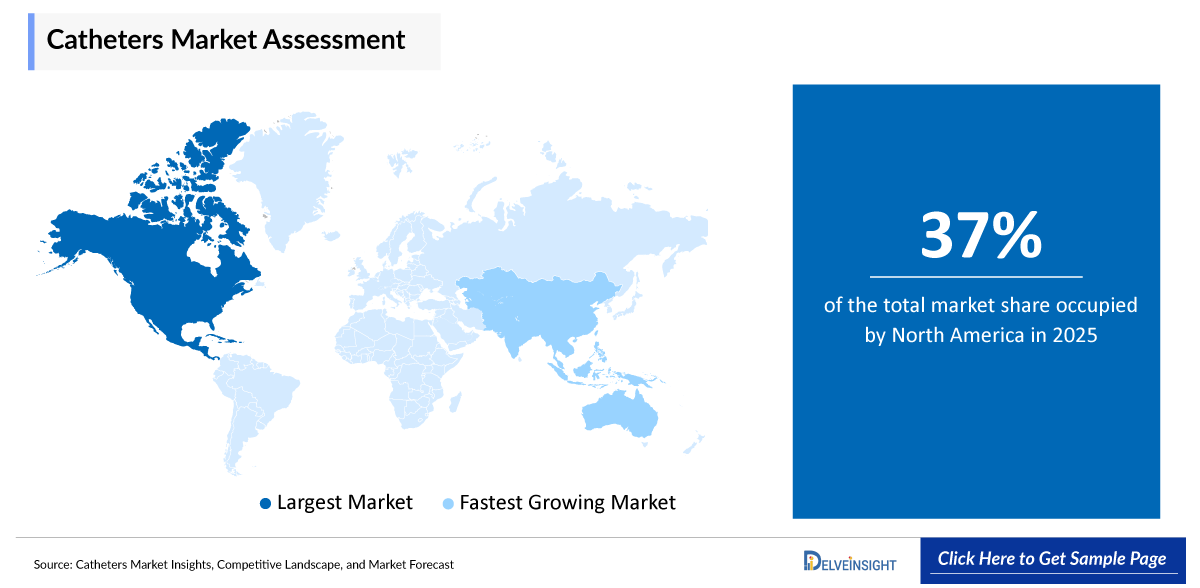
- North America dominated the global Catheters market revenue with a 37% share in 2025, representing the highest regional market share globally.
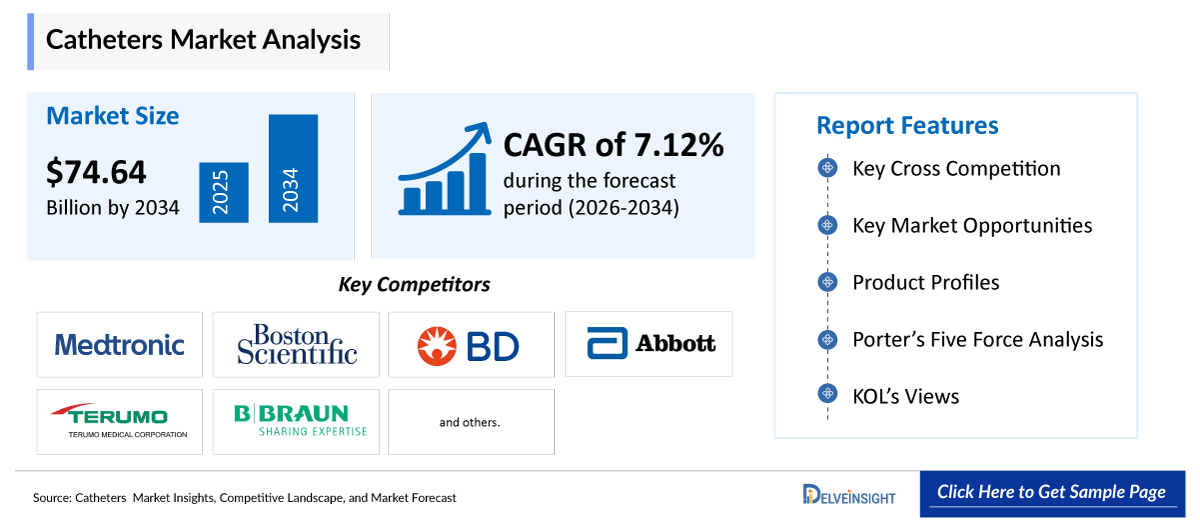
A catheter is a thin, flexible medical tube inserted into the body to deliver or remove fluids, administer medications, or provide diagnostic and therapeutic access to blood vessels, organs, and body cavities. Catheters are indispensable across cardiovascular intervention, urological management, intravenous therapy, and neurovascular procedures, and are manufactured under stringent regulatory and biocompatibility standards given their direct, often prolonged, contact with patient tissue and the bloodstream.
The market is organized by product type across cardiovascular, urological, intravenous (IV), and neurovascular catheters and others; by material, including polyurethane, silicone, PVC, and polyethylene; by catheter design across single-lumen, double-lumen, triple-lumen, and multi-lumen configurations; by tip type across straight-tip, curved-tip, and angled-tip catheters; and by end-user, led by hospitals, ambulatory surgical centers, and specialty clinics. Driven by the rising prevalence of chronic and cardiovascular disease, the growing preference for minimally invasive interventions, an aging global population, and continuous advancement in antimicrobial and biocompatible catheter technologies, catheters have become foundational infrastructure underpinning modern diagnostic and interventional healthcare delivery.
Catheters Market Key Growth Drivers
- The rising global burden of cardiovascular disease, urological disorders, and chronic kidney disease is expanding demand for diagnostic and therapeutic catheterization across hospitals and specialty care settings.
- The growing clinical and patient preference for minimally invasive, catheter-based procedures over open surgery is accelerating adoption across cardiology, urology, and neurovascular care.
- An aging global population with higher rates of urinary incontinence, vascular disease, and long-term venous access needs is sustaining recurring catheter demand.
- Continuous innovation in antimicrobial and hydrophilic coatings, and in biocompatible materials such as polyurethane and silicone, is reducing catheter-associated infections and improving clinical outcomes.
- Rapid expansion of pulsed-field ablation (PFA) and electrophysiology catheter platforms from Medtronic, Boston Scientific, and Abbott is broadening the interventional cardiology catheter segment.
- Expanding ambulatory surgical center infrastructure and rising outpatient procedure volumes are increasing accessibility and driving incremental catheter demand outside traditional hospital settings.
- Growing home healthcare adoption and self-catheterization awareness, particularly in urology, are expanding the addressable market beyond acute-care settings.
Key Companies in Catheters Market
The competitive landscape is led by the following active manufacturers:
- Medtronic
- Boston Scientific
- BD (Becton, Dickinson and Company)
- Teleflex
- Abbott
- Terumo Corporation
- B. Braun
- Cook Medical
- Edwards Lifesciences
- Coloplast, and others
For illustrative purposes, only the top 10 companies are listed in the Table of Contents. The report may include analysis and references to additional companies relevant to the market assessment.
Catheters Market Size
The following snapshot summarizes the principal report metrics for the Catheters market.
|
Report Metrics |
Details |
|
2025 Market Size |
USD 40.3 billion |
|
2034 Projected Market Size |
USD 74.64 billion |
|
Growth Rate (2026-2034) |
7.12% CAGR |
|
Largest Market |
North America |
|
Fastest Growing Market |
Asia-Pacific |
|
Market Structure |
Moderately Consolidated |
All market values are expressed in USD and represent DelveInsight estimates synthesized from primary and secondary research.
Factors Contributing to the Growth of the Catheters Market
Catheters Market Drivers
- Rising Global Burden of Cardiovascular and Chronic Disease: The most powerful driver of the Catheters market is the escalating global burden of cardiovascular disease, chronic kidney disease, and urological disorders. Cardiovascular catheters are central to the diagnosis and treatment of coronary artery disease, arrhythmias, and structural heart conditions, and rising rates of hypertension, diabetes, and obesity are expanding the patient pool requiring catheter-based intervention. As cardiovascular procedure volumes climb worldwide and rising rates of end-stage renal disease drive greater use of hemodialysis and central venous catheters, demand for both diagnostic and therapeutic catheter platforms rises directly, anchoring market growth through 2034.
- Growing Preference for Minimally Invasive Procedures: A structural shift toward minimally invasive, catheter-based interventions over open surgery is a central growth engine for the market. Catheter-based angioplasty, ablation, and structural heart procedures offer shorter recovery times, fewer complications, and reduced hospital stays compared with traditional surgery, driving strong clinical and patient preference. Advances in catheter navigation, imaging integration, and pulsed-field ablation technology from leading manufacturers are expanding the range of conditions treatable through catheter-based approaches, sustaining strong procedure growth and recurring device demand across cardiology, urology, and neurovascular care.
- Aging Population and Rising Chronic Care Needs: The global aging population is expanding demand for long-term vascular access, urinary management, and interventional cardiovascular care. Elderly patients experience disproportionately higher rates of urinary incontinence, neurogenic bladder, vascular disease, and the need for long-term venous access for medication and nutrition delivery. As life expectancy rises across developed and emerging markets alike, the population requiring intermittent, indwelling, and specialty catheters expands correspondingly, translating into sustained demand for both hospital-based and home-care catheter products across the forecast period.
- Technological Innovation in Materials and Coatings: Continuous innovation in catheter materials and coatings is improving clinical outcomes and expanding adoption. Antimicrobial and hydrophilic coatings reduce catheter-associated infections and improve patient comfort, while advances in polyurethane and silicone formulations improve flexibility, biocompatibility, and kink resistance. Manufacturers are increasingly focused on infection-resistant technologies given the clinical and cost burden of catheter-related bloodstream and urinary tract infections, and these innovations are becoming key differentiators that drive premiumization and replacement demand across the product portfolio.
- Expansion of Electrophysiology and Pulsed-Field Ablation Platforms: Rapid commercial expansion of pulsed-field ablation (PFA) and electrophysiology catheter platforms is a significant emerging driver. Medtronic's Affera Sphere-9 and Sphere-360 catheters, Boston Scientific's FARAWAVE and FARAPULSE platforms, and Abbott's Volt PFA system have each secured regulatory approvals and are driving strong double-digit growth in catheter-based atrial fibrillation treatment. As adoption of PFA technology broadens beyond early-adopter centers and competitive intensity among leading manufacturers increases, the specialty cardiovascular catheter segment is expected to expand rapidly through the forecast period.
- Expanding Ambulatory Surgical Center and Home Healthcare Infrastructure: The expansion of ambulatory surgical centers and home healthcare infrastructure is broadening the settings in which catheter-based care is delivered. Ambulatory surgical centers increasingly perform diagnostic and interventional catheter procedures previously confined to hospitals, improving cost efficiency and patient access. At the same time, growing awareness of self-catheterization and expanding home-based dialysis and urinary management support are shifting a portion of demand toward outpatient and home settings, widening the addressable market for intermittent and specialty catheter products.
Catheters Market Restraints
Despite strong momentum, the Catheters market faces material constraints. Catheter-associated infections and complications, including catheter-related bloodstream infections and urinary tract infections, remain a persistent clinical and cost burden that can limit prolonged catheter use and drive procedural caution. Stringent and evolving regulatory requirements across major markets lengthen product approval timelines and raise compliance costs, particularly for advanced electrophysiology and structural heart catheters. Reimbursement constraints and pricing pressure in cost-sensitive healthcare systems can slow adoption of premium, coated, or specialty catheter products. Product recalls and safety concerns tied to catheter fracture, migration, or material degradation can undermine clinician confidence and trigger costly corrective actions. The availability of skilled interventionalists and specialized nursing staff to place and manage advanced catheters is limited in many emerging markets, constraining procedure volumes. High costs associated with advanced, coated, and multi-lumen catheter technologies can restrict adoption in price-sensitive and lower-income regions. Together, these clinical, regulatory, reimbursement, and workforce barriers temper the pace of growth, even as the underlying drivers of chronic disease burden, minimally invasive adoption, and material innovation remain firmly intact.
Catheters Market Segment Analysis
The catheters market by product type (cardiovascular catheters, urological catheters, intravenous (iv) catheters, neurovascular catheters, and others), material (polyurethane, silicone, pvc, polyethylene, and others), catheter design (single-lumen catheters, double-lumen catheters, triple-lumen catheters, and multi-lumen catheters), tip type (straight-tip catheters, curved-tip catheters, angled-tip catheters, and others), end-users (hospitals, ambulatory surgical centers, specialty clinics, and others), and geography (North America, Europe, Asia-Pacific, and Rest of World).
By Product Type
Dominant Subsegment: Cardiovascular Catheters.
The cardiovascular catheters segment accounted for 37% of the Catheters market in 2025. Cardiovascular catheters lead the market because they underpin the diagnosis and treatment of coronary artery disease, arrhythmias, and structural heart conditions, which together represent one of the largest and most procedure-intensive areas of modern medicine. High-volume interventional cardiology procedures, including angioplasty, stenting, and electrophysiology ablation, depend on a broad portfolio of guiding, diagnostic, and therapeutic catheters, and the rapid commercial rollout of pulsed-field ablation platforms from Medtronic, Boston Scientific, and Abbott is reinforcing segment demand. The rising global prevalence of cardiovascular disease, combined with an aging population and growing preference for minimally invasive intervention over open-heart surgery, sustains great and dependable demand for cardiovascular catheter manufacturing. While neurovascular catheters are the fastest-growing product type, propelled by expanding stroke-intervention volumes, the scale, procedure frequency, and technological depth of cardiovascular catheterization secure the segment's leadership across the forecast period.
By Material
Dominant Subsegment: Polyurethane.
The polyurethane segment accounted for 50% of the Catheters market in 2025. Polyurethane is the leading material because it offers an optimal balance of flexibility, strength, biocompatibility, and kink resistance, making it the material of choice across central venous, cardiovascular, and urological catheter platforms. Polyurethane catheters soften at body temperature, improving patient comfort during prolonged indwelling use, while maintaining the mechanical integrity required for navigation through the vasculature. These properties have made polyurethane the standard substrate for a wide range of diagnostic and therapeutic catheters, and continued advances in polyurethane formulations, including antimicrobial and hydrophilic surface treatments, are reinforcing its dominant position. Silicone remains preferred for long-term indwelling and highly flexible applications given its superior biocompatibility, and PVC and polyethylene continue to serve cost-sensitive, shorter-term applications, but the breadth of clinical use cases and continuous formulation innovation secure polyurethane's leadership across the forecast period.
By Catheter Design
Dominant Subsegment: Single-Lumen Catheters.
The single-lumen catheters segment accounted for 41% of the Catheters market in 2025. Single-lumen catheters lead the market because they are the simplest, most widely used configuration across routine intravenous access, urinary drainage, and short-term diagnostic procedures, offering lower cost and ease of use relative to multi-lumen alternatives. Their high-volume use in peripheral IV therapy, basic urological catheterization, and diagnostic angiography across hospitals and ambulatory settings underpins great and recurring demand. Multi-lumen and triple-lumen catheters, by contrast, are increasingly favored for complex critical-care and hemodialysis applications requiring simultaneous fluid administration, medication delivery, and monitoring, and are consequently the fastest-growing design category as critical-care and oncology infusion needs expand. Nonetheless, the sheer procedural frequency and cost efficiency of single-lumen catheters secure their leadership across the forecast period.
By Tip Type
Dominant Subsegment: Straight-Tip Catheters.
The straight-tip catheters segment accounted for 44% of the Catheters market in 2025. Straight-tip catheters lead the market because they are the standard configuration for routine vascular access, urinary drainage, and diagnostic procedures where direct, unobstructed navigation is sufficient. Their simple design, lower manufacturing cost, and broad compatibility with standard insertion techniques make them the default choice across high-volume clinical settings. Curved-tip and angled-tip catheters are gaining share in complex interventional cardiology, neurovascular, and selective catheterization procedures that require precise vessel navigation and access to tortuous anatomy, positioning angled-tip catheters as the fastest-growing tip-type category. Even so, the scale of routine catheterization procedures secures the leadership of straight-tip designs across the forecast period.
By End-Users
Dominant Subsegment: Hospitals.
The hospitals segment accounted for 54% of the catheter market in 2025. Hospitals lead the market because they remain the primary setting for both diagnostic and therapeutic catheter-based procedures, ranging from routine intravenous access to complex cardiovascular, neurovascular, and urological interventions requiring specialized equipment and multidisciplinary clinical teams. The concentration of interventional cardiology suites, cardiac catheterization labs, and critical-care units within hospitals drives sustained high-volume catheter consumption. Ambulatory surgical centers are the fastest-growing end-user segment as a growing share of diagnostic angiography, urological, and lower-acuity interventional procedures shifts to outpatient settings that offer cost efficiency and shorter recovery pathways. Specialty clinics continue to support dialysis and urology-focused catheter use. Nonetheless, the breadth and complexity of hospital-based interventional care secure the segment's leadership across the forecast period.
Catheters Market Region Analysis
Dominant Region: North America
North America accounted for 37% of the global Catheters market revenue in 2025, representing the highest regional market share globally. The region's dominance reflects a mature and well-established healthcare infrastructure, a high burden of cardiovascular, urological, and chronic kidney disease, and the presence of leading global manufacturers including Medtronic, Boston Scientific, BD, Teleflex, Abbott, and Edwards Lifesciences headquartered in the United States. North America hosts the largest concentration of interventional cardiology and electrophysiology procedure volumes, and the rapid commercial rollout of pulsed-field ablation catheter platforms is reinforcing procedural demand. Supportive reimbursement frameworks, clear FDA regulatory pathways, and rapid adoption of innovative technologies such as antimicrobial-coated and intravascular imaging catheters further strengthen the region's leadership. Continued investment in ambulatory surgical center infrastructure and home-based catheter care solutions is expected to sustain North America's leading position across the forecast period.
Fastest Growing Region: Asia-Pacific
Asia-Pacific is the fastest-growing region in the Catheters market. The region's elevated CAGR is driven by a large and expanding patient base, rapid healthcare infrastructure development, and rising healthcare spending across China, Japan, India, South Korea, and Australia. China is expanding cardiac catheterization and interventional cardiology capacity, Japan is advancing adoption of minimally invasive and electrophysiology technologies, and India is emerging as a high-growth market on the strength of a large diabetic and cardiovascular disease population combined with improving hospital infrastructure and healthcare access. Rising government healthcare investment, expanding insurance coverage, and growing awareness of minimally invasive treatment options are accelerating adoption, while multinational manufacturers continue to expand regional manufacturing and distribution footprints. The combination of high disease burden, infrastructure build-out, and improving healthcare access positions Asia-Pacific as the principal source of incremental growth over the forecast period.
Catheters Market Regional Commentary
North America
North America accounted for 37% of the global Catheters market revenue in 2025. The United States dominates on the strength of its mature healthcare infrastructure, high chronic and cardiovascular disease burden, presence of leading global manufacturers, and clear FDA regulatory pathways, while rapid adoption of pulsed-field ablation and antimicrobial-coated catheter technologies reinforces its leadership.
Europe
Europe is a large and advanced regional market, supported by strong healthcare systems, established EMA regulatory frameworks, and a significant presence of leading manufacturers including B. Braun and Coloplast, headquartered in Germany and Denmark, respectively. Growing adoption of home healthcare and self-catheterization solutions across Germany, France, the United Kingdom, Italy, and Spain continues to reinforce the region's role in both diagnostic and therapeutic catheter demand.
Asia-Pacific
Asia-Pacific is the fastest-growing region, propelled by a large patient population, rapid healthcare infrastructure build-out, and growing healthcare investment across China, Japan, India, South Korea, and Australia. Expanding interventional cardiology capacity, rising insurance coverage, and improving access to minimally invasive treatment are accelerating regional catheter adoption and manufacturing investment.
Rest of World
The Rest of World region, spanning Latin America, the Middle East, and Africa, is an emerging growth frontier. Expanding healthcare infrastructure, rising prevalence of cardiovascular and chronic kidney disease, and growing government investment in diagnostic and interventional care are gradually broadening access, while international manufacturers extend distribution networks and local partnerships to support regional capacity.
Catheters Market Competitive Landscape
The Catheters market is classified as Moderately Consolidated. A group of large, diversified medical device manufacturers with broad catheter portfolios and global distribution networks, including Medtronic, Boston Scientific, BD, and Abbott, secures large hospital and health-system contracts and anchors the top tier, while specialized and fast-scaling providers such as Teleflex, Terumo Corporation, B. Braun, Cook Medical, Edwards Lifesciences, and Coloplast compete through focused product innovation, regional manufacturing strength, and deep clinical relationships in cardiovascular, urological, and vascular access catheters, increasing competition across the fastest-growing product segments.
The competitive landscape can be evaluated across the following dimensions:
- Market concentration: Moderately consolidated, with large diversified manufacturers leading and a strong field of specialized catheter providers.
- Leading players: Medtronic, Boston Scientific, BD, and Abbott anchor the top tier through broad catheter portfolios and global distribution scale.
- Geographic reach: Leaders operate global manufacturing and distribution networks spanning North America, Europe, and Asia-Pacific, supporting rapid regional market access.
- Product portfolio strength: Top players offer end-to-end catheter portfolios spanning cardiovascular, urological, IV, and neurovascular applications with advanced coating and design technologies.
- Technology access: Ownership of pulsed-field ablation, electrophysiology mapping, and antimicrobial coating technologies is a decisive competitive advantage.
- Strategic partnerships: Collaborations between manufacturers, such as Medtronic's sensor integration partnership with Abbott, extend product reach and clinical capability.
- M&A and expansion activity: Active bolt-on acquisitions and manufacturing capacity expansion, including Teleflex's interventional and vascular access acquisitions and Boston Scientific's structural heart and catheter manufacturing investments, strengthen competitive positioning.
- Manufacturing capabilities: Advanced polymer processing, precision extrusion, and cleanroom manufacturing facilities are key competitive moats.
- Innovation focus: Pulsed-field ablation catheters, antimicrobial and hydrophilic coatings, miniaturized and steerable designs, and home-care-oriented urinary catheters define the current innovation frontier.
Catheters Market Recent Developmental Activities
- In 2026, Teleflex Incorporated completed a bolt-on acquisition to strengthen its interventional and vascular access product offerings, including catheter-based solutions.
- Strategic significance: Expands Teleflex's vascular access catheter portfolio and reinforces its position among leading interventional device providers.
- In 2026, Abbott received FDA approval for its Volt pulsed field ablation catheter system, indicated for both paroxysmal and persistent atrial fibrillation.
- Strategic significance: Allows Abbott to compete directly with Medtronic and Boston Scientific in the fast-growing pulsed-field ablation catheter segment.
- In 2026, Medtronic reported continued global adoption momentum for its Affera Sphere-9 and Sphere-360 mapping and ablation catheters, including expanded CE Mark approval and U.S. IDE first cases for Sphere-360 in paroxysmal atrial fibrillation.
- Strategic significance: Strengthens Medtronic's electrophysiology catheter platform and broadens its addressable pulsed-field ablation opportunity.
- In 2025, Edwards Lifesciences received FDA approval for its Sapien 3 transcatheter aortic valve replacement (TAVR) platform.
- Strategic significance: Reinforces Edwards Lifesciences' leadership in structural heart catheter-delivered therapies.
- In May 2025, Boston Scientific Corporation launched the Sterling SL PTA Balloon Dilatation Catheter, a high-performance balloon dilatation catheter for peripheral angioplasty below the knee, in the United States and Europe.
- Strategic significance: Expands Boston Scientific's peripheral vascular catheter portfolio and strengthens its position in below-the-knee angioplasty.
- In October 2024, Boston Scientific Corporation received FDA approval for its FARAWAVE NAV Ablation Catheter, a navigation-enabled pulsed-field ablation system.
- Strategic significance: Strengthens Boston Scientific's electrophysiology catheter platform and its position in the atrial fibrillation treatment market.
- In February 2024, Boston Scientific Corporation invested in expanded catheter and structural heart device manufacturing capabilities at its local production plants.
- Strategic significance: Increases global manufacturing capacity to support rising demand for cardiovascular and structural heart catheters.
- In 2024, Teleflex Incorporated launched a new range of hydrophilic-coated intermittent catheters, with early adoption concentrated in European hospitals focused on reducing infection rates.
- Strategic significance: Strengthens Teleflex's urology catheter portfolio and addresses growing demand for infection-resistant coating technology.
- In 2024, Coloplast introduced a redesigned urinary catheter line aimed at home healthcare, targeting the aging population across Europe and North America.
- Strategic significance: Expands Coloplast's home-care urology catheter offering and strengthens its position in self-catheterization solutions.
- In 2024, B. Braun released an innovative intravenous catheter with improved safety features designed to reduce needlestick injury and improve clinical handling.
- Strategic significance: Strengthens B. Braun's IV catheter portfolio and reinforces its focus on clinician and patient safety.
Catheters Market Segmentation
- Catheters Market by Product Type
- Cardiovascular Catheters
- Urological Catheters
- Intravenous (IV) Catheters
- Neurovascular Catheters
- Others
- Catheters Market by Material
- Polyurethane
- Silicone
- PVC
- Polyethylene
- Others
- Catheters Market by Catheter Design
- Single-Lumen Catheters
- Double-Lumen Catheters
- Triple-Lumen Catheters
- Multi-Lumen Catheters
- Catheters Market by Tip Type
- Straight-Tip Catheters
- Curved-Tip Catheters
- Angled-Tip Catheters
- Others
- Catheters Market by End-Users
- Hospitals
- Ambulatory Surgical Centers
- Specialty Clinics
- Others
Catheters Market by Geography
- North America Catheters Market
- United States Catheters Market Size in USD million (2023-2034)
- Canada Catheters Market Size in USD million (2023-2034)
- Mexico Catheters Market Size in USD million (2023-2034)
- Europe Catheters Market
- Germany Catheters Market Size in USD million (2023-2034)
- United Kingdom Catheters Market Size in USD million (2023-2034)
- France Catheters Market Size in USD million (2023-2034)
- Italy Catheters Market Size in USD million (2023-2034)
- Spain Catheters Market Size in USD million (2023-2034)
- Rest of Europe Catheters Market Size in USD million (2023-2034)
- Asia-Pacific Catheters Market
- China Catheters Market Size in USD million (2023-2034)
- Japan Catheters Market Size in USD million (2023-2034)
- India Catheters Market Size in USD million (2023-2034)
- Australia Catheters Market Size in USD million (2023-2034)
- South Korea Catheters Market Size in USD million (2023-2034)
- Rest of Asia-Pacific Catheters Market Size in USD million (2023-2034)
- Rest of the World (RoW) Catheters Market
- Middle East Catheters Market Size in USD million (2023-2034)
- Africa Catheters Market Size in USD million (2023-2034)
- South America Catheters Market Size in USD million (2023-2034)
Catheters Market Recent Industry Trends and Milestones (2023-2026):
|
Category |
Key Developments |
|
Catheters Market Product Approval |
Regulatory momentum is expanding commercial demand across cardiovascular and electrophysiology catheters. Abbott received FDA approval for its Volt pulsed-field ablation catheter, Medtronic advanced its Affera Sphere-9 and Sphere-360 platforms with expanded CE Mark and U.S. IDE approvals, and Boston Scientific secured FDA approval for its FARAWAVE NAV ablation catheter and launched the Sterling SL PTA balloon dilatation catheter. Edwards Lifesciences received FDA approval for its Sapien 3 TAVR platform. Each approval creates durable, recurring demand for compliant manufacturing and reliable supply across the interventional catheter value chain. |
|
Catheters Market Expansion |
Manufacturers broadened capacity and capability across the value chain. Boston Scientific invested in expanded catheter and structural heart manufacturing capacity, Teleflex completed a bolt-on acquisition strengthening its interventional and vascular access portfolio, Teleflex launched hydrophilic-coated intermittent catheters, Coloplast introduced a redesigned home-care urinary catheter line, and B. Braun released a safety-enhanced intravenous catheter. Decentralized, regionally distributed manufacturing and infection-resistant coating technology continued to expand across the industry. |
|
Catheters Market Investment |
Capital investment concentrated on pulsed-field ablation and electrophysiology catheter platforms, structural heart catheter-delivered therapies, and home-care urology solutions. Leading manufacturers including Medtronic, Boston Scientific, and Abbott expanded manufacturing capacity and R&D investment to support rapid commercial growth in pulsed-field ablation, while Teleflex and other mid-sized players pursued bolt-on acquisitions to strengthen vascular access and interventional portfolios. |
|
Company Strategy |
Medtronic: Electrophysiology and pulsed-field ablation leadership through the Affera platform. Boston Scientific: Broad cardiovascular catheter portfolio expansion and structural heart manufacturing investment. BD: Vascular access and infusion therapy catheter breadth. Teleflex: Interventional and vascular access portfolio expansion through bolt-on acquisitions and coated intermittent catheter launches. Abbott: Pulsed-field ablation market entry through Volt system approval. Terumo Corporation: Interventional cardiology and vascular access catheter innovation. B. Braun: Safety-enhanced intravenous catheter technology. Cook Medical: Specialty and minimally invasive catheter solutions. Edwards Lifesciences: Structural heart catheter-delivered therapy leadership through Sapien 3. Coloplast: Home-care urology catheter innovation. |
|
Emerging Technologies |
Pulsed-field ablation is the leading edge of innovation, with Medtronic, Boston Scientific, and Abbott each commercializing competing platforms and reporting rapid adoption growth. Antimicrobial and hydrophilic coatings, miniaturized and steerable catheter designs, and sensor-integrated navigation are addressing infection risk and procedural precision, while growing home-care and self-catheterization adoption is expanding urology catheter innovation. Collaborations between manufacturers, such as Medtronic's sensor-integration partnership with Abbott, are accelerating cross-platform technology development. |
Catheters Market Startup Funding and Investment Trends
Investment in the catheter ecosystem has increasingly concentrated on advanced materials, minimally invasive delivery technologies, infection prevention, and next-generation catheter platforms designed to improve patient safety and procedural outcomes. Capital and strategic investment are flowing toward companies developing specialized catheter technologies for cardiovascular, neurovascular, urological, electrophysiology, and peripheral vascular applications, with increasing emphasis on drug-eluting, antimicrobial, steerable, and sensor-enabled catheter systems.
|
Company |
Total Funding |
Funding Stage |
Main Offering |
Core Technology |
|
RapidPulse |
$48M |
Series B |
Cyclic Aspiration Catheter |
Pulsed/cyclic aspiration catheter technology for mechanical thrombectomy and removal of ischemic-stroke clots. The 2026 round was oversubscribed and supports the TURBO IDE study and catheter platform development. |
|
Request for unlocking the report of the @ Catheters Market Insights | ||||
Strategic transactions and product investments by established medical device manufacturers, including Medtronic, Boston Scientific, Abbott, Becton Dickinson, and Terumo, highlight the continued value of expanding catheter portfolios through differentiated technologies and complementary minimally invasive platforms. At the same time, emerging companies are attracting investment by developing highly specialized catheter technologies, including steerable and robotic-assisted systems, advanced ablation catheters, intravascular imaging-enabled catheters, and antimicrobial catheter solutions. Collectively, these investments signal strong industry conviction that technological differentiation, minimally invasive procedures, advanced materials, and catheter-enabled precision intervention will define the next phase of competitive advantage in the global catheters market.
Key Takeaways from the Catheters Market Report Study
- Market size analysis for the current Catheters market size (2025), and market forecast for 9 years (2026 to 2034).
- Top key product/technology developments, mergers, acquisitions, partnerships, and joint ventures that happened over the last 3 years.
- Key companies dominating the global Catheters market.
- Various opportunities available for competitors in the Catheters market space.
- What are the top-performing segments in 2025? How will these segments perform in 2034?
- Which are the top-performing regions and countries in the current Catheters market scenario?
- Which are the regions and countries where companies should concentrate their opportunities for Catheters market growth in the future?
Target audience who can benefit from this Catheters market report study
- Catheters product providers
- Research organizations and consulting companies
- Neurodegenerative disease therapeutics-related organizations, associations, forums, and other alliances
- Government and corporate offices
- Start-up companies, venture capitalists, and private equity firms
- Distributors and traders dealing in Catheters
- Various end-users who want to know more about the Catheters market and the latest technological developments in the Catheters market.