charcot marie tooth disease epidemiology forecast insight
Charcot–Marie–Tooth (CMT) Disease Insights and Trends
- According to published epidemiological studies, CMT Disease is the most common inherited peripheral neuropathy, with an estimated prevalence of approximately 1 in 2,500 individuals worldwide.
- CMT Disease affects approximately 2.6–3 million people globally, highlighting the significant worldwide burden of inherited neuropathies.
- The estimated prevalence of CMT disease ranges from approximately ~9–28 cases per 100,000 population, with variability observed across different geographic regions and study methodologies.
Charcot–Marie–Tooth (CMT) Disease Epidemiology Forecast in the 7MM
- 2025 Prevalent Cases of Charcot–Marie–Tooth (CMT) Disease: ~XX
- 2036 Projected Prevalent Cases of Charcot–Marie–Tooth (CMT) Disease : ~XX
- Charcot–Marie–Tooth (CMT) Disease Growth Rate (2026–2036): XX% CAGR
DelveInsight's ‘CMT Disease – Epidemiology Forecast – 2036’ report delivers an in-depth understanding of the CMT disease, historical and forecasted epidemiology, in the United States, EU4 (Germany, Spain, Italy, and France) and the United Kingdom, and Japan.
|
Study Period
|
2022–2036
|
|
Historical Year
|
2022–2025
|
|
Forecast Period
|
2026–2036
|
|
Base Year
|
2026
|
|
Geographies Covered
|
- North America : The US;
- Europe: Germany, France, Italy, Spain and the UK;
- Asia-Pacific: Japan
|
|
CMT Disease Epidemiology CAGR
(Forecast period)
|
XX% (2026–2036)
|
|
CMT Disease Epidemiology Segmentation Analysis
|
Patient Burden Assessment
- Total Prevalent Cases of CMT Disease
- Total Diagnosed Prevalent Cases of CMT Disease
- Gender-specific Diagnosed Prevalent Cases of CMT Disease
- Age-specific Diagnosed Prevalent Cases of CMT Disease
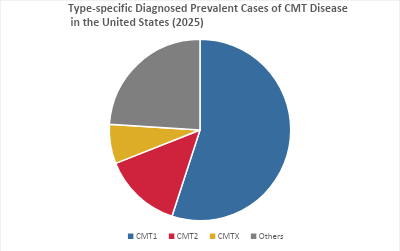
- Type-specific Diagnosed Prevalent Cases of CMT Disease
- Total Treated Cases of CMT Diseases
|
Charcot–Marie–Tooth (CMT) Disease Understanding and Diagnosis Algorithm
Charcot–Marie–Tooth (CMT) Disease Overview and Diagnosis
CMT disease is a group of inherited peripheral neuropathies characterized by progressive degeneration of peripheral nerves, leading to distal muscle weakness, sensory loss, and impaired motor function. Diagnosis of CMT disease is primarily based on a combination of clinical evaluation, family history, neurological examination, electrophysiological studies, and genetic testing. Patients commonly present with distal muscle weakness, sensory deficits, foot deformities, steppage gait, and reduced or absent deep tendon reflexes.
Further details are provided in the report.
Charcot–Marie–Tooth (CMT) Disease Diagnosis
Diagnosis of CMT disease is based on clinical evaluation, family history, neurological examination, electrophysiological studies, and genetic testing. Common clinical findings include distal muscle weakness, reduced tendon reflexes, sensory impairment, and gait dysfunction. NCS and electromyography (EMG) help differentiate demyelinating and axonal subtypes, while molecular genetic testing confirms the underlying mutation and supports subtype classification. Increasing adoption of NGS and molecular diagnostics is improving early and accurate diagnosis of CMT disease.
Further details are provided in the report.
Charcot–Marie–Tooth (CMT) Disease Epidemiology
Key Findings from Charcot–Marie–Tooth (CMT) Disease Epidemiological Analysis and Forecast
- According to the secondary analysis, the estimated prevalence of CMT disease ranges from approximately 9–28 per 100,000 population worldwide.
- According to the Charcot Marie Tooth Association, CMT disease affects more than 3 million people globally.
- CMT disease is the most common inherited neuropathy, with an estimated prevalence ranging from 1 in 1,500 to 1 in 10,000 individuals in France.
- As per secondary analysis, CMT1A accounts for approximately 60–70% of all CMT disease cases and is caused by a duplication on chromosome 17p11.2, resulting in overexpression of the Peripheral Myelin Protein 22 (PMP22) gene.
- CMT disease is generally considered a rare disease; however, epidemiological surveys conducted in Europe and the United States have reported a prevalence of approximately 1 per 2,500 people, while in Japan, it is around 1 per 10,000 people.
- CMT disease affects an estimated 1 in 2,500 people in the United States. Although CMT disease is classified as a rare disease (affecting fewer than 200,000 people in the US), experts believe the actual number of affected individuals may be significantly higher. Globally, an estimated 2.6 million people are affected by CMT disease.
Scope of the Report
- The report covers a segment of a descriptive overview of hand eczema, explaining their causes, signs and symptoms, and pathogenesis.
- Comprehensive insight has been provided into the epidemiology segments and forecasts, the future growth potential of the diagnosis rate, and disease progression.
Report Insights
Charcot–Marie–Tooth (CMT) Disease Patient Population Forecast
Report Key Strengths
- Epidemiology‑based (Epi‑based) Bottom‑up Forecasting
- 11-year Forecast
- Patient Burden Trends (by geography)
FAQs
- What are the disease risks, burdens, and unmet needs of hand eczema? What will be the growth opportunities across the 7MM concerning the patient population with hand eczema?
- What is the historical and forecasted hand eczema patient pool in the US, EU4 (Germany, France, Italy, and Spain), the UK, and Japan?
Reasons to Buy
- Insights on patient burden/disease prevalence, evolution in diagnosis, and factors contributing to the change in the epidemiology of the disease during the forecast years.
- To understand key opinion leaders’ perspectives around the diagnostic challenges to overcome barriers in the future.
- Detailed insights on various factors hampering disease diagnosis and other existing diagnostic challenges.
1 Key Insights
2 Report Introduction
3 Executive Summary
4 Epidemiology Forecast Methodology
5 Charcot–Marie–Tooth (CMT) Disease Epidemiology Overview at a Glance
5.1 Patient Share (%) Distribution by Country in 2025 in the 7MM
5.2 Patient Share (%) Distribution by Country in 2036 in the 7MM
6 Disease Background And Overview of Charcot–Marie–Tooth (CMT) Disease
6.1 Introduction
6.2 Causes
6.3 Diagnosis
6.3.1 Diagnostic Guidelines
6.3.2 Diagnostic Algorithm
7 Epidemiology and Patient Population of Charcot–Marie–Tooth (CMT) Disease
7.1 Key Findings
7.2 Assumptions and Rationale: The 7MM
7.2.1 Total Diagnosed Prevalent Cases of CMT disease in the 7MM
7.3 The United States
7.3.1 Total Prevalent Cases of CMT Disease in the United States
7.3.2 Total Diagnosed Prevalent Cases of CMT Disease in the United States
7.3.3 Gender-specific Diagnosed Prevalent Cases of CMT Disease in the United States
7.3.4 Type-specific Diagnosed Prevalent Cases of CMT Disease in the United States
7.3.5 Age-specific Diagnosed Prevalent Cases of CMT Disease in the United States
7.3.6 Total Treated Cases of CMT Disease in the United States
7.4 EU4 and the UK
7.4.1 Total Prevalent Cases of CMT Disease in EU and the UK
7.4.2 Total Diagnosed Prevalent Cases of CMT Disease in EU and the UK
7..4.3 Gender-specific Diagnosed Prevalent Cases of CMT Disease in EU and the UK
7.4.4 Type-specific Diagnosed Prevalent Cases of CMT Disease in EU and the UK
7.4.5 Age-specific Diagnosed Prevalent Cases of CMT Disease in EU and the UK
7.4.6 Total Treated Cases of CMT Disease in EU and the UK
7.5 Japan
7.5.1 Total Prevalent Cases of CMT Disease in Japan
7.5.2 Total Diagnosed Prevalent Cases of CMT Disease in Japan
7.5.3 Gender-specific Diagnosed Prevalent Cases of CMT Disease in Japan
7.5.4 Type-specific Diagnosed Prevalent Cases of CMT Disease in Japan
7.5.5 Age-specific Diagnosed Prevalent Cases of CMT Disease in Japan
7.5.6 Total Treated Cases of CMT Disease in Japan
8 KOL Views of Charcot–Marie–Tooth (CMT) Disease
9 Appendix
9.1 Bibliography
9.2 Report Methodology
10 DelveInsight Capabilities
11 Disclaimer
12 About DelveInsight
List of Tables:
List of Table
Table 1: Summary of Charcot–Marie–Tooth Disease, Epidemiology, and Key Events (2022-2036)
Table 2: Key Events
Table 3: Classification and Genetics of CMT Disease
Table 4: Multidisciplinary Members and Roles in the Diagnosis and Management of CMT
Table 5: Molecular Diagnostic Methods to Detect CMT1A Duplication/HNPP Deletion
Table 6: Summary of CMT Classification, Including Clinical Data (Such as Electrophysiological Results) and Molecular Findings
Table 7: Total Prevalent Cases of Charcot–Marie–Tooth Disease in the 7MM (2022-2036)
Table 8: Total Diagnosed Prevalent Cases of Charcot–Marie–Tooth Disease in the 7MM (2022-2036)
Table 9: Total Prevalent Cases of Charcot–Marie–Tooth Disease in the United States (2022-2036)
Table 10: Diagnosed Prevalent Cases of Charcot–Marie–Tooth Disease in the US (2022-2036)
Table 11: Gender-specific Diagnosed Prevalent Cases of Charcot–Marie–Tooth Disease in the US (2022-2036)
Table 12: Type-specific Diagnosed Prevalent Cases of Charcot–Marie–Tooth Disease in the US (2022-2036)
Table 13: Age-specific Diagnosed Prevalent Cases of Charcot–Marie–Tooth Disease in the US (2022-2036)
Table 14: Prevalent Cases of Charcot–Marie–Tooth Disease in EU-5 (2022-2036)
Table 15: Diagnosed Prevalent Cases of Charcot–Marie–Tooth Disease in EU-5 (2022-2036)
Table 16: Gender-specific Diagnosed Prevalent Cases of Charcot–Marie–Tooth Disease in EU-5 (2022-2036)
Table 17: Type-specific Diagnosed Prevalent Cases of Charcot–Marie–Tooth Disease in EU5 (2022-2036)
Table 18: Age-specific Diagnosed Prevalent Cases of Charcot–Marie–Tooth Disease in EU5 (2022-2036)
Table 19: Prevalent Cases of Charcot–Marie–Tooth Disease in Japan (2022-2036)
Table 20: Diagnosed Prevalent Cases of Charcot–Marie–Tooth Disease in Japan (2022-2036)
Table 21: Gender-specific Diagnosed Prevalent Cases of Charcot–Marie–Tooth Disease in Japan (2018–2030)
Table 22: Type-specific Diagnosed Prevalent cases of Charcot–Marie–Tooth Disease in Japan (2022-2036)
Table 23: Age-specific Diagnosed Prevalent cases of Charcot–Marie–Tooth Disease in Japan (2022-2036)
List of Figures:
List of Figures
Figure 1: Patients with CMT Disease
Figure 2: Different Forms of Charcot–Marie–Tooth Disease
Figure 3: Different Forms of Charcot–Marie–Tooth Disease and Associated Genes
Figure 4: Schematic summary showing various Charcot-Marie-Tooth disease (CMT)-related genes and pathways in the peripheral nerve
Figure 5: Diagnostic Protocol for Axonal CMT; Adapted From England et al. (n.d.)
Figure 6: Diagnostic Protocol for Demyelinating CMT; Adapted From England et al. (n.d.)
Figure 7: Diagnostic Protocol of CMT with a Suspected Recessive Inheritance Pattern
Figure 8: An Algorithm for Genetic Testing of CMT Using Clinical and Electrophysiological Features and Disease Subtype-specific NGS Panels
Figure 9: Diagnostic Algorithm in the Patient with CMT
Figure 10: Total Prevalent Cases of Charcot–Marie–Tooth Disease in the 7MM (2022-2036)
Figure 11: Total Diagnosed Prevalent Cases of Charcot–Marie–Tooth Disease in the 7MM (2022-2036)
Figure 12: Total Prevalent Cases of Charcot–Marie–Tooth Disease in the United States (2022-2036)
Figure 13: Diagnosed Prevalent Cases of Charcot–Marie–Tooth Disease in the US (2022-2036)
Figure 14: Gender-specific Diagnosed Prevalent Cases of Charcot–Marie–Tooth Disease in the US (2022-2036)
Figure 15: Type-specific Diagnosed Prevalent Cases of Charcot–Marie–Tooth Disease in the US (2022-2036)
Figure 16: Age-specific Diagnosed Prevalent Cases of Charcot–Marie–Tooth Disease in the US, (2022-2036)
Figure 17: Prevalent Cases of Charcot–Marie–Tooth Disease in EU-5 (2022-2036)
Figure 18: Diagnosed Prevalent Cases of Charcot–Marie–Tooth Disease in EU-5 (2022-2036)
Figure 19: Gender-specific Diagnosed Prevalent Cases of Charcot–Marie–Tooth Disease in EU-5 (2022-2036)
Figure 20: Type-specific Diagnosed Prevalent cases of Charcot–Marie–Tooth Disease in EU-5 (2022-2036)
Figure 21: Age-specific Diagnosed Prevalent cases of Charcot–Marie–Tooth Disease in EU-5 (2022-2036)
Figure 22: Prevalent Cases of Charcot–Marie–Tooth Disease in Japan (2022-2036)
Figure 23: Diagnosed Prevalent Cases of Charcot–Marie–Tooth Disease in Japan (2022-2036)
Figure 24: Gender-specific Diagnosed Prevalent Cases of Charcot–Marie–Tooth Disease in Japan (2022-2036)
Figure 25: Type-specific Diagnosed Prevalent cases of Charcot–Marie–Tooth Disease in Japan (2022-2036)
Figure 26: Age-specific Diagnosed Prevalent cases of Charcot–Marie–Tooth Disease in Japan (2022-2036)
Figure 27: Patient Journey