
Charcot-Marie-Tooth Disease Market Summary
- The Charcot–Marie–Tooth Disease Market Size is anticipated to grow with a significant CAGR duirng the study period (2022-2036).
- The leading Charcot–Marie–Tooth Disease companies developing therapies in the treatment market include - NMD Pharma, Novartis, Actio Biosciences, Vanda Pharmaceuticals, Augustine Therapeutics, ENCell, and others.
Charcot–Marie–Tooth Disease Market & Epidemiology Insights
- Charcot–Marie–Tooth Disease is a group of inherited peripheral neuropathies characterized by progressive degeneration of motor and sensory peripheral nerves, leading to distal muscle weakness, muscle atrophy, sensory loss, gait abnormalities, and foot deformities. Unlike muscular dystrophies, CMT disease primarily affects the peripheral nerves rather than the muscles themselves.
- The disease is genetically heterogeneous, with more than 100 genes associated with different CMT disease subtypes. Mutations involving genes such as PMP22, MPZ, GJB1, and MFN2 are among the most commonly implicated genetic abnormalities. CMT1A, caused by duplication of the PMP22 gene, accounts for approximately 60–70% of all CMT disease cases.
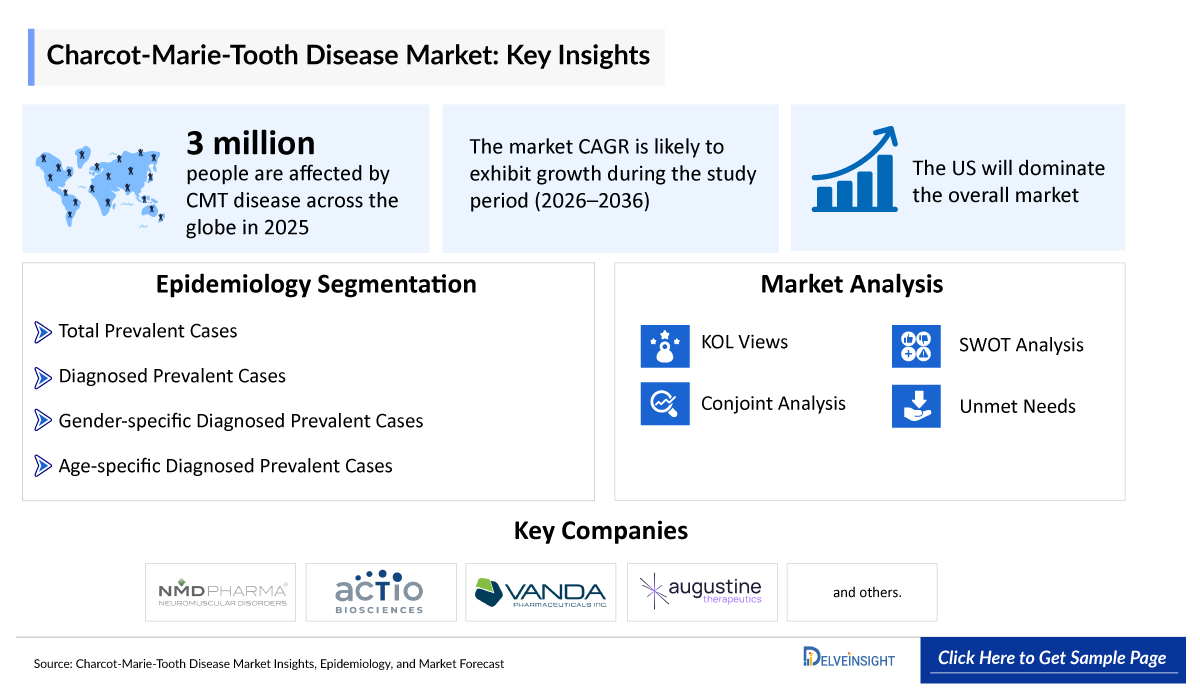
- Charcot-Marie-Tooth Disease is considered one of the most common inherited neuromuscular disorders, with epidemiological studies estimating a prevalence of approximately 1 in 2,500 individuals in the United States and Europe. Globally, it is estimated to affect more than 2.6–3 million people worldwide.
- Charcot-Marie-Tooth Disease Diagnosis is based on clinical evaluation, family history, neurological examination, Nerve Conduction Studies (NCS), electromyography (EMG), and increasingly, molecular genetic testing and next-generation sequencing, which are improving subtype identification and diagnostic accuracy.
- Currently, there are no FDA-approved disease-modifying therapies for CMT disease, and treatment primarily focuses on supportive and symptomatic management, including physical therapy, occupational therapy, orthopedic support, pain management, orthotics, and corrective surgery for skeletal deformities.
- The increasing understanding of the molecular and genetic basis of CMT disease is driving the development of targeted and precision-based therapies. Emerging therapeutic approaches include siRNA therapies, Antisense Oligonucleotides, HDAC6 Inhibitors, gene therapies, and neuromuscular modulators aimed at slowing disease progression or improving neuromuscular function.
- Key Charcot-Marie-Tooth Disease Pipeline therapies under development include ignaseclant (NMDP-08) from NMD Pharma, EDK060 from Novartis, and ABS-0871 from Actio Biosciences. Several of these programs have received FDA Orphan Drug Designation, reflecting the significant unmet medical need in CMT disease.
- Despite increasing pipeline activity and advances in genetic diagnostics, CMT disease remains associated with substantial unmet needs due to progressive disability, absence of curative therapies, delayed diagnosis in genetically complex cases, and significant impact on patient mobility, quality of life, and long-term functional independence.
Charcot–Marie–Tooth Disease Market Size and Forecast in the 7MM
- 2025 Charcot–Marie–Tooth Disease Market Size: ~USD XX million
- 2036 Projected Charcot–Marie–Tooth Disease Market Size: ~USD XX million
- Charcot–Marie–Tooth Disease Growth Rate (2026–2036): XX% CAGR
Request for Unlocking the Sample Page of the "Charcot-Marie-Tooth Treatment Market"
Key Factors Driving the Growth of Charcot–Marie–Tooth Disease Market
- Expanding Pipeline Innovation and Emergence of Targeted Therapies: The CMT disease treatment landscape is evolving with increasing development of targeted therapies, including gene therapies, ASOs, HDAC6 inhibitors, and neuromuscular modulators.
- High Unmet Need Due to Absence of Approved Curative Therapies: CMT disease remains a progressive inherited peripheral neuropathy with limited pharmacological treatment options, as current disease management primarily relies on supportive care, physiotherapy, orthopedic interventions, and symptomatic treatment. Multiple published reviews emphasize that no broadly effective curative therapy is currently available, thereby creating substantial unmet medical need and driving investment in novel therapeutic development.
- Increasing Adoption of Genetic Testing and Precision Diagnostics: Advancements in next-generation sequencing and molecular diagnostic technologies are significantly improving the identification and classification of CMT disease subtypes. Published studies report that more than 60–70 CMT disease-associated genes have been identified, enabling earlier and more accurate diagnosis and facilitating patient selection for emerging precision therapies and clinical trials.
DelveInsight's ‘Charcot–Marie–Tooth Disease Market Insights, Epidemiology and Market Forecast – 2036’ report delivers an in-depth understanding of the CMT, historical and forecasted epidemiology, as well as the CMT disease market trends in the United States, EU4 (Germany, Spain, Italy, and France), and the United Kingdom, and Japan.
The Charcot–Marie–Tooth Disease market report delivers a comprehensive analysis of the current treatment landscape, including standards of care, clinical practices, and evolving therapeutic algorithms. It evaluates CMT disease patient burden trends, revenue & market share dynamics, peak patient share & therapy uptake analysis, and provides an in-depth market size assessment, and growth rate projections (Historical & Forecast 2022–2036) across global regions. The report highlights key unmet medical needs in CMT disease and maps the competitive and clinical landscape to uncover high‑value opportunities, providing a clear outlook on future market growth potential.
Scope of the Charcot-Marie-Tooth Disease Market | |
|
Study Period |
2022–2036 |
|
Historical Year |
2022–2025 |
|
Forecast Period |
2026–2036 |
|
Base Year |
2026 |
|
Geographies Covered |
|
|
Charcot-Marie-Tooth Disease Market CAGR (Forecast period) |
XX% (2026–2036) |
|
Charcot-Marie-Tooth Disease Epidemiology Segmentation Analysis |
Patient Burden Assessment
|
|
Charcot-Marie-Tooth Disease Companies |
|
|
Charcot-Marie-Tooth Disease Therapies |
|
|
Charcot-Marie-Tooth Disease Market |
Segmented by
|
|
Analysis |
|
Charcot–Marie–Tooth Disease Understanding
Charcot–Marie–Tooth Disease Overview and Diagnosis
CMT disease is a group of inherited peripheral neuropathies characterized by progressive degeneration of peripheral nerves, leading to distal muscle weakness, sensory loss, and impaired motor function. It is considered one of the most common inherited neuromuscular disorders and primarily affects the motor and sensory nerves of the limbs. Clinically, CMT disease typically presents with slowly progressive weakness and atrophy of the distal lower extremities, foot deformities such as pes cavus, gait abnormalities, reduced tendon reflexes, and sensory impairment, with progression to hand weakness in advanced stages.
Charcot–Marie–Tooth Disease Diagnosis
Charcot-Marie-Tooth Disease Diagnosis is based on clinical evaluation, family history, neurological examination, electrophysiological studies, and genetic testing. Common clinical findings include distal muscle weakness, reduced tendon reflexes, sensory impairment, and gait dysfunction. NCS and electromyography (EMG) help differentiate demyelinating and axonal subtypes, while molecular genetic testing confirms the underlying mutation and supports subtype classification. Increasing adoption of NGS and molecular diagnostics is improving early and accurate diagnosis of CMT disease.
Further details are provided in the report...
Charcot–Marie–Tooth Disease Treatment
Treatment of CMT disease is primarily supportive and symptomatic, as there are currently no FDA-approved disease-modifying therapies available. Management mainly focuses on maintaining mobility, reducing disability progression, and improving quality of life through a multidisciplinary approach. Common interventions include physical therapy, muscle strengthening and stretching exercises, occupational therapy, orthopedic support, shoe orthotics, leg braces, and corrective surgery for skeletal deformities such as pes cavus and hammertoes. Pharmacological management is mainly directed toward symptom control, particularly neuropathic pain and musculoskeletal discomfort. Commonly used medications include pain relievers, tricyclic antidepressants (TCAs), and anticonvulsants for neuropathic pain management. Early initiation of rehabilitation programs may help preserve muscle strength, flexibility, and functional independence.
Overall, treatment is individualized based on disease severity, functional impairment, and genetic subtype, while emerging pipeline therapies including gene-targeted approaches, antisense oligonucleotides, and neuromuscular modulators are expected to significantly transform the future treatment landscape of CMT disease.
Further details related to country-based variations are provided in the report...
Charcot–Marie–Tooth Disease Unmet Needs
The section “unmet needs of Charcot–Marie–Tooth Disease” outlines the critical gaps between the current state of patient care, diagnosis, and the ideal & effective management of the disease. It highlights the obstacles experienced by patients, clinicians, and researchers and identifies potential solutions for future progress.
- Absence of FDA-approved disease-modifying therapies
- Delayed and incomplete genetic diagnosis
- Progressive disability and functional decline despite supportive treatment
- Limited availability of targeted therapies for genetically diverse CMT disease subtypes, and others…..
Note: Comprehensive unmet needs insights in CMT disease and their strategic implications are provided in the full report...
Charcot–Marie–Tooth Disease Epidemiology
The Charcot–Marie–Tooth Disease epidemiology section provides insights about the historical and current Charcot–Marie–Tooth Disease patient pool and forecasted trends for individual seven major countries. It helps to recognize the causes of current and forecasted trends by exploring numerous studies and views of key opinion leaders. This part of the Charcot–Marie–Tooth Disease market report also provides the diagnosed patient pool and their trends along with assumptions undertaken.
Key Findings from Charcot–Marie–Tooth Disease Epidemiological Analysis and Forecast
- According to the secondary analysis, the estimated Charcot-Marie-Tooth Disease Prevalence disease ranges from approximately 9–28 per 100,000 population worldwide.
- According to the Charcot Marie Tooth Association, CMT disease affects more than 3 million people globally.
- CMT disease is the most common inherited neuropathy, with an estimated prevalence ranging from 1 in 1,500 to 1 in 10,000 individuals in France.
- As per secondary analysis, CMT1A accounts for approximately 60–70% of all CMT disease cases and is caused by a duplication on chromosome 17p11.2, resulting in overexpression of the Peripheral Myelin Protein 22 (PMP22) gene.
- CMT disease is generally considered a rare disease; however, epidemiological surveys conducted in Europe and the United States have reported a prevalence of approximately 1 per 2,500 people, while in Japan, it is around 1 per 10,000 people.
- CMT disease affects an estimated 1 in 2,500 people in the United States. Although CMT disease is classified as a rare disease (affecting fewer than 200,000 people in the US), experts believe the actual number of affected individuals may be significantly higher. Globally, an estimated 2.6 million people are affected by CMT disease.
Charcot–Marie–Tooth Disease Epidemiology Segmentation
- Total Charcot-Marie-Tooth Disease Prevalent Cases
- Total Charcot-Marie-Tooth Disease Diagnosed Prevalent Cases
- Charcot-Marie-Tooth Disease Gender-specific Diagnosed Prevalent Cases
- Charcot-Marie-Tooth Disease Age-specific Diagnosed Prevalent Cases
- Charcot-Marie-Tooth Disease Type-specific Diagnosed Prevalent Cases
- Total Charcot-Marie-Tooth Disease Treated Cases
Recent Developments in the Charcot–Marie–Tooth Disease Treatment Landscape:
- In August 2026, ReviR Therapeutics received FDA Rare Pediatric Disease Designation for RTX-117, its investigational therapy targeting Charcot-Marie-Tooth disease (CMT). RTX-117 is designed as a targeted RNA-modulating medicine aimed at addressing underlying genetic causes of CMT, a progressive hereditary neuromuscular condition. This regulatory status provides incentives to accelerate clinical development, supporting ReviR's effort to deliver novel precision therapies to pediatric patients facing severe, debilitating rare peripheral nerve disorders.
- In June 2026, Vanda Pharmaceuticals Inc. announced that the FDA had granted Rare Pediatric Disease Designation to VCA-894A, its investigational antisense oligonucleotide therapy being developed for the treatment of Charcot-Marie-Tooth disease, axonal, type 2S (CMT2S).
- In March 2026, NMD Pharma announced a poster presentation and a late-breaking oral presentation highlighting safety and efficacy data from its Phase IIa SYNAPSE-CMT study evaluating ignaseclant (formerly known as NMD670) in patients living with Charcot-Marie-Tooth disease (CMT) types 1 or 2 at a leading Muscular Dystrophy Association Clinical & Scientific Conference.
- In February 2026, Cycle Pharmaceuticals announced that they have completed the acquisition of Applied Therapeutics.
- In February 2026, NMD Pharma announced the topline results from its Phase IIa SYNAPSE-CMT study evaluating ignaseclant in patients living with CMT types 1 or 2. There are currently no FDA-approved therapies for the treatment of CMT disease.
- In March 2025, Actio Biosciences announced first participant dosed in phase I clinical trial of abs-0871, a novel TRPV4 inhibitor, for the treatment of CMT disease 2C.
Charcot–Marie–Tooth Disease Drug Analysis & Competitive Landscape
The Charcot–Marie–Tooth Disease drug chapter provides a detailed, market-focused review of the emerging pipeline across Phase I–III Charcot-Marie-Tooth Disease Clinical Trials. It covers the mechanism of action, clinical trial data, regulatory approvals, patents, collaborations, and strategic partnerships for each therapy, along with their advantages, limitations, and recent developments. This section offers critical insights into the CMT disease treatment landscape, supporting market assessment, competitive analysis, and growth forecasting for the CMT disease therapeutics market.
Charcot–Marie–Tooth Disease Pipeline Analysis
-
Govorestat: Applied Therapeutics
Govorestat (AT-007) is a next-generation, potent and selective Aldose Reductase Inhibitor (ARI) being developed for the treatment of multiple rare diseases, including CMT-SORD. Govorestat is a Central Nervous System-penetrant ARI with a highly selective mechanism of action compared to historical ARIs, avoiding off-target effects. Govorestat has received Orphan Medicinal Product Designation from the European Medicines Agency (EMA) for CMT-SORD. Govorestat has also received ODD from the FDA for the treatment of CMT-SORD.
-
Ignaseclant (NMDP-08): NMD Pharma
Ignaseclant (NMDP-08/NMD670), developed by NMD Pharma’s, lead development program. It is an investigational first-in-class small molecule inhibitor of the skeletal muscle specific Chloride Ion Channel 1 (CIC-1). NMDP-08 is currently being evaluated in the SYNAPSE-CMT Phase II clinical trial, which began in November 2024.
Competitive Landscape of Charcot–Marie–Tooth Disease Pipeline Drugs | ||||||
|
Drug Name |
Company |
Highest Phase |
Indication |
RoA |
MoA |
Anticipated Launch in the US |
|
Govorestat |
Cycle Pharmaceuticals (Applied Therapeutics) |
III |
CMT Sorbitol Dehydrogenase Deficiency (CMT-SORD) |
Oral |
Aldose reductase inhibitor |
Information is available in the full report |
|
Ignaseclant (NMDP-08) |
NMD Pharma |
II |
Type 1 and Type 2 CMT Disease |
Oral |
ClC-1 inhibitor |
Information is available in the full report |
|
ABS-0871 |
Actio biosciences |
I |
CMT subtype 2C |
Oral |
TRPV4 inhibitor |
Information is available in the full report |
|
AGT-100216 |
Augustine Therapeutics |
I |
CMT |
Oral |
HDAC6 inhibitor |
Information is available in the full report |
|
VCA-894A |
Vanda Pharmaceuticals |
I |
CMT2S |
Intrathecal |
Antisense oligonucleotide therapy |
Information is available in the full report |
|
Note: Launch insights are provisional and may change with future report updates or the occurrence of major key catalysts. | ||||||
Note: Detailed emerging therapies assessment will be provided in the final report...
Charcot–Marie–Tooth Disease Companies, Market Leaders, and Emerging Companies
- NMD Pharma
- Novartis
- Actio Biosciences
- Vanda Pharmaceuticals
- Augustine Therapeutics
- ENCell, and others
Charcot–Marie–Tooth Disease Market Outlook
The Charcot-Marie-Tooth Disease Market Outlook is gradually evolving from a historically supportive care based landscape toward the development of targeted and disease-modifying therapies, although current management continues to rely primarily on physiotherapy, orthopedic support, rehabilitation, and symptomatic pain management. Despite advances in genetic research, there are currently no FDA-approved disease-modifying therapies for CMT disease, highlighting a substantial unmet need and driving increasing investment in gene-targeted approaches, antisense oligonucleotides, RNA-based therapies, and neuromuscular modulators.
With growing understanding of the molecular and genetic basis of CMT disease, the Charcot-Marie-Tooth Disease Therapeutics Market Landscape is increasingly shifting toward precision medicine approaches targeting specific disease-causing mutations such as PMP22 duplication, which accounts for nearly 50–70% of CMT1A cases. Emerging pipeline therapies including ignaseclant (NMDP-08), EDK060 currently being evaluated in an ongoing clinical trial in Canada, VCA-894A, are being developed to improve neuromuscular function, suppress pathogenic gene overexpression, or slow peripheral nerve degeneration. In parallel, increasing adoption of genetic testing and next-generation sequencing is improving subtype identification and supporting patient stratification for targeted clinical development.
- The United States continues to represent a major Charcot-Marie-Tooth Disease Therapeutics Market, supported by increasing rare disease awareness, improved access to molecular diagnostics, strong orphan drug incentives, and growing investment in inherited neuromuscular disorders.
- The Charcot-Marie-Tooth Disease Treatment Landscape is gradually transitioning from purely supportive management toward genetically targeted and disease-modifying therapeutic approaches.
- The absence of approved curative therapies and the progressive nature of disability remain major unmet needs, driving the development of novel therapies targeting PMP22 overexpression, axonal degeneration, and neuromuscular dysfunction.
- Emerging Charcot-Marie-Tooth Disease Pipeline assets including siRNA therapies, antisense oligonucleotides, HDAC6 inhibitors, and ClC-1 inhibitors are expected to expand future treatment options and intensify competition within the CMT disease therapeutic landscape during the forecast period.
Further details will be provided in the report….
Charcot-Marie-Tooth Disease Drug Class/Insights into Leading Emerging and Marketed Therapies (2022–2036 Forecast)
The Charcot-Marie-Tooth Disease Treatment Landscape primarily comprises supportive therapies, symptomatic pharmacological management, and emerging targeted therapies, each aimed at improving mobility, reducing complications, and addressing the underlying genetic mechanisms of disease progression.
- Supportive and rehabilitative therapies: Include physical therapy, occupational therapy, orthopedic support, shoe orthotics, leg braces, and corrective surgery, which currently form the foundation of CMT disease management by helping maintain mobility, muscle strength, and functional independence.
- Symptomatic pharmacological therapies: Mainly include treatments for neuropathic pain and musculoskeletal discomfort, such as pain relievers, TCAs, and anticonvulsants. These therapies help manage symptoms but do not prevent disease progression.
- Targeted and disease-modifying therapies: Emerging pipeline approaches include siRNA therapies, ASOs, HDAC6 inhibitors, and neuromuscular modulators, designed to target underlying genetic abnormalities such as PMP22 overexpression and peripheral nerve dysfunction. Investigational therapies including, ignaseclant, VCA-894A, AGT-100216, and others reflect the growing shift toward precision medicine in CMT disease.
Overall, supportive care remains the current standard of treatment, while emerging gene-targeted therapies are expected to drive future innovation in the CMT disease therapeutic landscape.
Charcot–Marie–Tooth Disease Drug Uptake
This section focuses on the uptake rate of potential Charcot-Marie-Tooth Disease drugs expected to be launched in the market during the forecast period (2026–2036). The analysis covers the CMT disease drug’s uptake, performance at peak, factors affecting performance during prime years of growth, patient uptake by therapy, and anticipated sales generated by each drug.
The uptake of therapies in CMT disease is expected to remain primarily centered on supportive and rehabilitative management, including physical therapy, orthopedic support, and symptomatic pain treatment, due to the absence of approved disease-modifying therapies. These interventions are anticipated to maintain steady utilization as they remain essential for preserving mobility and functional independence. In contrast, emerging gene-targeted and precision therapies such as siRNA therapies, ASOs, HDAC6 inhibitors, and neuromuscular modulators are expected to witness gradual uptake as clinical evidence and genetic diagnostics continue to advance. Investigational therapies including ignaseclant, VCA-894A, and others are anticipated to drive future innovation, particularly in genetically defined CMT disease subtypes. Future adoption of these therapies will depend on demonstrated efficacy in slowing disease progression, improving motor function, long-term safety, and successful regulatory approvals.
Detailed insights of emerging therapies' drug uptake is included in the report....
Charcot–Marie–Tooth Disease Market Access and Reimbursement
Reimbursement is a crucial factor that affects the drug’s access to the market. Often, the decision to reimburse comes down to the price of the drug relative to the benefit it produces in treated patients. To reduce the healthcare burden of these high-cost therapies, many payment models are being considered by payers and other industry insiders.
NOTE: Further Details are provided in the final report….
Charcot–Marie–Tooth Disease Therapies Price Scenario & Trends
Pricing and analogue assessment of CMT disease therapies highlights evolving price dynamics structures. This section summarizes the cost of approved treatments, the closest and most appropriate analogue selection for emerging therapies, and understanding of how pricing influences market access, adherence, and long-term uptake.
Further details are provided in the final report….
Charcot–Marie–Tooth Disease Industry Experts and Physician Views
To keep up with Charcot–Marie–Tooth disease market trends, we take Key Opinion Leaders (KOLs) and Subject Matter Experts (SMEs) opinions working in the domain through primary research to fill the data gaps and validate our secondary research. Industry experts were contacted for insights on the emerging CMT disease therapies, evolving treatment landscape, patient adherence to conventional therapies, therapy switching trends, drug adoption and uptake, accessibility challenges, and epidemiology and real-world prescription patterns in CMT disease, including MD, PhD, Instructor, Postdoctoral Researcher, Professor, Researcher, and others.
DelveInsight’s analysts connected with 10+ KOLs to gather insights at the country level. Centers such as the Kagoshima University Graduate School of Medical and Dental, University of Arizona College of Medicine Phoenix etc., were contacted. Their opinion helps understand and validate current and emerging CMT disease therapies, highlight unmet medical needs, provide epidemiological context, and support strategic decisions for market access, therapy adoption, and pipeline prioritization in CMT disease.
| Region | Key Opinion Leaders (KOLs) and Subject Matter Experts (SMEs) |
|
Japan |
“Currently, the primary challenge faced by CMT research lies in identifying disease-modifying treatments. To date, no definitive pharmacological treatment for any CMT variant has been established; nonetheless, recent years have witnessed substantial progress.” |
|
United States |
“CMT is a rare disease with diverse phenotypes depending on the underlying causative mutations. Understanding the genetic mutations and etiology of CMT is essential for both accurate diagnosis and the development of future therapeutic approaches. Furthermore, as targeted treatment strategies become increasingly feasible, identification of the causative genes and recognition of genotype–phenotype correlations are becoming critically important.” |
Charcot-Marie-Tooth Disease Report Qualitative Analysis: SWOT and Conjoint Analysis
We perform qualitative and market Intelligence analysis using various approaches, such as SWOT analysis and conjoint analysis. In the SWOT analysis of CMT disease, strengths, weaknesses, opportunities, and threats in terms of disease diagnosis, patient awareness, patient burden, competitive landscape, cost-effectiveness, and geographical accessibility of therapies are provided. Conjoint analysis analyzes emerging therapies based on relevant attributes such as safety, efficacy, frequency of administration, route of administration, and order of entry. Scoring is given based on these parameters to analyze the effectiveness of therapy.
The team of analysts analyzes promising Charcot-Marie-Tooth Disease Emerging Therapies based on relevant attributes such as safety, efficacy, frequency of administration, route of administration, and order of entry. In efficacy, the trial’s primary and secondary outcome measures are evaluated, whereas the therapies’ safety is evaluated, wherein the acceptability, tolerability, and adverse events are majorly observed. In addition, the scoring is also based on the route of administration, order of entry, probability of success, and the addressable patient pool for each therapy. According to these parameters, the final weightage score and the ranking of the emerging therapies are decided.
Scope of the Charcot-Marie-Tooth Disease Market Report
- The Charcot-Marie-Tooth Disease Therapeutics Market Report covers a segment of key events, an executive summary, a descriptive overview, explaining their causes, signs and symptoms, pathogenesis, and currently available treatments.
- Comprehensive insight has been provided into the Charcot-Marie-Tooth Disease Epidemiology segments and forecasts, the future growth potential of the diagnosis rate, and disease progression along treatment guidelines.
- Additionally, an all-inclusive account of both the current and emerging treatments, along with the elaborate profiles of late-stage and prominent therapies, will have an impact on the current Charcot-Marie-Tooth Disease Treatment landscape.
- A detailed review of the Charcot-Marie-Tooth Disease Market, historical and forecasted Charcot-Marie-Tooth Disease Treatment Market Size, Charcot-Marie-Tooth Disease Drugs Market Share by therapies, detailed assumptions, and rationale behind our approach is included in the report, covering the 7MM drug outreach.
- The Charcot-Marie-Tooth Disease Therapeutics Market Report provides an edge while developing business strategies by understanding trends through SWOT analysis and expert insights/KOL views, patient journey, and treatment preferences that help in shaping and driving the 7MM Charcot-Marie-Tooth Disease Drugs Market.
Charcot-Marie-Tooth Disease Market Report Insights
- Charcot–Marie–Tooth Disease Patient Population Forecast
- Charcot–Marie–Tooth Disease Therapeutics Market Size
- Charcot–Marie–Tooth Disease Pipeline Analysis
- Charcot–Marie–Tooth Disease Market Size and Trends
- Charcot–Marie–Tooth Disease Market Opportunity (Current and forecasted)
Charcot-Marie-Tooth Disease Market Report Key Strengths
- Epidemiology‑based (Epi‑based) Bottom‑up Forecasting
- Artificial Intelligence (AI)-Enabled Market Research Report
- 11-Year Forecast
- Charcot–Marie–Tooth Disease Market Outlook (North America, Europe, Asia-Pacific)
- Patient Burden Trends (By Geography)
- Charcot–Marie–Tooth Disease Treatment Addressable Market (TAM)
- Charcot–Marie–Tooth Disease Competitive Landscape
- Charcot–Marie–Tooth Disease Major Companies Insights
- Charcot–Marie–Tooth Disease Price Trends and Analogue Assessment
- Charcot–Marie–Tooth Disease Therapies Drug Adoption/Uptake
- Charcot–Marie–Tooth Disease Therapies Peak Patient Share Analysis
Charcot-Marie-Tooth Disease Market Report Assessment
- Charcot–Marie–Tooth Disease Current Treatment Practices
- Charcot–Marie–Tooth Disease Unmet Needs
- Charcot–Marie–Tooth Disease Clinical Development Analysis
- Charcot–Marie–Tooth Disease Emerging Drugs Product Profiles
- Charcot–Marie–Tooth Disease Market Attractiveness
- Charcot–Marie–Tooth Disease Qualitative Analysis (SWOT and conjoint analysis)
- Charcot–Marie–Tooth Disease Market Drivers
- Charcot–Marie–Tooth Disease Market Barriers
Key Questions Answered in the Charcot-Marie-Tooth Disease Market Report:
Charcot-Marie-Tooth Disease Market Insights
- What was the Charcot-Marie-Tooth Disease Market Size, the Charcot-Marie-Tooth Disease Treatment Market Size by therapies, the Charcot-Marie-Tooth Disease Drugs Market Share (%) distribution in 2025, and what would it look like by 2036? What are the contributing factors for this growth?
- What are the anticipated pricing variations among different geographies for the emerging therapies in the future?
- What can be the future treatment paradigm of CMT disease?
- What are the disease risks, burdens, and Charcot-Marie-Tooth Disease Unmet Needs? What will be the growth opportunities across the 7MM concerning the patient population with CMT disease?
- Who is the major future competitor in the market, and how will the competitors affect their market share?
- What are the current options for the treatment of CMT disease? What are the current guidelines for treating CMT disease in the US, Europe, and Japan?
Reasons to Buy the Charcot-Marie-Tooth Disease Market Report
- The Charcot-Marie-Tooth Disease Therapeutics Market Report will help in developing business strategies by understanding the latest trends and changing treatment dynamics driving the Charcot-Marie-Tooth Disease Drugs Market.
- Bottom-up forecasting builds from the affected population to product forecasts, delivering a robust, data-driven approach ideal for new therapies and novel classes.
- Insights on patient burden/disease Charcot-Marie-Tooth Disease Incidence, evolution in diagnosis, and factors contributing to the change in the epidemiology of the disease during the forecast years.
- Understand the existing market opportunities in varying geographies and the growth potential over the coming years.
- Identifying strong upcoming players in the Charcot-Marie-Tooth Disease Market will help devise strategies to help get ahead of competitors.
- Detailed analysis and ranking of class-wise potential current and emerging therapies under the conjoint analysis section to provide visibility around leading classes.
- To understand KOLs’ perspectives on the accessibility, acceptability, and compliance-related challenges of existing treatment to overcome barriers in the future.
- Detailed insights into the unmet needs of the existing market so that the upcoming players can strengthen their development and launch strategy.
- This Artificial Intelligence (AI)-enabled report summarizes and simplifies complex datasets within the report into clear, actionable insights for stakeholders, investors, and healthcare providers, enabling faster, data-driven decisions.
Stay updated with us for Recent Articles