Chronic Myelomonocytic Leukaemia Pipeline
DelveInsight’s, “Chronic Myelomonocytic Leukemia Pipeline Insight, 2026” report provides comprehensive insights about 20+ companies and 25+ pipeline drugs in Chronic Myelomonocytic Leukemia pipeline landscape. It covers the pipeline drug profiles, including clinical and nonclinical stage products. It also covers the therapeutics assessment by product type, stage, route of administration, and molecule type. It further highlights the inactive pipeline products in this space.
Geography Covered
- Global coverage
Chronic Myelomonocytic Leukemia Understanding
Chronic Myelomonocytic Leukemia Overview
Chronic myelomonocytic leukemia (CMML) is a clonal hematopoietic disorder characterized by an increase in monocytes and dysplasia of myeloid precursor cells. Classified as a myelodysplastic syndrome/myeloproliferative neoplasm (MDS/MPN), CMML shares this category with atypical chronic myeloid leukemia (CML), juvenile myelomonocytic leukemia, MDS/MPN with ring sideroblasts and thrombocytosis, and unclassified MDS/MPN. CMML predominantly affects older adults, with a male predominance, and is considered a rare disease with an estimated incidence of approximately 1 in 100,000. Unlike CML, which is defined by the presence of a BCR-ABL1 rearrangement, CMML lacks a pathognomonic finding for diagnosis, necessitating the exclusion of other diseases involving monocytosis and other MDS/MPN disorders. The disease is heterogenous, with distinct dysplastic and proliferative subtypes that influence treatment outcomes and prognosis.
CMML typically develops slowly and may not cause symptoms initially. When symptoms do occur, they can include tiredness, breathlessness, and pale skin due to anemia, as well as frequent infections that don't improve. Patients may experience easy bruising or nosebleeds from a low platelet count, abdominal discomfort from an enlarged spleen, weight loss, loss of appetite, excessive sweating, and skin rashes or lumps. The most common sign of CMML is an increased number of monocytes in the blood, which can settle in the liver and spleen, causing enlargement. This can lead to a reduced production of other blood cells in the bone marrow, resulting in anemia, leukopenia (low white blood cell count), and thrombocytopenia (low platelet count), causing a range of symptoms like fatigue, infections, and bleeding issues.
The exact cause of CMML remains unknown, but several risk factors have been identified that can increase the likelihood of developing the condition. The risk of CMML increases with age, with the average age at diagnosis being between 65 and 74 years. It is also slightly more common in men than women. Other known risk factors include exposure to certain chemicals in the workplace or environment, previous radiation exposure, and past treatments with chemotherapy or radiotherapy for cancer, which can lead to a form known as therapy-related CMML. People aged 60 or older are at a higher risk, and men tend to be more affected than women.
To confirm a diagnosis of CMML, doctors use several tests and tools, including a physical exam and blood tests. Blood tests such as a complete blood count with a differential and a blood smear help assess the number and types of blood cells. Bone marrow aspiration and biopsy are essential for diagnosing CMML, as they examine the appearance of monocytes in the bone marrow. Additional tests, like cytogenetic testing, can identify genetic abnormalities, which may help in the diagnosis and understanding of the disease.
Treatment for CMML depends on various factors, such as age, overall health, symptoms, and whether the disease is progressing rapidly. In younger patients with higher-risk CMML, a Stem Cell Transplant (SCT) is often the best option for potentially curing the disease, provided a matched donor is available. If SCT is not an option, the focus is on symptom relief through supportive care like transfusions and antibiotics. Chemotherapy, including drugs like azacitidine, decitabine, or hydroxyurea, is commonly used to manage symptoms and slow disease progression. In some cases, clinical trials exploring newer treatments may offer additional options.
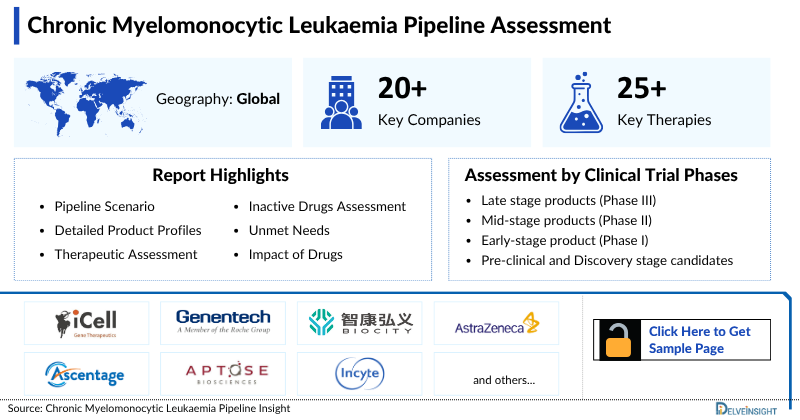
"Chronic Myelomonocytic Leukemia Pipeline Insight, 2026" report by DelveInsight outlays comprehensive insights of present scenario and growth prospects across the indication. A detailed picture of the Chronic Myelomonocytic Leukemia pipeline landscape is provided which includes the disease overview and Chronic Myelomonocytic Leukemia treatment guidelines. The assessment part of the report embraces, in depth Chronic Myelomonocytic Leukemia commercial assessment and clinical assessment of the pipeline products under development. In the report, detailed description of the drug is given which includes mechanism of action of the drug, clinical studies, NDA approvals (if any), and product development activities comprising the technology, Chronic Myelomonocytic Leukemia collaborations, licensing, mergers and acquisition, funding, designations and other product related details.
Chronic Myelomonocytic Leukemia Pipeline Report Highlights
The Chronic Myelomonocytic Leukemia companies and academics are working to assess challenges and seek opportunities that could influence Chronic Myelomonocytic Leukemia R&D. The therapies under development are focused on novel approaches to treat/improve Chronic Myelomonocytic Leukemia.
Chronic Myelomonocytic Leukemia Emerging Drugs Analysis
This segment of the Chronic Myelomonocytic Leukemia report encloses its detailed analysis of various drugs in different stages of clinical development, including Phase III, II, I, Preclinical and Discovery. It also helps to understand clinical trial details, expressive pharmacological action, agreements and collaborations, and the latest news and press releases.
Chronic Myelomonocytic Leukemia Emerging Drugs
Timdarpacept: ImmuneOnco Biopharma
Timdarpacept is a recombinant Signal Regulatory Protein α (SIRPα) IgG1 fusion protein currently being evaluated as a treatment for CMML. This innovative therapeutic agent functions by blocking the "Don't eat me" signal and activating the "Eat me" signal, which enhances Antibody-Dependent Cellular Phagocytosis (ADCP) and promotes the immune system's ability to target and eliminate tumor cells. Currently, the drug is in Phase III stage of its development for the treatment of Chronic Myelomonocytic Leukemia.
IO-202: Immune-Onc Therapeutics
IO-202 is a first-in-class, humanized IgG1 monoclonal antibody designed to target the Leukocyte Immunoglobulin-Like Receptor Subfamily B4 (LILRB4), which is overexpressed in chronic myelomonocytic leukemia (CMML) cells. By binding with high affinity to LILRB4, IO-202 facilitates antibody-dependent cellular cytotoxicity (ADCC) and antibody-dependent cellular phagocytosis (ADCP), enhancing the immune system's ability to eliminate malignant cells. The drug has received both fast track and orphan drug designations from the FDA, underscoring its potential as a therapeutic option for patients with CMML. Currently, the drug is in Phase I/II stage of its clinical trial for the treatment of Chronic Myelomonocytic Leukemia.
STX-0712: SOLU THERAPEUTICS, INC.
STX-0712 is an innovative therapeutic agent developed by Solu Therapeutics for the treatment of Chronic Myelomonocytic Leukemia (CMML). This drug is a CCR2-targeting Cytotoxicity Targeting Chimera (CyTAC) designed to selectively bind to CCR2, a receptor that is highly expressed on malignant monocytes in these hematologic cancers. The drug has shown robust activity in CMML, with favorable pharmacokinetics and tolerability observed in non-human primate models. Currently, the drug is in Phase I stage of its development for the treatment of Chronic Myelomonocytic Leukemia.
Further product details are provided in the report……..
Chronic Myelomonocytic Leukemia Drug Therapeutic Assessment
This segment of the report provides insights about the different Chronic Myelomonocytic Leukemia drugs segregated based on following parameters that define the scope of the report, such as:
Major Chronic Myelomonocytic Leukemia Players in Chronic Myelomonocytic Leukemia
There are approx. 20+ key companies which are developing the therapies for Chronic Myelomonocytic Leukemia. The companies which have their Chronic Myelomonocytic Leukemia drug candidates in the most advanced stage, i.e. Phase III include, ImmuneOnco Biopharma.
Chronic Myelomonocytic Leukemia Clinical Trial Phases
DelveInsight’s report covers around 25+ products under different phases of clinical development like
- Late stage products (Phase III)
- Mid-stage products (Phase II)
- Early-stage product (Phase I) along with the details of
- Pre-clinical and Discovery stage candidates
- Discontinued & Inactive candidates
Chronic Myelomonocytic Leukemia Drug Route of Administration
Chronic Myelomonocytic Leukemia pipeline report provides the therapeutic assessment of the pipeline drugs by the Route of Administration. Products have been categorized under various ROAs such as
- Oral
- Intravenous
- Subcutaneous
- Parenteral
- Topical
Chronic Myelomonocytic Leukemia Product Molecule Type
Products have been categorized under various Molecule types such as
- Recombinant fusion proteins
- Small molecule
- Monoclonal antibody
- Peptide
- Polymer
- Gene therapy
Chronic Myelomonocytic Leukemia Product Type
Drugs have been categorized under various product types like Mono, Combination and Mono/Combination.
Chronic Myelomonocytic Leukemia Clinical Trial Activities
The Chronic Myelomonocytic Leukemia pipeline report provides insights into different Chronic Myelomonocytic Leukemia clinical trials within Phase III, II, I, preclinical and discovery stage. It also analyses Chronic Myelomonocytic Leukemia therapeutic drugs key players involved in developing key drugs.
Chronic Myelomonocytic Leukemia Pipeline Development Activities
The Chronic Myelomonocytic Leukemia clinical Trial analysis report covers the detailed information of collaborations, acquisition and merger, licensing along with a thorough therapeutic assessment of emerging Chronic Myelomonocytic Leukemia drugs.
Chronic Myelomonocytic Leukemia Pipeline Report Insights
- Chronic Myelomonocytic Leukemia Pipeline Analysis
- Chronic Myelomonocytic Leukemia Therapeutic Assessment
- Chronic Myelomonocytic Leukemia Unmet Needs
- Impact of Chronic Myelomonocytic Leukemia Drugs
Chronic Myelomonocytic Leukemia Pipeline Report Assessment
- Chronic Myelomonocytic Leukemia Pipeline Product Profiles
- Chronic Myelomonocytic Leukemia Therapeutic Assessment
- Chronic Myelomonocytic LeukemiaPipeline Assessment
- Chronic Myelomonocytic Leukemia Inactive drugs assessment
- Chronic Myelomonocytic Leukemia Market Unmet Needs
Key Questions Answered In The Chronic Myelomonocytic Leukemia Pipeline Report:
- Current Treatment Scenario and Emerging Therapies:
- How many companies are developing Chronic Myelomonocytic Leukemia drugs?
- How many Chronic Myelomonocytic Leukemia drugs are developed by each company?
- How many emerging drugs are in mid-stage, and late-stage of development for the treatment of Chronic Myelomonocytic Leukemia?
- What are the key collaborations (Industry–Industry, Industry–Academia), Mergers and acquisitions, licensing activities related to the Chronic Myelomonocytic Leukemia therapeutics?
- What are the recent trends, drug types and novel technologies developed to overcome the limitation of existing therapies?
- What are the clinical studies going on for Chronic Myelomonocytic Leukemia and their status?
- What are the key designations that have been granted to the emerging drugs?
Chronic Myelomonocytic Leukemia Key Players
- ImmuneOnco Biopharma
- Immune-Onc Therapeutics
- SOLU THERAPEUTICS, INC.
- CD4CAR
- Cobimetinib
- BC3402
- AZD6738
- APG-115
- Tuspetinib
- NC525
- Itacitinib
- LP-108
- TRX103
- PRT2527
- DFV890
Chronic Myelomonocytic Leukemia Key Products
- Timdarpacept
- IO-202
- STX-0712
- iCell Gene Therapeutics
- Genentech, Inc.
- Biocity Biopharmaceutics Co., Ltd.
- AstraZeneca
- Ascentage Pharma Group Inc.
- Aptose Biosciences Inc.
- Incyte Corporation
- NextCure, Inc.
- Newave Pharmaceutical Inc
- Tr1X, Inc.
- Prelude Therapeutics
- Novartis Pharmaceuticals