
Chronic Urticaria Pipeline Summary
- The Chronic Urticaria Pipeline is advancing rapidly, with several biopharmaceutical companies developing innovative therapies aimed at improving disease control, reducing symptom burden, and addressing unmet patient needs.
- The leading Chronic Urticaria Companies include Synermore Biologics, Incyte Corporation, Jasper Therapeutics, Novartis, Regeneron/Sanofi, Principia Biopharma, Enanta Pharmaceuticals, Granular Therapeutics, Blueprint Medicines, Newave Pharmaceutical, and others.
Request for Unlocking the Sample Page of "Chronic Urticaria Pipeline Report"
Key Factors Driving the Growth of Chronic Urticaria Pipeline
-
Rising Prevalence of Chronic Urticaria
The increasing prevalence of chronic urticaria, particularly chronic spontaneous urticaria (CSU), is a major factor driving pipeline growth. A growing number of patients experience persistent hives and angioedema that significantly impact quality of life, creating a strong demand for innovative and more effective treatment options.
-
Significant Unmet Medical Needs
Despite the availability of antihistamines and biologics, many patients remain inadequately controlled or experience recurrent symptoms. This unmet need has encouraged pharmaceutical companies to develop novel therapies with improved efficacy, longer-lasting responses, and better safety profiles.
-
Advancements in Immunology Research
A deeper understanding of the immunological mechanisms underlying chronic urticaria has accelerated the development of targeted therapies. Research focusing on mast cells, IgE, Bruton tyrosine kinase (BTK), cytokines, and other inflammatory pathways is expanding the range of therapeutic approaches in the pipeline.
-
Growing Development of Targeted Biologics
The success of biologic therapies has stimulated the development of next-generation monoclonal antibodies targeting specific immune mediators involved in chronic urticaria. These targeted therapies offer the potential for improved disease control with fewer systemic adverse effects, driving continued investment in pipeline development.
-
Expanding Clinical Research Activities
Increasing numbers of clinical trials evaluating biologics, kinase inhibitors, and other novel therapeutic candidates are strengthening the chronic urticaria pipeline. Active research programs across multiple phases of development are expected to broaden future treatment options for patients.
-
Growing Adoption of Precision Medicine
Advances in biomarker research and patient stratification are supporting the development of personalized treatment strategies for chronic urticaria. Precision medicine approaches are expected to improve treatment selection, enhance clinical outcomes, and increase the success rate of investigational therapies.
-
Increasing Awareness and Early Diagnosis
Greater awareness among healthcare professionals and patients regarding chronic urticaria has improved diagnosis and disease management. Earlier identification of patients with uncontrolled disease is increasing participation in clinical trials and supporting the adoption of emerging therapies once approved.
"DelveInsight’s, “Chronic Urticaria Pipeline Insight, 2026” report provides comprehensive insights about 20+ companies and 30+ pipeline drugs in the Chronic Urticaria Pipeline landscape. It covers the pipeline drug profiles, including clinical and nonclinical stage products. It also covers the Chronic Urticaria Pipeline Therapeutics assessment by product type, stage, route of administration, and molecule type. It further highlights the inactive pipeline products in this space.
Geography Covered
- Global coverage
Chronic Urticaria Disease Understanding
Chronic Urticaria Overview
Chronic urticaria is a long-lasting skin disorder characterized by recurrent episodes of itchy hives, with or without angioedema, persisting for six weeks or more and often significantly affecting quality of life. The condition is broadly classified into chronic spontaneous urticaria, which occurs without an identifiable trigger, and chronic inducible urticaria (CIndU), where symptoms are provoked by specific physical or environmental factors such as cold, heat, pressure, sunlight, vibration, or exercise.
Chronic Urticaria is primarily driven by the activation of mast cells, resulting in the release of histamine and other inflammatory mediators that cause swelling and skin reactions. Common symptoms include recurrent raised welts or wheals, intense itching (pruritus) that can disrupt sleep and daily activities, and episodes of angioedema affecting areas such as the lips, eyelids, or throat. The chronic and unpredictable nature of the disease can impose a substantial physical and emotional burden on affected individuals.
Chronic Urticaria Diagnosis is largely based on clinical evaluation, with recurrent hives, angioedema, or both persisting for at least six weeks serving as the key diagnostic criterion. A thorough medical history and physical examination are essential to differentiate chronic spontaneous urticaria (CSU) from chronic inducible urticaria (CIndU) by identifying potential triggers and symptom patterns.
Initial laboratory assessments may include a complete blood count, inflammatory markers such as ESR or CRP, thyroid function tests, and selected autoimmune markers to exclude underlying conditions. In patients suspected of having CIndU, provocation or challenge testing may be performed to confirm specific physical or environmental triggers. Further diagnostic investigations are typically tailored according to the patient’s clinical presentation, medical history, and any atypical findings.
Chronic Urticaria treatment typically begins with second-generation H1-antihistamines, with dose escalation considered for patients who do not achieve adequate symptom control. For individuals who remain symptomatic despite antihistamine therapy, biologic agents such as anti-IgE monoclonal antibodies may be used. Short-term systemic corticosteroids can help manage acute exacerbations but are generally avoided for long-term use due to safety concerns. Emerging therapies that target mast cells and their signaling pathways, including KIT-directed agents, are being investigated for refractory disease, alongside trigger avoidance and supportive measures to improve patient outcomes and quality of life.
"Chronic Urticaria Pipeline Insight, 2026" report by DelveInsight outlays comprehensive insights of present scenario and growth prospects across the indication. A detailed picture of the Chronic Urticaria pipeline landscape is provided which includes the disease overview and Chronic Urticaria treatment guidelines. The assessment part of the report embraces, in depth Chronic Urticaria commercial assessment and clinical assessment of the pipeline products under development. In the Chronic Urticaria Pipeline Report, detailed description of the drug is given which includes mechanism of action of the drug, clinical studies, NDA approvals (if any), and product development activities comprising the technology, Chronic Urticaria collaborations, licensing, mergers and acquisition, funding, designations and other product related details.
Chronic Urticaria Pipeline Report Highlights
The Chronic Urticaria Companies and academics are working to assess challenges and seek opportunities that could influence Chronic Urticaria R&D. The Chronic Urticaria Therapies under development are focused on novel approaches to treat/improve Chronic Urticaria.
Chronic Urticaria Emerging Drugs Analysis
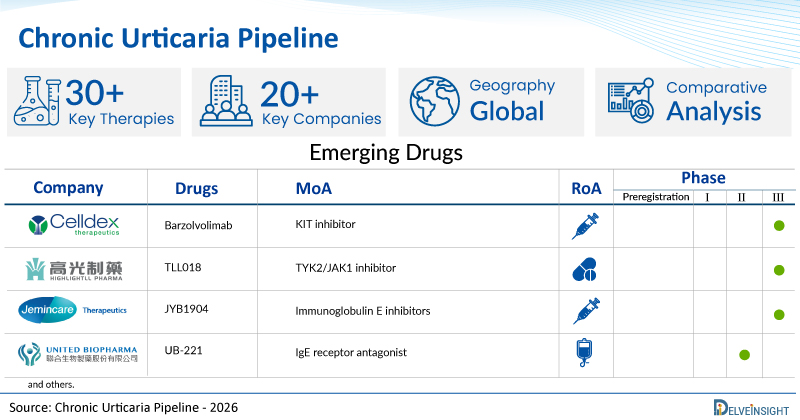
This segment of the Chronic Urticaria Pipeline Report encloses its detailed analysis of various drugs in different stages of clinical development, including Phase III, II, I, Preclinical and Discovery. It also helps to understand Chronic Urticaria Clinical Trials details, expressive pharmacological action, agreements and collaborations, and the latest news and press releases.
Chronic Urticaria Emerging Drugs
-
Barzolvolimab: Celldex Therapeutics Inc
Barzolvolimab (CDX-0159) is an investigational humanized monoclonal antibody being developed by Celldex Therapeutics. It selectively targets the KIT receptor tyrosine kinase and inhibits its activation. Since KIT signaling plays a critical role in mast cell growth, survival, migration, and function, and mast cells are key contributors to inflammation and wheal formation in chronic urticaria, inhibition of KIT can help reduce mast cell activity.
By preventing stem cell factor (SCF) from binding to KIT and blocking KIT dimerization, barzolvolimab decreases both mast cell numbers and function, addressing a fundamental disease mechanism in chronic spontaneous urticaria and other mast cell-mediated urticarias. The therapy is currently being evaluated in Phase III clinical development.
-
UB-221: United BioPharma
UB-221 is an investigational humanized IgG1 monoclonal antibody developed by United BioPharma for the treatment of chronic spontaneous urticaria (CSU). It targets the Cε3 domain of immunoglobulin E (IgE), neutralizing circulating IgE and suppressing new IgE production through interaction with the CD23 receptor on B cells.
This dual mechanism may provide more sustained control of mast cell and basophil activation, which are key drivers of urticaria symptoms. UB-221 has demonstrated promising activity in early clinical studies and is currently in Phase II clinical development for CSU.
-
SAR449028: Sanofi
SAR449028 is an investigational monoclonal antibody that selectively inhibits wild-type KIT, a receptor that plays a central role in mast cell survival, activation, and function. By targeting KIT signaling, SAR449028 aims to reduce mast cell numbers and activity, addressing a key underlying driver of chronic urticaria.
The therapy is being developed for both chronic spontaneous urticaria (CSU) and chronic inducible urticaria (CIndU), as well as other mast cell–mediated allergic diseases. SAR449028 is currently in Phase II clinical development for CSU and CIndU.
-
EDP-978: Enanta Pharmaceuticals
EDP-978 is an investigational, once-daily oral small-molecule inhibitor of KIT, a receptor tyrosine kinase that plays a critical role in mast cell survival and activation. By selectively blocking KIT signaling, EDP-978 aims to reduce mast cell activity and numbers, addressing a key underlying driver of chronic spontaneous urticaria (CSU). Preclinical studies have demonstrated potent and highly selective KIT inhibition with favorable pharmacokinetic and drug-like properties, supporting its potential as an oral treatment for mast cell-mediated diseases. EDP-978 is currently in Phase I clinical development for chronic urticaria, with initial clinical studies evaluating its safety, tolerability, pharmacokinetics, and pharmacodynamics.
-
ALY-301: Alys Pharmaceuticals
ALY-301 is an investigational first-in-class bispecific antibody designed to selectively target and deplete mast cells by binding both c-KIT and CD203c. By specifically inhibiting mast cell survival and activity while sparing other c-KIT–expressing cells, ALY-301 aims to overcome the safety limitations associated with conventional c-KIT inhibitors and enable chronic dosing.
Since mast cells are key drivers of wheal formation and inflammation in chronic urticaria, ALY-301 targets a fundamental disease mechanism. The therapy is currently being evaluated in a Phase I/Ib clinical trial in patients with cold urticaria, a subtype of chronic inducible urticaria and a recognized model for broader chronic urticaria populations.
Further product details are provided in the report……..
Chronic Urticaria Drug Therapeutic Assessment
This segment of the Chronic Urticaria Pipeline Report provides insights about the different Chronic Urticaria drugs segregated based on following parameters that define the scope of the report, such as:
Major Chronic Urticaria Players Companies
There are approx. 28+ key companies which are developing the therapies for Chronic Urticaria. The Chronic Urticaria Companies which have their Chronic Urticaria drug candidates in the most advanced stage, i.e. Phase III include, Celldex Therapeutics Inc.
Chronic Urticaria Clinical Trial Phases
DelveInsight’s Chronic Urticaria Pipeline Report covers around 30+ products under different phases of clinical development like
- Late stage products (Phase III)
- Mid-stage products (Phase II)
- Early-stage product (Phase I) along with the details of
- Pre-clinical and Discovery stage candidates
- Discontinued & Inactive candidates
Chronic Urticaria Drug Route of Administration
Chronic Urticaria pipeline report provides the therapeutic assessment of the pipeline drugs by the Route of Administration. Products have been categorized under various ROAs such as
- Oral
- Intravenous
- Subcutaneous
- Parenteral
- Topical
Chronic Urticaria Product Molecule Type
Chronic Urticaria Products have been categorized under various Molecule types such as
- Recombinant fusion proteins
- Small molecule
- Monoclonal antibody
- Peptide
- Polymer
- Gene therapy
Chronic Urticaria Product Type
Chronic Urticaria Drugs have been categorized under various product types like Mono, Combination and Mono/Combination.
Chronic Urticaria Clinical Trials Activities
The report provides insights into Chronic Urticaria Pipeline within Phase III, II, I, preclinical and discovery stage. It also analyses Chronic Urticaria therapeutic drugs key players involved in developing key drugs.
Chronic Urticaria Pipeline Report Insights
The Chronic Urticaria Pipeline Analysis report covers the detailed information of collaborations, acquisition and merger, licensing along with a thorough therapeutic assessment of emerging Chronic Urticaria drugs.
Chronic Urticaria Report Insights
- Chronic Urticaria Pipeline Analysis
- Chronic Urticaria Therapeutic Assessment
- Chronic Urticaria Unmet Needs
- Impact of Chronic Urticaria Drugs
Chronic Urticaria Report Assessment
- Chronic Urticaria Pipeline Product Profiles
- Chronic Urticaria Therapeutic Assessment
- Chronic Urticaria Pipeline Assessment
- Inactive Drugs Assessment
- Chronic Urticaria Unmet Needs
Key Questions Answered In The Chronic Urticaria Pipeline Report
Current Chronic Urticaria Treatment Scenario and Emerging Therapies:
- How many companies are developing Chronic Urticaria drugs?
- How many Chronic Urticaria drugs are developed by each company?
- How many emerging drugs are in mid-stage, and late-stage of development for the treatment of Chronic Urticaria?
- What are the key collaborations (Industry–Industry, Industry–Academia), Mergers and acquisitions, licensing activities related to the Chronic Urticaria therapeutics?
- What are the recent trends, drug types and novel technologies developed to overcome the limitation of existing therapies?
- What are the clinical studies going on for Chronic Urticaria and their status?
- What are the key designations that have been granted to the emerging drugs?
Chronic Urticaria Companies
- Celldex Therapeutics Inc
- United BioPharma
- Sanofi
- Enanta Pharmaceuticals
- Alys Pharmaceuticals
- Hangzhou Highlightll Pharmaceutical
- Jemincare
- Yuhan Corporation
- Septerna
- Novartis
- Jiangsu Hansoh Pharmaceutical Co., Ltd.
- Evommune
- BeiGene
- Longbio Pharma
Chronic Urticaria Key Products
- Barzolvolimab
- UB-221
- SAR449028
- EDP-978
- ALY-301
- Girocitinib
- JYB-1904
- YH35324
- SEP-631
- KRP M223
- HS-10561
- EVO756
- BGB-16673
- LP-003
Stay updated with us for Recent Articles @ New DelveInsight Blogs

