Common Warts Market Summary
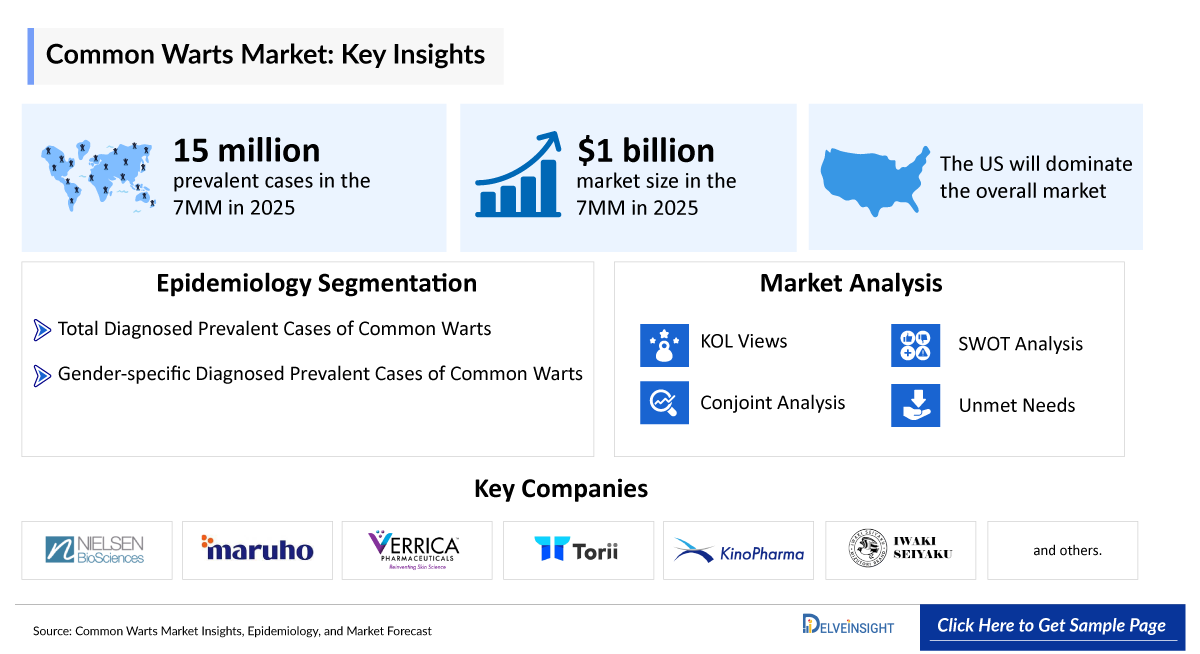
- The Common Warts Market Size was valued at approximately USD 1,000 million in 2025 and is expected to grow at a significant CAGR during the forecast period from 2026 to 2036.
- The leading Common Warts companies developing therapies in the treatment market include - Nielsen Biosciences, Maruho, Verrica Pharmaceuticals, Torii Pharmaceutical, KinoPharma, Iwaki Seiyaku, and others
Common Warts Market & Epidemiology Insights
- Common warts (verruca vulgaris) are benign epidermal proliferations caused by low-risk human papillomavirus (HPV) types (1, 2, 4, 27, and 57), entering through micro-abrasions in the skin. They present as well-demarcated, hyperkeratotic papules, commonly affecting the hands, fingers, and feet, with higher prevalence in children, adolescents, and immunocompromised individuals.
- HPV drives keratinocyte hyperproliferation and immune evasion, contributing to persistence and recurrence despite treatment. Transmission occurs via direct contact or contaminated surfaces (fomites), supporting high incidence and recurrence rates, particularly in communal settings.
- Diagnosis is primarily clinical, based on characteristic morphology and thrombosed capillaries (“black dots”), with biopsy reserved for atypical or resistant cases.
- The treatment landscape is dominated by topical keratolytics (salicylic acid) and cryotherapy, which remain first-line therapies due to accessibility and established efficacy. Destructive modalities (electrosurgery, laser therapy, surgical excision) are used in refractory cases, but are limited by pain, scarring, and higher costs. Immunotherapeutic approaches (e.g., intralesional Candida antigen) are gaining traction by targeting the underlying viral etiology and reducing recurrence rates.
- Common warts currently lack FDA-approved, specifically indicated prescription therapies, reflecting a notable treatment gap in dermatology. Available management is largely limited to non-specific approaches such as keratolytic agents (e.g., salicylic acid) and procedural interventions like cryotherapy, rather than targeted, virus-specific drugs. This underscores an unmet need for standardized, evidence-driven pharmacologic options that directly address the underlying HPV infection and improve long-term clearance rates and recurrence control.
- The Common Warts emerging pipeline, including CANDIN, YCANTH (VP-102), and KNP2002, focuses on immunomodulatory and antiviral mechanisms to improve efficacy, tolerability, and convenience.
- The Common Warts market is characterized by high-volume, low-cost therapies alongside niche, high-value procedures, creating opportunities for innovative, patient-friendly treatments with durable outcomes.
Common Warts Market Size and Forecast in the 7MM
- 2025 Common Warts Market Size: ~USD 1,000 million
- 2036 Projected Common Warts Market Size: ~USD XX million
- Common Warts Growth Rate (2026–2036): XX% CAGR
DelveInsight's ‘Common Warts Market Insights, Epidemiology and Market Forecast – 2036’ report delivers an in-depth understanding of the common warts, historical and forecasted epidemiology, as well as the common warts market trends in the United States, EU4 (Germany, Spain, Italy, and France) and the United Kingdom, and Japan.
The Common Warts market report delivers a comprehensive analysis of the current treatment landscape, including standards of care, clinical practices, and evolving therapeutic algorithms. It evaluates, common warts patient burden trends, revenue & market share dynamics, peak patient share & therapy uptake analysis, and provides an in-depth market size assessment, and growth rate projections (Historical & Forecast 2022–2036) across global regions. The report highlights key unmet medical needs in common warts and maps the competitive and clinical landscape to uncover high‑value opportunities, providing a clear outlook on future market growth potential.
Scope of the Common Warts Market Report | |
|
Study Period |
2022–2036 |
|
Historical Year |
2022–2025 |
|
Forecast Period |
2026–2036 |
|
Base Year |
2026 |
|
Geographies Covered |
|
|
Common Warts Market CAGR (Forecast period) |
XX% (2026–2036) |
|
Common Warts Epidemiology Segmentation Analysis |
Patient Burden Assessment
|
|
Common Warts Companies |
|
|
Common Warts Therapies |
|
|
Common Warts Market |
Segmented by
|
|
Analysis |
|
|
| |
Key Factors Driving the Common Warts Market
- Emergence of Targeted and Immunotherapeutic Therapies: The pipeline is shifting toward HPV-targeted and immune-mediated treatments, with assets like CANDIN, YCANTH (VP-102), and KNP2002 aiming to improve efficacy and reduce recurrence, signaling a paradigm shift beyond lesion destruction.
- High Prevalence and Recurrence Burden: Common warts have high prevalence and recurrence rates, particularly in children and immunocompromised populations, driving repeat treatments and sustained market demand.
- Demand for Safer and Patient-friendly Treatments: Limitations of current therapies such as pain, scarring, and multiple sessions are increasing demand for minimally invasive, well-tolerated, and convenient options.
Common Warts Disease Understanding
Common Warts Overview
Common warts (verruca vulgaris) are benign epidermal proliferations caused by HPV infection, most commonly types 1, 2, 4, 27, and 57, entering through micro-abrasions in the skin. They present as rough, hyperkeratotic papules on the hands, fingers, periungual areas, and feet, often causing pain or cosmetic concern.
They are classified into common, plantar, flat, and periungual warts based on morphology and location. Transmission occurs via direct contact or fomites, making them highly contagious.Despite being benign and self-limiting, they show high recurrence due to persistent HPV infection and immune evasion, and are most prevalent in children, adolescents, and immunocompromised patients, contributing to a high global disease burden.
Common Warts Diagnosis
Diagnosis of common warts (verruca vulgaris) is primarily clinical, based on characteristic appearance of rough, hyperkeratotic papules and typical distribution on the hands, fingers, periungual areas, and feet. A key clinical feature includes thrombosed capillaries (“black dots”) on dermoscopic or close examination.
In atypical, recurrent, or treatment-resistant cases, dermoscopy aids visualization of vascular patterns, while skin biopsy may be performed to exclude other lesions and confirm HPV-related pathology. Diagnosis is largely visual and non-invasive, and laboratory testing is rarely required.Accurate and early recognition is important to guide appropriate therapy selection and avoid unnecessary invasive procedures.
Further details are provided in the report....
Common Warts Diagnosis Treatment
The treatment of common warts (verruca vulgaris) is primarily aimed at lesion removal and reducing recurrence. First-line therapies include topical salicylic acid and cryotherapy (liquid nitrogen), which are widely used due to accessibility and established efficacy, though multiple treatment sessions are often required.
In refractory cases, in-office procedures such as trichloroacetic acid (TCA), electrosurgery, laser therapy, and surgical excision are used to achieve lesion clearance. Immunotherapeutic approaches, including intralesional Candida antigen and other off-label agents, are increasingly used to stimulate a host immune response against HPV, particularly in recurrent or multiple warts. Emerging therapies aim to improve outcomes by targeting the underlying viral infection, including CANDIN (Nielsen BioSciences / Maruho), YCANTH (VP-102) (Verrica Pharmaceuticals / Torii Pharmaceutical), and KNP2002 (KinoPharma / Iwaki Seiyaku), which focus on immunomodulatory and antiviral mechanisms.
Further details related to country-based variations are provided in the report.
Common Warts Unmet Needs
The section “unmet needs of Common warts” outlines the critical gaps between the current state of patient care, diagnosis, and the ideal & effective management of the disease. It highlights the obstacles experienced by patients, clinicians, and researchers and identifies potential solutions for future progress.
- High recurrence due to persistent HPV infection
- Lack of HPV-targeted disease-modifying therapies
- Painful and poorly tolerated procedures in children
- Poor patient adherence due to long treatment duration
- No standardized global treatment algorithm for common warts, and others…..
Note: Comprehensive unmet needs insights in common warts and their strategic implications are provided in the full report...
Common Warts Epidemiology
The Common Warts epidemiology section provides insights about the historical and current Common Warts patient pool and forecasted trends for individual seven major countries. It helps to recognize the causes of current and forecasted trends by exploring numerous studies and views of key opinion leaders. This part of the Common Warts market report also provides the diagnosed patient pool and their trends along with assumptions undertaken.
Key Findings from Common Warts Epidemiological Analysis and Forecast
- According to DelveInsight’s estimates, in 2025, the total number of prevalent cases of common warts in the 7MM were ~15,063,000.
- The highest burden is observed in children and adolescents, while immunocompromised individuals also show significantly increased incidence and persistence rates.
- HPV infections causing cutaneous warts are most commonly linked to low-risk types 1, 2, 4, 27, and 57, which account for the majority of common wart cases.
- In Europe, warts were identified as the most common skin disease, with a prevalence of 41.3%, highlighting their significant burden on dermatological health in the region.
- Plantar warts account for a significant proportion of cases in clinical settings, as they are more likely to become symptomatic due to pressure and pain on weight-bearing surfaces.
- Despite being benign, common warts show a high spontaneous resolution rate (within 1–2 years in many cases), but a substantial proportion persist or recur due to immune evasion by HPV.
- As per the secondary analysis, warts are a common condition worldwide, affecting about 10% of the population, with prevalence rising to 10–20% in school-aged children; they are rare in infancy and early childhood, increase during school years, peak between 12 and 16 years, and are more frequently observed in immunosuppressed individuals and meat handlers.
Common Warts Epidemiology Segmentation
- Total Prevalent Cases of Warts
- Total Diagnosed Prevalent Cases of Warts
- Total Diagnosed Prevalent Cases of Common Warts
- Treated Cases of Common Warts
Recent Developments in the Common Warts Treatment Landscape
- In October 2025, Nielsen BioSciences announced Maruho has expanded its existing licensing agreement with Nielsen BioSciences for CANDIN (Purified Candida albicans Antigen) for the treatment of common warts (verruca vulgaris) in adolescents and adults. Under the expanded agreement, Maruho has secured exclusive development and commercialization rights across additional Asian territories, strengthening its dermatology portfolio and supporting broader regional expansion of this investigational immunotherapy.
- In January 2026, Verrica Pharmaceuticals announced that the first patient was dosed in December 2025 in the global Phase III program evaluating YCANTH (VP-102) for the treatment of common warts.
- In December 2025, Verrica Pharmaceuticals announced that the first patient was dosed in the global Phase III program of VP-102 for the treatment of common warts.
- In August 2025, Iwaki Seiyaku announced that hat it has obtained the results of the safety and efficacy of a Phase II clinical study of an ointment formulation for the indication of verruca vulgaris (also known as “common warts” ) being developed in collaboration with KinoPharma.
- In July 2025, Verrica Pharmaceuticals announced that it had entered into the second amendment to its existing Collaboration and Licensing Agreement with Torii Pharmaceutical to initiate a global pivotal Phase III clinical trial of Verrica’s product, YCANTH, for the treatment of common warts.
Common Warts Drug Analysis & Competitive Landscape
The Common Warts drug chapter provides a detailed, market-focused review of the emerging pipeline across Phase II–III Common Warts clinical trials. It covers the mechanism of action, clinical trial data, regulatory approvals, patents, collaborations, and strategic partnerships for each therapy, along with their advantages, limitations, and recent developments. This section offers critical insights into the Common warts treatment landscape, supporting market assessment, competitive analysis, and growth forecasting for the Common warts therapeutics market.
Common Warts Pipeline Analysis
CANDIN: Nielsen Biosciences and Maruho
CANDIN (Candida albicans Skin Test Antigen for Cellular Immunity) is being repurposed as an immunotherapeutic approach for common warts, designed to activate the immune system against HPV-driven lesions. Nielsen BioSciences advanced the program to Phase III trial following encouraging Phase II results in the US, which were peer-reviewed and published in Dermatology & Therapy. Currently, CANDIN is approved in the US only as a diagnostic skin test for cellular hypersensitivity to Candida albicans and is not yet approved in the US or Japan for the treatment of common warts.
VP-102 (YCANTH): Verrica Pharmaceuticals and Torii Pharmaceutical
Verrica Pharmaceuticals’ lead candidate, YCANTH (VP-102), is a proprietary drug-device combination featuring a GMP-controlled 0.7% cantharidin formulation delivered via a single-use applicator for precise topical dosing. In June 2019, Verrica announced positive topline results from the COVE-1 Phase II open-label trial, which evaluated the safety and efficacy of YCANTH in subjects with up to six common warts. Building on these findings, a Type C meeting with the FDA in November 2023 resulted in alignment on the pivotal Phase III trial design.
Competitive Landscape of Common Warts Pipeline Drugs | ||||||
|
Drug Name |
Company |
Highest Phase |
Indication |
RoA |
MoA |
Anticipated Launch in the US |
|
CANDIN |
Nielsen Biosciences and Maruho |
III |
Common Warts |
Intradermal |
Immunotherapeutic agent |
Information is available in the full report |
|
VP-102 (YCANTH) |
Verrica Pharmaceuticals and Torii Pharmaceutical |
III |
Common Warts |
Topical |
Vesication (blistering agent)) |
Information is available in the full report |
|
KNP2002 |
KinoPharma and Iwaki Seiyaku |
II |
Common Warts |
Topical |
HPV genome transcription inhibitor |
Information is available in the full report |
|
Note: Launch insights are provisional and may change with future report updates or the occurrence of major key catalysts. | ||||||
Note: Detailed emerging therapies assessment will be provided in the final report...
Common Warts Key Players, Market Leaders and Emerging Companies
- Nielsen Biosciences
- Maruho
- Verrica Pharmaceuticals
- Torii Pharmaceutical
- KinoPharma
- Iwaki Seiyaku, and others
Common Warts Market Outlook
The common warts market is evolving gradually from a procedure-driven, lesion-destructive treatment paradigm toward immune-mediated and mechanism-based therapies targeting the underlying HPV infection. While topical salicylic acid and cryotherapy continue to dominate as first-line and in-office standards of care due to their accessibility and familiarity, their limitations in terms of pain, recurrence, and treatment adherence are driving demand for more effective and patient-friendly alternatives. This has created a strong foundation for the development of immunotherapeutic and antiviral approaches aimed at improving long-term clearance rates.
The emergence of novel pipeline assets such as CANDIN (Nielsen BioSciences and Maruho), YCANTH (VP-102) (Verrica Pharmaceuticals and Torii Pharmaceutical), and KNP2002 (KinoPharma and Iwaki Seiyaku) reflects a shift toward immunomodulatory, antiviral, and targeted mechanisms, which are expected to redefine treatment approaches by reducing recurrence and treatment burden.
Geographically, the United States represents the largest market, driven by high treatment uptake, strong dermatology infrastructure, and early adoption of advanced therapies, while EU5 and Japan continue to show steady growth supported by improving access to dermatological care and increasing awareness of treatment options.
Overall, the market is expected to expand steadily during the forecast period, supported by high disease prevalence, persistent recurrence burden, and unmet need for durable therapies, with innovation focused on improved tolerability, convenience, and HPV-targeted mechanisms expected to drive future growth.
Further details will be provided in the report….
Drug Class/Insights into Leading Emerging and Marketed Therapies in Common Warts (2022–2036 Forecast)
The common warts (verruca vulgaris) treatment landscape (2022–2036) is primarily driven by destructive therapies, topical agents, and emerging immunomodulatory and antiviral approaches, with a growing shift toward strategies that enhance lesion clearance, reduce recurrence, and improve patient tolerability rather than relying solely on symptomatic lesion removal.
- Topical therapies: Include keratolytic agents such as Salicylic acid, which remain the first-line treatment due to strong clinical evidence, OTC availability, and affordability. They act by gradual desquamation of hyperkeratotic tissue, enabling clearance of Human papillomavirus–infected cells. Other topical options include Imiquimod, an immune response modifier used off-label in cutaneous warts to stimulate local antiviral immunity.
- Non-pharmacological therapies: Include cryotherapy (liquid nitrogen), electrosurgery, curettage, laser ablation, and occlusion-based approaches such as duct tape therapy. These methods are widely used for rapid lesion destruction, particularly in symptomatic or recalcitrant cases, although they may be associated with discomfort and variable recurrence rates.
- Immunotherapeutic approaches: Include intralesional antigen-based therapies such as CANDIN (Candida antigen), which stimulate a systemic cell-mediated immune response against HPV-infected keratinocytes. These therapies are increasingly utilized in patients with multiple, recurrent, or treatment-resistant warts, offering the advantage of clearing both treated and distant lesions.
- Emerging and pipeline therapies: The development landscape is evolving with candidates targeting improved efficacy, tolerability, and recurrence prevention. Key assets include VP-102 (a standardized topical cantharidin formulation), CANDIN (being further evaluated for broader dermatologic use), and early-stage programs such as VBP-245 and KNP2002. These therapies leverage vesicant, immunomodulatory, or antiviral mechanisms to provide more consistent and controlled treatment outcomes compared to traditional approaches.
Overall, the current treatment paradigm for common warts is largely centered on topical keratolytics and destructive procedures, which focus on lesion removal rather than viral eradication. However, immunotherapeutic strategies and standardized pipeline agents are expected to shift the landscape toward more targeted, durable, and recurrence-reducing therapies.
Common Warts Drug Uptake
This section focuses on the uptake rate of potential drugs expected to be launched in the market during the forecast period (2026–2036). The analysis covers the common warts drug’s uptake, performance at peak, factors affecting performance during prime years of growth, patient uptake by therapy, and anticipated sales generated by each drug.
The uptake of therapies for common warts (verruca vulgaris) is expected to vary across topical agents, procedural interventions, immunotherapies, and emerging targeted therapies, reflecting differences in efficacy, convenience, tolerability, and recurrence outcomes.
Established first-line therapies such as topical salicylic acid are expected to maintain high and sustained uptake due to their over-the-counter availability, low cost, and ease of use, despite requiring prolonged treatment duration. Similarly, cryotherapy is anticipated to retain strong adoption in clinical practice owing to its familiarity among physicians and relatively high clearance rates, particularly in dermatology and primary care settings.
In contrast, off-label immunotherapies such as intralesional Candida antigen (CANDIN-based therapy) are expected to show moderate but increasing uptake, driven by their ability to address immune-mediated clearance and reduce recurrence, especially in refractory and multiple-wart cases.
Next-generation and pipeline therapies such as CANDIN, YCANTH (VP-102), and KNP2002 are expected to demonstrate gradual uptake, supported by growing clinical evidence and a shift toward immunomodulatory and antiviral mechanisms aimed at improving long-term clearance and reducing recurrence burden.
Common Warts Market Access and Reimbursement Scenario
Reimbursement may be referred to as the negotiation of a price between a manufacturer and a payer that allows the manufacturer access to the market. It is provided to reduce the high costs and make the essential drugs affordable. Health technology assessment (HTA) plays an important role in reimbursement decision-making and recommending the use of a drug. These recommendations vary widely throughout the seven major markets, even for the same drug. In the US healthcare system, both Public and Private health insurance coverage are included. Also, Medicare and Medicaid are the largest government-funded programs in the US. The major healthcare programs, including Medicare, Medicaid, Health Insurance Program (CHIP), and the state and federal health insurance marketplaces, are overseen by the Centres for Medicare & Medicaid Services (CMS). Other than these, Pharmacy Benefit Managers (PBMs) and third-party organisations that provide services and educational programs to aid patients are also present.
The report further provides detailed insights on the country-wise accessibility and reimbursement scenarios, cost-effectiveness scenario of currently used therapies, programs making accessibility easier and out-of-pocket costs more affordable, insights on patients insured under federal or state government prescription drug programs, etc.
NOTE: Further Details are provided in the final report….
Common Warts Therapies Price Scenario & Trends
Pricing and analogue assessment of common warts therapies highlights evolving price dynamics structures. This section summarizes the cost of approved treatments, closest and most appropriate analogue selection for emerging therapies, and understanding of how pricing influences market access, adherence, and long-term uptake.
Further details are provided in the final report….
Industry Experts and Physician Views for Common Warts
To keep up with common warts market trends, we take Key Opinion Leaders (KOLs) and Subject Matter Experts (SMEs) opinions working in the domain through primary research to fill the data gaps and validate our secondary research. Industry experts were contacted for insights on the common warts emerging therapies, evolving treatment landscape, patient adherence to conventional therapies, therapy switching trends, drug adoption and uptake, accessibility challenges, and epidemiology and real-world prescription patterns in common warts, including MD, PhD, Instructor, Postdoctoral Researcher, Professor, Researcher, and others.
DelveInsight’s analysts connected with 10+ KOLs to gather insights at country level. Centers such as the Baylor Scott and White Research Institute in Dallas, Women’s Hospital and Harvard Medical School, and Uppsala University, etc. were contacted.Their opinion helps understand and validate current and emerging common warts therapies, highlight unmet medical needs, provide epidemiological context, and support strategic decisions for market access, therapy adoption, and pipeline prioritization in common warts.
|
Region |
Key Opinion Leaders (KOLs) and Subject Matter Experts (SMEs) |
|
United States |
" Common warts are benign skin growths caused by specific strains of human papillomavirus (HPV). These strains are typically not associated with cancer, but they can infect the skin through small cuts or abrasions, leading to active proliferation of epidermal cells and visible wart formation. Warts can spread via direct contact or contaminated surfaces, contributing to their high prevalence in communal environments.” |
|
United Kingdom |
“Diagnosis of common warts is primarily clinical, based on characteristic appearance, texture, and location. In atypical cases—such as rapidly growing lesions, persistent warts, or those that mimic other skin disorders—a biopsy may be performed to confirm the diagnosis and ensure accurate differentiation from other conditions.” |
Common Warts Report Qualitative Analysis: SWOT and Conjoint Analysis
We perform qualitative and market Intelligence analysis using various approaches, such as SWOT analysis and conjoint analysis.
In the SWOT analysis of Common Warts, strengths, weaknesses, opportunities, and threats in terms of disease diagnosis, patient awareness, patient burden, competitive landscape, cost-effectiveness, and geographical accessibility of therapies are provided.
Conjoint analysis analyzes emerging therapies based on relevant attributes such as safety, efficacy, frequency of administration, route of administration, and order of entry. Scoring is given based on these parameters to analyze the effectiveness of therapy.
The team of analysts analyzes promising emerging therapies based on relevant attributes such as safety, efficacy, frequency of administration, route of administration, and order of entry. In efficacy, the trial’s primary and secondary outcome measures are evaluated, whereas the therapies’ safety is evaluated, wherein the acceptability, tolerability, and adverse events are majorly observed. In addition, the scoring is also based on the route of administration, order of entry, probability of success, and the addressable patient pool for each therapy. According to these parameters, the final weightage score and the ranking of the emerging therapies are decided.
Scope of the Common Warts Market Report
- The Common Warts report covers a segment of key events, an executive summary, a descriptive overview of common warts, explaining their causes, signs and symptoms, pathogenesis, and currently available treatments.
- Comprehensive insight has been provided into the epidemiology segments and forecasts, the future growth potential of the diagnosis rate, and disease progression along treatment guidelines.
- Additionally, an all-inclusive account of both the current and emerging Common Warts treatments, along with the elaborative profiles of late-stage and prominent therapies, will have an impact on the current treatment landscape.
- A detailed review of the common warts market, historical and forecasted market size, market share by therapies, detailed assumptions, and rationale behind our approach is included in the report, covering the 7MM drug outreach.
- The Common Warts report provides an edge while developing business strategies by understanding trends through SWOT analysis and expert insights/KOL views, patient journey, and treatment preferences that help in shaping and driving the 7MM common warts market.
Common Warts Market Report Insights
- Common Warts Patient Population Forecast
- Common Warts Therapeutics Market Size
- Common Warts Pipeline Analysis
- Common Warts Market Size and Trends
- Common Warts Market Opportunity (Current and forecasted)
Common Warts Market Report Key Strengths
- Epidemiology‑based (Epi‑based) Bottom‑up Forecasting
- Artificial Intelligence (AI)-Enabled Market Research Report
- 11-Year Forecast
- Common Warts Market Outlook (North America, Europe, Asia-Pacific)
- Patient Burden Trends (By Geography)
- Common Warts Treatment Addressable Market (TAM)
- Common Warts Competitve Landscape
- Common Warts Major Companies Insights
- Common Warts Price Trends and Analogue Assessment
- Common Warts Therapies Drug Adoption/Uptake
- Common Warts Therapies Peak Patient Share Analysis
Common Warts Market Report Assessment
- Common Warts Current Treatment Practices
- Common Warts Unmet Needs
- Common Warts Clinical Development Analysis
- Common Warts Emerging Drugs Product Profiles
- Common Warts Market attractiveness
- Common Warts Qualitative Analysis (SWOT and conjoint analysis)
- Common Warts Market Drivers
- Common Warts Marke Barriers
FAQs Related to Common Warts Market Report:
Common Warts Market Insights
- What was the common warts market size, the market size by therapies, market share (%) distribution in 2025, and what would it look like by 2036? What are the contributing factors for this growth?
- What are the anticipated pricing variations among different geographies for the emerging therapies in the future?
- What can be the future treatment paradigm of common warts?
- What are the disease risks, burdens, and unmet needs of common warts? What will be the growth opportunities across the 7MM concerning the Common Warts patient population?
- Who is the major future competitor in the market, and how will the competitors affect their market share?
- What are the current options for the treatment of common warts? What are the current guidelines for treating common warts in the US, Europe, and Japan?
Reasons to Buy the Common Warts Market Forecast Report
- The Common Warts market report will help in developing business strategies by understanding the latest trends and changing treatment dynamics driving the common warts market.
- Bottom-up forecasting builds from the affected population to product forecasts, delivering a robust, data-driven approach ideal for new therapies and novel classes.
- Insights on patient burden/disease incidence, evolution in diagnosis, and factors contributing to the change in the epidemiology of the disease during the forecast years.
- Understand the existing market opportunities in varying geographies and the growth potential over the coming years.
- Identifying strong upcoming players in the market will help devise strategies to help get ahead of competitors.
- Detailed analysis and ranking of class-wise potential emerging therapies under the conjoint analysis section to provide visibility around leading classes.
- To understand KOLs’ perspectives on the accessibility, acceptability, and compliance-related challenges of existing treatment to overcome barriers in the future.
- Detailed insights on the unmet needs of the existing market so that the upcoming players can strengthen their development and launch strategy.
- This Artificial Intelligence (AI)-enabled report summarize and simplify complex datasets with in the report into clear, actionable insights for stakeholders, investors, and healthcare providers, enabling faster, data-driven decisions.