Corneal Edema Market Summary
- As per American Academy of Ophthalmology 2026, corneal edema is closely linked to progressive endothelial cell loss, with clinically significant edema generally emerging when endothelial cell density falls to approximately 500 cells/mm² or below, highlighting endothelial dysfunction as a key disease driver.
- A 2023 study by Briceno-Lopez et al. reported that corneal edema was the most common ocular surgery-related complication in Spain, with a prevalence ranging from 6.2% to 11.3%.
- Fuchs Endothelial Corneal Dystrophy (FECD) represents an important under recognized source of corneal edema, as endothelial changes can precede symptoms; early disease may remain clinically subtle before progressing to stromal/epithelial edema and visual impairment.
- The lack of approved disease-modifying therapies for corneal edema represents a substantial opportunity for emerging therapies, particularly those capable of restoring endothelial function, slowing corneal decompensation, and delaying or reducing dependence on corneal transplantation.
- According to the Optum claims study (2026) corneal edema or other corneal pathology in 0.07% of patients undergoing selective laser trabeculoplasty, highlighting corneal edema as a relevant ocular complication in this population.
- The emerging corneal edema pipeline is increasingly focused on endothelial regeneration and restoration, with candidates such as AURN001 (neltependocel + Y-27632) (Alcon/ Aurion Biotech) and EO2002 (Emmecell), exploring regenerative, cell-based, and pharmacological approaches to address underlying endothelial dysfunction.
- As per American Academy of Ophthalmology 2026, treatment of corneal edema is primarily guided by the underlying cause and disease severity. Medical approaches include hypertonic saline solutions to reduce mild epithelial edema, while bandage contact lenses may provide temporary relief of pain associated with epithelial bullae. Topical antihypertensive may be used when elevated intraocular pressure contributes to edema, and topical corticosteroids may be considered in inflammatory or uveitic cases. Advanced or persistent edema associated with endothelial dysfunction may require corneal transplantation or endothelial keratoplasty.
- Surgical intervention is primarily considered for severe or irreversible corneal edema associated with endothelial dysfunction, with endothelial keratoplasty such as Descemet Stripping Automated Endothelial Keratoplasty (DSAEK) and Descemet Membrane Endothelial Keratoplasty (DMEK) replacing the dysfunctional endothelial layer to restore corneal clarity. In patients with poor visual potential and painful epithelial bullae, procedures such as anterior stromal puncture, phototherapeutic keratectomy, or amniotic membrane placement may provide symptomatic relief.
DelveInsight’s “Corneal Edema Market Insights, Epidemiology, and Market Forecast – 2036” report delivers an in-depth understanding of corneal edema, historical and forecasted epidemiology, as well as the corneal edema market trends in the United States, EU4 (Germany, France, Italy, and Spain), the United Kingdom, and Japan.
The corneal edema market report delivers a comprehensive analysis of the current treatment landscape, including standards of care, clinical practices, and evolving therapeutic algorithms. It evaluates, corneal edema patient burden trends, revenue & market share dynamics, peak patient share & therapy uptake analysis, and provides an in-depth market size assessment and growth rate projections (Historical & Forecast 2022–2036) across the 7MM regions. The report highlights key unmet medical needs in corneal edema and maps the competitive and clinical landscape to uncover high value opportunities, providing a clear outlook on future market growth potential.
Scope of the Corneal Edema Market Report | |
|
Study Period |
2022–2036 |
|
Historical Year |
2022–2025 |
|
Forecast Period |
2026–2036 |
|
Base Year |
2025 |
|
Geographies Covered |
ü North America: The US ü Europe: Germany, France, Italy, Spain and the UK ü Asia-Pacific: Japan |
|
Corneal Edema Epidemiology Segmentation Analysis |
Patient Burden Assessment
|
|
Corneal Edema Companies |
|
|
Corneal Edema Market |
Segmented by
|
|
Analysis |
|
Corneal Edema Disease Understanding
Corneal Edema Overview
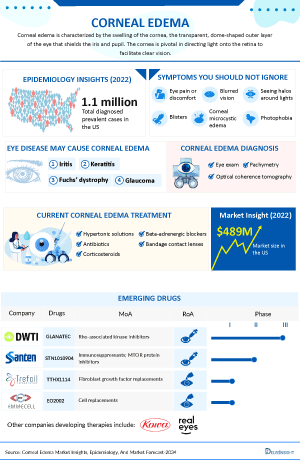
Corneal edema is characterized by excessive fluid accumulation within the cornea, causing corneal swelling and resulting in blurred, hazy, or cloudy vision. As the cornea is responsible for focusing light onto the retina, edema can significantly impair visual acuity. Corneal edema primarily results from corneal endothelial dysfunction, including conditions such as Fuchs' endothelial dystrophy and endothelial damage following intraocular surgery. Other causes include ocular trauma and inflammation, such as uveitis, which can disrupt corneal fluid regulation and promote swelling. Common symptoms include blurred or hazy vision, reduced visual acuity, and photophobia, with visual impairment largely resulting from light scattering through the fluid-filled cornea.
Corneal Edema Diagnosis and Treatment Algorithm
Corneal edema results from excessive fluid accumulation within the cornea, causing swelling and blurred or cloudy vision that can impair visual acuity. Diagnosis is primarily clinical and involves a comprehensive ophthalmic examination, including slit-lamp biomicroscopy and visual acuity assessment. Pachymetry and corneal topography/tomography may be used to quantify corneal thickening and assess structural changes, while endothelial evaluation can help identify underlying dysfunction.
Treatment is driven by the underlying cause and disease severity. Hypertonic saline and lubricating eye drops can provide symptomatic relief and reduce corneal swelling, while advanced endothelial dysfunction may require endothelial keratoplasty or corneal transplantation. The treatment landscape is increasingly shifting toward approaches that restore endothelial function and potentially delay or reduce the need for transplantation.
Corneal Edema Epidemiology
The Corneal Edema epidemiology section of the corneal edema market report offers information on the patient populations, including historical and projected trends for each of the seven major markets. Examining key opinion leader views from physicians or clinical experts can assist in identifying the reasons behind historical and projected trends. The diagnosed patient pool, their trends, and the underlying assumptions are all included in this section of the report.
This section also presents the data with relevant tables and graphs, offering a clear and concise view of the prevalence of corneal edema. Additionally, the report discloses the assumptions made during the analysis, ensuring data interpretation and presentation transparency. This epidemiological data is valuable for understanding the disease burden and its impact on the patient population across various regions.
Key Findings from Corneal Edema Epidemiology Report
- As per American Academy of Ophthalmology (2025), corneal edema represented 18.3% of corneal opacity/scar cases in the US IRIS Registry, corresponding to approximately 0.96 million affected patients, highlighting its substantial contribution to corneal morbidity.
- According to a national survey by the Japan Cornea Society and Keratoplasty Society of Japan, corneal edema was the leading indication for corneal transplantation in Japan in 2025, accounting for 39.3% of all corneal transplant cases, highlighting its substantial burden among patients requiring advanced corneal treatment.
Corneal Edema Epidemiology Segmentation
- Total Diagnosed Prevalent Cases of Corneal Edema
- Etiology-specific Diagnosed Prevalent Cases of Corneal Edema
- Total Treated Cases of Corneal Edema
Corneal Edema Drug Chapters
The drug chapter segment of the Corneal Edema report encloses the detailed analysis of Corneal Edema marketed drugs and late-stage (Phase-III and Phase-II) Corneal Edema pipeline drugs. It also helps to understand the Corneal Edema clinical trial details, expressive pharmacological action, agreements and collaborations, approval and patent details, advantages and disadvantages of each included drug and the latest news and press releases.
Emerging Corneal Edema Drugs
The corneal edema market is expected to evolve gradually, driven by the limited number of emerging therapies currently in development. Key players such as EO2002 and AURN001 among others are showing active commitment to addressing this unmet need, with ongoing efforts to advance novel treatment options for this complex condition.
EO2002: Emmecell
EO2002, developed by Emmecell, is a pioneering non-surgical magnetic cell-based therapy designed to modify diseases, particularly addressing corneal edema secondary to corneal endothelial dysfunction. This innovative therapy utilizes the exclusive Magnetic Cell Delivery (MCD) nanoparticle platform, allowing for easier access to treatment before the onset of disability and pain. EO2002 has the potential to prevent or delay the need for more invasive procedures like corneal transplantation.
In July 2026, Emmecell received FDA Regenerative Medicine Advanced Therapy RMAT designation for EO2002, an investigational corneal endothelial cell therapy for corneal edema secondary to endothelial dysfunction, and subsequently advanced the program into the Phase II EMERALD trial in the US, initiated in September 2026 (NCT07729137), underscoring the growing focus on regenerative, non-surgical approaches to corneal edema.
AURN001: Alcon/ Aurion Biotech
AURN001 (neltependocel + Y-27632) is an investigational allogeneic corneal endothelial cell therapy being developed by Aurion Biotech for corneal edema secondary to corneal endothelial dysfunction. It combines cultured human corneal endothelial cells (neltependocel) with the ROCK inhibitor Y-27632, designed to promote cell survival and adhesion and establish a functional endothelial cell layer. AURN001 is administered as a single intracameral injection and is currently being evaluated in the Phase III ASTRA trial in adults with corneal edema associated with endothelial dysfunction.
Alcon acquires majority interest in Aurion Biotech, to advance innovative cell therapy for corneal endothelial disease.
Aurion has received Breakthrough Therapy Designation (BTD) and Regenerative Medicine Advanced Therapy Designation (RMAT) from the US Food and Drug Administration (FDA) for AURN001, a novel cell therapy for the treatment of corneal edema secondary to corneal endothelial disease.
Emerging Corneal Edema Pipeline | ||||
|
Drug |
MoA |
RoA |
Company |
Phase |
|
AURN001 (neltependocel + Y-27632) |
Endothelial cell replacement and ROCK inhibition. |
Intracameral injection |
Alcon |
III |
|
EO2002 |
Regenerates the corneal endothelium through allogeneic endothelial cell therapy. |
Intracameral injection |
Emmecell |
II |
|
XX |
XX |
X |
XXX |
XXX |
Note: Detailed emerging therapies assessment will be provided in the final report...
Corneal Edema Market Outlook
The Corneal Edema therapeutics market is further expected to increase by the major drivers, such as the rising prevalence population, technological advancements, and upcoming therapies in the forecast period (2025–2036).
With ongoing research and continued dedication, the future holds hope for even more effective treatments and, ultimately, a cure for this challenging condition. According to DelveInsight, the corneal edema market in the 7MM is expected to change significantly during the forecast period 2025–2036.
Corneal Edema Market Segmentation
DelveInsight’s ‘Corneal Edema – Market Insights, Epidemiology, and Market Forecast – 2036’ report provides a detailed outlook of the current and future corneal edema market, segmented within countries, by therapies, and by classes. Further, the market of each region is then segmented by each therapy to provide a detailed view of the current and future market share of all therapies.
Corneal Edema Market Size by Countries
The Corneal Edema market size is assessed separately for various countries, including the United States, EU4 (Germany, France, Italy, and Spain), the UK, and Japan. In 2025, the United States held a significant share of the overall 7MM (Seven Major Markets) corneal edema market, primarily attributed to the country’s higher prevalence of the condition and the elevated cost of the available treatments. This dominance is projected to persist, especially with the potential early introduction of new products.
Corneal Edema Market Size by Therapies
Corneal edema market size by therapies is categorized into current and emerging markets for the study period 2022–2036.
Note: Detailed market segment assessment will be provided in the final report...
Corneal Edema Drugs Uptake
This section focuses on the sales uptake of potential corneal edema drugs that have recently been launched or are anticipated to be launched in the corneal edema market between 2022 and 2036. It estimates the market penetration of corneal edema drugs for a given country, examining their impact within and across classes and segments. It also touches upon the financial and regulatory decisions contributing to the probability of success (PoS) of the drugs in the corneal edema market.
The emerging corneal edema therapies are analyzed based on various attributes such as safety and efficacy in randomized clinical trials, order of entry and other market dynamics, and the unmet need they fulfill in the corneal edema market.
Note: Detailed assessment of drug uptake and attribute analysis will be provided in the full report on corneal edema...
Corneal Edema Market Access and Reimbursement
DelveInsight’s ‘Corneal Edema Market Insights, Epidemiology, and Market Forecast – 2036’ report provides a descriptive overview of the market access and reimbursement scenario of corneal edema.
This section includes a detailed analysis of the country-wise healthcare system for each therapy, enlightening the market access, reimbursement policies, and health technology assessments.
Corneal Edema Market Report KOL Views
To keep up with current corneal edema market trends and fill gaps in secondary findings, we interview KOLs and SMEs’ working in the corneal edema domain. Their opinion helps understand and validate current and emerging therapies and treatment patterns or corneal edema market trends. This will support the clients in potential upcoming novel treatments by identifying the overall scenario of the market and the corneal edema unmet needs.
Corneal Edema KOL Insights
DelveInsight’s analysts connected with 35+ KOLs to gather insights; however, interviews were conducted with 15+ KOLs in the 7MM. These KOLs were from organizations, institutes, and hospitals, such as Mercer University, US, University Hospital Tübingen, Germany, University of Barcelona, Barcelona, Spain, ellvitge-Idibell University Hospital, Barcelona, Spain, University of Leeds, Leeds, UK, and University of Occupational and Environmental Health, Japan, among others.
| Region | Key Opinion Leaders (KOLs) and Subject Matter Experts (SMEs) |
|
United States |
“Current management of corneal edema relies on symptomatic therapies and surgical interventions such as endothelial keratoplasty; however, treatment options remain limited for restoring endothelial function. Emerging regenerative therapies, including endothelial cell therapies and Rho kinase (ROCK) inhibitors, have the potential to transform disease management by promoting endothelial repair and reducing the need for transplantation.” |
|
Germany |
“Optimal management of corneal edema extends beyond reducing corneal swelling. Early diagnosis, regular monitoring of corneal thickness and endothelial cell density, timely intervention, and individualized treatment strategies are essential for preserving vision. A multidisciplinary approach involving corneal specialists, ophthalmologists, and eye care professionals is critical to achieving the best long-term patient outcomes.” |
Note: Detailed assessment of KOL Views will be provided in the full report on corneal edema...
Corneal Edema Competitive Intelligence Analysis
We conduct a competitive and market intelligence analysis of the corneal edema market, utilizing various competitive intelligence tools such as SWOT analysis and market entry strategies. The inclusion of these analyses is contingent upon data availability, ensuring a comprehensive and well-informed assessment of the market landscape and competitive dynamics.
Corneal Edema Pipeline Development Activities
The Corneal Edema pipeline report offers an analysis of therapeutic candidates in Phase II and Phase III stages and examines companies involved in developing targeted therapeutics for corneal edema. It provides valuable insights into the advancements and progress of potential treatments in clinical development for this condition.
Corneal Edema Clinical Trials Activities
The Corneal Edema clinical trial analysis report covers information on collaborations, acquisition and merger, licensing, patent details, and other information for emerging corneal edema therapies.
Scope of the Corneal Edema Market Report
- The report covers the descriptive overview of Corneal Edema, explaining its causes, signs and symptoms, pathophysiology, diagnosis and currently available therapies
- Comprehensive insight has been provided into the Corneal Edema epidemiology and treatment in the 7MM
- Additionally, an all-inclusive account of both the current and emerging therapies for Corneal Edema is provided, along with the assessment of new therapies, which will have an impact on the current treatment landscape
- A detailed review of the Corneal Edema market; historical and forecasted is included in the report, covering drug outreach in the 7MM
- The report provides an edge while developing business strategies, by understanding trends shaping and driving the global Corneal Edema market
Corneal Edema Market Report Insights
- Corneal Edema Patient Population
- Corneal Edema Therapeutic Approaches
- Corneal Edema Pipeline Analysis
- Corneal Edema Market Size and Trends
- Corneal Edema Market Opportunities
- Impact of Upcoming Corneal Edema Therapies
Corneal Edema Market Report Key Strengths
- 11 Years Forecast
- The 7MM Coverage
- Corneal Edema Epidemiology Segmentation
- Key Cross Competition
- Highly Analyzed Corneal Edema Market
- Corneal Edema Drugs Uptake
Corneal Edema Market Report Assessment
- Corneal Edema Current Treatment Practices
- Corneal Edema Unmet Needs
- Corneal Edema Pipeline Product Profiles
- Corneal Edema Market Attractiveness
- Corneal Edema Market Drivers
- Corneal Edema Market Barriers
Key Questions Answered in the Corneal Edema Market Report:
- How common is corneal edema?
- What are the key findings of corneal edema epidemiology across the 7MM, and which country will have the highest number of patients during the study period (2022–2036)?
- What are the currently available treatments for corneal edema?
- What are the disease risk, burden, and unmet needs of corneal edema?
- At what CAGR is the corneal edema market and its epidemiology is expected to grow in the 7MM during the forecast period (2025–2036)?
- How would the unmet needs impact the corneal edema market dynamics and subsequently influence the analysis of the related trends?
- What would be the forecasted patient pool of corneal edema in the 7MM covering the United States, EU4 (Germany, France, Italy, and Spain), the UK, and Japan?
- Among EU4 and the UK, which country will have the highest number of Corneal Edema patients during the forecast period (2026–2036)?
- How many companies are currently developing therapies for the treatment of corneal edema?
Reasons to buy Corneal Edema Market Forecast Report
- The report will help in developing business strategies by understanding the latest trends and changing treatment dynamics driving the corneal edema Market.
- Insights on patient burden/disease prevalence, evolution in diagnosis, and factors contributing to the change in the epidemiology of the disease during the forecast years.
- To understand the existing market opportunity in varying geographies and the growth potential over the coming years.
- Distribution of historical and current patient share based on real-world prescription data along with reported sales of current treatment in the US, EU4 (Germany, France, Italy, and Spain), the United Kingdom, and Japan.
- Identification of strong upcoming players in the market will help in devising strategies that will help in getting ahead of competitors.
- Detailed analysis and ranking of class-wise potential current and emerging therapies under the attribute analysis section to provide visibility around leading classes.
- Highlights of access and reimbursement policies of approved therapies, barriers to accessibility of off-label expensive therapies, and patient assistance programs.
- To understand the perspective of key opinion leaders around the accessibility, acceptability, and compliance-related challenges of existing treatment to overcome barriers in the future.
- Detailed insights on the unmet needs of the existing market so that the upcoming players can strengthen their development and launch strategy.