Defibrillator Market Summary
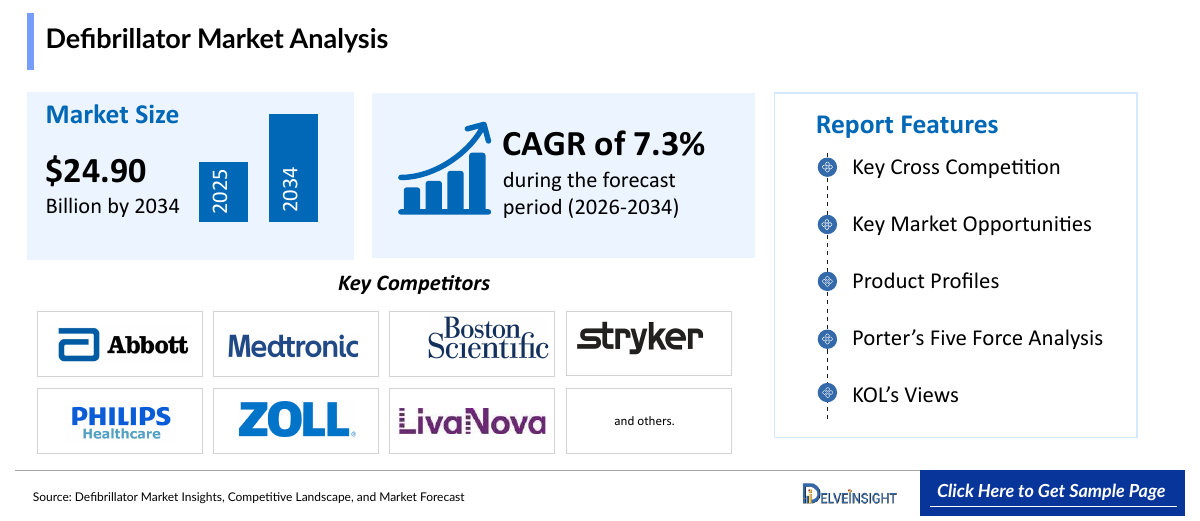
- The Defibrillator market is estimated at USD 13.20 billion in 2025 and is projected to reach USD 24.90 billion by 2034. Growth is anchored in the rising burden of cardiovascular disease and sudden cardiac arrest, expanding public-access defibrillation, and continuous innovation in implantable and wearable defibrillation technologies.
- The global Defibrillator market is growing at a CAGR of 7.3% during the forecast period from 2026 to 2034.
- By product type, the implantable cardioverter defibrillator (ICD) segment dominated the Defibrillator market with a 68% share in 2025.
- By end-user, the hospitals segment dominated the Defibrillator market with a 69% share in 2025.
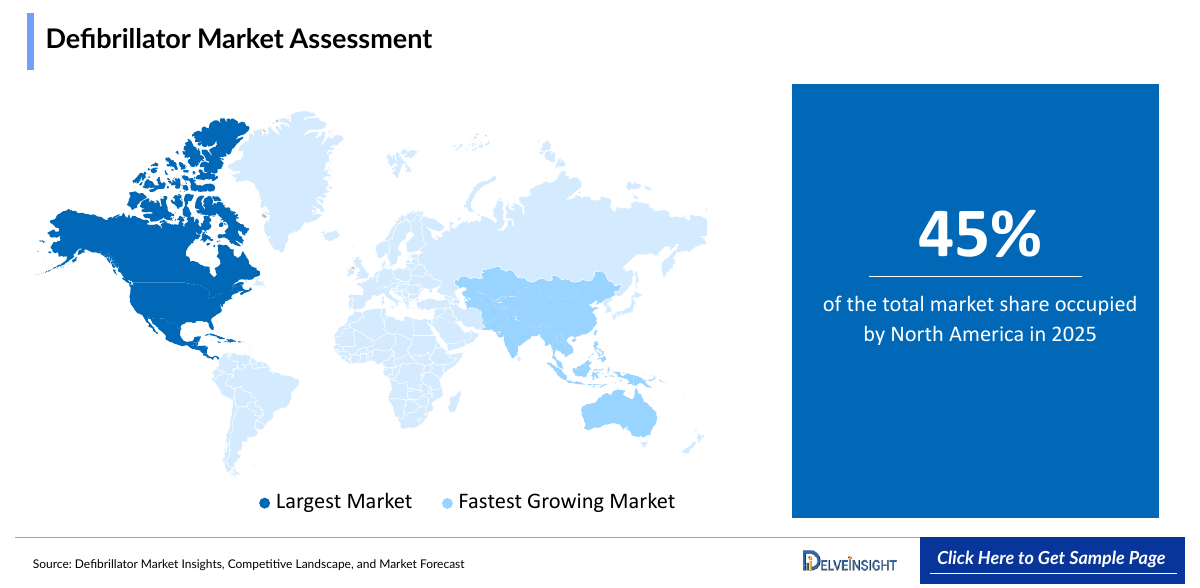
- North America dominated the global Defibrillator market revenue with a 45% share in 2025, representing the highest regional market share globally.
A defibrillator is a life-saving medical device that delivers a controlled electrical shock to the heart to terminate life-threatening arrhythmias, principally ventricular fibrillation and pulseless ventricular tachycardia, and restore a normal rhythm. Defibrillators fall into two broad families. Implantable cardioverter defibrillators (ICDs) are surgically placed devices that continuously monitor heart rhythm and automatically deliver anti-tachycardia pacing or shocks, and they include single-chamber ICDs, dual-chamber ICDs, cardiac resynchronization therapy defibrillators (CRT-D), and subcutaneous ICDs (S-ICD). External defibrillators are used outside the body by clinicians, first responders, or lay bystanders, and include semi-automated devices, automated external defibrillators (AEDs), and wearable cardioverter defibrillators. The market is organized by product type across implantable and external defibrillators; by end-user across hospitals, ambulatory surgical centers, homecare settings, and others; and by geography across North America, Europe, Asia-Pacific, and the Rest of the World. Driven by the global burden of cardiovascular disease, the expansion of public-access defibrillation programs, and innovation in extravascular, leadless-compatible, connected, and wearable systems, defibrillators have become essential infrastructure in the prevention and treatment of sudden cardiac death.
Defibrillator Market Key Growth Drivers
- The rising burden of cardiovascular disease and sudden cardiac arrest is driving demand, with the World Health Organization estimating that cardiovascular diseases caused about 19.8 million deaths worldwide in 2022 and more than 350,000 out-of-hospital cardiac arrests occurring in the United States each year.
- Population aging and the growing prevalence of heart failure and ventricular arrhythmias are expanding the pool of patients eligible for ICD and CRT-D therapy.
- Public-access defibrillation programs, AED mandates in schools, workplaces, and transport hubs, and heightened public awareness are expanding the installed base of automated external defibrillators, with survival chances falling by roughly 10% for every minute defibrillation is delayed.
- Technology innovation, including extravascular ICDs, subcutaneous and modular leadless-compatible systems, conduction-system-pacing-capable defibrillators, connected AEDs, and AI-enabled wearable defibrillators, is broadening clinical indications and patient acceptance.
- A steady cadence of regulatory approvals and product launches, such as the 2026 FDA approval of BIOTRONIK's Acticor Sky and Rivacor Sky systems and the 2025 FDA premarket approval of ZOLL's Zenix monitor/defibrillator, is refreshing the installed base and supporting replacement demand.
- The shift of care toward ambulatory and home settings, supported by wearable defibrillators, home AEDs, and remote monitoring, is opening new demand channels beyond the hospital.
- The convergence of disease burden, public-access expansion, innovation, and care-setting shift is expected to sustain steady, high-single-digit growth in the market through 2034.
Key Companies in Defibrillator Market
The competitive landscape is led by the following active manufacturers:
- Abbott
- Medtronic
- Boston Scientific Corporation
- Stryker
- Koninklijke Philips N.V.
- ZOLL Medical Corporation
- MicroPort Scientific Corporation
- LivaNova PLC
- Biotronik, Inc.
- Nihon Kohden Corporation
For illustrative purposes, only the top 10 companies are listed in the Table of Contents. The report may include analysis and references to additional companies relevant to the market assessment.
Defibrillator Market Size
The following snapshot summarizes the principal report metrics for the Defibrillator market.
|
Report Metrics |
Details |
|
2025 Market Size |
USD 13.20 billion |
|
2034 Projected Market Size |
USD 24.90 billion |
|
Growth Rate (2026-2034) |
7.3% CAGR |
|
Largest Market |
North America |
|
Fastest Growing Market |
Asia-Pacific |
|
Market Structure |
Moderately Concentrated |
All market values are expressed in USD and represent DelveInsight estimates synthesized from primary and secondary research.
Factors Contributing to the Growth of the Defibrillator Market
Market Drivers
Rising Burden of Cardiovascular Disease and Sudden Cardiac Arrest
The most powerful driver of the Defibrillator market is the large and growing burden of cardiovascular disease. The World Health Organization estimates that cardiovascular diseases caused about 19.8 million deaths worldwide in 2022, making them the leading cause of death globally, while in the United States more than 350,000 cardiac arrests occur outside the hospital every year and survival to hospital discharge remains around 10%. Because ventricular fibrillation is reversible only through rapid defibrillation, and survival chances fall by roughly 10% for every minute of delay, defibrillators are among the most time-critical and highest-value interventions in cardiology. Implantable devices protect patients who have survived a prior arrest or carry a high risk of ventricular arrhythmia, while external devices serve the far larger population at risk of an unexpected event. As ischemic heart disease, cardiomyopathy, and arrhythmia prevalence rise, demand for both implantable and external defibrillators expands in step, anchoring market growth through 2034.
Population Aging and Growth in Heart Failure
Demographic change is steadily enlarging the addressable patient pool. Older adults carry the highest prevalence of heart failure, prior myocardial infarction, and ventricular arrhythmia, which are the principal clinical indications for ICD and CRT-D therapy under major cardiology guidelines. Improved survival after myocardial infarction and better long-term heart-failure management are also creating a larger cohort of patients who live long enough to qualify for device therapy. Combination CRT-D devices, which pair resynchronization with defibrillation for patients with heart failure and conduction delay, are benefiting directly from this trend. Rising life expectancy in Japan, Europe, China, and North America, together with greater referral and screening of at-risk patients, supports sustained procedure volumes and device replacement cycles across the forecast period.
Expansion of Public-Access Defibrillation and AED Adoption
Public-access defibrillation is reshaping the external defibrillator segment. Governments, schools, employers, sports venues, airports, and transport operators are deploying AEDs at scale, supported by Good Samaritan protections, workplace and school requirements, and CPR and AED training campaigns. Public awareness has been reinforced by high-profile cardiac arrest events, including the January 2023 collapse of an NFL player on live television, and the CARES registry reports that bystander AED use among patients who arrested in public has climbed to its highest level since 2016. Modern AEDs offer voice prompts, CPR coaching, self-testing, and cloud-connected fleet management, making them easier to use and maintain. As installation expands and aging units are replaced, AED demand creates a durable, recurring revenue stream for external defibrillator manufacturers through the forecast period.
Technology Innovation Broadening Clinical Indications
Continuous innovation is expanding what defibrillators can do and who can receive them. Medtronic's Aurora extravascular ICD, approved by the FDA in October 2023, places the lead outside the heart and veins to reduce long-term lead complications, and competitors, including Abbott, through its January 2026 collaboration with AtaCor Medical, are advancing rival extravascular systems. Boston Scientific's subcutaneous ICD and its modular mCRM system, which pairs the S-ICD with a leadless pacemaker, point toward fully leadless rhythm management. BIOTRONIK's Acticor Sky and Rivacor Sky devices are billed as the first high-voltage systems capable of left bundle branch area pacing. On the external side, connected AEDs, advanced monitor/defibrillators, and AI-enabled wearable defibrillators are improving usability and response. These advances widen the eligible population and encourage upgrades, directly supporting market growth.
Regulatory Approvals, Product Launches, and Replacement Demand
A steady flow of regulatory approvals and launches is refreshing portfolios and the installed base. In addition to the Aurora EV-ICD approval, BIOTRONIK received FDA approval for its Acticor Sky and Rivacor Sky ICD and CRT-D systems in April 2026 after a CE-market launch in February 2026, ZOLL's Zenix monitor/defibrillator received FDA premarket approval in October 2025 and EU MDR approval in February 2026, and Stryker launched its LIFEPAK 35 monitor/defibrillator in 2024 as a successor to the long-serving LIFEPAK 15. Each approval brings new features, longer battery life, and improved connectivity that motivate hospitals, emergency medical services, and public-access operators to replace aging equipment. Because defibrillators are class III devices that require rigorous premarket approval, new products create meaningful differentiation and reinforce the leadership of established manufacturers across the forecast period.
Shift Toward Ambulatory, Homecare, and Remote-Monitored Care
Care delivery is migrating beyond the hospital, and defibrillation is following. Wearable cardioverter defibrillators such as ZOLL's LifeVest, whose next-generation version launched in the United States in January 2026, protect patients at temporary risk, for example after myocardial infarction or while an ICD decision is pending, without requiring an implant. Home AEDs serve high-risk households, and remote monitoring of implanted devices allows clinicians to track arrhythmias, battery status, and heart-failure indicators between visits. Ambulatory surgical centers are increasingly positioned for lower-complexity device procedures as outpatient pathways mature. This shift widens the range of settings in which defibrillators are prescribed and supported, expanding the market beyond traditional inpatient use and supporting recurring revenue from monitoring, consumables, and service.
Healthcare Infrastructure Investment and Strategic Portfolio Moves
Healthcare investment in Asia-Pacific, Latin America, and the Middle East, combined with active portfolio reshaping among leading manufacturers, is broadening the market. Philips agreed in 2025 to sell its Emergency Care business, including AEDs and advanced life support defibrillators, to Bridgefield Capital under a brand-license arrangement of up to 15 years, while Nihon Kohden approved the acquisition of a 90.3% stake in DOWELL Co., Ltd. in January 2026 to extend its medical-technology capabilities. Meanwhile, Abbott, Medtronic, Boston Scientific, and BIOTRONIK continue to invest in next-generation rhythm-management platforms. Growing hospital capacity, emergency medical services, and cardiac-care programs in emerging economies, together with this corporate activity, are expanding availability and sustaining competition and innovation.
Market Restraints
Despite strong momentum, the Defibrillator market faces material constraints. The high cost of implantable devices, implant procedures, and follow-up care, together with uneven reimbursement across countries, limits adoption in cost-sensitive and emerging markets. Implant-related complications, including lead failure, infection, vascular injury, and inappropriate shocks, create clinical risk, drive revisions, and can discourage patients and referring physicians. Stringent regulatory requirements, including FDA premarket approval and EU MDR certification, lengthen development timelines and raise costs, and the industry has seen recalls tied to issues such as power-supply failures and unexpected device shutdowns. Evolving clinical evidence, such as debate over the benefit of primary-prevention ICDs in some non-ischemic cardiomyopathy patients, may temper implant volumes, while a limited supply of trained electrophysiologists and implanting physicians constrains access in many regions. In external defibrillation, low public awareness, insufficient CPR and AED training, and the ownership burden of maintenance, batteries, and electrode pads can limit effective use. Together, these cost, safety, regulatory, evidence, and workforce barriers temper the pace of growth, even as the underlying drivers of cardiovascular disease burden, aging, and public-access expansion remain firmly intact.
Defibrillator Market Segment Analysis
The Defibrillator Market is segmented by product type (implantable cardioverter defibrillator [single chamber ICD, dual chamber ICD, CRT-D, subcutaneous ICD (S-ICD)], and external defibrillator [semi-automated, automated, and wearable]), end-user (hospitals, ambulatory surgical centers, homecare settings, and others), and geography (North America, Europe, Asia-Pacific, and Rest of World).
By Product Type
Dominant Subsegment: Implantable Cardioverter Defibrillator (ICD).
The implantable cardioverter defibrillator segment accounted for 68% of the Defibrillator market in 2025. ICDs are the leading product type because they deliver continuous, long-term protection for patients at high risk of sudden cardiac death, command far higher unit values than external devices, and generate recurring revenue from replacement, leads, programmers, and remote monitoring. Established guideline support for secondary prevention and for selected primary-prevention patients with reduced ejection fraction, together with the expanding use of CRT-D in heart failure, sustains large and dependable implant volumes. Dual chamber ICDs and CRT-D devices anchor value, while subcutaneous ICDs and the new extravascular ICDs are gaining ground among patients who want to avoid transvenous leads, supported by innovation from Boston Scientific, Medtronic, Abbott, and BIOTRONIK. External defibrillators, spanning semi-automated devices, AEDs, and wearable cardioverter defibrillators, are the faster-growing product type, propelled by public-access defibrillation programs, connected AEDs, and wearable adoption. Nonetheless, the high value, recurring nature, and clinical permanence of implantable therapy secure the ICD segment's leadership across the forecast period.
By End-User
Dominant Subsegment: Hospitals.
The hospitals segment accounted for 69% of the Defibrillator market in 2025. Hospitals are the leading end-user because ICD and CRT-D implantation, device programming, lead revision, and follow-up are performed predominantly in hospital electrophysiology and cardiac catheterization laboratories by specialist teams. Hospitals also purchase and maintain the largest fleets of manual, semi-automated, and automated defibrillators for emergency departments, intensive care units, operating rooms, wards, and crash carts, and they are the primary buyers of professional monitor/defibrillators used by emergency medical services. Established reimbursement for inpatient and hospital-outpatient device procedures, along with strong replacement cycles, reinforces the segment's scale. Homecare settings are the fastest-growing end-user, driven by wearable defibrillators, home AEDs, and remote monitoring, while ambulatory surgical centers are gaining share as lower-complexity device procedures shift to outpatient pathways, and the others category captures public-access and emergency-response buyers. Nonetheless, the concentration of implant procedures and equipment purchasing in hospitals secures their clear leadership across the forecast period.
Defibrillator Market Region Analysis
Dominant Region: North America
North America accounted for 45% of the global Defibrillator market revenue in 2025, representing the highest regional market share globally. The region's dominance reflects a high burden of cardiovascular disease, widespread ICD and CRT-D implantation supported by established reimbursement, and the presence of leading manufacturers including Medtronic, Boston Scientific, Abbott, Stryker, and ZOLL. The United States has one of the most extensive public-access defibrillation ecosystems in the world, supported by Good Samaritan protections, workplace and school AED programs, and strong emergency medical services networks. Early FDA approvals of novel systems, such as the Aurora extravascular ICD and the Zenix monitor/defibrillator, give patients and clinicians first access to new technology, while high healthcare spending and rapid adoption of connected and remote-monitored devices reinforce demand. Reimbursement strength, regulatory clarity, and a dense network of electrophysiology centers anchor the region's continued leadership across the forecast period.
Fastest Growing Region: Asia-Pacific
Asia-Pacific is the fastest-growing region in the Defibrillator market. The region's elevated CAGR is driven by a rising burden of cardiovascular disease, rapidly aging populations, expanding healthcare infrastructure, and growing awareness of sudden cardiac arrest across China, Japan, India, South Korea, and Australia. Japan combines one of the world's oldest populations with long-standing public AED availability and domestic leaders such as Nihon Kohden; China is scaling cardiac-care capacity and local manufacturers such as MicroPort; and India is expanding cardiology access and CPR and AED training. Government healthcare investment, rising procedure volumes, and increasing public-access defibrillation initiatives are accelerating adoption, while global manufacturers expand local presence and regulatory registrations. The combination of high disease burden, infrastructure build-out, and growing device access positions Asia-Pacific as the principal source of incremental growth over the forecast period.
Regional Commentary
North America
North America accounted for 45% of the global Defibrillator market revenue in 2025. The United States dominates on the strength of its high ICD implantation rates, established reimbursement, extensive public-access defibrillation programs, early access to FDA-approved innovation, and the home bases of leading manufacturers, while Canada and Mexico contribute through expanding cardiac-care and emergency-response networks.
Europe
Europe is a large and advanced regional market, supported by a strong cardiology and electrophysiology base, established CE-marking and EU MDR frameworks, and universal-coverage healthcare systems in Germany, the United Kingdom, France, Italy, and Spain. Home-grown manufacturers such as BIOTRONIK and Philips, together with early CE-market launches such as BIOTRONIK's Acticor Sky and Rivacor Sky and ZOLL's MDR-approved AED 3 and Zenix, reinforce the region's role in both implantable and external defibrillation, while national public-access defibrillation programs continue to widen AED coverage.
Asia-Pacific
Asia-Pacific is the fastest-growing region, propelled by a rising burden of cardiovascular disease, rapid population aging, and growing healthcare investment across China, Japan, India, South Korea, and Australia. Japan's mature AED ecosystem and domestic manufacturers, China's expanding cardiac-care infrastructure and local device makers, and India's growing cardiology access and CPR training are accelerating regional adoption and procedure volumes.
Rest of World
The Rest of World region, spanning Latin America, the Middle East, and Africa, is an emerging growth frontier. Expanding hospital and emergency-care infrastructure, rising cardiovascular disease prevalence, and growing awareness of sudden cardiac arrest are gradually broadening access to both implantable and external defibrillators, while international partnerships, distributor networks, and regulatory harmonization support the build-out of regional capacity.
Defibrillator Market Competitive Landscape
The Defibrillator market is classified as Moderately Concentrated. In implantable defibrillators, a small group of global cardiac rhythm management leaders, including Medtronic, Abbott, and Boston Scientific, anchors the top tier through broad ICD, CRT-D, and subcutaneous portfolios, deep clinical evidence, and large electrophysiology sales forces, with BIOTRONIK and MicroPort challenging through differentiated devices. In external defibrillation, ZOLL, Philips, Stryker, and Nihon Kohden compete across AEDs, professional monitor/defibrillators, and wearable systems through connected-device ecosystems, emergency medical services relationships, and public-access channels, increasing competition in the fastest-growing product segments.
The competitive landscape can be evaluated across the following dimensions:
- Market concentration: Moderately concentrated, with a few global leaders dominating implantable defibrillators and a more fragmented, multi-vendor field in external defibrillators.
- Leading players: Medtronic, Abbott, and Boston Scientific anchor implantable therapy, while ZOLL, Philips, Stryker, and Nihon Kohden lead external defibrillation.
- Geographic reach: Leaders operate global sales, service, and clinical-support networks; Philips' emergency care business alone serves more than 130 countries with an installed base of more than 3 million AEDs and advanced life support devices.
- Product portfolio strength: Top players offer end-to-end portfolios spanning single chamber, dual chamber, CRT-D, and subcutaneous or extravascular ICDs, as well as AEDs, monitor/defibrillators, and wearable defibrillators.
- Clinical evidence and regulatory track record: Large pivotal trials, long-term registry data, and successful FDA premarket approval and EU MDR certification are decisive advantages in a class III device market.
- Strategic partnerships: Collaborations such as Abbott's January 2026 tie-up with AtaCor Medical on extravascular ICDs and Boston Scientific's modular pairing of the S-ICD with a leadless pacemaker extend technology reach.
- M&A and portfolio activity: Active reshaping, including Philips' agreement to sell its Emergency Care business to Bridgefield Capital and Nihon Kohden's approval to acquire a 90.3% stake in DOWELL Co., Ltd.
- Manufacturing and quality capabilities: High-reliability device manufacturing, battery and high-voltage electronics expertise, and robust post-market surveillance are key competitive moats.
- Innovation focus: Extravascular and leadless-compatible ICDs, conduction-system-pacing-capable devices, connected and cloud-managed AEDs, AI-enabled wearables, and remote monitoring.
Defibrillator Market Recent Developmental Activities
In April 2026, BIOTRONIK, Inc. received U.S. FDA approval for its Acticor Sky and Rivacor Sky ICD and CRT-D systems, which add physiology-driven pacing options, a new anti-tachycardia pacing suite, and workflow features such as automated heart-failure insight and 24/7 MRI readiness. Strategic significance: Brings BIOTRONIK's next-generation high-voltage platform to the U.S., the largest implantable defibrillator market.
In March 2026, Medtronic received FDA approval for an expanded indication of a defibrillation lead for use with conduction system pacing. Strategic significance: Extends Medtronic's defibrillation lead portfolio into physiological pacing approaches and reinforces its leadership in implantable rhythm management.
In February 2026, ZOLL Medical Corporation, announced that its AED 3 automated external defibrillator and Zenix monitor/defibrillator received EU Medical Device Regulation approval. Strategic significance: Secures European market access for ZOLL's flagship external defibrillators under the stricter MDR framework.
In February 2026, BIOTRONIK, Inc., launched its Acticor Sky and Rivacor Sky ICD and CRT-D family across CE markets, featuring the world's first CE-approved high-voltage device capable of left bundle branch area pacing. Strategic significance: Establishes a first-mover position in conduction-system-pacing-capable defibrillators in Europe.
In January 2026, Abbott announced a collaboration with AtaCor Medical to advance an investigational extravascular ICD system, with a pivotal IDE trial (ALARION EV) planned for 2026. Strategic significance: Positions Abbott to compete in the extravascular ICD category pioneered by Medtronic's Aurora system.
In January 2026, ZOLL Medical Corporation launched its next-generation LifeVest wearable cardioverter defibrillator in the United States. Strategic significance: Strengthens ZOLL's leadership in wearable defibrillation and supports growth of ambulatory and homecare protection.
In January 2026, Nihon Kohden Corporation approved the acquisition of a 90.3% stake in DOWELL Co., Ltd. Strategic significance: Extends Nihon Kohden's scale in adjacent medical-technology capabilities across its resuscitation and patient-monitoring portfolio.
In October 2025, ZOLL Medical Corporation received FDA premarket approval for its Zenix monitor/defibrillator for emergency medical services and hospital use. Strategic significance: Refreshes ZOLL's professional defibrillator lineup and supports replacement demand among EMS and hospital customers.
In February 2025, Koninklijke Philips N.V. signed an agreement to sell its Emergency Care business, which includes AEDs and advanced life support defibrillators, to Bridgefield Capital, with an exclusive brand license of up to 15 years. Strategic significance: Marks a major ownership change among top-tier external defibrillator suppliers and sharpens Philips' strategic focus.
In June 2024, Stryker launched its LIFEPAK 35 monitor/defibrillator, a modern, touchscreen-based platform designed to succeed the LIFEPAK 15. Strategic significance: Renews Stryker's flagship professional defibrillator platform for EMS and hospital customers.
In May 2024, Boston Scientific Corporation reported that the pivotal MODULAR ATP study of its mCRM system, which pairs the EMBLEM S-ICD with the EMPOWER leadless pacemaker, met its primary safety and effectiveness endpoints at six months. Strategic significance: Validates a modular, fully leadless approach to tachycardia therapy and builds on Boston Scientific's S-ICD franchise.
In October 2023, Medtronic received FDA approval for its Aurora extravascular ICD, the first defibrillation system to place the lead outside the heart and veins while providing anti-tachycardia and backup pacing. Strategic significance: Creates a new ICD category and opens a pathway for patients who are not ideal candidates for transvenous systems.
Defibrillator Market Segmentation
Defibrillator Market by Product Type
- Implantable Cardioverter Defibrillator (ICD)
- Single Chamber ICD
- Dual Chamber ICD
- CRT-D
- Subcutaneous ICD (S-ICD)
- External Defibrillator
- Semi-Automated
- Automated
- Wearable
Defibrillator Market by End-User
- Hospitals
- Ambulatory Surgical Centers
- Homecare Settings
- Others
Defibrillator Market by Geography
- North America Defibrillator Market
- United States Defibrillator Market Size in USD million (2023-2034)
- Canada Defibrillator Market Size in USD million (2023-2034)
- Mexico Defibrillator Market Size in USD million (2023-2034)
- Europe Defibrillator Market
- Germany Defibrillator Market Size in USD million (2023-2034)
- United Kingdom Defibrillator Market Size in USD million (2023-2034)
- France Defibrillator Market Size in USD million (2023-2034)
- Italy Defibrillator Market Size in USD million (2023-2034)
- Spain Defibrillator Market Size in USD million (2023-2034)
- Rest of Europe Defibrillator Market Size in USD million (2023-2034)
- Asia-Pacific Defibrillator Market
- China Defibrillator Market Size in USD million (2023-2034)
- Japan Defibrillator Market Size in USD million (2023-2034)
- India Defibrillator Market Size in USD million (2023-2034)
- Australia Defibrillator Market Size in USD million (2023-2034)
- South Korea Defibrillator Market Size in USD million (2023-2034)
- Rest of Asia-Pacific Defibrillator Market Size in USD million (2023-2034)
- Rest of the World (RoW) Defibrillator Market
- Middle East Defibrillator Market Size in USD million (2023-2034)
- Africa Defibrillator Market Size in USD million (2023-2034)
- South America Defibrillator Market Size in USD million (2023-2034)
Defibrillator Market Recent Industry Trends and Milestones (2023-2026)
|
Category |
Key Developments |
|
Defibrillator Market Product Approval |
Regulatory momentum is refreshing implantable and external defibrillator portfolios. Medtronic received FDA approval for its Aurora extravascular ICD in October 2023, BIOTRONIK secured CE-market launch (February 2026), and FDA approval (April 2026) for its Acticor Sky and Rivacor Sky ICD and CRT-D systems, and Medtronic obtained an expanded FDA indication for a defibrillation lead for conduction system pacing in March 2026. On the external side, ZOLL's Zenix monitor/defibrillator received FDA premarket approval in October 2025 and EU MDR approval in February 2026, alongside MDR approval for the ZOLL AED 3. Each approval introduces new clinical capability and drives replacement demand across hospitals, emergency medical services, and public-access programs. |
|
Defibrillator Market Expansion |
Manufacturers broadened portfolios across the value chain. Stryker launched its LIFEPAK 35 monitor/defibrillator and introduced the LIFEPAK CR2 AED in India in 2024, ZOLL launched its next-generation LifeVest wearable cardioverter defibrillator in the United States in January 2026, and Boston Scientific advanced its modular mCRM system, pairing the EMBLEM S-ICD with the EMPOWER leadless pacemaker. Connected AEDs with cloud dashboards and fleet-management software, remote monitoring of implanted devices, and AI-enabled alarm reduction in wearables improved usability, uptime, and clinical insight. |
|
Defibrillator Market Investment |
Strategic capital and portfolio activity accelerated. Philips agreed to sell its Emergency Care business, including AEDs and advanced life support defibrillators, to Bridgefield Capital in 2025 under a brand license of up to 15 years; Nihon Kohden approved the acquisition of a 90.3% stake in DOWELL Co., Ltd. in January 2026, and Abbott entered a collaboration with AtaCor Medical in January 2026 to advance an extravascular ICD, with a pivotal trial planned for 2026. Leading manufacturers continued to invest in clinical evidence, next-generation rhythm-management platforms, and local presence in Asia-Pacific. |
|
Company Strategy |
Abbott: Next-generation rhythm management, including the AtaCor extravascular ICD collaboration. Medtronic: Category leadership through the Aurora EV-ICD and conduction-system-pacing-compatible leads. Boston Scientific Corporation: S-ICD leadership and the modular leadless mCRM system. Stryker: Professional monitor/defibrillator renewal through LIFEPAK 35 and public-access AEDs. Koninklijke Philips N.V.: Continued AED and resuscitation presence through its Emergency Care business under a brand license following the sale to Bridgefield Capital. ZOLL Medical Corporation: Connected AEDs, Zenix, and the LifeVest wearable defibrillator. MicroPort Scientific Corporation: Cardiac rhythm management portfolio and growth in China and international markets. LivaNova PLC: Cardiac rhythm management heritage within a broader medical-technology portfolio. Biotronik, Inc.: Acticor Sky and Rivacor Sky with conduction-system-pacing capability. Nihon Kohden Corporation: AEDs, patient monitoring, and expansion in Asia through new subsidiaries and the DOWELL acquisition. |
|
Emerging Technologies |
Extravascular ICDs that place the defibrillation lead outside the heart and veins are the leading edge of implantable innovation, alongside subcutaneous and modular leadless-compatible systems and high-voltage devices capable of conduction system pacing. Connected AEDs with self-test telemetry, cloud fleet management, and CPR feedback, together with AI-driven wearable defibrillator algorithms that reduce false alarms, are improving readiness and usability. Remote monitoring platforms that combine arrhythmia, battery, and heart-failure indicators are expanding, while apps and dispatch integrations that guide trained bystanders to the nearest AED are emerging, and collaboration between manufacturers, clinicians, and emergency services is accelerating clinical translation. |
Defibrillator Market Startup Funding and Investment Trends
|
Company |
Total Funding |
Funding Stage |
Main Offering |
Core Technology |
|
Philips Emergency Care Business |
Terms undisclosed |
Sold to Bridgefield Capital (2025) |
AEDs and ALS defibrillators |
Resuscitation and emergency care devices |
|
Request to unlock the report on the @ Defibrillator Market | ||||
Investment in the Defibrillator ecosystem has concentrated on extravascular and leadless-compatible implantable technologies, connected external defibrillators, and portfolio realignment among established players. The following companies illustrate recent funding and investment activity and technology focus.
Capital and strategic activity are flowing toward extravascular ICD technology, connected external defibrillators, and portfolio realignment. Philips' agreement to sell its Emergency Care business to Bridgefield Capital, Nihon Kohden's approved acquisition of a 90.3% stake in DOWELL Co., Ltd., and Abbott's collaboration with AtaCor Medical underscore the strategic value of resuscitation and defibrillation capability. Emerging innovators such as AtaCor Medical are advancing extravascular defibrillation, while established leaders including Medtronic, Boston Scientific, BIOTRONIK, and ZOLL continue to invest in next-generation implantable, wearable, and connected platforms. Collectively, these moves signal conviction that extravascular and leadless-compatible ICDs, conduction-system-pacing-capable devices, connected AEDs, and wearable protection will define the next phase of competitive advantage in the global Defibrillator market.
Key Takeaways from the Defibrillator Market Report Study
- Market size analysis for the current Defibrillator market size (2025), and market forecast for 9 years (2026 to 2034).
- Top key product/technology developments, mergers, acquisitions, partnerships, and joint ventures that happened over the last 3 years.
- Key companies dominating the global Defibrillator market.
- Various opportunities available for competitors in the Defibrillator market space.
- What are the top-performing segments in 2025? How will these segments perform in 2034?
- Which are the top-performing regions and countries in the current Defibrillator market scenario?
- Which are the regions and countries where companies should concentrate their opportunities for Defibrillator market growth in the future?
Target audience who can benefit from this Defibrillator market report study
- Defibrillator product providers
- Research organizations and consulting companies
- Defibrillator -related organizations, associations, forums, and other alliances
- Government and corporate offices
- Start-up companies, venture capitalists, and private equity firms
- Distributors and traders dealing in defibrillators
- Various end-users who want to know more about the Defibrillator market and the latest technological developments in the Defibrillator market.