Dry Age-related Macular Degeneration Epidemiology
Dry Age-related Macular Degeneration (AMD) Insights and Trends
- Dry AMD may advance to geographic atrophy, resulting in irreversible vision loss due to the depletion of retinal pigment epithelium (RPE), photoreceptors, and choriocapillaris in the macula.
- Early diagnosis, regular monitoring, and lifestyle modifications remain critical in the comprehensive management of dry AMD.
- In 2025, the total number of prevalent cases of geographic atrophy was ~831,100 in the US. These cases are projected to increase by 2036.
- In the US, the total age-specific cases of geographic atrophy were the highest in the age group 85+ years followed by 65-84 years and ≤64 years age group in 2025.
- Early-stage dry AMD is frequently underdiagnosed because patients are often asymptomatic or present with subtle visual changes that may go unnoticed, leading to delayed detection despite the availability of advanced imaging tools such as OCT.
- There is a significant unmet need for standardized, large-scale screening programs and accessible diagnostic infrastructure, particularly in emerging markets, to enable early identification and monitoring of disease progression before irreversible vision loss occurs.
Dry Age-related Macular Degeneration (AMD) Epidemiology Forecast in the US
- 2025 Prevalent Cases of Dry AMD: ~68,164,000
- Dry AMD Growth Rate (2026–2036): ~2.5% CAGR
DelveInsight's ‘Dry Age-related Macular Degeneration (AMD) Epidemiology Forecast – 2036’ report delivers an in-depth understanding of the dry AMD, historical and forecasted epidemiology, in the United States, EU4 (Germany, Spain, Italy, and France) and the United Kingdom, and Japan.
|
Study Period
|
2022–2036
|
|
Historical Year
|
2022–2025
|
|
Forecast Period
|
2026–2036
|
|
Base Year
|
2026
|
|
Geographies Covered
|
|
|
Dry Age-related Macular Degeneration (AMD) Epidemiology CAGR
(Forecast period)
|
~2.5% (2026–2036)
|
|
Dry Age-related Macular Degeneration (AMD) Epidemiology Segmentation Analysis
|
Patient Burden Assessment
-
Total Prevalent Cases of AMD
-
Stage-specific Prevalent Cases of AMD
-
Total Prevalent Cases of Geographic Atrophy
-
Total Prevalent Cases of Dry AMD
-
Total Diagnosed Prevalent Cases of Dry AMD
-
Age-specific Cases of Early and Intermediate AMD
-
Age-specific Cases of Geographic Atrophy
-
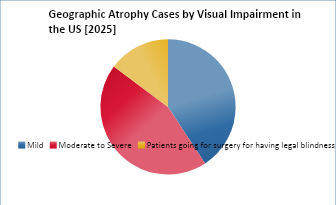
Geographic Atrophy Cases by Visual Impairment
|
Dry Age-related Macular Degeneration (AMD) Understanding and Diagnosis Algorithm
Dry Age-related Macular Degeneration (AMD) Overview
Dry AMD is a chronic, progressive retinal disorder that primarily affects the macula, the central part of the retina responsible for sharp, detailed vision. It is the most common form of age-related macular degeneration. The condition is characterized by the accumulation of extracellular deposits called drusen beneath the retina and gradual degeneration of retinal pigment epithelium (RPE) cells. Over time, this leads to central vision loss, impacting activities such as reading, driving, and recognizing faces. Advanced stages may progress to geographic atrophy, a severe form marked by irreversible retinal cell loss. Risk factors include aging, smoking, genetic predisposition, and cardiovascular conditions.
Further details are provided in the report.
Dry Age-related Macular Degeneration (AMD) Diagnosis
Diagnosis of dry AMD relies on comprehensive ophthalmic evaluation and advanced imaging techniques. Eye care specialists typically use dilated fundus examination to identify drusen and pigmentary changes. Imaging modalities such as OCT provide high-resolution cross-sectional images of the retina, enabling early detection and monitoring of disease progression. Fundus autofluorescence and fluorescein angiography may also be used to assess retinal health and differentiate between dry and wet AMD. Increasingly, artificial intelligence-based tools are being integrated into diagnostic workflows to improve accuracy and facilitate earlier intervention.
Further details are provided in the report.
Dry Age-related Macular Degeneration (AMD) Epidemiology
Key Findings from Dry Age-related Macular Degeneration (AMD) Epidemiological Analysis and Forecast
- In 2025, the total prevalent cases of AMD were ~72,103,000 in the 7MM. These cases are projected to increase by 2036.
- The early and intermediate stages of AMD are major contributors among the stage-specific prevalent cases of AMD. In 2025, the late stage accounted for ~1,846,500 cases in the US.
- In the US, the total age-specific cases of geographic atrophy were 77,570 in the ≤64 years age group in 2025.
- It is observed that early and intermediate AMD occurs majorly in the age group of 65-84 years. In the US, the total age-specific cases of early and intermediate AMD were ~5,024,900 in the ≤64 years in 2025.
Scope of the Report
- The report covers a segment of a descriptive overview of dry AMD, explaining their causes, signs and symptoms, and pathogenesis.
- Comprehensive insight has been provided into the epidemiology segments and forecasts, the future growth potential of the diagnosis rate, and disease progression.
Report Insights
Dry Age-related Macular Degeneration (AMD) Patient Population Forecast
Report Key Strengths
- Epidemiology‑based (Epi‑based) Bottom‑up Forecasting
- 11-year Forecast
- Patient Burden Trends (by geography)
FAQs
- What are the disease risks, burdens, and unmet needs of dry AMD? What will be the growth opportunities across the 7MM concerning the patient population with dry AMD?
- What is the historical and forecasted dry AMD patient pool in the US, EU4 (Germany, France, Italy, and Spain), the UK, and Japan?
Reasons to Buy
- Insights on patient burden/disease prevalence, evolution in diagnosis, and factors contributing to the change in the epidemiology of the disease during the forecast years.
- To understand key opinion leaders’ perspectives around the diagnostic challenges to overcome barriers in the future.
- Detailed insights on various factors hampering disease diagnosis and other existing diagnostic challenges.
1 Key Insights
2 Report Introduction
3 Executive Summary
4 Epidemiology Methodology of Dry Age-related Macular Degeneration (AMD)
5 Dry Age-related Macular Degeneration (AMD) Epidemiology Overview at a Glance
5.1 Patient Share (%) Distribution by Country in 2026
5.2 Patient Share (%) Distribution by Country in 2036
6 Disease Background And Overview of Dry Age-related Macular Degeneration (AMD)
6.1 Introduction
6.2 Causes
6.3 Signs And Symptoms
6.4 Diagnosis
6.4.1 Differential Diagnosis
6.4.2 Diagnostic Algorithm
6.4.3 Diagnostic Guidelines
6.4.3.1 NCCN Guidelines for Diagnosis of Dry Age-related Macular Degeneration (AMD)
7 Epidemiology and Patient Population of Dry Age-related Macular Degeneration (AMD)
7.1 Key Findings
7.2 Assumption and Rationale
7.3 Total Prevalent Cases of Dry Age-related Macular Degeneration (AMD) in the 7MM
7.4 The United States
7.4.1 Total Prevalent Cases of AMD in the United States
7.4.2 Stage-specific Prevalent Cases of AMD in the United States
7.4.3 Total Prevalent Cases of Geographic Atrophy in the United States
7.4.4 Total Prevalent Cases of Dry AMD in the United States
7.4.5 Total Diagnosed Prevalent Cases of Dry AMD in the United States
7.4.6 Age-specific Cases of Early and Intermediate AMD in the United States
7.4.7 Age-specific Cases of Geographic Atrophy in the United States
7.4.8 Geographic Atrophy Cases by Visual Impairment in the United States
7.5 EU4 and the UK
7.5.1 Total Prevalent Cases of AMD in the EU4 and the UK
7.5.2 Stage-specific Prevalent Cases of AMD in the EU4 and the UK
7.5.3 Total Prevalent Cases of Geographic Atrophy in the EU4 and the UK
7.5.4 Total Prevalent Cases of Dry AMD in the EU4 and the UK
7.5.5 Total Diagnosed Prevalent Cases of Dry AMD in the EU4 and the UK
7.5.6 Age-specific Cases of Early and Intermediate AMD in the EU4 and the UK
7.5.7 Age-specific Cases of Geographic Atrophy in the EU4 and the UK
7.5.8 Geographic Atrophy Cases by Visual Impairment in the EU4 and the UK
7.6 Japan
7.6.1 Total Prevalent Cases of AMD in Japan
7.6.2 Stage-specific Prevalent Cases of AMD in Japan
7.6.3 Total Prevalent Cases of Geographic Atrophy in Japan
7.6.4 Total Prevalent Cases of Dry AMD in Japan
7.6.5 Total Diagnosed Prevalent Cases of Dry AMD in Japan
7.6.6 Age-specific Cases of Early and Intermediate AMD in Japan
7.6.7 Age-specific Cases of Geographic Atrophy in Japan
7.6.8 Geographic Atrophy Cases by Visual Impairment in Japan
8 Appendix
8.1 Bibliography
8.2 Report Methodology
9 DelveInsight Capabilities
10 Disclaimer
11 About DelveInsight
List of Tables:
List of Tables
Table 1: Summary of Dry AMD Epidemiology (2021-2034)
Table 2: The Beckman Clinical Classification of AMD
Table 3: AMD Classification in NICE Guidance
Table 4: Environmental Risk Factors for AMD, Divided Into no Modifiable and Modifiable Factors
Table 5: Partially Distinct and Partially Overlapping Risk and Protective Factors for Progression to Geographic Atrophy (Incidence) Versus Progression of Geographic Atrophy (Expansion)
Table 6: Prevalence of Non-vision Threatening AMD in 2019 by Age
Table 7: Prevalence of Vision Threatening AMD in 2019 by Age
Table 8: Total Prevalent Cases of AMD in the 7MM, in thousand (2021-2034)
Table 9: Total Prevalent Cases of Dry AMD in the 7MM, in thousand (2021-2034)
Table 10: Total Prevalent Cases of AMD in the US, in thousand (2021-2034)
Table 11: Stage-specific Prevalent Cases of AMD in the US, in thousand (2021-2034)
Table 12: Total Prevalent Cases of Geographic Atrophy in the US, in thousand (2021-2034)
Table 13: Total Prevalent Cases of Dry AMD in the US, in thousand (2021-2034)
Table 14: Total Diagnosed Prevalent Cases of Dry AMD in the US, in thousand (2021-2034)
Table 15: Age-specific Cases of Early and Intermediate AMD in the US, in thousand (2021-2034)
Table 16: Age-specific Cases of Geographic Atrophy in the US, in thousand (2021-2034)
Table 17: Geographic Atrophy Cases by Visual Impairment in the US, in thousand (2021-2034)
Table 18: Total Prevalent Cases of AMD in EU4 and the UK, in thousand (2021-2034)
Table 19: Stage-specific Prevalent Cases of AMD in EU4 and the UK, in thousand (2021-2034)
Table 20: Total Prevalent Cases of Geographic Atrophy in EU4 and the UK, in thousand (2021-2034)
Table 21: Total Prevalent Cases of Dry AMD in EU4 and the UK, in thousand (2021-2034)
Table 22: Total Diagnosed Prevalent Cases of Dry AMD in EU4 and the UK, in thousand (2021-2034)
Table 23: Age-specific Cases of Early and Intermediate AMD in EU4 and the UK, in thousand (2021-2034)
Table 24: Age-specific Cases of Geographic Atrophy in EU4 and the UK, in thousand (2021-2034)
Table 25: Geographic Atrophy Cases by Visual Impairment in EU4 and the UK, in thousand (2021-2034)
Table 26: Total Prevalent Cases of AMD in Japan, in thousand (2021-2034)
Table 27: Stage-specific Prevalent Cases of AMD in Japan, in thousand (2021-2034)
Table 28: Total Prevalent Cases of Geographic Atrophy in Japan, in thousand (2021-2034)
Table 29: Total Prevalent Cases of Dry AMD in Japan, in thousand (2021-2034)
Table 30: Total Diagnosed Prevalent Cases of Dry AMD in Japan, in thousand (2021-2034)
Table 31: Age-specific Cases of Early and Intermediate AMD in Japan, in thousand (2021-2034)
Table 32: Age-specific Cases of Geographic Atrophy in Japan, in thousand (2021-2034)
Table 33: Geographic Atrophy Cases by Visual Impairment in Japan, in thousand (2021-2034)
List of Figures:
List of Figures
Figure 1: Anatomy of the Fundus and Macula
Figure 2: Clinical Manifestations and Pathology of AMD from the Early to Late Stage
Figure 3: Role of C3 in Complement Overactivation and Progression of Geographic Atrophy
Figure 4: Pathways Involved in AMD Pathogenesis
Figure 5: Cellular Senescence Contributing to AMD
Figure 6: Inflammation in AMD
Figure 7: Biomarkers Used to Assess the Progression of Intermediate AMD
Figure 8: The Royal College of Ophthalmologists Commissioning Diagnostic Guidelines on AMD
Figure 9: Total Prevalent Cases of AMD in the 7MM (2021-2034)
Figure 10: Total Prevalent Cases of Dry AMD in the 7MM (2021-2034)
Figure 11: Total Prevalent Cases of AMD in the US (2021-2034)
Figure 12: Stage-specific Prevalent Cases of AMD in the US (2021-2034)
Figure 13: Total Prevalent Cases of Geographic Atrophy in the US (2021-2034)
Figure 14: Total Prevalent Cases of Dry AMD in the US (2021-2034)
Figure 15: Total Diagnosed Prevalent Cases of Dry AMD in the US (2021-2034)
Figure 16: Age-specific Cases of Early and Intermediate AMD in the US (2021-2034)
Figure 17: Age-specific Cases of Geographic Atrophy in the US (2021-2034)
Figure 18: Geographic Atrophy Cases by Visual Impairment in the US (2021-2034)
Figure 19: Total Prevalent Cases of AMD in EU4 and the UK (2021-2034)
Figure 20: Stage-specific Prevalent Cases of AMD in EU4 and the UK (2021-2034)
Figure 21: Total Prevalent Cases of Geographic Atrophy in EU4 and the UK (2021-2034)
Figure 22: Total Prevalent Cases of Dry AMD in EU4 and the UK (2021-2034)
Figure 23: Total Diagnosed Prevalent Cases of Dry AMD in EU4 and the UK (2021-2034)
Figure 24: Age-specific Cases of Early and Intermediate AMD in EU4 and the UK (2021-2034)
Figure 25: Age-specific Cases of Geographic Atrophy in EU4 and the UK (2021-2034)
Figure 26: Geographic Atrophy Cases by Visual Impairment in EU4 and the UK (2021-2034)
Figure 27: Total Prevalent Cases of AMD in Japan (2021-2034)
Figure 28: Stage-specific Prevalent Cases of AMD in Japan (2021-2034)
Figure 29: Total Prevalent Cases of Geographic Atrophy in Japan (2021-2034)
Figure 30: Total Prevalent Cases of Dry AMD in Japan (2021-2034)
Figure 31: Total Diagnosed Prevalent Cases of Dry AMD in Japan (2021-2034)
Figure 32: Age-specific Cases of Early and Intermediate AMD in Japan (2021-2034)
Figure 33: Age-specific Cases of Geographic Atrophy in Japan (2021-2034)
Figure 34: Geographic Atrophy Cases by Visual Impairment in Japan (2021-2034)