Dry Eye Disease Market Summary
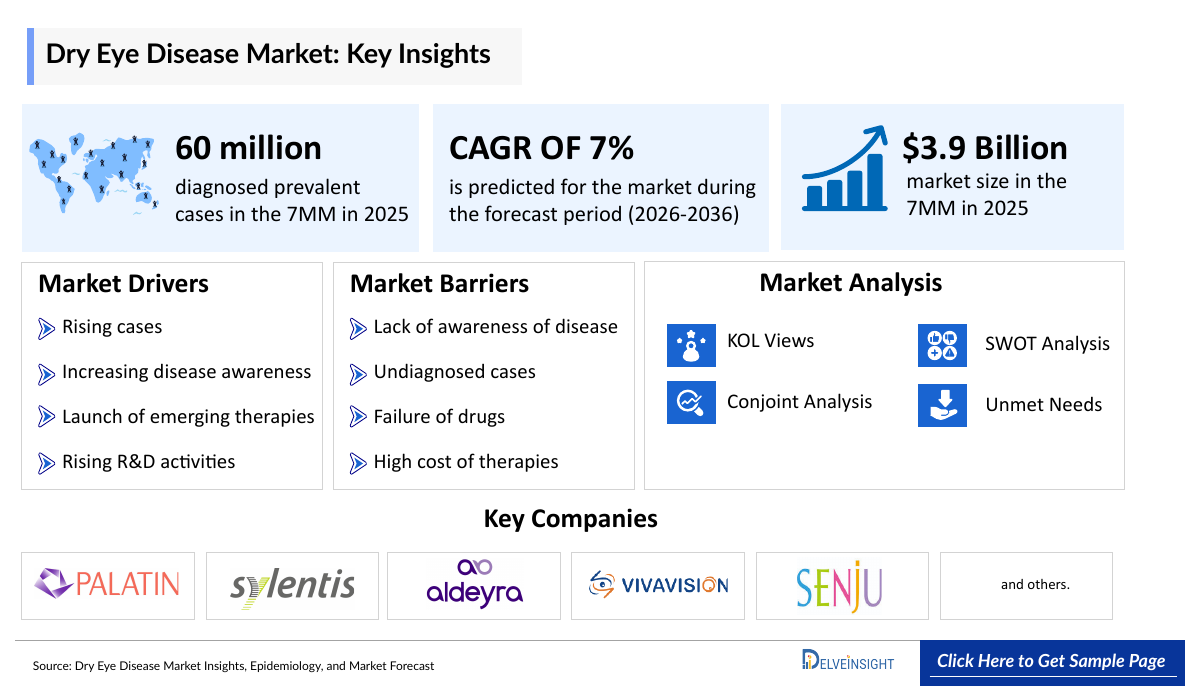
- According to DelveInsight’s analysis, the Dry Eye Disease market across the 7MM was valued at approximately USD 3.9 billion in 2025 and is projected to expand at a CompounDry Eye Disease Annual Growth Rate (CAGR) of ~7%, reflecting steady growth driven by the anticipated entry of advanced therapies and improved clinical management.
- Dry Eye Disease is a multifactorial ocular surface disease characterized by tear-film instability, ocular surface inflammation, and neurosensory abnormalities, resulting in dryness, irritation, fluctuating vision, and ocular discomfort. The disease is broadly categorized into aqueous-deficient and evaporative Dry Eye Disease, although mixed presentations are common, reinforcing the need for differentiated treatment approaches.
- In 2025, the United States accounted for approximately 23 million diagnosed prevalent Dry Eye Disease cases, underscoring the substantial addressable patient population and the commercial opportunity for therapies that provide more durable symptom control and address underlying disease mechanisms.
- Dry Eye Disease management remains multimodal and largely chronic, ranging from OTC artificial tears, lubricants, and warm compresses to prescription anti-inflammatory therapies such as cyclosporine and in-office interventions targeting meibomian gland dysfunction. The approval of TRYPTYR, which stimulates natural tear production through corneal sensory nerve activation, further expands treatment beyond conventional lubrication and anti-inflammatory approaches.
- The therapeutic landscape is increasingly shifting from symptomatic lubrication toward mechanism-specific intervention, with emerging candidates targeting inflammation, tear-film instability, ocular surface damage, and neurosensory dysfunction. PL9643 and AR-15512, together with approved therapies such as MIEBO, VEVYE, AND TRYPTYR, are broadening treatment options across distinct disease pathways, while reproxalap remains under regulatory evaluation. This diversification could increase treatment adoption by enabling greater alignment between therapy choice and underlying Dry Eye Disease phenotype.
Dry Eye Disease Market size and forecast
- 2025 Dry Eye Disease Market Size in the 7MM: ~USD 3.9 billion
- Dry Eye Disease Growth Rate (2026–2036) in the 7MM: ~7% CAGR
DelveInsight's "Dry Eye Disease Market Insights, Epidemiology and Market Forecast – 2036" report delivers an in-depth understanding of Dry Eye Disease, historical and forecasted epidemiology, as well as the Dry Eye Disease therapeutics market trends in the United States, EU4 (Germany, Spain, Italy, and France), the United Kingdom, and Japan.
The Dry Eye Disease market report delivers a comprehensive analysis of the current treatment landscape, including standards of care, clinical practices, and evolving therapeutic algorithms. It evaluates, Dry Eye Disease patient burden trends, revenue & market share dynamics, peak patient share & therapy uptake analysis, and provides an in-depth market size assessment, and growth rate projections (Historical & Forecast 2022–2036) across the 7MM regions. The report highlights key unmet medical needs in Dry Eye Disease and maps the competitive and clinical landscape to uncover high value opportunities, providing a clear outlook on future market growth potential.
Scope of the Dry Eye Disease Market Report | |
|
Study Period |
2022–2036 |
|
Historical Year |
2022–2025 |
|
Forecast Period |
2026–2036 |
|
Base Year |
2025 |
|
Geographies Covered |
ü North America: The US ü Europe: Germany, France, Italy, Spain and the UK ü Asia-Pacific: Japan |
|
Dry Eye Disease Market CAGR (Forecast period) |
~7% (2026-2036) |
|
Dry Eye Disease Epidemiology Segmentation Analysis |
Patient Burden Assesment · Diagnosed Prevalent Cases of DED · Gender Specific Diagnosed Prevalent Cases of DED · Age Specific Diagnosed Prevalent Cases of DED · Severity Specific Diagnosed Prevalent Cases of DED · Treated Cases of DED |
|
Dry Eye Disease Companies |
· Palatin Technologies · Sylentis · Aldeyra Therapeutics · Viva Vision · Senju Pharmaceutical and others |
|
Dry Eye Disease Therapies |
· PL9643 · VVN001 · Tivanisiran (SYL1001) · AZR-MD-001 and others |
|
Dry Eye Disease Market |
Segmented by · Region/Geographies · Drugs/Therapies · Class of Therapies |
|
Analysis |
· Addressable Patient Population · Market drivers and Market barriers · Cost assumptions and Pricing Analogues · KOL views · SWOT analysis · Reimbursement · Attribute analysis · Unmet needs |
Dry Eye Disease Understanding
Dry Eye Disease Overview
Dry Eye Disease is broadly classified according to its predominant underlying mechanism into aqueous-deficient dry eye (ADDE), characterized by reduced tear production, and evaporative dry eye (EDE), characterized by excessive tear evaporation. These categories frequently overlap, with many patients exhibiting features of both mechanisms. Meibomian gland dysfunction (MGD) is a major contributor to evaporative Dry Eye Disease, while lacrimal gland dysfunction, including that associated with autoimmune conditions such as Sjögren syndrome, can contribute to aqueous deficiency. Environmental exposures, aging, contact lens use, and eyelid or blink abnormalities can further exacerbate disease.
Dry Eye Disease Diagnosis
Diagnosis involves a comprehensive assessment of symptoms, tear-film homeostasis, and ocular-surface health. Common evaluations include tear-film breakup time (TBUT) to assess tear-film stability, Schirmer testing to estimate aqueous tear production, and slit-lamp examination with ocular-surface staining to identify corneal and conjunctival damage. Additional assessments of tear osmolarity, tear volume, and meibomian gland function can help determine the predominant Dry Eye Disease subtype and guide treatment selection.
Further details are proviDry Eye Disease in the report...
Dry Eye Disease Treatment Landscape
The current Dry Eye Disease treatment landscape is centered on artificial tears, prescription anti-inflammatory therapies, and measures targeting tear-film instability and meibomian gland dysfunction. In the US, approved options include cyclosporine, XIIDRA, CEQUA, VEVYE, MIEBO, and TRYPTYR, providing treatment options across inflammation, tear evaporation, and tear-production pathways.
Supportive management remains important and includes warm compresses and eyelid hygiene for MGD, artificial tears, environmental modifications, and in-office procedures such as thermal therapies and intense pulsed light (IPL). Despite these options, many patients require long-term or combination treatment, highlighting persistent unmet needs in achieving durable disease control.
The treatment landscape continues to evolve toward mechanism-specific therapies, with emerging candidates such as AZR-MD-001 and PL9643 targeting distinct aspects of Dry Eye Disease pathophysiology. Rebamipide, a mucin secretagogue approved in Japan, further represents the shift toward therapies addressing ocular-surface homeostasis, although evidence demonstrating clear superiority over existing mucin-targeting therapies remains limited.
Further details related to country-based variations are proviDry Eye Disease in the report...
Dry Eye Disease Unmet Needs
The section “unmet needs of Dry Eye Disease” outlines the critical gaps between the current state of patient care, diagnosis, and the ideal & effective management of the disease. It highlights the obstacles experienced by patients, clinicians, and researchers and identifies potential solutions for future progress.
1. Dry Eye Disease remains frequently underdiagnosed and undertreated, partly because the relationship between patient-reported symptoms and clinical signs can be inconsistent.
2. A substantial proportion of patients continue to experience persistent symptoms despite available therapies, highlighting limitations in achieving sustained disease control.
3. Disease heterogeneity and multiple underlying mechanisms contribute to variable treatment responses and make a one-size-fits-all approach challenging.
4. Chronic Dry Eye Disease can substantially impair vision-related quality of life, affecting visual performance, work productivity, daily activities, and overall well-being.
5. There remains an unmet need for more effective, durable, and mechanism-specific treatments that can provide sustained symptom control and enable more personalized management.
Note: Comprehensive unmet needs insights in Dry Eye Disease and their strategic implications are proviDry Eye Disease in the full report...
Dry Eye Disease Epidemiology
The Dry Eye Disease epidemiology section provides insights about the historical and current Dry Eye Disease patient pool and forecasted trends for individual seven major countries. It helps to recognize the causes of current and forecasted trends by exploring numerous studies and views of key opinion leaders. This part of the Dry Eye Disease market report also provides the diagnosed patient pool and their trends along with assumptions undertaken.
Key Findings from Dry Eye Disease Epidemiological Analysis and Forecast
- As of 2025, the total diagnosed prevalent cases of Dry Eye Disease across the 7MM are estimated at approximately 60 million cases, reflecting the significant and growing burden of ocular surface disease.
- In 2025, the gender-specific diagnosed prevalent cases of Dry Eye Disease across the 7MM were estimated at approximately 35% in males and 65% in females, demonstrating a substantially higher disease burden among women.
- Age-specific analysis indicates that individuals aged 50 years and above represented the largest proportion of diagnosed Dry Eye Disease cases across the 7MM in 2025, highlighting the strong association between aging and disease prevalence.
- In 2025, the diagnosed prevalent cases of Dry Eye Disease in Japan were estimated at approximately 1.1 million in the 18-39 years age group, 1.3 million in the 40-49 years age group, and 8.1 million in the 50 years and above age group.
- In 2025, the severity-specific diagnosed prevalent cases of Dry Eye Disease in the UK were estimated to comprise approximately 45% mild, 20% moderate, and 35% severe cases.
Dry Eye Disease Epidemiology Segmentation
- Diagnosed Prevalent Cases of Dry Eye Disease
- Gender Specific Diagnosed Prevalent Cases of Dry Eye Disease
- Age Specific Diagnosed Prevalent Cases of Dry Eye Disease
- Severity Specific Diagnosed Prevalent Cases of Dry Eye Disease
- Treated Cases of Dry Eye Disease
Recent Developments in the Dry Eye Disease Treatment Landscape:
- In April 2026, Senju Pharmaceutical and Mochida Pharmaceutical launched AVAREPT in Japan, expanding the range of approved therapies available for patients with Dry Eye Disease, and, in December 2025, it received manufacturing and marketing approval in Japan for the treatment of Dry Eye Disease, introducing a novel TRPV1 antagonist mechanism to the therapeutic landscape.
- In 2026, AZR-MD-001 continued to advance toward a US. NDA submission, with Azura targeting 2H 2026 after receiving positive FDA pre-NDA feedback. The FDA determined that the CELESTIAL and ARIES studies satisfied the efficacy requirements for approval, while the ASTRO safety database was considered sufficient to support the planned submission.
Dry Eye Disease Drug Analysis & Competitive Landscape
The Dry Eye Disease drug chapter provides a detailed, market-focused review of approved therapies and the emerging pipeline across mid and late Phase Dry Eye Disease clinical trials. It covers mechanism of action, clinical trial data, regulatory approvals, patents, collaborations, strategic partnerships upcoming Key catalyst for each therapy, along with their advantages, limitations, and recent developments. This section offers critical insights into the Dry Eye Disease treatment landscape, supporting market assessment, competitive analysis, and growth forecasting for the Dry Eye Disease therapeutics market.
Approved Therapies for Dry Eye Disease
Lifitegrast (XIIDRA): Bausch + Lomb
Lifitegrast (XIIDRA) is a prescription eye drop acquired by Bausch + Lomb to treat both the signs and symptoms of chronic Dry Eye Disease. As a topical lymphocyte function-associated antigen-1 (LFA-1) antagonist, it blocks the interaction between LFA-1 and ICAM-1, inhibiting the T-cell activation and cytokine release that drives ocular surface inflammation.
- In May 2026, the multi-billion dollar deal also transferred critical development assets to Bausch + Lomb, including SAF312 (an investigational therapy for chronic ocular surface pain) and the rights to use the AcuStream drug delivery device.
- In September 2025, Bausch + Lomb officially finalized the acquisition of XIIDRA from Novartis for up to USD 2.5 billion, integrating the commercialized dry eye giant into its core ophthalmic portfolio to expand its global front-of-eye footprint.
Dry Eye Disease Marketed/Approved Therapies | ||||||
|
Drug/Therapy |
Company |
Indication |
Molecule Type |
MoA |
RoA |
Marketed Region |
|
XIIDRA |
Bausch + Lomb |
DED |
Small Molecule |
LFA-1 antagonist; reduces T-cell adhesion |
Ophthalmic eye drops |
US |
|
TYRVAYA |
Viatris |
DED |
Small Molecule |
Cholinergic agonist |
Intranasal spray |
US |
|
Note: To be continued in the final report | ||||||
Note: Detailed marketed therapies assessment will be proviDry Eye Disease in the final report...
Dry Eye Disease Pipeline Analysis
Tivanisiran (SYL1001): Sylentis
Tivanisiran (SYL1001) is an investigational, first-in-class small interfering RNA (siRNA) developed as preservative-free eye drops by Sylentis (a subsidiary of PharmaMar) to treat the signs and symptoms of Dry Eye Disease. It utilizes RNA interference technology to selectively silence the messenger RNA responsible for producing Transient Receptor Potential Vanilloid-1 (TRPV1), a cell receptor that detects and transmits ocular pain and mediates local inflammatory responses on the eye's surface.
Dry Eye Disease Competitive Landscape of Pipeline Drugs | ||||||
|
Drug Name |
Company |
Highest Phase |
Indication |
RoA |
MoA |
Anticipated Launch in the US |
|
Tivanisiran (SYL1001) |
Sylentis |
Phase III |
DED |
Topical |
TRPV1 siRNA inhibitor |
Information is available in the full report |
|
PL9643 |
Palatin/ Altanispac Labs |
Phase III |
DED |
Topical |
MCR Agonist |
Information is available in the full report |
|
Note: Launch insights are provisional and may change with future report updates or the occurrence of major key catalysts. To be continued in the final report | ||||||
Note: Detailed emerging therapies assessment will be proviDry Eye Disease in the final report.
Dry Eye Disease Key Players, Market Leaders and Emerging Companies
- Sylentis
- Azura Ophthalmics
- Viva Vision
- Senju Pharmaceutical and others
Dry Eye Disease Market Outlook
The market outlook for Dry Eye Disease remains highly favorable, driven by the increasing prevalence of the disease, growing screen exposure, aging populations, and rising awareness among patients and healthcare providers. While currently available therapies primarily target inflammation, tear production, and tear film stabilization, many patients continue to experience persistent symptoms, highlighting significant unmet needs. The emergence of novel therapies with differentiated mechanisms of action, including treatments targeting meibomian gland dysfunction, ocular surface inflammation, and neurosensory abnormalities, is expected to reshape the treatment landscape. Continued innovation, improved diagnostic approaches, and expanding therapeutic options are anticipated to enhance patient outcomes, increase treatment adoption, and support sustained market growth across the 7MM.
Key marketed therapies shaping current management
Overall, in Dry Eye Disease, the launch targeted biologics, improved diagnosis through autoantibody testing (e.g., Anti-AChR), and increasing disease awareness are expected to drive steady growth in the 7MM Dry Eye Disease market from 2022–2036, with strong commercial implications for both marketed products and emerging pipelines.
- Among the 7MM, the United States accounted for the largest market size of Dry Eye Disease, valued at approximately USD 3 billion in 2025, reflecting its dominant position driven by high disease awareness, widespread diagnosis, and strong adoption of prescription therapies.
- Among the European countries, the UK represented the largest Dry Eye Disease market, with a market size of approximately USD 250 million in 2025, supported by a well-established healthcare system and increasing utilization of advanced ophthalmic therapies.
Further details will be proviDry Eye Disease in the report...
Drug Class/Insights into Leading Emerging and Marketed Therapies in Dry Eye Disease (2022–2036 Forecast)
The treatment landscape of Dry Eye Disease is rapidly evolving, with both marketed and emerging therapies targeting inflammation, tear film instability, tear deficiency, excessive tear evaporation, neurosensory abnormalities, and meibomian gland dysfunction. Continued innovation in immunomodulators, secretagogues, TRPV1 antagonists, and novel ocular surface therapies is expected to improve disease control and address persistent unmet needs.
- Calcineurin Inhibitors: This class includes marketed therapies such as Restasis, and Vevye. These agents suppress T-cell activation and reduce ocular surface inflammation, thereby enhancing tear production and improving ocular surface health in patients with chronic Dry Eye Disease.
- LFA-1 Antagonists: Xiidra represents this class and works by inhibiting the interaction between lymphocyte function-associated antigen-1 (LFA-1) and ICAM-1, reducing T-cell-mediated inflammation and alleviating the signs and symptoms of Dry Eye Disease.
Market Access and Reimbursement of Approved therapies in Dry Eye Disease
The report further provides detailed insights on the country-wise accessibility and reimbursement scenarios, cost-effectiveness scenario of approved therapies, programs making accessibility easier and out-of-pocket costs more affordable, insights on patients insured under federal or state government prescription drug programs, etc.
United States
The US health care system includes both private and public health insurance coverage. Whether a drug product is covered, and at what price, is determined by each payer’s coverage, coding, and payment criteria for health insurance plans. The largest government-funDry Eye Disease programs are Medicare and Medicaid. Private plans, which cover far more Americans than public plans, have more flexibility to make coverage and reimbursement determinations.
Reimbursement is a crucial factor that affects the drug’s access to the market. Often, the decision to reimburse comes down to the price of the drug relative to the benefit it produces in treated patients. To reduce the healthcare burden of these high-cost therapies, many payment models are being considered by payers and other industry insiders.
NOTE: Further Details are proviDry Eye Disease in the final report...
Dry Eye Disease Therapies Price Scenario & Trends
Pricing and analogue assessment of Dry Eye Disease therapies highlights evolving price dynamics structures. This section summarizes the cost of approved treatments, closest and most appropriate analogue selection for emerging therapies, and understanding of how pricing influences market access, adherence, and long-term uptake.
Industry Experts and Physician Views for Dry Eye Disease
To keep up with Dry Eye Disease market trends, we take Key Opinion Leaders (KOLs) and Subject Matter Experts (SMEs) opinions working in the domain through primary research to fill the data gaps and validate our secondary research. Industry Experts were contacted for insights on the Dry Eye Disease emerging therapies, evolving treatment landscape, patient adherence to conventional therapies, therapy switching trends, drug adoption and uptake, accessibility challenges, and epidemiology and real-world prescription patterns including MD, PhD, Instructor, Postdoctoral Researcher, Professor, Researcher, and others.DelveInsight’s analysts engaged with 8+ key opinion leaders (KOLs) across major markets to capture country-level insights in Dry Eye Disease Leading centers such as University of California and Royal College of Physicians, among others, were consulted to validate clinical practices, treatment patterns, and emerging therapeutic perspectives.
Their opinion helps understand and validate current and emerging Dry Eye Disease, therapies, highlight unmet medical needs, provide epidemiological context, and support strategic decisions for Market access, therapy adoption, and pipeline prioritization in Dry Eye Disease.
| Region | Key Opinion Leaders (KOLs) and Subject Matter Experts (SMEs) |
|
United States |
“Despite the availability of multiple therapeutic options, a substantial unmet need remains in DED due to inadequate symptom control, delayed onset of action, and variability in patient response. KOLs emphasize the importance of therapies that provide rapid, durable relief while addressing underlying disease mechanisms such as ocular surface inflammation, tear film instability, and meibomian gland dysfunction to improve long-term outcomes and quality of life.” |
|
Japan |
“DED is associated with a wide range of risk factors that contribute to tear film instability and ocular surface dysfunction. Key risk factors include contact lens wear, autoimmune diseases such as Sjögren syndrome, diabetes, thyroid disorders, certain medications including antihistamines and antidepressants, poor sleep quality, advancing age, and a history of ocular surgery, all of which can increase disease susceptibility.” |
Dry Eye Disease Report Qualitative Analysis: SWOT and Attribute Analysis
We perform qualitative and market Intelligence analysis using various approaches, such as SWOT analysis and attribute analysis.
In the SWOT analysis of Dry Eye Disease, strengths, weaknesses, opportunities, and threats in terms of disease diagnosis, patient awareness, patient burden, competitive landscape, cost-effectiveness, and geographical accessibility of therapies are proviDry Eye Disease. Attribute analysis analyzes emerging therapies based on relevant attributes such as safety, efficacy, frequency of administration, route of administration, and order of entry. Scoring is given based on these parameters to analyze the effectiveness of therapy.
The team of analysts analyzes promising emerging therapies based on relevant attributes such as safety, efficacy, frequency of administration, route of administration, and order of entry. In efficacy, the trial’s primary and secondary outcome measures are evaluated, whereas the therapies’ safety is evaluated, wherein the acceptability, tolerability, and adverse events are majorly observed. In addition, the scoring is also based on the route of administration, order of entry, probability of success, and the addressable patient pool for each therapy. According to these parameters, the final weightage score and the ranking of the emerging therapies are deciDry Eye Disease.
Scope of the Dry Eye Disease Market Report
- The report covers a segment of key events, an executive summary, a descriptive overview of Dry Eye Disease, explaining their causes, signs and symptoms, pathogenesis, and currently available treatments.
- Comprehensive insight has been proviDry Eye Disease into the epidemiology segments and forecasts, the future growth potential of the diagnosis rate, and disease progression along treatment guidelines.
- Additionally, an all-inclusive account of both the current and emerging treatments, along with the elaborative profiles of late-stage and prominent therapies, will have an impact on the current treatment landscape.
- A detailed review of the Dry Eye Disease market, historical and forecasted market size, market share by therapies, detailed assumptions, and rationale behind our approach is incluDry Eye Disease in the report, covering the 7MM drug outreach.
- The report provides an edge while developing business strategies by understanding trends through SWOT analysis and expert insights/KOL views, patient journey, and treatment preferences that help in shaping and driving the 7MM Dry Eye Disease market.
Dry Eye Disease Market Report Insights
- Dry Eye Disease Patient Population Forecast
- Dry Eye Disease Therapeutics Market Size
- Dry Eye Disease Pipeline Analysis
- Dry Eye Disease Market Size and Trends
- Dry Eye Disease Market Opportunity (Current and forecasted)
Dry Eye Disease Market Report Key Strengths
- Dry Eye Disease Epidemiology Based (Epi based) Bottom up Forecasting
- Artificial Intelligence (AI)-enabled Market Research Report
- 11-year forecast
- Dry Eye Disease Market Outlook (North America, Europe, Asia-Pacific)
- Patient Burden Trends (by geography)
- Dry Eye Disease Treatment Addressable Market (TAM)
- Dry Eye Disease Competitive Landscape
- Dry Eye Disease Major Companies Insights
- Dry Eye Disease Price trends and Analogue Assessment
- Dry Eye Disease Therapies Drug Adoption/Uptake
- Dry Eye Disease Therapies Peak Patient Share analysis
Dry Eye Disease Market Report Assessment
- Dry Eye Disease Current Treatment Practices
- Dry Eye Disease Unmet Needs
- Dry Eye Disease Clinical Development Analysis
- Dry Eye Disease Emerging Drugs Product Profiles
- Dry Eye Disease Market Attractiveness
- Dry Eye Disease Qualitative Analysis (SWOT and Attribute analysis)
- Dry Eye Disease Market Drivers
- Dry Eye Disease Market Barriers
FAQs Related to the Dry Eye Disease Market Report:
Dry Eye Disease Market Insights
- What was the Dry Eye Disease market size, the market size by therapies, market share (%) distribution in 2025, and what would it look like by 2036? What are the contributing factors for this growth?
- What are the anticipated pricing variations among different geographies for the emerging therapies in the future?
- What can be the future treatment paradigm of Dry Eye Disease?
- What are the disease risks, burdens, and unmet needs of Dry Eye Disease? What will be the growth opportunities across the 7MM concerning the Dry Eye Disease patient population?
- Who is the major future competitor in the market, and how will the competitors affect their market share?
- What are the current options for the treatment of Dry Eye Disease?
- What are the current guidelines for treating Dry Eye Disease in the US, Europe, and Japan?
Reasons to Buy Dry Eye Disease Market Forecast Report
- The report will help in developing business strategies by understanding the latest trends and changing treatment dynamics driving the Dry Eye Disease market.
- Bottom up forecasting builds from the affected population to product forecasts, delivering a robust, data driven approach ideal for new therapies and novel classes.
- Insights on patient burden/prevalence, evolution in diagnosis, and factors contributing to the change in the epidemiology of the disease during the forecast years.
- Understand the existing market opportunities in varying geographies and the growth potential over the coming years.
- Identifying strong upcoming players in the market will help devise strategies to help get ahead of competitors.
- Detailed analysis and ranking of class-wise potential current and emerging therapies under the attribute analysis section to provide visibility around leading classes.
- To understand KOLs’ perspectives on the accessibility, acceptability, and compliance-related challenges of existing treatment to overcome barriers in the future.
- Detailed insights on the unmet needs of the existing market so that the upcoming players can strengthen their development and launch strategy.
- This Artificial Intelligence (AI) enabled report summarize and simplify complex datasets within the report into clear, actionable insights for stakeholders, investors, and healthcare providers, enabling faster, data driven decisions.