dystrophic epidermolysis bullosa epidemiology forecast
Dystrophic Epidermolysis Bullosa (DEB) Insights and Trends
- Dystrophic Epidermolysis Bullosa (DEB) is a rare genetic skin disorder characterized by extreme skin fragility, leading to blistering and chronic wounds following minor trauma. It is caused by mutations in the COL7A1 gene, which encodes type VII collagen, a key protein responsible for anchoring the epidermis to the dermis.
- DEB is classified into two major forms: dominant DEB (DDEB), which is generally milder, and recessive DEB (RDEB), which is more severe and associated with extensive blistering, scarring, and systemic complications.
- The hallmark symptom of DEB is recurrent blister formation that can lead to painful erosions, chronic wounds, and progressive scarring. Over time, repeated injury and healing may result in deformities such as fusion of fingers and toes (mitten deformities).
- Patients with severe forms, particularly RDEB, are at a high risk of developing aggressive cutaneous squamous cell carcinoma, which is a leading cause of mortality in these individuals.
- DEB can also involve extracutaneous complications, including abnormalities in the nails, teeth, eyes, and gastrointestinal tract, significantly impacting overall health and quality of life.
- Diagnosis of DEB involves clinical evaluation supported by confirmatory tests such as genetic testing to identify COL7A1 mutations. Skin biopsy with immunofluorescence mapping or electron microscopy may be used to determine the level of skin separation and assess collagen VII expression.
- Early and accurate diagnosis is critical for appropriate disease management, genetic counseling, and timely initiation of supportive and emerging therapeutic interventions.
Dystrophic Epidermolysis Bullosa (DEB) Epidemiology Forecast in the 7MM
- 2025 Total Diagnosed Prevalent Cases of Dystrophic Epidermolysis Bullosa (DEB): ~ 14,300
- Dystrophic Epidermolysis Bullosa (DEB) Growth Rate (2026–2036): 0.5% CAGR
DelveInsight's ‘Dystrophic Epidermolysis Bullosa (DEB) – Epidemiology Forecast – 2036’ report delivers an in-depth understanding of the dystrophic epidermolysis bullosa, historical and forecasted epidemiology of the United States, EU4 (Germany, Spain, Italy, and France), and the United Kingdom, and Japan.
Geography Covered
|
Study Period
|
2022–2036
|
|
Historical Year
|
2022–2025
|
|
Forecast Period
|
2026–2036
|
|
Base Year
|
2026
|
|
Geographies Covered
|
- North America: The US;
- Europe: Germany, France, Italy, Spain, and the UK;
- Asia-Pacific: Japan
|
|
Dystrophic Epidermolysis Bullosa (DEB) Epidemiology CAGR
(Study period/Forecast period)
|
0.5% (2026–2036)
|
|
Dystrophic Epidermolysis Bullosa (DEB) Epidemiology Segmentation Analysis
|
Patient Burden Assessment
- Total Prevalent Cases of Epidermolysis Bullosa
- Total Diagnosed Prevalent Cases of Epidermolysis Bullosa
- Total Diagnosed Prevalent Cases of Dystrophic Epidermolysis Bullosa (DEB)
- Gender-specific Cases of Dystrophic Epidermolysis Bullosa (DEB)
- Age-specific Cases of Dystrophic Epidermolysis Bullosa (DEB)
|
Dystrophic Epidermolysis Bullosa (DEB) Understanding and Diagnosis Algorithm
Dystrophic Epidermolysis Bullosa (DEB) Overview
DEB is a rare, inherited skin disorder characterized by extreme skin fragility, leading to recurrent blistering, erosions, and chronic wounds following minor mechanical trauma. The condition is caused by mutations in the COL7A1 gene, which encodes type VII collagen, a critical component responsible for anchoring the epidermis to the dermis. DEB is broadly classified into dominant and recessive forms, with recessive DEB generally presenting with more severe clinical manifestations, including extensive blistering, scarring, deformities, and increased risk of aggressive squamous cell carcinoma. The disease significantly impacts patients’ quality of life, often requiring lifelong wound care, pain management, and multidisciplinary clinical support.
Dystrophic Epidermolysis Bullosa (DEB) Diagnosis
Diagnosis of DEB is based on clinical features such as skin fragility, blistering, and scarring, typically presenting early in life. Confirmation is achieved through genetic testing to identify COL7A1 mutations. Skin biopsy with immunofluorescence mapping or electron microscopy may be used to determine the level of skin separation and support diagnosis.
Further details are provided in the report…
Dystrophic Epidermolysis Bullosa (DEB) Epidemiology
Key Findings from Dystrophic Epidermolysis Bullosa (DEB) Epidemiological Analysis and Forecast
- The total prevalent cases of epidermolysis bullosa in the 7MM were ~47,500 cases in 2025, which is expected to increase during the forecast period (2026–2036).
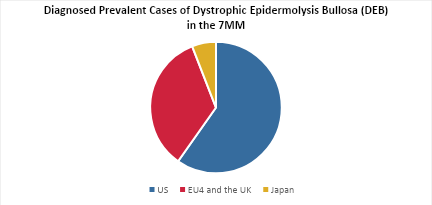
- The highest number of prevalent cases was observed in the United States. On the other hand, among EU4 and the UK countries, the highest number of epidermolysis bullosa cases was observed in Germany in 2025.
- In 2025, the total diagnosed prevalent cases of dystrophic epidermolysis bullosa in 7MM were 14,300, which are expected to increase by 2036.
- Epidermolysis is more prevalent in children and young adults, as ~78% cases were in the age group of <19 years in the 7MM in 2025.
- Epidermolysis bullosa simplex is the most common form of epidermolysis bullosa, accounting for approximately 61%, 5%, and 34% cases of EBS, JEB, and DEB in the 7MM in 2025.
Scope of the Report
- The report covers a segment of a descriptive overview of dystrophic epidermolysis bullosa, explaining its causes, signs and symptoms, and pathogenesis.
- Comprehensive insight has been provided into the epidemiology segments and forecasts, the future growth potential of the diagnosis rate, and disease progression.
Report Insights
Dystrophic Epidermolysis Bullosa (DEB) Patient Population Forecast
Report Key Strengths
- Epidemiology‑based (Epi‑based) bottom‑up forecasting
- 11-year forecast
- Patient Burden trends (by geography)
FAQs
- What are the disease risks, burdens, and unmet needs of dystrophic epidermolysis bullosa? What will be the growth opportunities across the 7MM concerning the patient population with dystrophic epidermolysis bullosa?
- What is the historical and forecasted dystrophic epidermolysis bullosa patient pool in the US, EU4 (Germany, France, Italy, and Spain), the UK, and Japan?
Reasons to Buy
- Insights on patient burden/disease prevalence, evolution in diagnosis, and factors contributing to the change in the epidemiology of the disease during the forecast years.
- To understand key opinion leaders’ perspectives on the diagnostic challenges to overcome barriers in the future.
- Detailed insights into various factors hampering disease diagnosis and other existing diagnostic challenges.
1: Key Insights
2: Report Introduction
3: Executive Summary of Dystrophic Epidermolysis Bullosa (DEB)
4: Epidemiology Forecast Methodology of Dystrophic Epidermolysis Bullosa (DEB)
5: Disease Background and Overview of Dystrophic Epidermolysis Bullosa (DEB)
5.1: Introduction
5.2: Causes of Dystrophic Epidermolysis Bullosa (DEB)
5.3: Signs and Symptoms of Dystrophic Epidermolysis Bullosa (DEB)
5.4: Pathogenesis of Dystrophic Epidermolysis Bullosa (DEB)
5.5: Diagnosis of Dystrophic Epidermolysis Bullosa (DEB)
6: Epidemiology and Patient Population of Dystrophic Epidermolysis Bullosa (DEB)
6.1: Key Findings
6.2: Assumption and Rationale
6.3: Total Diagnosed Prevalent Cases of Epidermolysis Bullosa
6.4: Total Diagnosed Prevalent Cases of Dystrophic Epidermolysis Bullosa (DEB)
6.5: The United States
6.5.1: Total Prevalent Cases of Epidermolysis Bullosa in the United States
6.5.2: Total Diagnosed Prevalent Cases of Epidermolysis Bullosa in the United States
6.5.3: Total Diagnosed Prevalent Cases of Dystrophic Epidermolysis Bullosa (DEB) in the United States
6.5.4: Gender-specific Cases of Dystrophic Epidermolysis Bullosa (DEB) in the United States
6.5.5: Age-specific Cases of Dystrophic Epidermolysis Bullosa (DEB) in the United States
6.6: EU4 and the UK
6.6.1: Total Prevalent Cases of Epidermolysis Bullosa in EU4 and the UK
6.6.2: Total Diagnosed Prevalent Cases of Epidermolysis Bullosa in EU4 and the UK
6.6.3: Total Diagnosed Prevalent Cases of Dystrophic Epidermolysis Bullosa (DEB) in EU4 and the UK
6.6.4: Gender-specific Cases of Dystrophic Epidermolysis Bullosa (DEB) in EU4 and the UK
6.6.5: Age-specific Cases of Dystrophic Epidermolysis Bullosa (DEB) in EU4 and the UK
6.7: Japan
6.7.1: Total Prevalent Cases of Epidermolysis Bullosa in Japan
6.7.2: Total Diagnosed Prevalent Cases of Epidermolysis Bullosa in Japan
6.7.3: Total Diagnosed Prevalent Cases of Dystrophic Epidermolysis Bullosa (DEB) in Japan
6.7.4: Gender-specific Cases of Dystrophic Epidermolysis Bullosa (DEB) in Japan
6.7.5: Age-specific Cases of Dystrophic Epidermolysis Bullosa (DEB) in Japan
7: Appendix
7.1: Bibliography
7.2: Report Methodology
8: DelveInsight Capabilities
9: Disclaimer
10: About DelveInsight
List of Tables:
List of Tables
Table 1: Summary of Dystrophic Epidermolysis Bullosa (DEB) Epidemiology (2022–2036)
Table 2: DEB Subtypes and their Features
Table 3: Kindler Subtypes and their Features
Table 4: Recommendations for Laboratory Diagnosis of Dystrophic Epidermolysis Bullosa (DEB)
Table 5: Level of Evidence
Table 6: Grades of Recommendation Made by the Guideline Panel
Table 7: Total Diagnosed Prevalent Cases of Epidermolysis Bullosa in the 7MM
Table 8: Total Diagnosed Prevalent Cases of Dystrophic Epidermolysis Bullosa (DEB) in the 7MM
Table 9: Total Prevalent Cases of Epidermolysis Bullosa in the United States (2022–2036)
Table 10: Total Diagnosed Prevalent Cases of Epidermolysis Bullosa in the United States (2022–2036)
Table 11: Total Diagnosed Prevalent Cases of Dystrophic Epidermolysis Bullosa (DEB) in the United States
Table 12: Gender-specific Cases of Dystrophic Epidermolysis Bullosa (DEB) in the United States (2022–2036)
Table 13: Age-specific Cases of Dystrophic Epidermolysis Bullosa (DEB) in the United States (2022–2036)
Table 14: Total Prevalent Cases of Epidermolysis Bullosa in EU4 and the UK (2022–2036)
Table 15: Total Diagnosed Prevalent Cases of Epidermolysis Bullosa in EU4 and the UK (2022–2036)
Table 16: Total Diagnosed Prevalent Cases of Dystrophic Epidermolysis Bullosa (DEB) in EU4 and the UK (2022–2036)
Table 17: Gender-specific Cases of Dystrophic Epidermolysis Bullosa (DEB) in EU4 and the UK (2022–2036)
Table 18: Age-specific Cases of Dystrophic Epidermolysis Bullosa (DEB) in EU4 and the UK (2022–2036)
Table 19: Total Prevalent Cases of Epidermolysis Bullosa in Japan (2022–2036)
Table 20: Total Diagnosed Prevalent Cases of Epidermolysis Bullosa in Japan (2022–2036)
Table 21: Total Diagnosed Prevalent Cases of Dystrophic Epidermolysis Bullosa (DEB) in Japan (2022–2036)
Table 22: Gender-specific Cases of Dystrophic Epidermolysis Bullosa (DEB) in Japan (2022–2036)
Table 23: Age-specific Cases of Dystrophic Epidermolysis Bullosa (DEB) in Japan (2022–2036)
List of Figures:
List of Figures
Figure 1: Symptoms and Complications of Epidermolysis Bullosa Simplex
Figure 2: Total Diagnosed Prevalent Cases of Epidermolysis Bullosa in the 7MM
Figure 3: Total Diagnosed Prevalent Cases of Dystrophic Epidermolysis Bullosa (DEB) in the 7MM
Figure 4: Total Prevalent Cases of Epidermolysis Bullosa in the United States (2022–2036)
Figure 5: Total Diagnosed Prevalent Cases of Epidermolysis Bullosa in the United States (2022–2036)
Figure 6: Total Diagnosed Prevalent Cases of Dystrophic Epidermolysis Bullosa (DEB) in the United States
Figure 7: Gender-specific Cases of Dystrophic Epidermolysis Bullosa (DEB) in the United States (2022–2036)
Figure 8: Age-specific Cases of Dystrophic Epidermolysis Bullosa (DEB) in the United States (2022–2036)
Figure 9: Total Prevalent Cases of Epidermolysis Bullosa in EU4 and the UK (2022–2036)
Figure 10: Total Diagnosed Prevalent Cases of Epidermolysis Bullosa in EU4 and the UK (2022–2036)
Figure 11: Total Diagnosed Prevalent Cases of Dystrophic Epidermolysis Bullosa (DEB) in EU4 and the UK (2022–2036)
Figure 12: Gender-specific Cases of Dystrophic Epidermolysis Bullosa (DEB) in EU4 and the UK (2022–2036)
Figure 13: Age-specific Cases of Dystrophic Epidermolysis Bullosa (DEB) in EU4 and the UK (2022–2036)
Figure 14: Total Prevalent Cases of Epidermolysis Bullosa in Japan (2022–2036)
Figure 15: Total Diagnosed Prevalent Cases of Epidermolysis Bullosa in Japan (2022–2036)
Figure 16: Total Diagnosed Prevalent Cases of Dystrophic Epidermolysis Bullosa (DEB) in Japan (2022–2036)
Figure 17: Gender-specific Cases of Dystrophic Epidermolysis Bullosa (DEB) in Japan (2022–2036)
Figure 18: Age-specific Cases of Dystrophic Epidermolysis Bullosa (DEB) in Japan (2022–2036)