Essential Thrombocythemia Epidemiology
Essential Thrombocythemia Insights and Trends
- According to DelveInsight’s analysis, the total diagnosed prevalent cases of essential thrombocythemia were ~338,000 in the 7MM (the United States, the EU4 (Germany, France, Italy, and Spain), the United Kingdom, and Japan) in 2025.
- Essential thrombocythemia is a chronic myeloproliferative neoplasm (MPN) characterized by an increased number of platelets in the blood. Most commonly diagnosed in women over the age of 50.
- The primary cause of essential thrombocythemia is the overproduction of hematopoietic cells due to the mutations of the JAK2, CALR, or MPL genes. These genes are known as ’driver mutations‘ due to their role in developing a myeloproliferative neoplasm. Though 90% of adults have JAK2, CALR, or MPL mutations, it is not unusual to find children with a molecular triple wildtype status.
- Many essential thrombocythemia patients are asymptomatic. Consequently, the disease is often diagnosed as part of a routine check-up after a blood test reveals a high platelet count.
- The median estimate of survival among essential thrombocythemia patients is 20 years. However, depending on the age of presentation, this varies, and as a result, the median survival of patients younger than 60 years of age approaches 33 years.
- The most common cause of morbidity and mortality is thrombosis, which occurs among 20% of essential thrombocythemia patients, compared to bleeding complications in 10% of this population.
- The risk of complications of essential thrombocythemia by thrombosis in Japanese patients is lower as compared to Western populations, suggesting that genetic background, such as race, may influence the clinical features.”
- Over time, a minority of individuals with essential thrombocythemia (approximately 10%) may progress to a related condition known as post- essential thrombocythemia myelofibrosis. This transformation is characterized by the development of fibrotic (scar) tissue in the bone marrow, which can lead to anemia, persistent fatigue, and splenomegaly.
- A bone marrow biopsy may be conducted to identify classical signs of essential thrombocythemia or exclude myelofibrosis. Additionally, gene mutation analysis of blood cells, particularly for mutations like JAK2, CALR, or MPL, can aid in confirming the diagnosis, with JAK2 mutations being the most common.
Essential Thrombocythemia Epidemiology Forecast in the 7MM
- 2025 Essential Thrombocythemia Diagnosed Prevalent Cases: ~338,000
- 2036 Essential Thrombocythemia Diagnosed Prevalent Cases: ~XXXX
- Essential Thrombocythemia Growth Rate (2026–2036): ~1% CAGR
DelveInsight's ‘Essential Thrombocythemia – Epidemiology Forecast – 2036’ report delivers an in-depth understanding of Essential Thrombocythemia, historical and forecasted epidemiology in the United States, EU4 (Germany, Spain, Italy, and France) and the United Kingdom, and Japan.
|
Study Period
|
2022–2036
|
|
Historical Year
|
2022–2025
|
|
Forecast Period
|
2026–2036
|
|
Base Year
|
2026
|
|
Geographies Covered
|
- North America: The US;
- Europe: Germany, France, Italy, and Spain and the UK;
- Asia-Pacific: Japan
|
|
Essential Thrombocythemia Epidemiology CAGR
(Study period/Forecast period)
|
~1% (2026–2036)
|
|
Essential Thrombocythemia Epidemiology Segmentation Analysis
|
Patient Burden Assessment
- Total Diagnosed Prevalent Cases of Essential Thrombocythemia
- Symptom-specific Diagnosed Prevalent Cases of Essential Thrombocythemia
- Gender-specific Diagnosed Prevalent Cases of Essential Thrombocythemia
- Mutation-specific Diagnosed Prevalent Cases of Essential Thrombocythemia
- Risk-specific Diagnosed Prevalent Cases of Essential Thrombocythemia
- Age-specific Diagnosed Prevalent Cases of Essential Thrombocythemia
- Total Treated Cases of Essential Thrombocythemia
|
Essential Thrombocythemia Understanding and Diagnosis Algorithm
Essential Thrombocythemia Overview and Diagnosis
Essential thrombocythemia is a rare, chronic blood disorder characterized by the overproduction of platelets due to abnormal bone marrow activity. It belongs to the group of myeloproliferative neoplasms and is commonly associated with mutations such as JAK2, CALR, or MPL. Patients may be asymptomatic or present with symptoms related to thrombosis, bleeding, headaches, or microvascular disturbances. The condition carries an increased risk of blood clots and, less commonly, progression to myelofibrosis or acute leukemia. Management is risk-adapted, focusing on reducing thrombotic risk through cytoreductive therapy and antiplatelet agents. With appropriate treatment, many patients maintain a near-normal life expectancy.
Essential Thrombocythemia Diagnosis
Diagnosis of essential thrombocythemia is based on a combination of clinical evaluation, laboratory findings, and molecular testing. It typically begins with a complete blood count (CBC) showing persistently elevated platelet levels (≥450 × 10⁹/L). A bone marrow biopsy is performed to confirm increased megakaryocytes with characteristic morphology and to exclude other myeloproliferative disorders. Molecular testing plays a key role, with identification of driver mutations such as JAK2, CALR, or MPL supporting the diagnosis. Secondary causes of thrombocytosis (e.g., infection, inflammation, and iron deficiency) must be ruled out. Diagnosis is ultimately established using standardized criteria such as those from the World Health Organization.
Further details are provided in the report.
Essential Thrombocythemia Epidemiology
Key Findings from Essential Thrombocythemia Epidemiological Analysis and Forecast
- The United States accounted for ~170,000 diagnosed prevalent cases of essential thrombocythemia in 2025. These cases are anticipated to increase by 2036.
- In 2025, symptom-specific cases of essential thrombocythemia in the United States were ~68,000 and ~102,000 for asymptomatic and symptomatic, respectively.
- In the United States, essential thrombocythemia shows a clear female predominance, with approximately 65% of cases occurring in females compared to 35% in males, indicating a higher disease burden among women.
- In 2025, among mutation-specific cases of essential thrombocythemia in the US, JAK2 mutations accounted for the highest number of cases (~92,000), significantly exceeding CALR, MPL, and triple-negative subtypes.
- In the United States, essential thrombocythemia shows a risk distribution across very-low-risk, low-risk, intermediate-risk, and high-risk groups, with the highest proportion observed in the high-risk category (~38%) and the lowest in the intermediate-risk group (~15%).
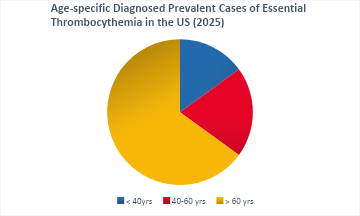
- In essential thrombocythemia, age-specific distribution shows that patients aged >60 years account for the highest proportion of cases, followed by those aged 40–60 years, while individuals aged <40 years represent the lowest share, primarily due to the age-related accumulation of somatic mutations and increased diagnostic detection in older populations.
Numbers are subject to change with report updation, clinical information updates, etc.
Scope of the Report
- The report covers a segment of an executive summary, a descriptive overview of essential thrombocythemia, explaining its causes, signs and symptoms, and pathogenesis.
- Comprehensive insight has been provided into the epidemiology segments and forecasts, the future growth potential of the diagnosis rate, and disease progression.
Report Insights
Essential Thrombocythemia Patient Population Forecast
Report Key Strengths
- Epidemiology‑based (Epi‑based) Bottom‑up Forecasting
- 11-year Forecast
- Patient Burden Trends (by geography)
FAQs
- What are the disease risks, burdens, and unmet needs of essential thrombocythemia? What will be the growth opportunities across the 7MM concerning the patient population with essential thrombocythemia?
- What is the historical and forecasted essential thrombocythemia patient pool in the US, EU4 (Germany, France, Italy, and Spain), the UK, and Japan?
Reasons to Buy
- Insights on patient burden/disease prevalence, evolution in diagnosis, and factors contributing to the change in the epidemiology of the disease during the forecast years.
- To understand key opinion leaders’ perspectives on the diagnostic challenges to overcome barriers in the future.
- Detailed insights into various factors hampering disease diagnosis and other existing diagnostic challenges.
1 Key Insights
2 Report Introduction
3 Executive Summary
4 Essential Thrombocythemia Epidemiology Overview at a Glance
4.1 Patient Share (%) Distribution by Country in 2025 in the 7MM
4.2 Patient Share (%) Distribution by Country in 2036 in the 7MM
5 Epidemiology Forecast Methodology of Essential Thrombocythemia
6 Disease Background and Overview of Essential Thrombocythemia
6.1 Introduction
6.2 Types
6.3 Symptoms
6.4 Causes
6.5 Pathophysiology
6.6 Diagnosis
6.6 Diagnosis Guidelines
7 Epidemiology and Patient Population of Essential Thrombocythemia
7.1 Key Findings
7.2 Assumptions and Rationale
7.3 Total Diagnosed Prevalent Cases of Essential Thrombocythemia in the 7MM
7.4 The United States
7.4.1 Total Diagnosed Prevalent Cases of Essential Thrombocythemia in the United States
7.4.2 Symptom-specific Diagnosed Prevalent Cases of Essential Thrombocythemia in the United States
7.4.3 Gender-specific Diagnosed Prevalent Cases of Essential Thrombocythemia in the United States
7.4.4 Mutation-specific Diagnosed Prevalent Cases of Essential Thrombocythemia in the United States
7.4.5 Risk-specific Diagnosed Prevalent Cases of Essential Thrombocythemia in the United States
7.4.6 Age-specific Diagnosed Prevalent Cases of Essential Thrombocythemia in the United States
7.4.7 Total Treated Cases of Essential Thrombocythemia in the United States
7.5 EU4 and the UK
7.5.1 Total Diagnosed Prevalent Cases of Essential Thrombocythemia in EU4 and the UK
7.5.2 Symptom-specific Diagnosed Prevalent Cases of Essential Thrombocythemia in EU4 and the UK
7.5.3 Gender-specific Diagnosed Prevalent Cases of Essential Thrombocythemia in EU4 and the UK
7.5.4 Mutation-specific Diagnosed Prevalent Cases of Essential Thrombocythemia in EU4 and the UK
7.5.5 Risk-specific Diagnosed Prevalent Cases of Essential Thrombocythemia in EU4 and the UK
7.5.6 Age-specific Diagnosed Prevalent Cases of Essential Thrombocythemia in EU4 and the UK
7.5.7 Total Treated Cases of Essential Thrombocythemia in EU4 and the UK
7.6 Japan
7.6.1 Total Diagnosed Prevalent Cases of Essential Thrombocythemia in Japan
7.6.2 Symptom-specific Diagnosed Prevalent Cases of Essential Thrombocythemia in Japan
7.6.3 Gender-specific Diagnosed Prevalent Cases of Essential Thrombocythemia in Japan
7.6.4 Mutation-specific Diagnosed Prevalent Cases of Essential Thrombocythemia in Japan
7.6.5 Risk-specific Diagnosed Prevalent Cases of Essential Thrombocythemia in Japan
7.6.6 Age-specific Diagnosed Prevalent Cases of Essential Thrombocythemia in Japan
7.6.7 Total Treated Cases of Essential Thrombocythemia in Japan
8 Appendix
8.1 Bibliography
8.2 Report Methodology
9 DelveInsight Capabilities
10 Disclaimer
11 About DelveInsight
List of Tables:
Table 1: Summary of Essential Thrombocythemia Epidemiology (2022–2036)
Table 2: IPS Essential Thrombocythemia Thrombosis Score
Table 3: Current Prognostic Models for Overall Survival in Essential Thrombocythemia
Table 4: International Consensus Classification Diagnostic Criteria for Essential Thrombocythemia and Post-Essential Thrombocythemia MF
Table 5: Total Diagnosed Prevalent Cases of Essential Thrombocythemia in 7MM (2022–2036)
Table 6: Total Treated Cases of Essential Thrombocythemia in 7MM (2022–2036)
Table 7: Total Diagnosed Prevalent Cases of Essential Thrombocythemia in the United States (2022–2036)
Table 8: Symptom-specific Diagnosed Prevalent Cases of Essential Thrombocythemia in the United States (2022–2036)
Table 9: Gender-specific Diagnosed Prevalent Cases of Essential Thrombocythemia in the United States (2022–2036)
Table 10: Mutation-specific Diagnosed Prevalent Cases of Essential Thrombocythemia in the United States (2022–2036)
Table 11: Risk-specific Diagnosed Prevalent Cases of Essential Thrombocythemia in the United States (2022–2036)
Table 12: Age-specific Diagnosed Prevalent Cases of Essential Thrombocythemia in the United States (2022–2036)
Table 13: Total Treated Cases of Essential Thrombocythemia in the United States (2022–2036)
Table 14: Total Diagnosed Prevalent Cases of Essential Thrombocythemia in EU4 and the UK (2022–2036)
Table 15: Symptom-specific Diagnosed Prevalent cases of Essential Thrombocythemia in EU4 and the UK (2022–2036)
Table 16: Gender-specific Diagnosed Prevalent cases of Essential Thrombocythemia in EU4 and the UK (2022–2036)
Table 17:Mutation-specific Diagnosed Prevalent Cases of Essential Thrombocythemia in EU4 and the UK (2022–2036)
Table 18:Risk-specific Diagnosed Prevalent Cases of Essential Thrombocythemia in EU4 and the UK (2022–2036)
Table 19: Age-specific Diagnosed Prevalent Cases of Essential Thrombocythemia in EU4 and the UK (2022–2036)
Table 20: Total Treated Cases of Essential Thrombocythemia in EU4 and the UK (2022–2036)
Table 21:Total Diagnosed Prevalent Cases of Essential Thrombocythemia in Japan (2022–2036)
Table 22:Symptom-specific Diagnosed Prevalent Cases of Essential Thrombocythemia in Japan (2022–2036)
Table 23:Gender-specific Diagnosed Prevalent Cases of Essential Thrombocythemia in Japan (2022–2036)
Table 24: Mutation-specific Diagnosed Prevalent Cases of Essential Thrombocythemia in Japan (2022–2036)
Table 25: Risk-specific Diagnosed Prevalent Cases of Essential Thrombocythemia in Japan (2022–2036)
Table 26: Age-specific Diagnosed Prevalent Cases of Essential Thrombocythemia in Japan (2022–2036)
Table 27: Total Treated Cases of Essential Thrombocythemia in Japan (2022–2036)
List of Figures:
Figure 1: Risk Factors Associated With Essential Thrombocythemia
Figure 2: Signs and Symptoms of Essential Thrombocythemia
Figure 3: Symptom of Essential Thrombocythemia, Enlarged Spleen
Figure 4: AAA Survival Model in Essential Thrombocythemia. Overall Survival Data Among 598 MayoClinic Patients Stratified by Age, ANC, and ALC, Median Follow-up of 8.4 Years
Figure 5: Thrombosis Risk Stratification in Essential Thrombocythemia
Figure 6: Practical Diagnostic Algorithm for MPNs
Figure 7: Diagnostic Algorithm of Essential Thrombocythemia
Figure 8: NCCN Guidelines Version 2026
Figure 9: Total Diagnosed Prevalent Cases of Essential Thrombocythemia in 7MM (2022–2036)
Figure 10: Total Treated Cases of Essential Thrombocythemia in 7MM (2022–2036)
Figure 11:Total Diagnosed Prevalent Cases of Essential Thrombocythemia in the United States (2022–2036)
Figure 12: Symptom-specific cases of Essential Thrombocythemia in the United States (2022–2036)
Figure 13: Gender-specific Diagnosed Prevalent Cases of Essential Thrombocythemia in the United States (2022–2036)
Figure 14: Mutation-specific Diagnosed Prevalent Cases of Essential Thrombocythemia in the United States (2022–2036)
Figure 15: Risk-specific Diagnosed Prevalent Cases of Essential Thrombocythemia in the United States (2022–2036)
Figure 16: Age-specific Diagnosed Prevalent Cases of Essential Thrombocythemia in the United States (2022–2036)
Figure 17: Total Treated Cases of Essential Thrombocythemia in the United States (2022–2036)
Figure 18: Total Diagnosed Prevalent Cases of Essential Thrombocythemia in EU4 and the UK (2022–2036)
Figure 19: Symptom-specific Diagnosed Prevalent cases of Essential Thrombocythemia in EU4 and the UK (2022–2036)
Figure 20: Gender-specific Diagnosed Prevalent Cases of Essential Thrombocythemia in EU4 and the UK (2022–2036)
Figure 21:Mutation-specific Diagnosed Prevalent Cases of Essential Thrombocythemia in EU4 and the UK (2022–2036)
Figure 22:Risk-specific Diagnosed Prevalent Cases of Essential Thrombocythemia in EU4 and the UK (2022–2036)
Figure 23:Age-specific Diagnosed Prevalent Cases of Essential Thrombocythemia in EU4 and the UK (2022–2036)
Figure 24: Total Treated Cases of Essential Thrombocythemia in EU4 and the UK (2022–2036)
Figure 25: Total Diagnosed Prevalent Cases of Essential Thrombocythemia in Japan (2022–2036)
Figure 26: Symptom-specific Diagnosed Prevalent cases of Essential Thrombocythemia in Japan (2022–2036)
Figure 27:Gender-specific Diagnosed Prevalent Cases of Essential Thrombocythemia in Japan (2022–2036)
Figure 28: Mutation-specific Diagnosed Prevalent Cases of Essential Thrombocythemia in Japan (2022–2036)
Figure 29: Risk-specific Diagnosed Prevalent Cases of Essential Thrombocythemia in Japan (2022–2036)
Figure 30: Age-specific Diagnosed Prevalent Cases of Essential Thrombocythemia in Japan (2022–2036)
Figure 31: Total Treated Cases of Essential Thrombocythemia in Japan (2022–2036)