.png&w=256&q=75)
gastroenteropancreatic neuroendocrine tumors gep nets epidemiology forecast
Gastroenteropancreatic Neuroendocrine Tumors (GEP-NET) Insights and Trends
- GEP NETs are heterogeneous tumors arising from neuroendocrine cells in the gastrointestinal tract and pancreas, with incidence increasing over recent decades, partly due to enhanced detection and imaging practices; while exact rates vary by region and subtype, their rising recognition underscores unmet clinical needs.
- According to the secondary search, net project, the incidence of malignant GEP-NET during 2000–2007 was 1.7 per 100,000 population per year in Europe, corresponding to an estimated 26,000 new cases.
- As per the secondary sesrch, the annual incidence of the disease was 6.47 cases per 100,000 population, with an adjusted prevalence of 0.052%. The mean age at diagnosis was 58 ± 15 years, and the sex distribution was nearly equal, with 51% men and 49% women in Spain.
- The most common primary tumor site was the pancreas (52%), followed by the jejunum–ileum (23%).
- Non-functional/asymptomatic/unknown NETs are more in number than functional NETs.
Gastroenteropancreatic Neuroendocrine Tumors (GEP-NET) Epidemiology Forecast in the US
-
2025 Incident Cases of GEP-NET: ~19,000
-
GEP-NET Growth Rate (2026–2036): 2% CAGR
DelveInsight's ‘Gastroenteropancreatic Neuroendocrine Tumors (GEP-NET) Epidemiology Forecast – 2036’ report delivers an in-depth understanding of the GEP-NET, historical and forecasted epidemiology, in the United States, EU4 (Germany, Spain, Italy, and France) and the United Kingdom, and Japan.
|
Study Period |
2022–2036 |
|
Historical Year |
2022–2025 |
|
Forecast Period |
2026–2036 |
|
Base Year |
2026 |
|
Geographies Covered |
|
|
GEP-NET Epidemiology CAGR (Forecast period) (US) |
2% (2026–2036) |
|
GEP-NET Epidemiology Segmentation Analysis |
Patient Burden Assessment
|
Gastroenteropancreatic Neuroendocrine Tumors (GEP-NET) Understanding and Diagnosis Algorithm
Gastroenteropancreatic Neuroendocrine Tumors (GEP-NET) Overview and Diagnosis
GEP-NET are rare, heterogeneous cancers of the pancreas and gastrointestinal tract. Their complexity and late-stage presentation require individualized treatment based on tumor grade, location, hormone activity, and patient symptoms, with management primarily focused on advanced and metastatic disease. Despite advances in diagnostics, GEP-NET are often not identified for up to 5–7 years after clinical symptoms appear, as the symptoms are not specific.
Further details are provided in the report.
Gastroenteropancreatic Neuroendocrine Tumors (GEP-NET) Diagnosis
Diagnosis of GEP-NET relies on a combination of biochemical testing, imaging, and sometimes genetic evaluation. Common biochemical markers include chromogranin A, pancreatic hormones (insulin, gastrin, glucagon), and serotonin metabolites such as 5-HIAA in urine, depending on tumor functionality. Imaging studies such as contrast-enhanced CT and MRI are used to localize primary tumors and assess metastatic spread.
Further details are provided in the report.
Gastroenteropancreatic Neuroendocrine Tumors (GEP-NET) Epidemiology
Key Findings from GEP-NET Epidemiological Analysis and Forecast
-
According to DelveInsight’s estimates, in 2025, the total number of incident cases of NETs in the US were ~31,000.
-
At the time of diagnosis, 24% of patients presented with distant metastases, most frequently involving the liver (44%), peritoneum (25%), or multiple organs (22%). The majority of tumors were sporadic and non-functional.
-
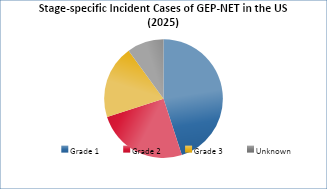
Surgical resection of the primary tumor was performed in 66% of patients. Histopathological grading showed that most tumors were well differentiated, with 73% classified as Grade 1 (G1), 22% as Grade 2 (G2), and 5% as Grade 3 (G3).
-
The incidence of GEP-NET is higher in the US compared with Germany or France.
-
The incidence of GEP-NET continues to increase-particularly in older adults.
-
GEP NETs represent the most common NET subtype, comprising 50–70% of all NETs.
Scope of the Report
- The report covers a segment of a descriptive overview of GEP-NET, explaining their causes, signs and symptoms, and pathogenesis.
- Comprehensive insight has been provided into the epidemiology segments and forecasts, the future growth potential of the diagnosis rate, and disease progression.
Report Insights
Gastroenteropancreatic Neuroendocrine Tumors (GEP-NET) Patient Population Forecast
Report Key Strengths
- Epidemiology‑based (Epi‑based) Bottom‑up Forecasting
- 11-year Forecast
- Patient Burden Trends (by geography)
Unlock comprehensive Gastroenteropancreatic Neuroendocrine Tumors Indication Market Insights with detailed forecasts, epidemiology trends, and emerging therapeutic opportunities through 2036.
FAQs
-
What are the disease risks, burdens, and unmet needs of GEP-NET? What will be the growth opportunities across the 7MM concerning the patient population with GEP-NET?
-
What is the historical and forecasted GEP-NET patient pool in the US, EU4 (Germany, France, Italy, and Spain), the UK, and Japan?
Reasons to Buy
-
Insights on patient burden/disease prevalence, evolution in diagnosis, and factors contributing to the change in the epidemiology of the disease during the forecast years.
-
To understand key opinion leaders’ perspectives around the diagnostic challenges to overcome barriers in the future.
-
Detailed insights on various factors hampering disease diagnosis and other existing diagnostic challenges.
-pipeline.png&w=256&q=75)