Gastroesophageal Reflux Disease Epidemiology
Gastroesophageal Reflux Disease (GERD) Insights and Trends
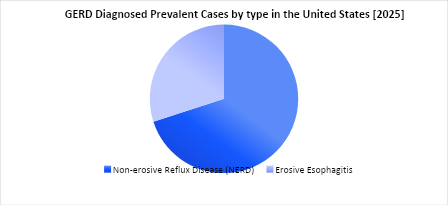
- Non-Erosive GERD is the largest subcategory of GERD and is characterized by reflux-related symptoms in the absence of esophageal mucosal erosions.
- Night time GERD symptoms are highly prevalent, affecting up to an estimated 80% of patients with GERD which can be associated with impaired sleep, reduced work productivity, and increased risk of esophageal and respiratory complications.
- The gold standard for diagnosing GERD is impedance-pH monitoring. This test is particularly valuable when endoscopy doesn't reveal esophagitis yet patients continue to experience refractory or recurrent symptoms or require invasive therapy.
- A significant proportion of GERD patients remain undiagnosed or are diagnosed only after symptom progression, particularly those with atypical or extra-esophageal manifestations. The lack of definitive, non-invasive diagnostic tools and symptom overlap with other gastrointestinal disorders often leads to delayed diagnosis, disease progression, and increased healthcare burden which remains a significant unmet need.
Gastroesophageal Reflux Disease (GERD) Epidemiology Forecast in the United States
- 2025 Prevalent Cases of GERD: ~ 64,174,200
- 2036 Projected Prevalent Cases of GERD: ~ 68,092,300
- GERD Growth Rate (2026–2036): 0.5% CAGR
DelveInsight's ‘Gastroesophageal Reflux Disease (GERD) Epidemiology Forecast – 2036’ report delivers an in-depth understanding of the GERD, historical and forecasted epidemiology, in the United States, EU4 (Germany, Spain, Italy, and France) and the United Kingdom, and Japan.
|
Study Period |
2022–2036 |
|
Historical Year |
2022–2025 |
|
Forecast Period |
2026–2036 |
|
Base Year |
2026 |
|
Geographies Covered |
|
|
Gastroesophageal Reflux Disease (GERD) US Epidemiology CAGR (Forecast period) |
0.5% (2026–2036) |
|
Gastroesophageal Reflux Disease (GERD) Epidemiology Segmentation Analysis |
Patient Burden Assessment
|
Gastroesophageal Reflux Disease (GERD) Understanding and Diagnosis Algorithm
Gastroesophageal Reflux Disease (GERD) Overview
GERD is a chronic digestive disorder characterized by the reflux of stomach contents into the esophagus, resulting in troublesome symptoms and/or complications. The condition primarily occurs due to dysfunction of the lower esophageal sphincter, which normally prevents gastric contents from flowing back into the esophagus. Common symptoms include heartburn, acid regurgitation, chest discomfort, dysphagia, chronic cough, hoarseness, and sleep disturbances. GERD is one of the most prevalent gastrointestinal disorders worldwide and can significantly impair quality of life. If left untreated, chronic reflux may lead to complications such as erosive esophagitis, esophageal strictures, Barrett’s esophagus, and an increased risk of esophageal adenocarcinoma.
Further details are provided in the report.
Gastroesophageal Reflux Disease (GERD) Diagnosis
GERD is typically diagnosed based on clinical symptoms, particularly the presence of frequent heartburn and regurgitation. In patients with typical symptoms and no alarm features, an empirical trial of acid-suppressive therapy is often used to support the diagnosis. For individuals with persistent symptoms, atypical presentations, or suspected complications, diagnostic investigations may include upper gastrointestinal endoscopy to assess mucosal damage, ambulatory esophageal pH monitoring to quantify acid exposure, and esophageal impedance-pH testing to detect both acid and non-acid reflux. Esophageal manometry may also be performed to evaluate esophageal motility disorders and lower esophageal sphincter function.
Further details are provided in the report.
Gastroesophageal Reflux Disease (GERD) Epidemiology
Key Findings from Gastroesophageal Reflux Disease (GERD) Epidemiological Analysis and Forecast
- GERD remains one of the most common chronic gastrointestinal disorders in the United States, with ~33,724,000 diagnosed prevalent cases in 2025.
- Among gender-specific cases of GERD, females (~60%) had highest number of cases than men in United States in 2025.
- In 2025, age group of more than 70 years had the highest (~30%) number of GERD cases followed by the age group of 60-69 (~22%), while the lowest number of cases were observed in age group less than 19 in United States.
- Among the EU4 and the UK, the UK had the highest prevalent cases of GERD in 2025 folllowed by Italy, while Spain accounted for the least number fo cases.
- Among individuals with erosive esophagitis, disease severity is similarly skewed toward the milder end of the spectrum: Grade B represents the single largest subgroup, followed by Grade A, while severe mucosal damage (Grade D) remains relatively uncommon. This distribution highlights a core challenge in GERD management—most patients present with symptom-driven, non-erosive disease or mild mucosal changes, yet still experience significant and often persistent symptom burden that may not align with endoscopic findings.
Scope of the Report
- The report covers a segment of a descriptive overview of GERD, explaining their causes, signs and symptoms, and pathogenesis.
- Comprehensive insight has been provided into the epidemiology segments and forecasts, the future growth potential of the diagnosis rate, and disease progression.
Report Insights
Gastroesophageal Reflux Disease (GERD) Patient Population Forecast
Report Key Strengths
- Epidemiology‑based (Epi‑based) Bottom‑up Forecasting
- 11-year Forecast
- Patient Burden Trends (By Geography)
FAQs
- What are the disease risks, burdens, and unmet needs of GERD? What will be the growth opportunities across the 7MM concerning the patient population with GERD?
- What is the historical and forecasted GERD patient pool in the US, EU4 (Germany, France, Italy, and Spain), the UK, and Japan?
Reasons to Buy
- Insights on patient burden/disease prevalence, evolution in diagnosis, and factors contributing to the change in the epidemiology of the disease during the forecast years.
- To understand key opinion leaders’ perspectives around the diagnostic challenges to overcome barriers in the future.
- Detailed insights on various factors hampering disease diagnosis and other existing diagnostic challenges.
-pipeline.png&w=256&q=75)