Gender Dysphoria Market
Key Highlights
- Gender dysphoria is a psychological condition characterized by significant distress or discomfort that arises when an individual's gender identity (their personal sense of their own gender) does not align with their sex assigned at birth.
- Treatment for gender dysphoria is multifaceted and tailored to the individual's needs, often involving a combination of psychological support, hormone therapy, and surgical interventions.
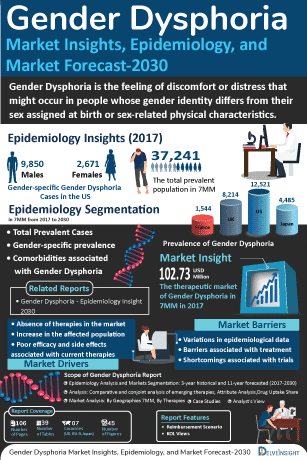
- In 2023, the total prevalent cases of Gender Dysphoria in 7MM was ~38,000 cases which is anticipated to increase in the forecasted period.
- In 2023, US accounted for the highest prevalent cases of gender dysphoria ~35% in the 7MM.
- The market is anticipated to witness a substantial positive shift owing to better uptake of existing drugs and raised awareness.
- The market size of gender dysphoria (GD) in 7MM was estimated to be ~USD 100 million in 2023.
- The United States accounts for the largest market size of Gender Dysphoria in comparison to EU4 (Germany, Spain, Italy, France), the United Kingdom, and Japan.
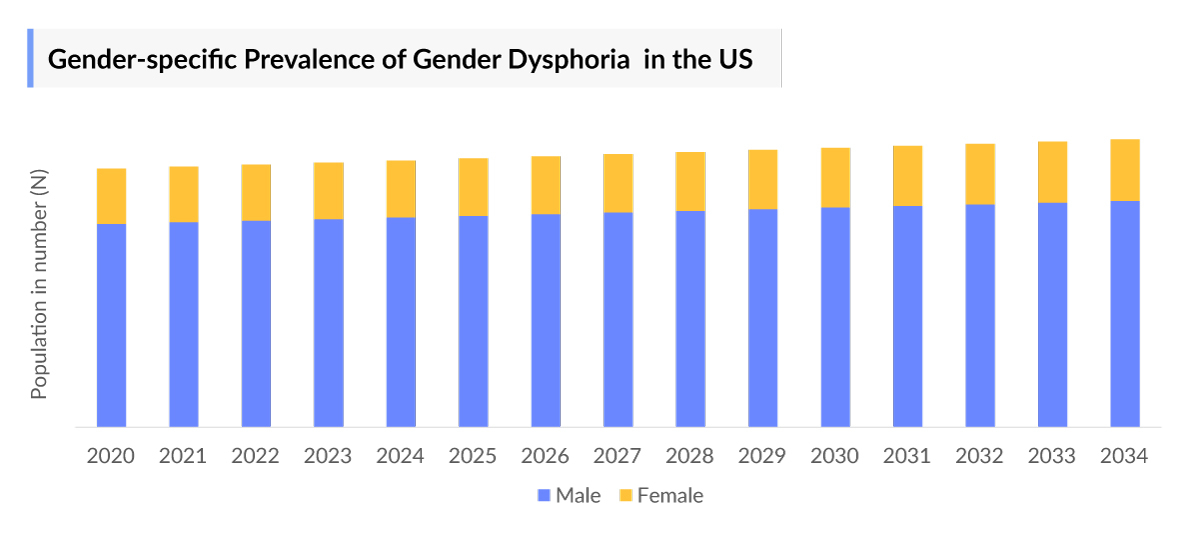
- In the US, males were predominant, accounting for approximately 80% of cases in 2023.
DelveInsight's “Gender Dysphoria – Market Insights, Epidemiology and Market Forecast – 2034” report delivers an in-depth understanding of Gender Dysphoria, historical and forecasted epidemiology as well as the Gender Dysphoria market trends in the United States, EU4 (Germany, Spain, Italy, and France) and the United Kingdom, and Japan.
Gender Dysphoria market report provides real-world prescription pattern analysis, emerging drugs, market share of individual therapies, and historical and forecasted 7MM Gender Dysphoria market size from 2020 to 2034. The report also covers current Gender Dysphoria treatment practices/algorithms and unmet medical needs to curate the best opportunities and assess the market’s underlying potential.
Geography Covered
- The United States
- EU4 (Germany, France, Italy, and Spain) and the United Kingdom
- Japan
|
Study Period |
2020–2034 |
|
Forecast Period |
2024–2034 |
|
Geographies Covered |
US, EU4 (Germany, France, Italy, and Spain) the UK, and Japan |
|
Gender Dysphoria Epidemiology |
Segmented by: Prevalence of Gender Dysphoria Gender-specific Prevalence of Gender Dysphoria Comorbidities Associated with Gender Dysphoria |
|
Gender Dysphoria Market |
Segmented by: · Region · Therapies |
|
Analysis |
· KOL Views · SWOT Analysis · Reimbursement · Conjoint Analysis · Unmet needs |
Gender Dysphoria Understanding and Treatment Algorithm
Gender Dysphoria Overview, Country-Specific Treatment Guidelines and Diagnosis
Gender dysphoria is a psychological condition characterized by significant discomfort or distress that arises when an individual's gender identity does not align with their sex assigned at birth. This incongruence can lead to a range of emotional and psychological challenges, including anxiety, depression, and social difficulties. Individuals experiencing gender dysphoria may feel a strong desire to transition to the gender with which they identify, seeking to align their physical appearance and social roles with their gender identity. While some transgender and gender-diverse individuals may feel comfortable with their bodies without medical intervention, others may experience profound distress that necessitates support and treatment to improve their quality of life.
The diagnosis of gender dysphoria is based on criteria outlined in the Diagnostic and Statistical Manual of Mental Disorders (DSM-5). For a diagnosis to be made, individuals must experience a marked incongruence between their experienced gender and their assigned gender for at least six months, accompanied by significant distress or impairment in social, occupational, or other important areas of functioning. This may manifest through a strong desire to be of the other gender, significant discomfort with one’s primary or secondary sex characteristics, or a strong desire to be treated as another gender. The diagnosis aims to facilitate access to appropriate healthcare and support for those affected by gender dysphoria.
Further details related to country-based variations in diagnosis are provided in the report
Gender Dysphoria Treatment
Treatment for gender dysphoria is multifaceted and tailored to the individual's needs. It may include psychological support, hormone therapy, and surgical interventions. Psychological support often involves counselling to help individuals navigate their feelings and experiences related to gender identity. Hormone therapy, such as estrogen or testosterone, is commonly used to induce physical changes that align with one's gender identity, while surgical options may include procedures like chest or breast surgery and genital reconstruction. The primary goal of treatment is to alleviate the distress associated with gender dysphoria and improve overall well-being, enabling individuals to live authentically in their identified gender.
CHT (Cross-sex hormone therapy), The medical necessity of hormone therapy for gender dysphoria has been well-established. The protocol is comprised of exogenous endocrine agents to induce feminizing or masculinizing changes. The administration of hormone therapy must be individualized based on the patient’s goals, the risk/benefit ratio, medical contraindications, and adverse effects. There are two broad classes of hormone regimens: (a) estrogen therapies and (b) testosterone-lowering therapies.
In FtM individuals, CHT aims at reducing female and inducing male secondary sex characteristics. This therapy is based on testosterone usage, which can be associated with progestins if menses do not cease. In MtF individuals, CHT aims at reducing male and inducing female secondary sex characteristics. This therapy is based on the use of estrogens in combination with antiandrogens.
Puberty suppression and gender-affirming hormone therapy, The puberty suppression protocol follows the Endocrine Society Guidelines and is based on the ‘Dutch approach’ designed by Professor Cohen-Kettenis and Delemarre-van de Waal. The concept is to stop pubertal progression, thereby attenuating the distress and anxiety linked to the appearance of secondary sexual characteristics. It allows time for evaluation and may spare adolescents later gender-affirming surgical procedures such as chest masculinization for transboys, ablation of Adam’s apple, and facial surgeries for transgirls, which may prevent the deepening of the voice in transgirls. GnRHa is the currently preferred treatment option and is used to suppress puberty as in precocious puberty.
Gender reassignment surgery, gender reassignment (which includes psychotherapy, hormonal therapy, and surgery) has been demonstrated as the most effective treatment for patients affected by gender dysphoria. Gender reassignment surgery is a series of complex surgical procedures (genital and nongenital) performed to treat gender dysphoria. Genital procedures performed for gender dysphorias, such as vaginoplasty, clitorolabioplasty, penectomy, and orchidectomy in male-to-female transsexuals, and penile and scrotal reconstruction in female-to-male transsexuals, are the core procedures in gender reassignment surgery. Nongenital procedures, such as breast enlargement, mastectomy, facial feminization surgery, voice surgery, and other masculinization and feminization procedures, complete the surgical treatment available.
Gender Dysphoria Epidemiology
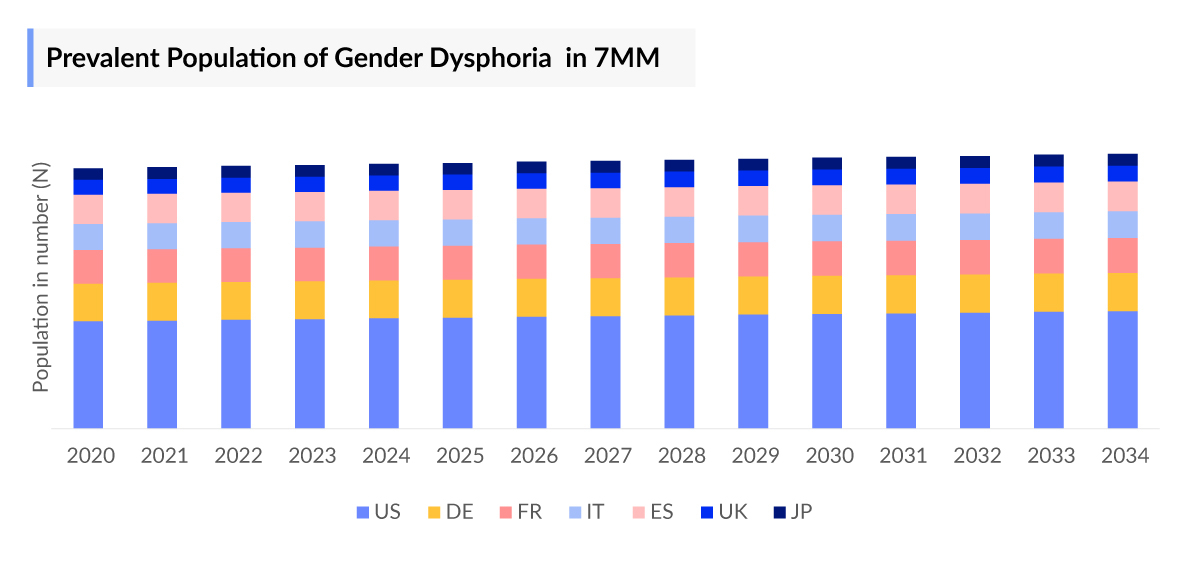
The gender dysphoria epidemiology chapter in the report provides historical as well as forecasted in the 7MM covering the United States, EU4 countries (Germany, France, Italy, and Spain), the United Kingdom, and Japan from 2024 to 2034. The Gender Dysphoria epidemiology is segmented with detailed insights into the prevalence of gender dysphoria, gender-specific prevalence of gender dysphoria, comorbidities associated cases of gender dysphoria.
- In 2023, the prevalent population of Gender Dysphoria in US was found to be ~13,000 cases.
- In 2023, it was found that the gender ratio was slightly in favor of males as compared to females in the US.
- Among EU4 and the UK, UK accounted for the highest prevalent cases of gender dysphoria ~8,500 cases followed by Germany ~5,000 cases.
Gender Dysphoria Drug Chapter
The drug chapter segment of the Gender Dysphoria report encloses a detailed analysis of Gender Dysphoria marketed drugs and late-stage (Phase III and Phase II) pipeline drugs. It also deep dives into the Gender Dysphoria pivotal clinical trial details, recent and expected market approvals, patent details, the latest news, and recent deals and collaborations.

Gender Dysphoria Market Outlook
The dynamics of the Gender Dysphoria market are currently a consequence of existing therapies, including high-cost surgeries. Further developments in patient-reported outcomes research, transgender-specific provider education, and technical advancements to gender-confirming surgery (GCS) procedures are necessary to meet the healthcare needs of this population.
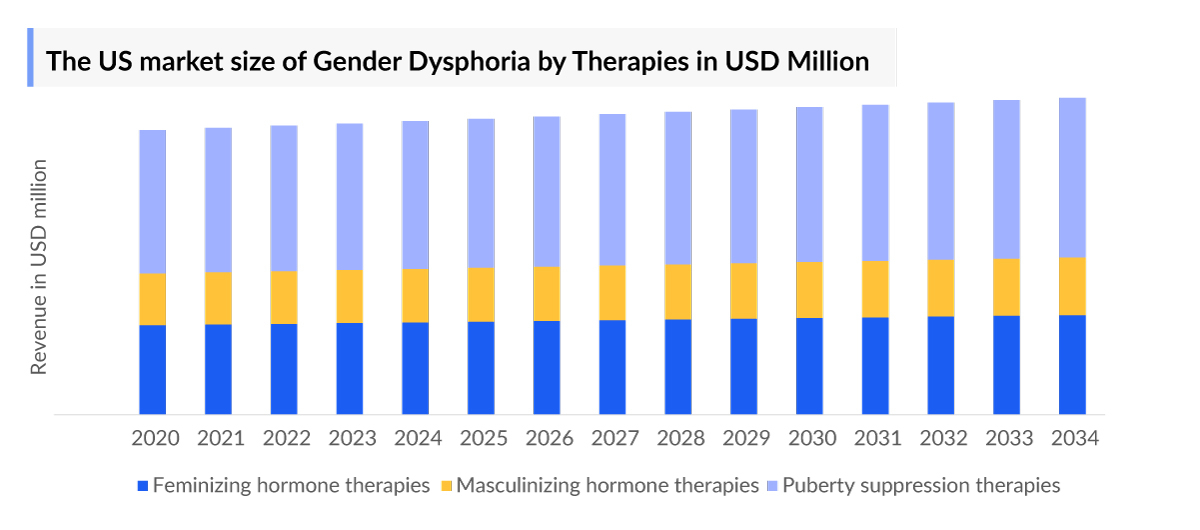
- • In the 7MM, US contributed the most revenue ~45% in 2023.
- • In 2023, Puberty suppression therapies contributed the most in US i.e. ~USD 20 million.
- • Among EU4 and the UK, UK generated the highest revenue of ~US 20 million in 2023.
- • No pharmaceutical company is currently involved in the R&D activities, yet some significant trials are underway sponsored by universities and research organizations.
Gender Dysphoria Drugs Uptake
This section focuses on the uptake rate of potential drugs expected to be launched in the market during 2024–2034, which depends on the competitive landscape, safety, and efficacy data along with order of entry. It is important to understand that the key players evaluating their novel therapies in the pivotal and confirmatory trials should remain vigilant when selecting appropriate comparators to stand the greatest chance of a positive opinion from regulatory bodies, leading to approval, smooth launch, and rapid uptake.
Further detailed analysis of emerging therapies drug uptake in the report…
Gender Dysphoria Activities
The report provides insights into different therapeutic candidates. It also analyzes key players involved in developing targeted therapeutics.
Pipeline Development Activities
The report covers information on collaborations, acquisitions and mergers, licensing, and patent details for Gender Dysphoria emerging therapies.
KOL Views
To keep up with the real-world scenario in current and emerging market trends, we take opinions from Key Industry leaders working in the domain through primary research to fill the data gaps and validate our secondary research. Industry Experts were contacted for insights on the evolving treatment landscape, patient reliance on conventional therapies, patient therapy switching acceptability, and drug uptake along with challenges related to accessibility.
DelveInsight’s analysts connected with 15+ KOLs to gather insights; however, interviews were conducted with 9+ KOLs in the 7MM. Their opinion helps understand and validate current and emerging treatment patterns of Gender Dysphoria. This will support the clients in potential upcoming novel treatments by identifying the overall scenario of the market and the unmet needs.
|
Region |
KOL Views |
|
United States |
The multidisciplinary approach to the treatment of gender dysphoria advocates for access to hormone therapy and surgical options as part of comprehensive care. They stress the importance of informed consent and the need for healthcare providers to be knowledgeable and sensitive to the needs of transgender individuals. |
|
Germany |
The affirmation of gender identity in children and adolescents, states that gender-affirming care is crucial for the mental health and well-being of young people experiencing gender dysphoria. It is recommended that healthcare providers work closely with families to provide supportive environments that respect the child's gender identity. |
|
France |
Concerned about the lack of proper neuropsychiatric assessments before the administration of these treatments. Adhering to established medical guidelines is not merely a procedural formality but a fundamental necessity to ensure that every treatment is both ethical and effective. |
Qualitative Analysis
We perform Qualitative and market Intelligence analysis using various approaches, such as SWOT analysis and Conjoint Analysis. In the SWOT analysis, strengths, weaknesses, opportunities, and threats in terms of gaps in disease diagnosis, patient awareness, physician acceptability, competitive landscape, cost-effectiveness, and geographical accessibility of therapies are provided.
Conjoint Analysis analyzes multiple approved and emerging therapies based on relevant attributes such as safety, efficacy, frequency of administration, route of administration, and order of entry. Scoring is given based on these parameters to analyze the effectiveness of therapy.
Further, the therapies’ safety is evaluated wherein the acceptability, tolerability, and adverse events are majorly observed, and it sets a clear understanding of the side effects posed by the drug in the trials. In addition, the scoring is also based on the probability of success, and the addressable patient pool for each therapy. According to these parameters, the final weightage score and the ranking of the emerging therapies are decided.
Market Access and Reimbursement
The report further provides detailed insights on the country-wise accessibility and reimbursement scenarios, cost-effectiveness scenario of currently used therapies, programs making accessibility easier and out-of-pocket costs more affordable, insights on patients insured under federal or state government prescription drug programs, etc.
Scope of the Report
The report covers a segment of key events, an executive summary, descriptive overview of Gender Dysphoria, explaining its causes, signs and symptoms, pathogenesis, and currently available therapies.
- Comprehensive insight has been provided into the epidemiology segments and forecasts, the future growth potential of diagnosis rate, and disease progression along with country specific treatment guidelines.
- Additionally, an all-inclusive account of both the current and emerging therapies, along with the elaborative profiles of late-stage and prominent therapies, will have an impact on the current treatment landscape.
- A detailed review of the Gender Dysphoria market, historical and forecasted market size, market share by therapies, detailed assumptions, and rationale behind our approach is included in the report, covering the 7MM drug outreach.
- The report provides an edge while developing business strategies, by understanding trends, through SWOT analysis and expert insights/KOL views, patient journey, and treatment preferences that help in shaping and driving the 7MM Gender Dysphoria market.
Gender Dysphoria Report Insights
- Patient Population
- Therapeutic Approaches
- Gender Dysphoria Pipeline Analysis
- Gender Dysphoria Market Size and Trends
- Existing and future Market Opportunity
Gender Dysphoria Report Key Strengths
- Eleven Years Forecast
- 7MM Coverage
- Gender Dysphoria Epidemiology Segmentation
- Inclusion of Country specific treatment guidelines
- KOL’s feedback on approved and emerging therapies
- Key Cross Competition
- Conjoint analysis
- Drugs Uptake and Key Market Forecast Assumptions
Gender Dysphoria Report Assessment
- Current Treatment Practices
- Unmet Needs
- Pipeline Product Profiles
- Market Attractiveness
- Qualitative Analysis (SWOT and Conjoint Analysis)
FAQs
- What is the growth rate of the 7MM Gender Dysphoria treatment market?
- What was the Gender Dysphoria total market size, the market size by therapies, market share (%) distribution in 2020, and what would it look like in 2034? What are the contributing factors/key catalysts for this growth?
- Is there any unexplored patient setting that can open the window for growth in the future?
- What are the pricing variations among different geographies for approved and off-label therapies?
- How would the market drivers, barriers, and future opportunities affect the market dynamics and subsequent analysis of the associated trends? Although multiple expert guidelines recommend testing for targetable mutations before therapy initiation, why do barriers to testing remain high?
- What are the current and emerging options for the treatment of Gender Dysphoria?
- How many companies are developing therapies for the treatment of Gender Dysphoria?
- What are the recent novel therapies, targets, mechanisms of action, and technologies developed to overcome the limitations of existing therapies?
- Patient/physician acceptability in terms of preferred treatment options as per real-world scenarios?
- What are the country-specific accessibility issues of expensive, recently approved therapies?
Reasons to buy
- The report will help in developing business strategies by understanding the latest trends and changing treatment dynamics driving the Gender Dysphoria Market.
- Insights on patient burden/disease prevalence, evolution in diagnosis, and factors contributing to the change in the epidemiology of the disease during the forecast years
- Understand the existing market opportunities in varying geographies and the growth potential over the coming years.
- Distribution of historical and current patient share based on real-world prescription data along with reported sales of approved products in the US, EU4 (Germany, France, Italy, and Spain), the United Kingdom, and Japan.
- Identifying strong upcoming players in the market will help devise strategies to help get ahead of competitors.
- Detailed analysis and ranking of class-wise potential current and emerging therapies under the conjoint analysis section to provide visibility around leading classes.
- Highlights of access and reimbursement policies of approved therapies, barriers to accessibility of expensive off-label therapies, and patient assistance programs.
- To understand Key Opinion Leaders’ perspectives around the accessibility, acceptability, and compliance-related challenges of existing treatment to overcome barriers in the future.
- Detailed insights on the unmet needs of the existing market so that the upcoming players can strengthen their development and launch strategy.