
Gene and Cell Therapies targeting CNS disorders Epidemiology
-
CNS therapies were historically limited to small molecules due to the poor ability of large molecules to penetrate the brain, and early attempts with monoclonal antibodies in neurological diseases showed limited success, underscoring persistent delivery challenges.
-
These constraints, combined with a broader reliance on symptomatic management, drove advances in molecular biology that enabled the identification of genetic drivers, laying the foundation for more targeted therapeutic approaches.
-
This shift prompted the exploration of gene therapy as an alternative strategy to address CNS diseases at a molecular level, although efficient delivery to specific brain regions remained a key obstacle.
-
Early gene therapy setbacks related to safety concerns and vector limitations provided critical learnings, leading to the development of improved AAV-based delivery systems with enhanced efficacy and tolerability. In parallel, progress in stem cell research introduced regenerative potential, while clinical success in rare monogenic disorders validated the feasibility of one-time, disease-modifying treatments.
-
Gene and cell therapies for CNS disorders are advancing rapidly, driven by the rising prevalence of conditions such as Alzheimer’s disease, Parkinson’s disease, Spinal Muscular Atrophy (SMA), Huntington’s disease, Amyotrophic Lateral Sclerosis (ALS), multiple sclerosis, Cerebral Adrenoleukodystrophy (CALD), and others. The growing patient burden and limited effectiveness of current treatments are increasing demand for innovative, disease-modifying therapies.
Cell and Gene Therapies Targeting CNS Disorders Epidemiology Forecast in the 7MM
-
2025 Cell and Gene Therapies Targeting CNS Disorders Diagnosed Prevalent Cases: ~XXX
-
2036 Cell and Gene Therapies Targeting CNS Disorders Diagnosed Prevalent Cases: ~XXX
-
Cell and Gene Therapies Targeting CNS Disorders Growth Rate (2026–2036): ~XX% CAGR
DelveInsight's ‘Cell and Gene Therapies Targeting CNS Disorders – Epidemiology Forecast – 2036’ report delivers an in-depth understanding of the cell and gene therapies targeting CNS disorders, historical and forecasted epidemiology in the United States, EU4 (Germany, Spain, Italy, and France), the United Kingdom, and Japan.
|
Study Period |
2022–2036 |
|
Historical Year |
2022–2025 |
|
Forecast Period |
2026–2036 |
|
Base Year |
2026 |
|
Geographies Covered |
|
|
Cell and Gene Therapies Targeting CNS Disorders Epidemiology CAGR (Study period/Forecast period) |
~XX% (2026–2036) |
|
Cell and Gene Therapies Targeting CNS Disorders Epidemiology Segmentation Analysis |
Patient Burden Assessment
|
Cell and Gene Therapies Targeting CNS Disorders: Understanding
Cell and Gene Therapies Targeting CNS Disorders Overview
Cell and gene therapies targeting CNS disorders represent a rapidly evolving field focused on addressing the underlying genetic and cellular causes of neurological diseases. These approaches include gene replacement, gene silencing, and cell-based regenerative strategies to restore or modify neuronal function. Advances in viral vectors (e.g., AAV) and improved delivery methods such as intrathecal and intracerebral administration have enhanced access to the brain. Several therapies have already achieved regulatory approval, particularly for rare genetic disorders, demonstrating strong clinical potential. Overall, this field is shifting CNS treatment from symptomatic management to long-term, potentially curative solutions.
CNS Disorders Diagnosis
Diagnosis of central nervous system (CNS) disorders involves a combination of clinical evaluation, neurological examination, and advanced diagnostic tools. Key methods include neuroimaging techniques such as MRI and CT scans to assess brain structure, along with electrophysiological tests like EEG to evaluate brain activity. Laboratory tests, including cerebrospinal fluid (CSF) analysis and genetic testing, help identify infections, inflammation, or inherited conditions. Increasing use of biomarkers and molecular diagnostics is improving early detection and disease characterization.
Further details are provided in the report.
Cell and Gene Therapies Targeting CNS Disorders Epidemiology
Key Findings from Cell and Gene Therapies Targeting CNS Disorders Epidemiological Analysis and Forecast
-
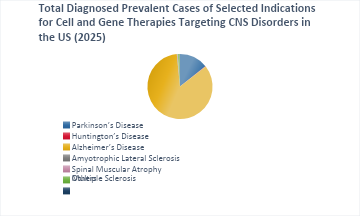
According to DelveInsight analysis, in 2025, there were 1,290,000 diagnosed prevalent cases of Parkinson’s disease in the US, and the cases are expected to increase at a CAGR of ~3%.
-
In 2025, the number of amyotrophic lateral sclerosis (ALS) cases in the United States was ~30,000.
-
In the United States, the total number of diagnosed prevalent cases of Huntington’s disease was 25,000 in 2025, which is expected to increase during the forecast period, i.e., 2026–2036.
-
In 2025, the total number of diagnosed prevalent cases of Alzheimer’s disease in the 7MM was 17,000,000. Among the 7MM countries, the US accounted for the highest number of diagnosed prevalent cases of Alzheimer’s disease, contributing around 45%, while the UK reported the lowest number of cases in 2025.
|
Sr. No. |
Indications |
Estimated Cases in 2025 in the US (Diagnosed Prevalence) |
|
1 |
Parkinson’s Disease |
~1,290,000 |
|
2 |
Huntington’s Disease |
~25,000 |
|
3 |
Alzheimer’s Disease |
~7,600,000 |
|
4 |
Amyotrophic Lateral Sclerosis |
~30,000 |
|
5 |
Spinal Muscular Atrophy |
~13,000 |
|
6 |
Multiple Sclerosis |
~86,000 |
*The list is not exhaustive and will be provided in the final report. Also, numbers are subject to change as per report updation.
Scope of the Report
-
The report covers a segment of an executive summary, a descriptive overview of cell and gene therapies targeting CNS disorders, explaining their causes, signs and symptoms, and pathogenesis.
-
Comprehensive insight has been provided into the epidemiology segments and forecasts, the future growth potential of the diagnosis rate, and disease progression.
Report Insights
Cell and Gene Therapies Targeting CNS Disorders Patient Population Forecast
Report Key Strengths
-
Epidemiology‑based (Epi‑based) Bottom‑up Forecasting
-
11-year Forecast
-
Patient Burden Trends (by geography)
FAQs
-
What are the disease risks, burdens, and unmet needs of cell and gene therapies targeting CNS disorders? What will be the growth opportunities across the 7MM concerning the patient population with cell and gene therapies targeting CNS disorders?
-
What are the historical and forecasted cell and gene therapies targeting the patient pool in the US, EU4 (Germany, France, Italy, and Spain), the UK, and Japan?
Reasons to Buy
-
Insights on patient burden/disease prevalence, evolution in diagnosis, and factors contributing to the change in the epidemiology of the disease during the forecast years.
-
To understand key opinion leaders’ perspectives on the diagnostic challenges to overcome barriers in the future.
-
Detailed insights into various factors hampering disease diagnosis and other existing diagnostic challenges.