
Glioma Epidemiology
Glioma Insights and Trends
- The incidence of glioma remains relatively low compared to other cancers; however, glioblastoma (GBM) accounts for nearly 45%–50% of all malignant primary brain tumors and represents the most aggressive subtype, driving the overall disease burden and mortality.
- Brainstem gliomas are uncommon in adults and account for only 1–2% of intracranial gliomas. They represent a heterogeneous group of tumors that differ from those found in their pediatric counterparts.
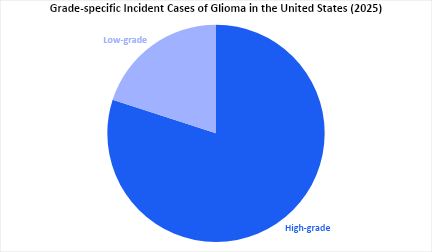
- High‑grade gliomas are the most frequent malignant primary brain tumors, which account for ~80% of all gliomas in the United States.
- In the US and other major markets, glioma incidence increases significantly with age, with the highest rates observed in individuals aged ≥65 years. Aging populations are expected to contribute to a gradual rise in overall glioma cases during the forecast period.
- GBM constitutes the largest share (~32,050) among glioma subtypes, while lower-grade gliomas (Grade II–III) represent a smaller but growing segment due to improved survival and better detection through advanced imaging and molecular diagnostics.
- Molecular classification has significantly reshaped glioma epidemiology, with biomarkers such as IDH mutation, MGMT promoter methylation, and H3K27M playing a critical role in disease stratification, prognosis, and treatment decision-making.
- Glioma incidence is generally higher in males compared to females, and slightly higher in Caucasian populations compared to other ethnic groups, although the underlying reasons remain unclear.
Glioma Epidemiology Forecast in the United States
- 2025 Incident Cases of Glioma: ~21,000
- Glioma Growth Rate (2026–2036): 1.5% CAGR
DelveInsight's ‘Glioma – Epidemiology Forecast – 2036’ report delivers an in-depth understanding of the glioma, historical and forecasted epidemiology in the United States, EU4 (Germany, Spain, Italy, and France) and the United Kingdom, and Japan.
|
Study Period |
2022–2036 |
|
Historical Year |
2022–2025 |
|
Forecast Period |
2026–2036 |
|
Base Year |
2026 |
|
Geographies Covered |
|
|
Glioma Epidemiology CAGR (Study period/Forecast period) |
1.5% (2026–2036) |
|
Glioma Epidemiology Segmentation Analysis |
Patient Burden Assesment
|
Glioma Understanding and Diagnosis Algorithm
Glioma Overview
Glioma is the most common central nervous system (CNS) neoplasm originating from glial cells. They are very diffusely infiltrative tumors that affect the surrounding brain tissue. Three common types of gliomas are classified based on phenotypic cell characteristics: Astrocytomas, ependymomas, and oligodendrogliomas. Gliomas are caused by the accumulation of genetic mutations in glial stem or progenitor cells, leading to their uncontrolled growth. Gliomas are further classified into Grades I–IV. Glioblastoma (GBM Grade IV) is the most malignant type, while pilocytic astrocytomas (Grade I) are the least malignant brain tumors among these Grades I–IV. Mutated genes are typically involved in the etiology of glioma. Examples of mutated genes in certain types of glioma include TP53, PTEN (tumor suppressor genes), BRAF (involved in cell growth), and IDH1 (involved in cellular metabolism).
Glioma Diagnosis
The diagnosis of glioma includes neurological exams (this exam tests vision, hearing, speech, strength, sensation, balance, coordination, reflexes, and the ability to think and remember), angiograms, magnetic resonance imaging (MRI), computerized tomography (CT), surgical biopsy, and others. The patient’s journey typically starts with the onset of symptoms like seizures, unusual headaches, mood and sensory disturbances, and difficulties in walking. Following an initial visit with a general practitioner, during which the patient underwent a complete physical examination, and the results revealed a few alarming findings related to a brain tumor, the patient was referred to a neuro-oncologist. Further, a neuro-oncologist will immediately recommend an MRI, given that it is the most prominent imaging method, gives good brain images, and aids in the accurate differential diagnosis of brain cancers. A biopsy is carried out to determine the disease’s stage if the MRI scans reflect glioma. Moreover, molecular examination of biomarkers may be applied to evaluate the type and grade. Once the grade of the glioma is determined, the appropriate treatment is provided to the patient.
Further details are provided in the report.
Glioma Epidemiology
Key Findings from Glioma Epidemiological Analysis and Forecast
- According to DelveInsight’s estimates, the total incident cases of glioma in the 7MM were approximately 51,000 in 2025.
- It has been observed that the incidence of high grade glioma is higher (~16,700) as compared to low grade glioma (~4,170) in the United States in 2025.
- According to DelveInsight estimates, in the United States, among all the grades, Grade IV accounted for the highest number of incident cases (~70%), followed by Grade II glioma (~15%), while Grade I had the least number of cases (~7%).
- In 2025, among gliomas in other parts of central nervous system in the United States, glioblastoma was the most prevalent in adults than in pediatrics, followed by anaplastic astrocytoma which was also found to be more prevalent in adults than in pediatrics.
- In Japan among gliomas in other parts of the central nervous system, Glioblastoma was found to be more incident in Adults (~2,735) in 2025.
Scope of the Report
The report covers a segment of an executive summary, a descriptive overview of Glioma, explaining its causes, signs and symptoms, and pathogenesis.
- Comprehensive insight has been provided into the epidemiology segments and forecasts, the future growth potential of the diagnosis rate, and disease progression.
Report Insights
- Glioma Patient Population Forecast
Report Key Strengths
- Epidemiology‑based (epi‑based) Bottom‑up Forecasting
- 11-year Forecast
- Patient Burden Trends (by geography)
FAQs
- What are the disease risks, burdens, and unmet needs of glioma? What will be the growth opportunities across the 7MM concerning the patient population with glioma?
- What is the historical and forecasted glioma patient pool in the US, EU4 (Germany, France, Italy, and Spain), the UK, and Japan?
Reasons to Buy
- Insights on patient burden/disease prevalence, evolution in diagnosis, and factors contributing to the change in the epidemiology of the disease during the forecast years.
- To understand key opinion leaders’ perspectives around the diagnostic challenges to overcome barriers in the future.
- Detailed insights on various factors hampering disease diagnosis and other existing diagnostic challenges.



.png&w=256&q=75)