Hashimoto's Thyroiditis Epidemiology
Key Highlights
- As per DelveInsight’s estimates, in 2024, there were approximately 50 million prevalent cases of Hashimoto’s thyroiditis in the 7MM, reflecting a significant disease burden.
- Among these prevalent cases in the 7MM, around 20 million were diagnosed with Hashimoto’s thyroiditis in 2024.
- In 2024, the US accounted for the highest number of diagnosed prevalent cases of Hashimoto's thyroiditis among the 7MM, with approximately 11 million cases.
- In 2024, among the EU4 and the UK, Germany accounted for the highest diagnosed prevalent cases of Hashimoto’s thyroiditis, representing 26% of the total cases, followed by 20% cases in the UK. Analysis by DelveInsight’s experts indicates that the overall diagnosed prevalent cases of Hashimoto’s thyroiditis are expected to rise in the coming years.
- According to DelveInsight analysis, nearly 280 thousand males and 1.1 million females were affected with Hashimoto’s thyroiditis in France in 2024. DelveInsight estimates that these numbers will increase by 2034.
- DelveInsight’s epidemiological model estimates that in 2024, the 35 years and above age group in the EU4 and the UK had the highest Hashimoto’s thyroiditis cases, nearly 4 million. In contrast, the 25-34 age group had the fewest cases, with around 1.6 million recorded.
- DelveInsight’s estimates indicate that in 2024, Japan had approximately 2 million diagnosed prevalent cases of Hashimoto’s thyroiditis, a figure expected to grow by 2034.
DelveInsight’s “Hashimoto’s Thyroiditis Epidemiology Forecast – 2034” report delivers an in-depth understanding of Hashimoto’s Thyroiditis, historical and forecasted epidemiology of Hashimoto’s Thyroiditis in the United States, EU4 (Germany, France, Italy, and Spain) and the United Kingdom, and Japan.
Geography Covered
- The United States
- EU4 (Germany, France, Italy, and Spain) and the United Kingdom
- Japan
Study Period: 2020–2034
Hashimoto’s Thyroiditis Understanding
Hashimoto’s Thyroiditis Overview
Hashimoto’s thyroiditis is a chronic autoimmune disorder characterized by lymphocytic infiltration of the thyroid gland, leading to progressive destruction and eventual hypothyroidism. It is the most common cause of hypothyroidism and is marked by the presence of anti-thyroid antibodies, such as anti-thyroglobulin and anti-thyroid peroxidase antibodies. The disease presents in various clinicopathologic forms, including classic, fibrous, IgG4-related, and juvenile variants, as well as transient thyrotoxicosis (hashitoxicosis) and painless thyroiditis. While primary Hashimoto’s arises spontaneously, secondary forms can be triggered by medications like interferon-alpha or immune checkpoint inhibitors. Chronic inflammation and autoantibody-driven damage impair thyroid function, often resulting in goiter, hormonal imbalances, and an increased risk of cardiovascular and malignant complications. The rising prevalence of Hashimoto’s highlights its significance as a major autoimmune endocrine disorder.
Hashimoto’s Thyroiditis Diagnosis
Diagnosis of Hashimoto’s thyroiditis relies on a combination of clinical, serological, and imaging findings. Anti-thyroid peroxidase antibodies are the most reliable serological marker, present in most cases, while anti-thyroglobulin antibodies may appear earlier but are less specific. Ultrasonography reveals hallmark features like decreased echogenicity, heterogeneous echotexture, and hypoechoic micronodules with echogenic rims, aiding in differentiation from other thyroid disorders. Fine-needle aspiration cytology (FNAC) is not routinely required but becomes crucial when nodules are present to exclude malignancy. Key cytological findings include lymphocytic infiltration, Hurthle cell changes, and reactive nuclear atypia, which must be distinguished from neoplastic processes.
The disease manifests across a spectrum of thyroid function, from euthyroid to overt hypothyroidism, with cytology reflecting disease progression. Increased lymphocytic infiltration and Hurthle cell metaplasia often correlate with advancing dysfunction. While some patients remain asymptomatic for years, others progress to hypothyroidism requiring hormone replacement. Nodular changes in Hashimoto’s warrant vigilant monitoring due to potential malignant transformation, underscoring the importance of integrating clinical, serological, and imaging data for accurate diagnosis and management.
Further details related to diagnosis are provided in the report...
Hashimoto’s Thyroiditis Epidemiology
For the purpose of designing the patient-based model for Hashimoto’s Thyroiditis, the report provides historical as well as forecasted epidemiology segmented by total prevalent cases of Hashimoto’s thyroiditis, total diagnosed prevalent cases of Hashimoto’s thyroiditis, gender-specific diagnosed prevalent cases of Hashimoto’s thyroiditis, age-specific diagnosed prevalent cases of Hashimoto’s thyroiditis, and cytology-specific diagnosed prevalent cases of Hashimoto’s thyroiditis in the 7MM covering the United States, EU4 countries (Germany, France, Italy, and Spain) and the United Kingdom, and Japan, from 2020 to 2034.
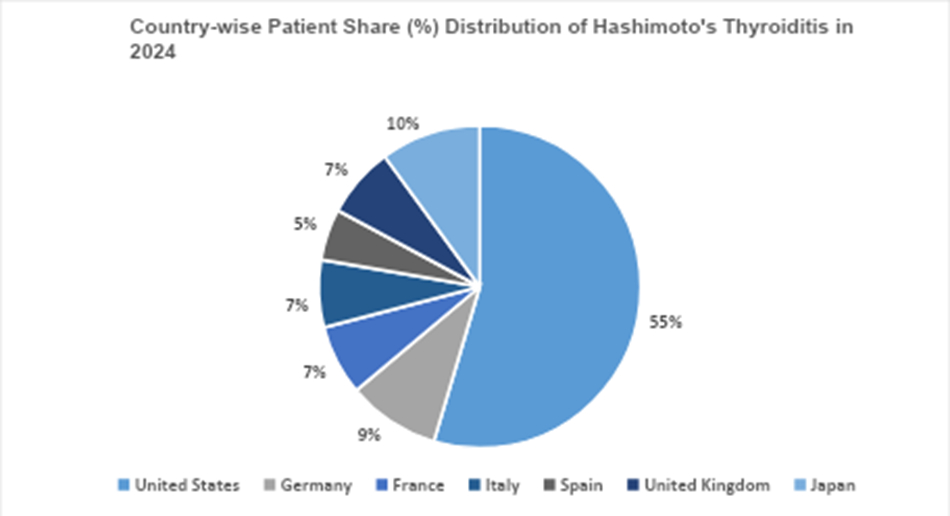
- According to DelveInsight’s estimates, in 2024, there were approximately 20 million diagnosed prevalent cases of Hashimoto's thyroiditis in the 7MM. Of these, the United States accounted for 55% of the cases, while EU4 and the UK accounted for nearly 35% and Japan represented 10% of the cases, respectively.
- In 2024, the US accounted for around 11 million diagnosed prevalent cases of Hashimoto’s thyroiditis. DelveInsight forecasts a rise in this figure by 2034, reflecting the growing burden of the disease. The rise in prevalent Hashimoto’s thyroiditis cases in the US is driven by demographic shifts—such as an aging population and a higher prevalence of coexisting autoimmune conditions—as well as lifestyle factors, including increased stress, evolving dietary patterns, and changes in gut microbiota that collectively contribute to immune dysregulation and thyroid autoimmunity
- In the US, age-specific cases are divided into three groups: 18-24 years, 25-34 years, and 35 years and above. In 2024, the 18-24 years age group had nearly 2.5 million cases, the 25-34 years age group had around 2.4 million cases, and 35 years and above age group had approximately 6 million cases.
- Hashimoto’s thyroiditis is also classified by cytology: euthyroid (asymptomatic), sub-clinical hypothyroid (asymptomatic), and clinically hypothyroid (symptomatic). Within EU4 and the UK, the euthyroid had the highest prevalence with around 3.4 million cases in 2024, while sub-clinical hypothyroid showed the lowest with around 650 thousand cases.
- In 2024, the UK recorded nearly 290 thousand diagnosed cases of Hashimoto’s thyroiditis in males and 1 million in females, reflecting a clear gender difference in disease prevalence.
- In the assessment done by DelveInsight, the estimated total diagnosed prevalent cases of Hashimoto’s thyroiditis in Japan were nearly 2 million in 2024.
KOL Views
To gaze into the epidemiology insights of the real world, we take KOLs and SMEs’ opinions working in the domain through primary research to fill the data gaps and validate our secondary research on disease prevalence.
DelveInsight’s analysts connected with 20+ KOLs to gather insights; however, interviews were conducted with 10+ KOLs in the 7MM. Centers such as the National Institutes of Health, US; University of California, US; Berkshire Medical Center, US; University of Duesseldorf , Germany; Centre Hospitalier Régional Universitaire Hôpital Claude-Huriez, France; Sapienza University of Rome, Italy; Institute of Cell Biology and Neurobiology, Italy; Instituto de Investigación Sanitaria Princesa, Spain; University of Surrey, the UK; Wakayama Medical University, Japan; Kuma Hospital, Japan and others were contacted. Their opinion helps understand and validate current disease prevalence, gender involved with the disease, diagnosis rate, and diagnostic criteria.
Scope of the Hashimoto’s Thyroiditis Market Report
- The report covers a segment of executive summary, descriptive overview of Hashimoto’s thyroiditis, explaining its causes, signs and symptoms, and currently available diagnostic algorithms and guidelines.
- Comprehensive insight has been provided into the epidemiology segments and forecasts, the future growth potential of diagnosis rate, disease progression, and diagnosis guidelines.
- The report provides an edge for understanding trends, expert insights/KOL views, and patient journeys in the 7MM.
- A detailed review of current challenges in establishing the diagnosis.
Hashimoto’s Thyroiditis Report Insights
- Hashimoto’s Thyroiditis Patient Population
- Country-wise Epidemiology Distribution
- Total Prevalent Cases of Hashimoto’s Thyroiditis
- Total Diagnosed Prevalent Cases of Hashimoto’s Thyroiditis
- Gender-specific Diagnosed Prevalent Cases of Hashimoto’s Thyroiditis
- Age-specific Diagnosed Prevalent Cases of Hashimoto’s Thyroiditis
- Cytology-specific Diagnosed Prevalent Cases of Hashimoto’s Thyroiditis
Hashimoto’s Thyroiditis Report Key Strengths
- 10 years Forecast
- The 7MM Coverage
- Hashimoto’s Thyroiditis Epidemiology Segmentation
Hashimoto’s Thyroiditis Report Assessment
- Current Diagnostic Practices
- Patient Segmentation
Hashimoto’s Thyroiditis Epidemiology Insights
- What are the disease risk, burdens, and unmet needs of Hashimoto’s thyroiditis? What will be the growth opportunities across the 7MM concerning the patient population of Hashimoto’s thyroiditis?
- What is the historical and forecasted Hashimoto’s thyroiditis patient pool in the United States, EU4 (Germany, France, Italy, and Spain) and the United Kingdom, and Japan?
- Why is the diagnosed prevalent cases of Hashimoto’s thyroiditis in Japan lower than the US?
- Which country has a high patient share for Hashimoto’s thyroiditis?
Reasons to Buy Hashimoto’s Thyroiditis Epidemiology Report
- Insights on patient burden/disease, evolution in diagnosis, and factors contributing to the change in the epidemiology of the disease during the forecast years.
- To understand the Hashimoto’s thyroiditis prevalence cases in varying geographies over the coming years.
- A detailed overview of Gender and Age-specific diagnosed prevalence of Hashimoto’s Thyroiditis, along with diagnosed prevalence of Hashimoto’s Thyroiditis based on Cytology.
- To understand the perspective of key opinion leaders around the current challenges with establishing the diagnosis options.
- Detailed insights on various factors hampering disease diagnosis and other existing diagnostic challenges.
Frequently Asked Questions
1. What is the forecast period covered in the report?
The Hashimoto’s thyroiditis Epidemiology report for the 7MM covers the forecast period from 2025 to 2034, providing a projection of epidemiology dynamics and trends during this timeframe.
2. Out of all EU4 countries and the UK, which country had the highest population of Hashimoto’s thyroiditis cases in 2024?
The highest cases of Hashimoto’s thyroiditis was found in the Germany among EU4 and the UK in 2024.
3. How is epidemiological data collected and analyzed for forecasting purposes?
Epidemiological data is collected through surveys, clinical studies, health records, and other sources. It is then analyzed to calculate disease rates, identify trends, and project future disease burdens using mathematical models.
4. Out of all 7MM countries, which country had the highest population of Hashimoto’s thyroiditis cases in 2024?
The highest cases of Hashimoto’s thyroiditis were found in the US among the 7MM in 2024.