Head and Neck Squamous Cell Carcinoma Market Summary
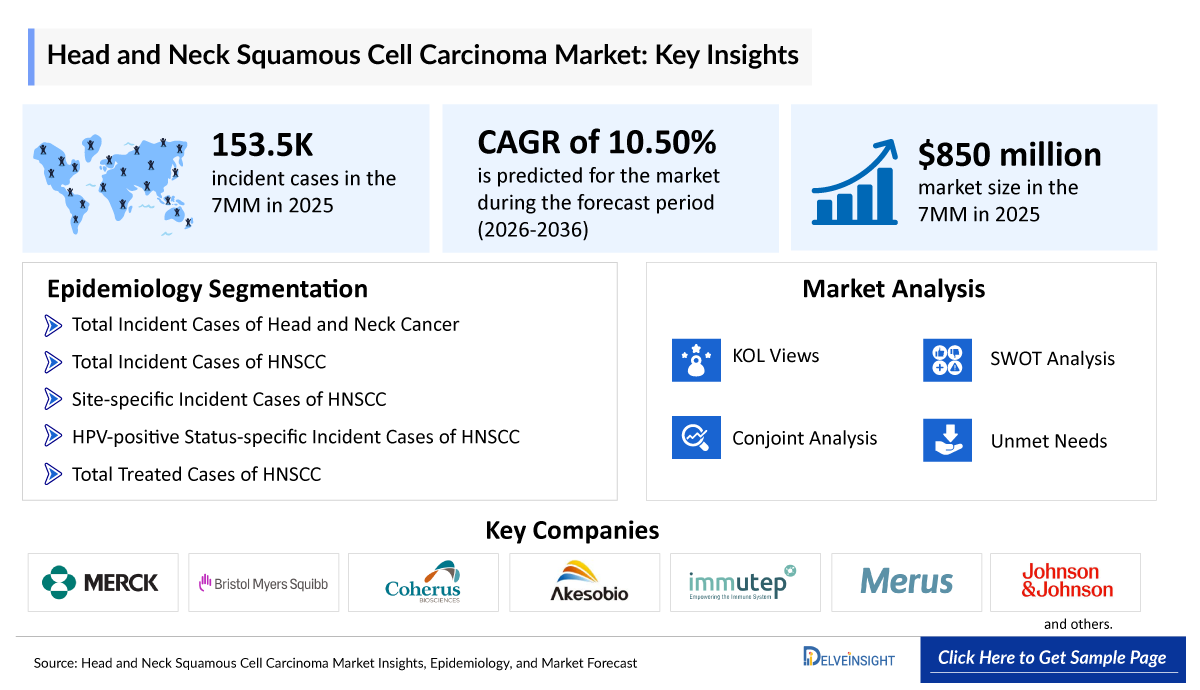
- The Head and Neck Squamous Cell Carcinoma Market Size was valued at approximately USD 850 million in 2025 and is projected to reach nearly USD 2,560 million by 2036, expanding at a CAGR of 10.5% during the 2026–2036 forecast period.
- The leading HNSCC Companies include Merck, Bristol Myers Squibb, Coherus BioSciences, Akeso Biopharma, Immutep, Merus N.V., NANOBIOTIX , Johnson & Johnson, PDS Biotechnology, BioNTech, and others.
Key HNSCC Market & Epidemiology Insights
- The rising incidence of Head and Neck Squamous Cell Carcinoma is strongly associated with Human Papillomavirus infection, with more than 90% of oropharyngeal cancer cases attributed to HPV in the US. Among these, the HPV16 subtype is responsible for around 90% of the cases. There is an opportunity to enhance current HNSCC treatments by developing immunotherapeutic approaches specifically designed to target HPV biology.
- The standard treatment for locoregionally advanced HPV16+ HNSCC generally includes chemoradiation (CRT) or surgery with subsequent adjuvant therapy. However, recurrence and metastasis rates remain high, particularly in advanced stages.
- Despite CRT’s effectiveness in the early stages, challenges such as treatment resistance, disease progression, and long-term adverse effects persist, particularly in patients with recurrent HPV16+ disease.
- KEYTRUDA and OPDIVO are the primary PD-1 inhibitors approved for treating recurrent or metastatic (R/M) HNSCC.
- KEYTRUDA monotherapy is the preferred first-line treatment for recurrent or metastatic HNSCC with high PD-L1 expression. However, only about 20% of patients respond, and there is no significant difference based on HPV status. Currently, no treatments are specifically approved for HPV16+ cancers.
- HPV-positive HNSCC remains partly resistant to PD-1 blockade due to immune evasion and tumor microenvironment (TME) suppression. E6/E7-targeted vaccines and T-cell receptor therapies (TCR therapies) show modest benefit, with greater promise in combination, but are limited by Human Leukocyte Antigen (HLA) restriction and antigen-processing resistance.
- First-line treatment options for R/M SCCHN are limited. For platinum-eligible patients, the recommended regimen is EXTREME (cetuximab, platinum, and 5-fluorouracil). However, clinical trials show that this combination offers a modest survival benefit of about 10 months and is associated with significant toxicities and side effects.
- Therapeutic vaccination in HNSCC has gained significant momentum in recent years, with several strategies nearing clinical application. ISA101b and PDS0101, have emerged as frontrunners, demonstrating considerable promise and positioning themselves as strong candidates for FDA approval in treating these tumors.
- The HNSCC Therapeutics Market landscape is highly competitive, with key HNSCC Companies like PDS Biotechnology, ISA Pharmaceuticals, Merus, BioNTech, and others driving innovative strategies to improve efficacy and broaden treatment options for HPV16+ HNSCC, offering new hope for patients with limited current alternatives.
Head and Neck Squamous Cell Carcinoma Market and Forecast in the 7MM
| 2025 HNSCC Market Size | ~USD 850 Million |
| 2036 Projected HNSCC Market Size | ~USD 2,560 Million |
| HNSCC Growth Rate (2026–2036) | 10.5% CAGR |
Key Factors Driving the Head and Neck Squamous Cell Carcinoma Market
-
Rising Incidence of Head and Neck Squamous Cell Carcinoma
The increasing global burden of HNSCC, driven primarily by tobacco use, alcohol consumption, and rising human papillomavirus (HPV) infections, is a key factor fueling market growth. In the US, HNSCC accounts for a significant proportion of cancer diagnoses, with incidence rates expected to rise steadily through 2036 due to persistent exposure to risk factors and improved diagnostic rates.
Notably, the growing incidence of HPV-positive oropharyngeal cancers is reshaping the epidemiology and expanding the treatable patient population.
-
Reshaping the Immunotherapy Landscape
The treatment of HPV16-positive HNSCC is undergoing a major shift, with therapeutic cancer vaccines emerging as a transformative pillar alongside checkpoint inhibitors. Unlike conventional immunotherapy that relies on pre-existing immune activity, vaccines aim to generate robust, antigen-specific T-cell responses targeting HPV16 oncoproteins (E6/E7).
Across the development spectrum neoadjuvant, first-line, and second-line settings these vaccines are poised to redefine outcomes by improving response durability, overcoming resistance to checkpoint inhibitors, and expanding treatment options for patients with limited therapies.
Therapeutic vaccines targeting HPV16 antigens like E6 and E7 oncoproteins are a major focus for emerging players. HNSCC Companies like ISA Pharmaceuticals, PDS Biotechnology, BioNTech, Nykode Therapeutics, and Inovio Pharmaceuticals are developing vaccines (e.g., ISA101, Versamune HPV, BNT113, abipapogene suvaplasmid, and INO-3112) designed to elicit robust immune responses against HPV16-infected cells.
-
Emerging Head and Neck Squamous Cell Carcinoma Competitive Landscape
Some of the HNSCC drugs in clinical trials include Petosemtamab, Amivantamab (RYBREVANT), Versamune HPV (PDS0101), BNT113, Eftilagimod alpha and others.
DelveInsight's ‘Head and Neck Squamous Cell Carcinoma Market Insights, Epidemiology and Market Forecast – 2036’ report delivers an in-depth understanding of the HNSCC, historical and forecasted epidemiology, as well as the HNSCC therapeutics market trends in the United States, EU4 (Germany, Spain, Italy, and France) and the United Kingdom, and Japan.
The Head and Neck Squamous Cell Carcinoma Treatment Market Report delivers a comprehensive analysis of the current treatment landscape, including standards of care, clinical practices, and evolving therapeutic algorithms. It evaluates HNSCC patient burden trends, revenue & market share dynamics, peak patient share & therapy uptake analysis, and provides an in-depth market size assessment and growth rate projections (Historical & Forecast 2022–2036) across global regions. The report highlights key unmet medical needs in HNSCC and maps the competitive and clinical landscape to uncover high‑value opportunities, providing a clear outlook on future market growth potential.
Scope of the HNSCC Market Report | |
|
Study Period |
2022–2036 |
|
Historical Year |
2022–2025 |
|
Forecast Period |
2026–2036 |
|
Base Year |
2026 |
|
Geographies Covered |
ü North America: The US; ü Europe: Germany, France, Italy, Spain and the UK; ü Asia-Pacific: Japan |
|
HNSCC Market CAGR (Study period/Forecast period) |
10.5% (2026 ̶ 2036) |
|
HNSCC Epidemiology Segmentation Analysis |
Patient Burden Assessment
|
|
HNSCC Companies |
|
|
HNSCC Therapies |
|
|
HNSCC Market |
Segmented By
|
|
Analysis |
|
Head and Neck Squamous Cell Carcinoma Disease Understanding
Head and Neck Squamous Cell Carcinoma Overview and Diagnosis
HNSCC comprises a group of malignancies originating from the squamous cells lining the head and neck region, including the oral cavity, hypopharynx, nasopharynx, oropharynx, lip, nasal cavity, paranasal sinuses, and salivary glands. These structures play essential roles in respiration, swallowing, and conditioning inspired air by filtering and humidifying it.
HNSCC represents a significant global health burden, with incidence and mortality rates showing considerable variation across geographic regions and demographic groups. The disease is more prevalent in certain populations, particularly men, older adults, and individuals of lower socioeconomic status.
Head and Neck Squamous Cell Carcinoma Diagnosis
Diagnosis of HNSCC is confirmed by biopsy of the primary tumor or neck mass, with the approach depending on lesion location, primary tumors are usually sampled with cup forceps, incisional, or excisional biopsy, while suspicious cervical lymph nodes undergo fine-needle aspiration (FNA); excisional neck mass biopsy is avoided unless FNA is repeatedly non-diagnostic, no primary is found, or lymphoma is suspected.
Histopathology shows varying degrees of squamous differentiation, from well-differentiated tumors with keratin pearls to poorly differentiated tumors with pleomorphism and minimal keratinization; HPV-negative cases are often well or moderately differentiated, whereas HPV-positive tumors tend to be poorly differentiated or basaloid.
Diagnosis is typically made with hematoxylin and eosin staining, with immunohistochemistry for pancytokeratin, cytokeratin 5/6, and p63 used for poorly differentiated cases. HPV testing is mandatory for all oropharyngeal and unknown primary tumors, with p16^INK4A^ immunohistochemistry (positive if >70% diffuse staining) serving as the standard surrogate marker for HPV status.
Head and Neck Squamous Cell Carcinoma Treatment
HNSCC requires a multidisciplinary treatment approach tailored to disease stage and patient factors. In locally advanced disease, surgery and/or radiotherapy remain the primary modalities, often combined with platinum-based chemotherapy (cisplatin) in concurrent or adjuvant settings to improve locoregional control and survival outcomes. Definitive chemoradiation is widely used in unresectable cases or for organ preservation strategies.
In the recurrent/metastatic setting, treatment outcomes have significantly improved with the integration of Immune Checkpoint Inhibitors. KEYTRUDA is established as a standard first-line therapy, used as monotherapy in PD-L1–positive tumors or in combination with platinum-based chemotherapy and fluorouracil regardless of PD-L1 status. OPDIVO is approved in the second-line setting following platinum failure. These agents have demonstrated improved overall survival compared to historical chemotherapy regimens, although response rates remain modest in unselected populations.
HPV-positive HNSCC represents a biologically distinct subgroup with better prognosis and treatment responsiveness, and ongoing efforts are focused on treatment de-escalation and personalized strategies. Selected patients with limited metastatic disease may benefit from local ablative approaches, including surgery or stereotactic radiotherapy, in addition to systemic therapy.
Further details related to country-based variations are provided in the report...
Head and Neck Squamous Cell Carcinoma Unmet Needs
The section “unmet needs of Head and Neck Squamous Cell Carcinoma” outlines the critical gaps between the current state of patient care, diagnosis, and the ideal & effective management of the disease. It highlights the obstacles experienced by patients, clinicians, and researchers and identifies potential solutions for future progress.
- Limited Specific Treatment
- Lack of Reliable Prognostic Biomarkers
- Lack of personalized and age-specific treatment
- Poor Survival with Standard of Care
- Lack of Robust Frameworks and HPV Biomarkers Delays Early Detection and others…..
Comprehensive unmet needs insights in HNSCC and their strategic implications are provided in the full report...
Head and Neck Squamous Cell Carcinoma Epidemiology
The Head and Neck Squamous Cell Carcinoma epidemiology section provides insights about the historical and current Head and Neck Squamous Cell Carcinoma patient pool and forecasted trends for individual seven major countries. It helps to recognize the causes of current and forecasted trends by exploring numerous studies and views of key opinion leaders. This part of the Head and Neck Squamous Cell Carcinoma market report also provides the diagnosed patient pool and their trends along with assumptions undertaken.
Key Findings from Head and Neck Squamous Cell Carcinoma Epidemiological Analysis and Forecast
- According to DelveInsight’s estimates, the total incident cases of HNSCC in the 7MM were approximately 153,500 in 2025.
- It has been observed that among EU4 and the UK, site-specific cases of HNSCC were found maximum in the oral cavity in 2025.
- Germany accounted for about 2,700 Oropharyngeal squamous cell cancer (OPSCC) incident cases in 2025.
- Japan accounted for about 3,900 cases of HPV16+ OPSCC incident cases in 2025.
Head and Neck Squamous Cell Carcinoma Epidemiology Segmentation
- Total Head and Neck Cancer Incident Cases
- Head and Neck Cancer Site-specific Incident Cases
- Head and Neck Cancer Status-specific Incident Cases
- Head and Neck Cancer Stage-specific Incident Cases
- Total Head and Neck Cancer Treated Cases
Head and Neck Squamous Cell Carcinoma Market Recent Breakthroughs and Developments
- In February 2026, the FDA has granted breakthrough therapy designation (BTD) to amivantamab and hyaluronidase-lpuj (RYBREVANT FASPRO; subcutaneous amivantamab) as monotherapy for the treatment of adult patients with recurrent or metastatic, HPV–unrelated HNSCC following disease progression on or after platinum-based chemotherapy and a PD-L1 or PD-1 inhibitor.
- In August 2025, Merus announced that enrollment in the Phase III LiGeR-HN2 trial in HNSCC is expected to be completed by the end of 2025, and in May 2025, the company further announced that it anticipates sharing a topline interim readout in 2026 for Petosemtamab (MCLA-158).
- In August 2025, NHS England announced patients with advanced head and neck cancers in England will be fast-tracked into a trial of a new cancer vaccine, as the NHS expands its world-leading trial ‘match-making’ service.
- In May 2025, Merus announced interim clinical data as of February 27, 2025, data cutoff from the ongoing Phase II trial of the bispecific antibody petosemtamab in combination with pembrolizumab in 1L PD-L1+ R/M HNSCC. The data was further presented at ASCO 2025.
Head and Neck Squamous Cell Carcinoma Drug Analysis & Competitive Analysis
The HNSCC drug chapter provides a detailed, market-focused review of approved therapies and the emerging Head and Neck Squamous Cell Carcinoma Pipeline across Phase I–III clinical trials. It covers the mechanism of action, clinical trial data, regulatory approvals, patents, collaborations, and strategic partnerships for each therapy, along with their advantages, limitations, and recent developments. This section offers critical insights into the Head and Neck Squamous Cell Carcinoma treatment landscape, supporting market assessment, competitive analysis, and growth forecasting for the HNSCC therapeutics market.
Head and Neck Squamous Cell Carcinoma Approved Therapies
-
Nivolumab (OPDIVO): Bristol Myers Squibb
OPDIVO is a PD-1 immune checkpoint inhibitor that is designed to uniquely harness the body’s immune system to help restore anti-tumor immune response. By harnessing the body’s immune system to fight cancer, OPDIVO has become an important treatment option across multiple cancers.
-
- In July 2014, OPDIVO was the first PD-1 immune checkpoint inhibitor to receive regulatory approval anywhere in the world. OPDIVO is currently approved in more than 65 countries, including the US, the EU, Japan, and China. Pembrolizumab
-
KEYTRUDA: Merck Sharp & Dohme
KEYTRUDA is an anti-PD-1 therapy that works by increasing the ability of the body’s immune system to help detect and fight tumor cells. KEYTRUDA is a humanized monoclonal antibody that blocks the interaction between PD-1 and its ligands, PD-L1 and PD-L2, thereby activating T lymphocytes, which may affect both tumor cells and healthy cells.
Merck has the industry’s largest immuno-oncology clinical research program. There are currently more than 1,600 trials studying KEYTRUDA across a wide variety of cancers and treatment settings. The KEYTRUDA clinical program seeks to understand the role of KEYTRUDA across cancers and the factors that may predict a patient’s likelihood of benefitting from treatment with KEYTRUDA, including exploring several different biomarkers.
-
- In June 2019, the US FDA approved KEYTRUDA for the first-line treatment of patients with metastatic or unresectable recurrent HNSCC (including patients with HPV).
Note: Detailed marketed therapies assessment will be provided in the final report...
Head and Neck Squamous Cell Carcinoma Pipeline Analysis
-
Petosemtamab (MCLA-158): Merus N.V.
Petosemtamab is a BICLONICS low-fucose human full-length IgG1 antibody targeting the EGFR and the Leucine-rich Repeat-containing G-protein-coupled Receptor 5 (LGR5). Petosemtamab is designed to exhibit three independent mechanisms of action, including inhibition of EGFR-dependent signaling, LGR5 binding leading to EGFR internalization and degradation in cancer cells, and enhanced antibody-dependent cell-mediated cytotoxicity and antibody-dependent cellular phagocytosis activity.
Petosemtamab is in clinical development in the expansion part of a Phase I/II open-label, multicenter trial evaluating petosemtamab monotherapy in patients with advanced solid tumors, including previously treated advanced (recurrent or metastatic) head and HNSCC. The evaluation with clinical data update is planned for 2025.
The FDA has also granted BTD for second-line recurrent/metastatic HNSCC. The company also needs substantial additional funding in connection with our continuing operations for petosemtamab.
-
- In August 2025, Merus announced the Phase III LiGeR-HN2 trial is anticipated to complete enrolment by the end of 2025. In May 2025, Merus announced that it anticipates sharing top-line interim readout of its Phase III trial in HNSCC in 2026.
-
Efti (eftilagimod alfa): Immutep/ Merck
Efti is a soluble LAG-3 protein and MHC Class II agonist that stimulates both innate and adaptive immunity for the treatment of cancer. As a first-in-class antigen presenting cell (APC) activator, Efti binds to MHC (major histocompatibility complex) Class II molecules on APC leading to activation and proliferation of CD8+ cytotoxic T cells, CD4+ helper T cells, dendritic cells, NK cells, and monocytes. It also upregulates the expression of key biological molecules like IFN-ƴ and CXCL10 that further boost the immune system’s ability to fight cancer. Efti has Fast Track designation in 1L HNSCC.
-
- In August 2025, Immutep announced it has received positive and constructive feedback from the US FDA, regarding future clinical development of its first-in-class MHC Class II agonist, efti in combination with KEYTRUDA, for first line treatment of recurrent/metastatic 1L HNSCC patients who have PD-L1 expression below 1 (Combined Positive Score [CPS] <1).
Comparison of HNSCC Emerging Drugs Under Development | |||||||
|
Drug Name |
Company |
Highest Phase |
Indication |
RoA |
MoA |
Molecule Type |
Anticipated Launch in the US |
|
Amivantamab (RYBREVANT) |
Johnson & Johnson |
III |
Recurrent/metastatic HNSCC (especially HPV-unrelated, PD-L1+ settings) |
IV and SC |
Bispecific antibody targeting EGFR and MET; inhibits tumor growth pathways and recruits immune cells for tumor cell killing |
Bispecific monoclonal antibody |
2028 |
|
BNT113 |
BioNTech |
III |
First-line HPV16+ HNSCC; HPV16+ HNSCC adjuvant and advanced |
Intradermal and IV route |
E6 modulators (Protein E6 modulators), and E7 modulators (Protein E7 modulators) |
mRNA vaccine |
Information is available in the full report |
|
Note: Launch insights are provisional and may change with future report updates or the occurrence of major key catalysts. | |||||||
Head and Neck Squamous Cell Carcinoma Companies
- Merck
- Bristol Myers Squibb
- Coherus BioSciences
- Akeso Biopharma
- Immutep
- Merus N.V.
- NANOBIOTIX
- Johnson & Johnson
- PDS Biotechnology
- BioNTech
- and others.
Head and Neck Squamous Cell Carcinoma Market Outlook
Nevertheless, despite guidelines recommending a similar treatment strategy for HPV-positive and -negative HNSCC tumors, evaluating HPV status is essential for the correct diagnosis and staging of oropharyngeal tumors.
Overall, the treatment approach for HPV-positive HNSCC patients can involve multiple options, such as surgery, RT, chemotherapy, targeted therapy, and immunotherapy. Pharmacological therapies, which destroy cancer cells, are either administered systematically or locally (by a medical oncologist). A pharmacological therapy administered to an HNC patient can be chemotherapy, targeted therapy, or immunotherapy.
Among all the available therapeutic options, chemotherapy is being extensively used in all lines of treatment. Multiple drugs have been identified with the advancement of medical technologies and increased research and development activities. Immunotherapeutic options have also been recognized for treating patients with HNC. American and European guidelines on the management of OPSCC patients do not differ according to the HPV status of the tumor.
The HNSCC Therapeutics Market is consolidating around a core group of approved immunotherapies that are redefining treatment sequencing and patient selection strategies. In the R/M HNSCC segment, pembrolizumab (KEYTRUDA) and nivolumab (OPDIVO) have become standard-of-care options, with adoption driven by PD-L1 biomarker testing and evolving guideline criteria.
CETUXIMAB retains value in locally advanced disease in combination with radiation, as well as in select metastatic cases. Overall, the market is transitioning toward a precision-based model in which immunotherapy serves as the backbone of care across multiple head and neck malignancies, integrated earlier in treatment algorithms to improve survival outcomes.
According to the estimates, the largest Head and Neck Squamous Cell Carcinoma Therapeutics Market Size was captured by the United States, i.e., ~USD 2,082million by 2036.
Currently, a number of HPV-targeted vaccines in HNSCC are being studied; the most encouraging findings have been seen when used in combination with checkpoint inhibitors as a first-line treatment for recurrent or metastatic disease. Although there are some studies looking at these vaccines in treatment-refractory patients, the response rate in that population tends to be lower. Additionally, ongoing trials are investigating the use of therapeutic vaccines in the without immunotherapy.
While PD-1 inhibitors have significantly changed the treatment landscape, resistance mechanisms such as tumor microenvironment factors and immune evasion—still limit their effectiveness, especially in patients with low PD-L1 expression or those previously treated with chemotherapy.
The established efficacy of immune checkpoint inhibitors in recurrent and metastatic HNSCC has sparked a growing interest in their neoadjuvant use. Neoadjuvant immunotherapy in HNSCC is promising, as it may reduce the risk of local recurrence and distant metastasis, potentially improving overall survival.
In 2025, among all the therapies for HNSCC, the highest revenue is estimated to be generated by KEYTRUDA, in the United States.
Therapeutic vaccines targeting HPV16 antigens like E6 and E7 oncoproteins are a major focus for emerging players. Companies like ISA Pharmaceuticals, PDS Biotechnology, BioNTech, Nykode Therapeutics, and Inovio Pharmaceuticals are developing vaccines (e.g., ISA101, Versamune HPV, BNT113, abipapogene suvaplasmid, and INO-3112) designed to elicit robust immune responses against HPV16-infected cells.
Further details will be provided in the report...
HNSCC Drug Class/Insights into Leading Emerging and Marketed Therapies (2022–2036 Forecast)
The HNSCC Therapeutics Market comprises immune checkpoint inhibitors, targeted biologics, chemotherapy-based regimens, and emerging precision and immune-modulating therapies, each addressing key oncogenic drivers such as PD-1/PD-L1–mediated immune evasion, EGFR signaling, and tumor microenvironment–driven resistance.
- Immune checkpoint inhibitors (PD-1/PD-L1 inhibitors): Pembrolizumab (KEYTRUDA) and Nivolumab (OPDIVO) form the backbone of treatment in recurrent/metastatic HNSCC by restoring anti-tumor immune responses through PD-1 blockade. These agents have demonstrated durable survival benefits and are widely used as monotherapy (in PD-L1–positive patients) or in combination with chemotherapy, establishing immunotherapy as the standard of care and expanding into earlier treatment settings.
- EGFR-targeted therapies: Cetuximab (ERBITUX) is a monoclonal antibody targeting EGFR, historically used in combination with radiation or chemotherapy. While it provides clinical benefit, its modest efficacy and resistance limitations have led to declining preference, though it still plays a role in patients ineligible for immunotherapy. Next-generation EGFR-directed approaches aim to improve outcomes through enhanced targeting and combination strategies.
- Chemotherapy and combination regimens: Platinum-based chemotherapy (cisplatin/carboplatin) combined with 5-fluorouracil remains an important component, particularly in combination with immunotherapy in the first-line setting. These regimens provide rapid tumor reduction and are commonly used in patients with high disease burden, supporting the continued relevance of chemotherapy within combination-based approaches.
- Emerging targeted therapies and bispecific antibodies: Novel agents such as RYBREVANT (amivantamab) are designed to simultaneously target EGFR and MET pathways, addressing resistance mechanisms and enhancing anti-tumor activity. These therapies represent a shift toward multi-targeted approaches and are being evaluated in both monotherapy and combination settings. Therapeutic vaccines targeting HPV16 antigens like E6 and E7 oncoproteins are a major focus for emerging players. Companies like ISA Pharmaceuticals, PDS Biotechnology, BioNTech, Nykode Therapeutics, and Inovio Pharmaceuticals are developing vaccines (e.g., ISA101, Versamune HPV, BNT113, abipapogene suvaplasmid, and INO-3112) designed to elicit robust immune responses against HPV16-infected cells.
Immune checkpoint inhibitors and combination regimens currently define the core treatment paradigm in HNSCC, with targeted biologics and emerging bispecific antibodies driving the next wave of innovation. The market is expected to evolve toward biomarker-driven, combination-based strategies, with increasing emphasis on overcoming immunotherapy resistance and improving long-term survival outcomes during the 2022–2036 forecast period.
Further details will be provided in the report...
Head and Neck Squamous Cell Carcinoma Drug Uptake
This section focuses on the uptake rate of potential HNSCC drugs expected to be launched in the market during the forecast period (2026–2036). The analysis covers the HNSCC market's uptake by drugs, patient uptake by therapy, and sales of each drug.
The uptake of HNSCC Therapies is expected to vary across immune checkpoint inhibitors, targeted therapies, and combination regimens. Recently approved and widely adopted immunotherapies such as pembrolizumab (KEYTRUDA) and nivolumab (OPDIVO) demonstrate strong and sustained uptake, particularly in the recurrent/metastatic setting, driven by their survival benefit and favorable safety profile compared to conventional chemotherapy.
Pembrolizumab, either as monotherapy in PD-L1–positive patients or in combination with platinum-based chemotherapy, continues to dominate the first-line setting, while cetuximab (ERBITUX), an EGFR inhibitor, maintains relevance in selected patients despite increasing competition from immunotherapies. The uptake of these agents is largely supported by the limitations of cytotoxic chemotherapy, high relapse rates, and the growing preference for biomarker-driven, durable treatment options.
In comparison, emerging therapies in HNSCC such as next-generation PD-1/PD-L1 inhibitors building on agents like pembrolizumab (KEYTRUDA) and nivolumab (OPDIVO), as well as combination immunotherapy regimens with chemotherapy or targeted agents—are expected to witness gradual but steady uptake as clinical evidence matures and optimal sequencing strategies are defined. In addition, EGFR-targeted therapy such as cetuximab continues to play a role in combination settings, while newer approaches aim to enhance efficacy beyond current standards.
Therapies targeting alternative immune checkpoints, modulation of the tumor microenvironment, and HPV-driven disease biology are anticipated to gain traction over the forecast period, particularly in patients progressing after first-line immunotherapy. Furthermore, the development of antibody–drug conjugates (ADCs) and precision-based therapies is expected to expand treatment options, offering improved efficacy in biomarker-defined populations. Collectively, these advancements are likely to diversify the HNSCC treatment landscape, improve clinical outcomes, and support more personalized therapeutic strategies across different patient subgroups..
Further detailed analysis of emerging therapies' drug uptake in the report...
Head and Neck Squamous Cell Carcinoma Market Access and Reimbursement
- The United States
The US Reimbursement for Head and Neck Squamous Cell Carcinoma Therapies | |
|
Drug |
Access Program |
|
Pembrolizumab (KEYTRUDA) |
· Merck Co-Pay Assistance Program · Merck Patient Assistance Program · Merck Access Program · Medicare / Medicaid coverage |
|
Nivolumab (OPDIVO) |
· BMS Access Support Co-Pay Assistance Program · Bristol Myers Squibb Patient Assistance Program · Patient Access Network (PAN) Foundation support |
Reimbursement is a crucial factor that affects the drug’s access to the market. Often, the decision to reimburse comes down to the price of the drug relative to the benefit it produces in treated patients. To reduce the healthcare burden of these high-cost therapies, many payment models are being considered by payers and other industry insiders.
Further details are provided in the final report...
Head and Neck Squamous Cell Carcinoma Therapies Price Scenario & Trends
Pricing and analogue assessment of HNSCC therapies highlights evolving price dynamics structures. This section summarizes the cost of approved treatments, closest and most appropriate analogue selection for emerging therapies, and understanding of how pricing influences market access, adherence, and long-term uptake.
- Pricing of HNSCC-Approved Drugs
The Wholesale Acquisition Cost (WAC) price of KEYTRUDA was USD 9,797 per dose, administered every 3 weeks, the cost for 12 months of KEYTRUDA was calculated to be approximately USD 170,000.
Cost of Therapies are INDCAIVE, and will be updated in the final report...
Industry Experts and Physician Views for Head and Neck Squamous Cell Carcinoma
To keep up with HNSCC market trends, we take Key Opinion Leaders (KOLs) and Subject Matter Experts (SMEs) opinions working in the domain through primary research to fill the data gaps and validate our secondary research. Industry experts were contacted for insights on the HNSCC emerging therapies, evolving treatment landscape, patient adherence to conventional therapies, therapy switching trends, drug adoption and uptake, accessibility challenges, and epidemiology and real-world prescription patterns in HNSCC, including MD, PhD, Instructor, Postdoctoral Researcher, Professor, Researcher, and others.
DelveInsight’s analysts connected with 10+ KOLs to gather insights; however, interviews were conducted with 6+ KOLs in the 7MM. Centers such as the –Florida International University, American Association for Cancer Research, and Institute of Cancer and Genomic Sciences, etc. were contacted. Their opinion helps understand and validate current and emerging HNSCC therapies, highlight unmet medical needs, provide epidemiological context, and support strategic decisions for market access, therapy adoption, and pipeline prioritization in HNSCC.
Region Key Opinion Leaders (KOLs) and Subject Matter Experts (SMEs)
United States “The idea is that many of our patients with HPV-associated cancer have a favorable outcome and that you might be able to decrease the intensity of therapy and improve their outcome is a very promising strategy. A group from Memorial Sloan Kettering Cancer Center has led an interesting pilot study in which they decrease the intensity of the radiation using a significantly lower dose but kept cisplatin in the treatment regimen. Those results are very promising. The subsequent study of this paradigm and a larger multicenter trial would potentially warrant a sea of change in the way we manage patients.”
| Region | Key Opinion Leaders (KOLs) and Subject Matter Experts (SMEs) |
|
United States |
“The idea is that many of our patients with HPV-associated cancer have a favorable outcome and that you might be able to decrease the intensity of therapy and improve their outcome is a very promising strategy. A group from Memorial Sloan Kettering Cancer Center has led an interesting pilot study in which they decrease the intensity of the radiation using a significantly lower dose but kept cisplatin in the treatment regimen. Those results are very promising. The subsequent study of this paradigm and a larger multicenter trial would potentially warrant a sea of change in the way we manage patients.” –MD, American Association for Cancer Research, Pennsylvania, US |
|
Germany |
“I think that has been a theme among this discussion that we have, that we have different populations. And HPV-positive disease has a completely different requirement than HPV-negative tumors. And for HPV-positive, we have a high amount of Asians that do survive. So, long-term survivorship is really already in place for these patients. Whatever we do for localized disease, for definite treatment, it will have those patients live long enough to face their late term toxicity.” – MD, Essen University Hospital, Essen, Germany |
Head and Neck Squamous Cell Carcinoma Report Qualitative Analysis: SWOT and Conjoint Analysis
We perform qualitative and Head and Neck Squamous Cell Carcinoma Therapeutics Market Intelligence analysis using various approaches, such as SWOT analysis and conjoint analysis. In the SWOT analysis of Head and Neck Squamous Cell Carcinoma, strengths, weaknesses, opportunities, and threats in terms of disease diagnosis, patient awareness, patient burden, competitive landscape, cost-effectiveness, and geographical accessibility of therapies are provided.
Conjoint analysis analyzes emerging therapies based on relevant attributes such as safety, efficacy, frequency of administration, route of administration, and order of entry. Scoring is given based on these parameters to analyze the effectiveness of therapy.
The team of analysts analyzes promising emerging therapies based on relevant attributes such as safety, efficacy, frequency of administration, route of administration, and order of entry. In efficacy, the trial’s primary and secondary outcome measures are evaluated, whereas the therapies’ safety is evaluated, wherein the acceptability, tolerability, and adverse events are majorly observed.
In addition, the scoring is also based on the route of administration, order of entry, probability of success, and the addressable patient pool for each therapy. According to these parameters, the final weightage score and the ranking of the emerging therapies are decided.
Scope of the HNSCC Market Report
- The Head and Neck Squamous Cell Carcinoma Therapeutics Market Report covers a segment of key events, an executive summary, a descriptive overview, explaining its causes, signs and symptoms, pathogenesis, and currently available treatments.
- Comprehensive insight has been provided into the epidemiology segments and forecasts, the future growth potential of the diagnosis rate, and disease progression along treatment guidelines.
- Additionally, an all-inclusive account of both the current and emerging treatments, along with the elaborative profiles of late-stage and prominent therapies, will have an impact on the current treatment landscape.
- A detailed review of the Head and Neck Squamous Cell Carcinoma Therapeutics Market, historical and forecasted market size, HNSCC Drugs Market Share by therapies, detailed assumptions, and rationale behind our approach is included in the report, covering the 7MM drug outreach.
- The Head and Neck Squamous Cell Carcinoma Therapeutics Market Report provides an edge while developing business strategies by understanding trends through SWOT analysis and expert insights/KOL views, patient journey, and treatment preferences that help in shaping and driving the 7MM HNSCC Drugs Market.
HNSCC Market Report Insights
- Head and Neck Squamous Cell Carcinoma Patient Population Forecast
- Head and Neck Squamous Cell Carcinoma Therapeutics Market Size
- Head and Neck Squamous Cell Carcinoma Pipeline Analysis
- Head and Neck Squamous Cell Carcinoma Market Size and Trends
- Head and Neck Squamous Cell Carcinoma Market Opportunity (Current and Forecasted)
HNSCC Market Report Key Strengths
- Epidemiology‑based (Epi‑based) Bottom‑up Forecasting
- Artificial Intelligence (AI)-enabled Market Research Report
- 11-year Forecast
- Head and Neck Squamous Cell Carcinoma Market Outlook (North America, Europe, Asia-Pacific)
- Patient Burden Trends (by geography)
- Head and Neck Squamous Cell Carcinoma Treatment Addressable Market (TAM)
- Head and Neck Squamous Cell Carcinoma Competitive Landscape
- Head and Neck Squamous Cell Carcinoma Major Companies Insights
- Head and Neck Squamous Cell Carcinoma Price Trends and Analogue Assessment
- Head and Neck Squamous Cell Carcinoma Therapies Drug Adoption/Uptake
- Head and Neck Squamous Cell Carcinoma Therapies Peak Patient Share Analysis
HNSCC Market Report Assessment
- Current Head and Neck Squamous Cell Carcinoma Treatment Practices
- Head and Neck Squamous Cell Carcinoma Unmet Needs
- Head and Neck Squamous Cell Carcinoma Clinical Development Analysis
- Head and Neck Squamous Cell Carcinoma Emerging Drugs Product Profiles
- Head and Neck Squamous Cell Carcinoma Market Attractiveness
- Head and Neck Squamous Cell Carcinoma Qualitative Analysis (SWOT and Conjoint Analysis)
- Head and Neck Squamous Cell Carcinoma Market Drivers
- Head and Neck Squamous Cell Carcinoma Market Barriers
Key Questions Answered in the Head and Neck Squamous Cell Carcinoma Market Report
HNSCC Market Insights
- What was the HNSCC Market Size, the market size by therapies, HNSCC Drugs Market Share (%) distribution in 2025, and what would it look like by 2036? What are the contributing factors for this growth?
- What are the anticipated pricing variations among different geographies for the emerging therapies in the future?
- What can be the future treatment paradigm of HNSCC?
- What are the disease risks, burdens, and unmet needs of HNSCC?
- What will be the growth opportunities across the 7MM concerning the patient population with HNSCC?
- Who is the major future competitor in the market, and how will the competitors affect their market share?
- What are the current options for the treatment of HNSCC?
- What are the current guidelines for treating HNSCC in the US, Europe, and Japan?
Reasons to Buy the HNSCC Market Forecast Report
- The Head and Neck Squamous Cell Carcinoma Therapeutics Market Report will help in developing business strategies by understanding the latest trends and changing treatment dynamics driving the HNSCC Drugs Market.
- Bottom-up forecasting builds from the affected population to product forecasts, delivering a robust, data driven approach ideal for new therapies and novel classes.
- Insights on patient burden/disease HNSCC Incidence, evolution in diagnosis, and factors contributing to the change in the epidemiology of the disease during the forecast years.
- Understand the existing Head and Neck Squamous Cell Carcinoma Drugs Market opportunities in varying geographies and the growth potential over the coming years.
- Identifying strong upcoming players in the Head and Neck Squamous Cell Carcinoma Drugs Market will help devise strategies to help get ahead of competitors.
- Detailed analysis and ranking of class-wise potential current and emerging therapies under the conjoint analysis section to provide visibility around leading classes.
- To understand KOLs’ perspectives on the accessibility, acceptability, and compliance-related challenges of existing treatment to overcome barriers in the future.
- Detailed insights on the unmet needs of the existing Head and Neck Squamous Cell Carcinoma Drugs Market so that the upcoming players can strengthen their development and launch strategy.
- This Artificial Intelligence (AI) enabled report summarize and simplify complex datasets within the report into clear, actionable insights for stakeholders, investors, and healthcare providers, enabling faster, data driven decisions.
Stay updated with us for Recent Articles