Hereditary Angioedema Epidemiology Summary
Hereditary Angioedema Epidemiology Insights and Trends
- A major health inequity for the rare disease community is the lengthy diagnostic journey, which varies by disease. While the average time for a rare disease diagnosis is 4–5 years, for conditions like HAE, 50% of patients wait over a decade for an accurate diagnosis.
- HAE is a variable and burdensome disease where the patients’ disease activity, frequency and severity of attacks, the impact of the disease on their daily lives, and their quality of life, along with the control of their condition, should be assessed at every visit.
- Based on gender, HAE is more prevalent in females (~60%) than men.
- Among EU4 and the Uk, Germany (~20) had the highest number of diagnosed prevalent cases of HAE followed by France, and Italy had the lowest number of cases. Gender differences have a big impact on HAE diagnosis, therapy, and prognosis, and a greater knowledge of these disparities could lead to new insights into the disease's origin.
Hereditary Angioedema Epidemiology Forecast in the 7MM
- 2025 Hereditary Angioedema Prevalent Cases: ~14,000
- Hereditary Angioedema Growth Rate (2026–2036): ~XX% CAGR
DelveInsight's ‘Hereditary Angioedema Epidemiology Forecast – 2036’ report delivers an in-depth understanding of the HAE, historical and forecasted epidemiology, in the United States, EU4 (Germany, Spain, Italy, and France) and the United Kingdom, and Japan.
|
Study Period |
2022–2036 |
|
Historical Year |
2022–2025 |
|
Forecast Period |
2026–2036 |
|
Base Year |
2026 |
|
Geographies Covered |
|
|
Hereditary Angioedema Epidemiology CAGR (Forecast period) |
~XX% (2026–2036) |
|
Hereditary Angioedema Epidemiology Segmentation Analysis |
Patient Burden Assessment
|
Hereditary Angioedema Understanding and Diagnosis Algorithm
Hereditary Angioedema Overview
HAE is a rare genetic disorder characterized by recurrent episodes of swelling affecting the skin, gastrointestinal tract, and upper airway. Most cases result from mutations in the SERPING1 gene, leading to deficiency or dysfunction of C1 esterase inhibitor (C1-INH). This causes excessive production of bradykinin, which increases vascular permeability and triggers swelling attacks. Symptoms may occur spontaneously or be precipitated by factors such as stress, trauma, infections, or hormonal changes. While attack frequency varies among patients, laryngeal attacks can be life-threatening due to the risk of airway obstruction.
Further details are provided in the report.
Hereditary Angioedema Diagnosis
Diagnosis is based on clinical history, family history, and laboratory testing. Patients typically present with recurrent swelling episodes without urticaria and may experience severe abdominal pain due to gastrointestinal involvement. Because symptoms often resemble allergic reactions or gastrointestinal disorders, diagnosis is frequently delayed. Confirmation is achieved through measurement of C4 levels and C1-INH antigenic and functional levels, while genetic testing may be used in selected cases to support diagnosis or family screening.
Further details are provided in the report.
Hereditary Angioedema Epidemiology
Key Findings from Hereditary Angioedema Epidemiological Analysis and Forecast
- As per the DelveInsight’s assessment, the total diagnosed prevalent cases of HAE in the 7MM in 2025 was ~14,000, which is expected to increase by 2036.
- Among the 7MM, the US accounted for the highest prevalent cases of HAE in 2025 while Japan accounted for the least number of prevalent cases.
- A higher percentage of diagnosed prevalent cases were observed in the age group 17–65 years in the US, i.e., ~5,500 in 2025.
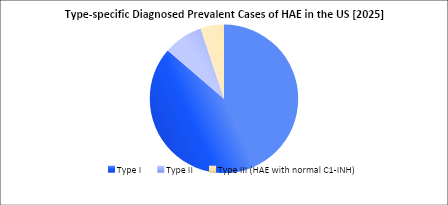
- Based on type-specific diagnosed prevalent cases of HAE, Type I (~80) had the highest number of type-specific cases followed by Type II (~10) cases.
Scope of the Report
- The report covers a segment of a descriptive overview of HAE, explaining their causes, signs and symptoms, and pathogenesis.
- Comprehensive insight has been provided into the epidemiology segments and forecasts, the future growth potential of the diagnosis rate, and disease progression.
Report Insights
Hereditary Angioedema Patient Population Forecast
Report Key Strengths
- Epidemiology‑based (Epi‑based) Bottom‑up Forecasting
- 11-year Forecast
- Patient Burden Trends (by Geography)
FAQs
- What are the disease risks, burdens, and unmet needs of HAE? What will be the growth opportunities across the 7MM concerning the patient population with HAE?
- What is the historical and forecasted HAE patient pool in the US, EU4 (Germany, France, Italy, and Spain), the UK, and Japan?
Reasons to Buy
- Insights on patient burden/disease prevalence, evolution in diagnosis, and factors contributing to the change in the epidemiology of the disease during the forecast years.
- To understand key opinion leaders’ perspectives around the diagnostic challenges to overcome barriers in the future.
- Detailed insights on various factors hampering disease diagnosis and other existing diagnostic challenges.