Hot Flashes Pipeline Summary
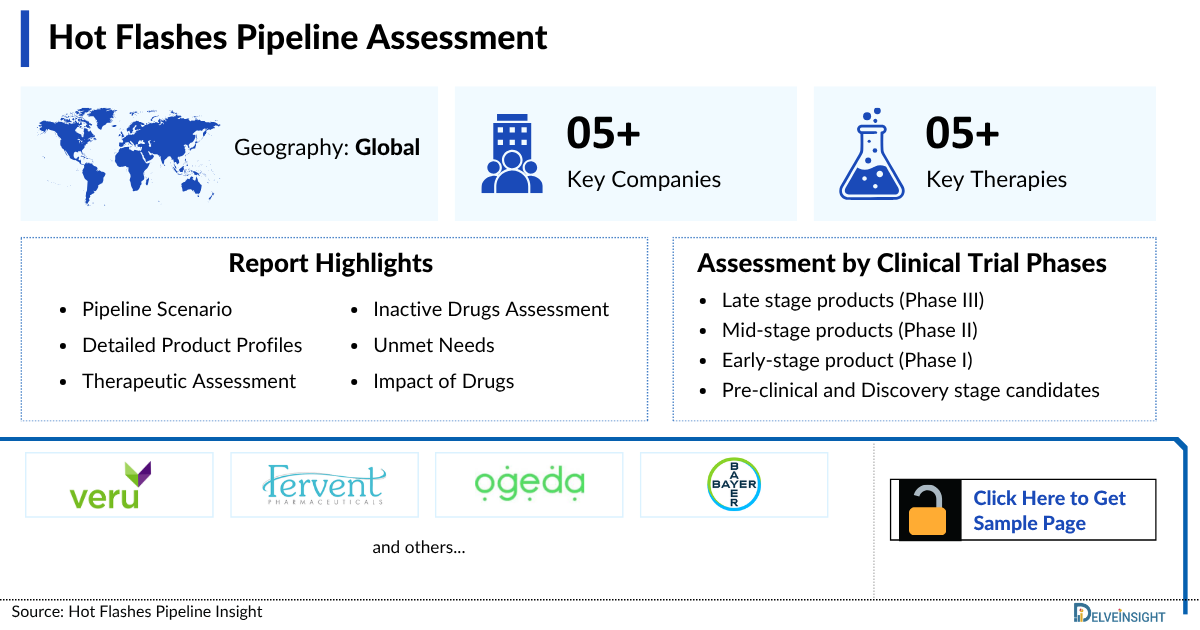
DelveInsight’s, “Hot Flashes Pipeline Insight, 2026” report provides comprehensive insights about 5+ companies and 5+ pipeline drugs in Hot Flashes pipeline landscape. It covers the pipeline drug profiles, including clinical and nonclinical stage products. It also covers the therapeutics assessment by product type, stage, route of administration, and molecule type. It further highlights the inactive pipeline products in this space.
Geography Covered
- Global coverage
Hot Flashes Disease Understanding
Hot Flashes Overview
Hot flashes are sudden, recurrent episodes of intense warmth, typically affecting the chest, neck, and face, followed by sweating. They are the most common reason women seek medical care during the perimenopausal period, particularly when symptoms adversely affect quality of life. Hot flashes may also be accompanied by palpitations, headache, fatigue, weakness, dizziness, anxiety, and excessive perspiration, and are commonly triggered by warm environments, hot beverages, or emotional stress. Their duration, frequency, and severity vary among individuals, often increasing during the menopausal transition and peaking around one year after the final menstrual period. Although they generally become less frequent and less intense over time, symptoms may persist from several months to years. Individual episodes typically last less than five minutes, with occurrence ranging from several times a week to as many as ten episodes per day.
The exact pathogenesis of hot flashes remains unclear; however, evidence suggests they arise from impaired central thermoregulatory function, leading to vasomotor symptoms (VMS). Estrogen withdrawal during menopause is considered the primary trigger, while neurotransmitters such as norepinephrine and serotonin also contribute to thermoregulatory dysfunction, providing the rationale for the use of selective serotonin reuptake inhibitors (SSRIs) and serotonin-norepinephrine reuptake inhibitors (SNRIs) in symptom management. Studies have shown that plasma norepinephrine metabolite levels increase before and during hot flashes, which are accompanied by peripheral vasodilation, elevated skin temperature in the extremities, and transient increases in systolic blood pressure and heart rate.
Hot flashes are the most prevalent menopausal vasomotor symptom (VMS), affecting up to 74% of women during the perimenopausal period. Approximately 65% of affected women experience symptoms for more than two years, while around 36% continue to have hot flashes for over five years.
Hot flashes are most commonly associated with perimenopause and menopause; however, other underlying conditions should be excluded before attributing symptoms solely to hormonal changes. Menopause is typically confirmed by the absence of menstruation for at least 12 months, supported by serum estradiol and follicle-stimulating hormone (FSH) levels. Differential diagnoses include carcinoid tumors, systemic mastocytosis, medullary thyroid carcinoma, pheochromocytoma, hyperthyroidism, acromegaly, and idiopathic anaphylaxis. In addition, several medications, including leuprolide, clomiphene, tamoxifen, raloxifene, tricyclic antidepressants, monoamine oxidase inhibitors, calcium channel blockers, selective serotonin reuptake inhibitors (SSRIs), and chemotherapy, can induce hot flashes, with tamoxifen-associated hot flashes occurring in up to 80% of treated women.
Management of hot flashes includes lifestyle modifications, hormonal therapy, and non-hormonal pharmacological options, with treatment selection based on symptom severity, patient preferences, and safety considerations. Lifestyle measures such as regular exercise, maintaining a cool environment, wearing layered clothing, consuming cold beverages, and limiting caffeine and alcohol are recommended as first-line approaches despite limited evidence. Systemic estrogen remains the most effective FDA-approved therapy, reducing vasomotor symptom (VMS) frequency by approximately 75%, while progesterone-based therapies may be considered for women who cannot receive estrogen. Hormone therapy (HT) should be administered at the lowest effective dose for the shortest duration due to potential risks, including breast cancer, stroke, and thromboembolic events, as highlighted by the Women's Health Initiative (WHI) study. Although bioidentical hormone products are available, compounded formulations have not demonstrated superior safety or efficacy over conventional HT. For women in whom hormonal therapy is contraindicated or unsuitable, non-hormonal prescription therapies, including paroxetine, venlafaxine, desvenlafaxine, gabapentin, pregabalin, and clonidine, offer modest symptom relief, with venlafaxine, gabapentin, and clonidine preferred in patients receiving tamoxifen or with a history of breast cancer. Complementary approaches such as yoga, acupuncture, relaxation techniques, breathing exercises, dietary modifications, reflexology, and hypnosis have also shown potential benefits, although robust clinical evidence supporting their effectiveness remains limited.
"Hot Flashes Pipeline Insight, 2026" report by DelveInsight outlays comprehensive insights of present scenario and growth prospects across the indication. A detailed picture of the Hot Flashes pipeline landscape is provided which includes the disease overview and Hot Flashes treatment guidelines. The assessment part of the report embraces, in depth Hot Flashes commercial assessment and clinical assessment of the pipeline products under development. In the report, detailed description of the drug is given which includes mechanism of action of the drug, clinical studies, NDA approvals (if any), and product development activities comprising the technology, Hot Flashes collaborations, licensing, mergers and acquisition, funding, designations and other product related details.
Hot Flashes Pipeline Report Highlights
The companies and academics are working to assess challenges and seek opportunities that could influence Hot Flashes R&D. The therapies under development are focused on novel approaches to treat/improve Hot Flashes.
Hot Flashes Emerging Drugs Chapters
This segment of the Hot Flashes report encloses its detailed analysis of various drugs in different stages of clinical development, including Phase III, II, I, Preclinical and Discovery. It also helps to understand clinical trial details, expressive pharmacological action, agreements and collaborations, and the latest news and press releases.
Hot Flashes Emerging Drugs
ABCL635: AbCellera
ABCL635 is a potential first-in-class monoclonal antibody being developed as a non-hormonal treatment for menopause-associated vasomotor symptoms (VMS), including hot flashes. The therapy selectively targets neurokinin 3 receptor (NK3R), a clinically validated membrane protein expressed on KNDy neurons within the hypothalamus that plays a key role in thermoregulation. Developed using AbCellera’s GPCR and ion channel discovery platform, ABCL635 is currently undergoing a Phase I/II clinical trial to evaluate its safety, tolerability, pharmacokinetics, pharmacodynamics, and efficacy in reducing the frequency and severity of vasomotor symptoms following subcutaneous administration.
Further product details are provided in the report...
Hot Flashes Therapeutic Assessment
This segment of the report provides insights about the different Hot Flashes drugs segregated based on following parameters that define the scope of the report, such as:
Major Players in Hot Flashes
There are approx. 5+ key companies which are developing the therapies for Hot Flashes. The companies which have their Hot Flashes drug candidates in the most advanced stage, i.e. Phase I/II include, AbCellera.
Hot Flashes Pipeline Phases
DelveInsight’s report covers around 5+ products under different phases of clinical development like
- Late stage products (Phase III)
- Mid-stage products (Phase II)
- Early-stage product (Phase I) along with the details of
- Pre-clinical and Discovery stage candidates
- Discontinued & Inactive candidates
Hot Flashes Drugs Route of Administration
Hot Flashes pipeline report provides the therapeutic assessment of the pipeline drugs by the Route of Administration. Products have been categorized under various ROAs such as
- Oral
- Intravenous
- Subcutaneous
- Parenteral
- Topical
Hot Flashes Drugs Molecule Type
Products have been categorized under various Molecule types such as
- Recombinant fusion proteins
- Small molecule
- Monoclonal antibody
- Peptide
- Polymer
- Gene therapy
Hot Flashes Pipeline Product Type
- Drugs have been categorized under various product types like Mono, Combination and Mono/Combination.
Hot Flashes Pipeline Development Activities
The Hot Flashes Pipeline report provides insights into different therapeutic candidates in Phase III, II, I, preclinical and discovery stage. It also analyses Hot Flashes therapeutic drugs key players involved in developing key drugs.
Hot Flashes Clinical Trials and Development Activities
The Hot Flashes clinical trials report covers the detailed information of collaborations, acquisition and merger, licensing along with a thorough therapeutic assessment of emerging Hot Flashes drugs.
Hot Flashes Pipeline Report Insights
- Hot Flashes Pipeline Analysis
- Hot Flashes Therapeutic Assessment
- Hot Flashes Unmet Needs
- Impact of Hot Flashes Drugs
Hot Flashes Pipeline Report Assessment
- Hot Flashes Pipeline Product Profiles
- Hot Flashes Therapeutic Assessment
- Hot Flashes Pipeline Assessment
- Inactive drugs assessment
- Hot Flashes Unmet Needs
Key Questions Answered in the Hot Flashes Pipeline Report:
- Current Treatment Scenario and Emerging Therapies:
- How many companies are developing Hot Flashes drugs?
- How many Hot Flashes drugs are developed by each company?
- How many emerging drugs are in mid-stage, and late-stage of development for the treatment of Hot Flashes?
- What are the key collaborations (Industry–Industry, Industry–Academia), Mergers and acquisitions, licensing activities related to the Hot Flashes therapeutics?
- What are the recent trends, drug types and novel technologies developed to overcome the limitation of existing therapies?
- What are the clinical studies going on for Hot Flashes and their status?
- What are the key designations that have been granted to the emerging drugs?
Key Hot Flashes Companies
- Abcellera
- Changchun High-Tech grou
- Vistagen
Key Hot Flashes Pipeline Products
- ABCL635
- GenSci074
- Refisolone
-Market.png&w=256&q=75)